
AI automation buying guides
RAG vs Fine-Tuning: A Buyer Decision Guide
RAG and fine-tuning solve different failure modes. A buyer should first decide whether the application lacks current evidence, behaves inconsistently, or has both problems. That diagnosis determines the architecture, evaluation plan and operating cost.
Prepared with AI assistance and checked against the linked sources. Numerical comparisons are illustrative unless expressly sourced.
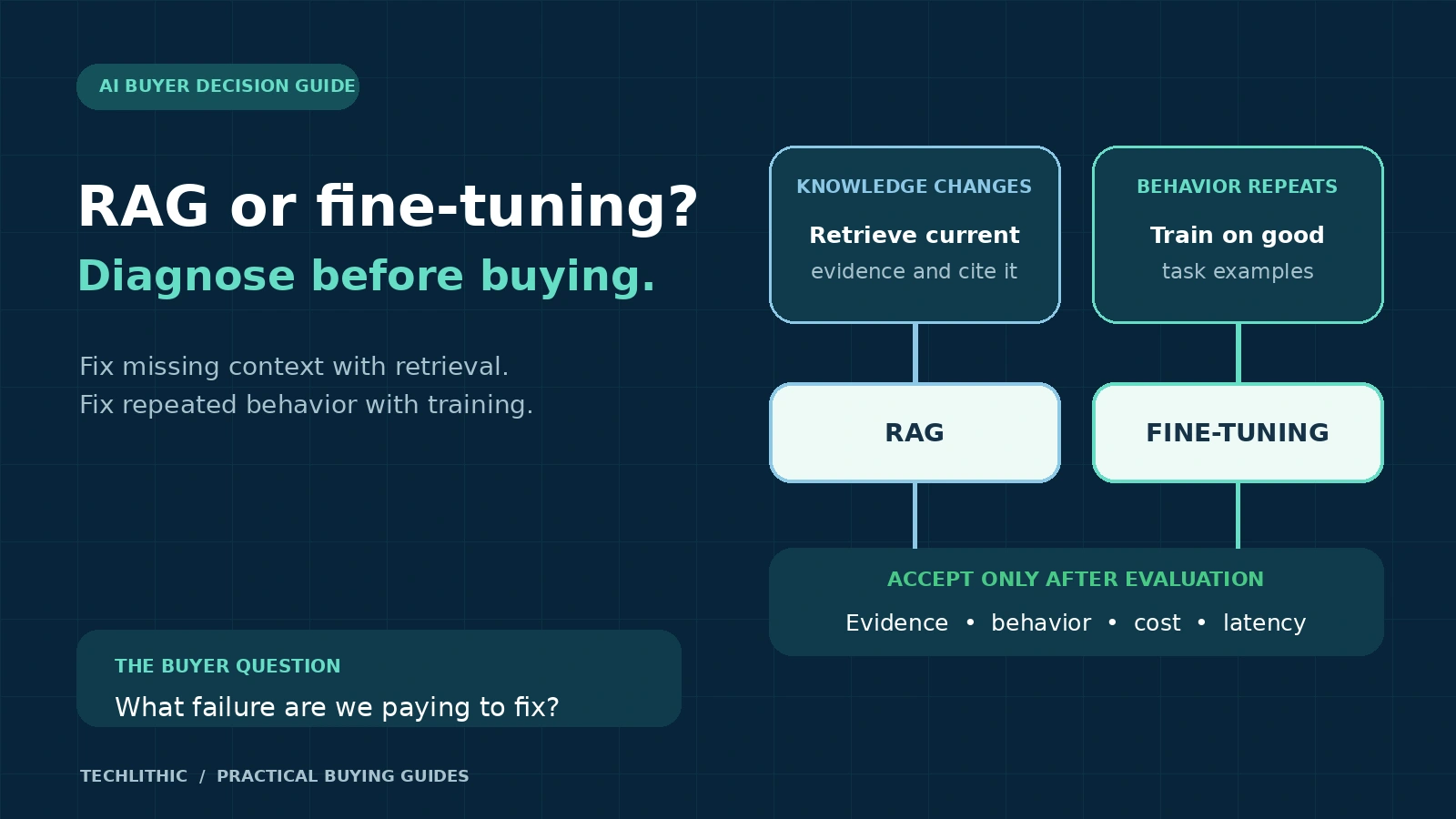
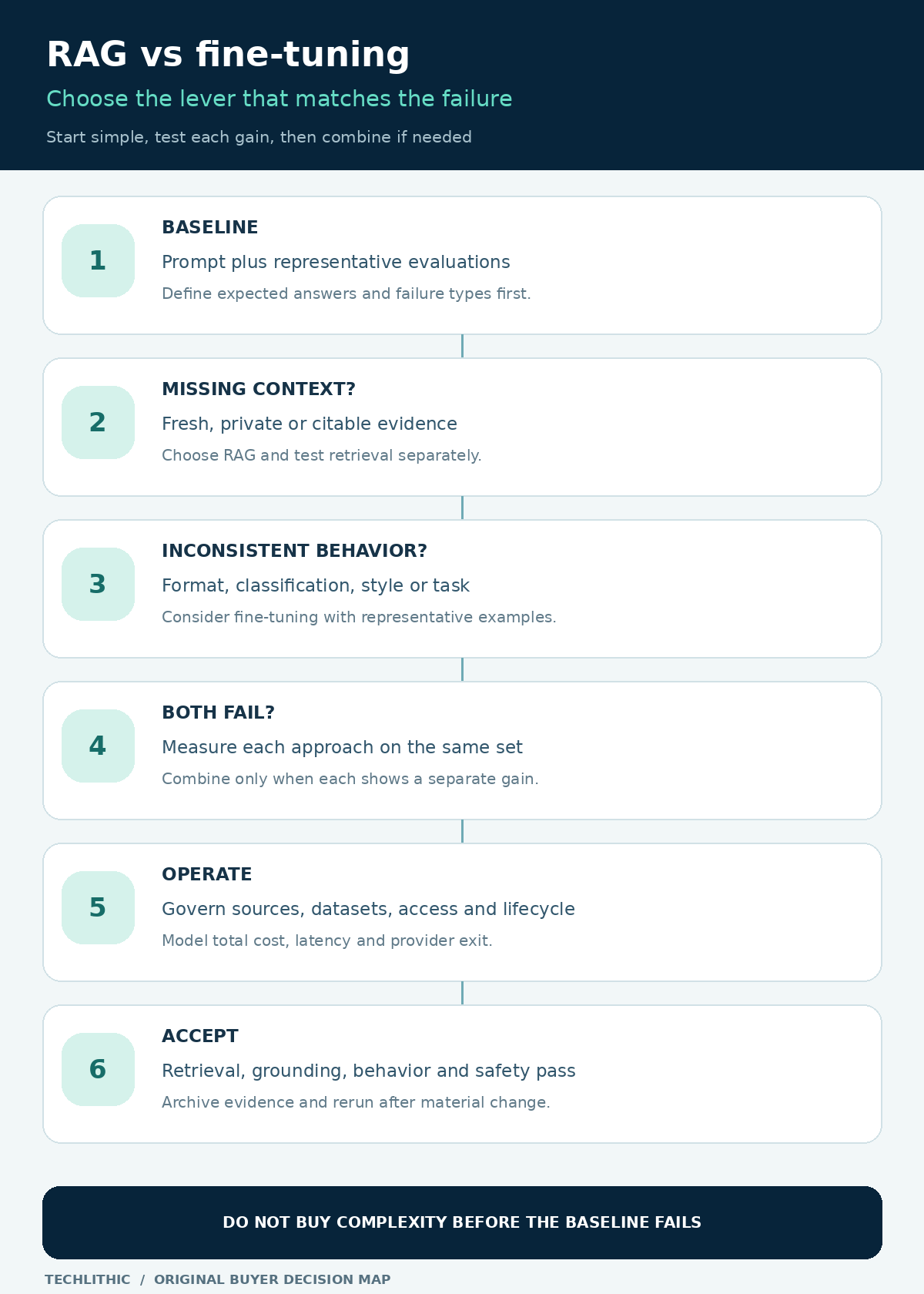
Start with a prompt-and-evaluation baseline. Add RAG when the model needs fresh, private or citable context. Consider fine-tuning when representative examples show a persistent behavior or task-performance problem. Combine them only when separate tests prove that both context and behavior need improvement.
Diagnose the failure before choosing the architecture
Buyers often receive proposals that treat retrieval-augmented generation, commonly called RAG, and fine-tuning as competing packages. The useful question is not which technique is more advanced. It is why the current system fails.
A context failure means the model lacks the right evidence at request time. The information may be private, newly changed, too detailed for a static prompt or absent from the base model. A behavior failure means the model sees adequate information but still formats, classifies, reasons or follows instructions inconsistently.
OpenAI's current optimization guide separates these axes. It recommends context optimization when knowledge is missing, outdated or proprietary, and model optimization when format, tone or reasoning behavior is inconsistent. It also recommends beginning with prompting and evaluation rather than assuming a fixed ladder from prompts to RAG to fine-tuning. [1]
Build a small evaluation set before procurement. For every failed case, record the input, expected output, evidence the model should use and failure type. If a better prompt solves the case, a larger architecture may not be justified. If the source never reached the model, training examples alone do not create an auditable source of truth.
Compare prompt design, RAG, fine-tuning and combination
Use the simplest option that meets the acceptance target. The following matrix keeps the decision tied to an operating requirement rather than a vendor label.
| Approach | Best fit | Primary operating work | Key limitation |
|---|---|---|---|
| Prompt design | Clear instructions, a few examples and stable context | Prompt versioning and regression tests | Long instructions consume context and can remain inconsistent |
| RAG | Fresh, private or citable knowledge | Source governance, indexing, retrieval and access control | Bad retrieval gives the model bad or incomplete context |
| Fine-tuning | Repeated task behavior, format, terminology or style | Representative training data, training runs and model evaluation | Knowledge changes require a new plan, and provider support can change |
| RAG plus fine-tuning | Both evidence and behavior fail after separate optimization | Both pipelines plus interaction testing | Highest operational complexity and regression surface |
These options can stack, but they should not be purchased as a bundle without evidence. OpenAI describes using RAG for recent or specialized context and fine-tuning for consistent behavior, while warning that each adds its own tuning and maintenance work. [1]
Choose RAG when evidence must change, filter or cite
RAG retrieves relevant content and adds it to the model input before generation. Microsoft describes a retrieve, augment and generate flow, with indexes supporting keyword, semantic, vector or hybrid search. It recommends RAG for private or frequently changing data and fine-tuning for behavior, style or task performance rather than fresh knowledge. [2]
RAG is a strong starting point for support policies, product documentation, contracts, research libraries and internal procedures where users should see evidence. It also supports document-level filtering when the search layer carries the required metadata and access rules.
Do not accept a proposal that equates a vector database with a complete RAG system. The buyer still needs source ownership, parsing, chunking, metadata, deletion, permissions, query construction, ranking, citation rendering, abstention and monitoring. OpenAI's retrieval guide notes that vector-store files are chunked, embedded and indexed, and that ranking thresholds and hybrid-search weights can change the returned evidence. [3]
RAG does not guarantee truth. Microsoft warns that sensitive material can be exposed if retrieval-time access control is weak and says retrieved content should be treated as untrusted input. It also identifies extra index, embedding, round-trip and input-token costs. [2] Require tests for missing evidence, conflicting versions, malicious document instructions and unauthorized sources.
Choose fine-tuning when the task behavior must become repeatable
Fine-tuning updates model parameters using task-specific examples. It can help when a base model repeatedly fails a narrow classification, structured-output, translation, terminology or instruction-following task even after a strong prompt baseline.
The training set should resemble production inputs and desired outputs. Keep training, validation and held-out evaluation data separate enough to detect overfitting. OpenAI's optimization guidance emphasizes representative examples and a hold-out set, while Google Cloud lists overfitting, data scarcity, catastrophic forgetting, compute demand and evaluation complexity among the risks buyers should plan for. [1] [4]
Do not use fine-tuning as a substitute for a frequently changing knowledge base. A trained model does not automatically expose which current policy supports an answer. AWS notes that fine-tuned models do not inherently provide source references and recommends starting with RAG for question answering over custom documents. [5]
Provider availability is a procurement dependency. As of November 1, 2026, OpenAI's supervised fine-tuning documentation says its platform is unavailable to new users and eligible existing customers can create training jobs only until January 6, 2027, subject to earlier base-model shutdowns. [6] This is an OpenAI-specific status, not a statement about all platforms. Buyers should verify the chosen provider, base-model lifecycle, export path, retraining process and exit plan before committing.
Treat source documents and training examples as different assets
RAG sources are operating knowledge assets. They need named owners, effective dates, audience rules, update and deletion paths, and metadata that supports filtering and citations. A source change should become retrievable inside an agreed freshness window without training a new model.
Fine-tuning examples are model-development assets. They need provenance, rights to use, consistent labeling, sensitive-data review, representative coverage and a record of which training run consumed them. Corrections must enter a future dataset and retraining cycle.
For both approaches, separate production data from safe evaluation fixtures. Define retention, encryption, region, vendor-data-use settings and incident procedures. Apply authorization before per-user content enters model context. If training data contains customer records, determine whether those records should be used and how deletion obligations will be handled.
Name who can add a source, approve a training example, launch a training job and promote a configuration.
Model total cost and latency by pipeline stage
Do not compare only the model's per-token price. Build a workload model using request volume, document volume, update frequency, prompt size, retrieved context, output length and service targets.
For RAG, include connectors, parsing, embedding, index storage, query-time retrieval, reranking, extra input tokens, monitoring and source operations. For fine-tuning, include data curation, expert labeling, training runs, evaluation, inference, retraining and migration when a base model changes.
RAG adds search and sometimes reranking before generation. Fine-tuning may shorten prompts or allow a smaller model, but that benefit must be measured on the accepted task. Google Cloud notes that fine-tuning a smaller model can sometimes reduce cost and latency for high-volume cases, while Microsoft documents the retrieval round trips, embedding work and added tokens in RAG. [4] [2]
Request a cost sheet with explicit assumptions and sensitivity ranges. Require measured p50 and p95 response time for the complete deployed path, including retrieval and safety checks.
Use one evaluation set to compare the approaches fairly
Create a representative set of inputs before implementation and keep a held-out portion for final comparison. Include common questions, long-tail wording, ambiguous requests, missing evidence, conflicting sources, restricted material, structured outputs and cases that should abstain or escalate.
Score retrieval and generation separately. Retrieval measures whether the correct evidence appears. Generation measures whether the final answer is grounded, relevant, complete and compliant with the output contract. Microsoft documents separate retrieval, document-retrieval, groundedness, relevance and completeness evaluators, which illustrates why one blended answer score can hide the source of failure. [7]
Compare at least the base prompt, improved prompt and proposed architecture on the same frozen set. If RAG improves evidence coverage but formatting remains inconsistent, the next experiment may target behavior. If fine-tuning improves format but answers still use stale facts, retrieval remains necessary.
Set release blockers by severity. An unauthorized retrieval or confident answer without evidence may block launch even when average quality improves. Archive the dataset version, source snapshot, prompt, model, retrieval settings, training-run identifier and results so the comparison can be reproduced.
Worked example: a support policy assistant
Consider an invented software company that wants an internal assistant to answer plan-policy questions and route support tickets. Policies change monthly. The routing output must use one of six fixed categories with a reason and escalation flag. This is a planning example, not a client result.
The team starts with a prompt baseline and 80 anonymized test cases. The model often answers from old general knowledge because the current policy is absent. It also misclassifies two similar routing categories. The failures are split into context and behavior groups.
First, the team adds RAG over approved policies, with effective-date metadata, access filters and citations. It tests updates, deletions, no-answer cases and conflicting versions. Current-policy answers improve, but category consistency still misses the agreed threshold.
Next, it tests fine-tuning with representative labeled routing examples, including the same retrieved-context format used in production. The combined system is accepted only if the held-out set shows separate gains in evidence retrieval and category behavior, permission tests pass, and latency stays within the service target.
A different result is valid. If a clearer schema and few-shot prompt fixes routing, the team keeps RAG plus prompting and avoids fine-tuning. If the policy set is tiny and stable, a maintained prompt or rules engine may be enough. The decision follows measured failure, not architecture prestige.
Compare proposals on deliverables, ownership and exit
Ask every supplier to quote the same discovery and pilot scope. The baseline should include use-case boundaries, evaluation data, current prompt, model candidates, source inventory, security requirements, expected volume, latency target and acceptance thresholds.
A RAG proposal should specify ingestion formats, chunking, metadata, retrieval modes, reranking, access control, citation behavior, update and deletion targets, monitoring and source handover. A fine-tuning proposal should specify dataset creation, labeling rules, split strategy, supported base model, training method, experiment tracking, held-out evaluation, retraining and portability.
Require configuration and evidence, not only deployed endpoints. A bounded AI knowledge-base scope should leave behind the source register, retrieval tests and operating runbook. A custom model training scope should leave behind dataset documentation, evaluation results, model lineage and a lifecycle plan.
TechLithic offers both services and AI integration engineering. Apply the same checklist to TechLithic or any other provider. Reject proposals that guarantee accuracy without a representative evaluation set, hide recurring components, or make the business dependent on undocumented provider settings.
Run the buyer decision and acceptance checklist
- Is the business problem defined as missing context, inconsistent behavior, both, or neither?
- Does a prompt-only baseline exist on a representative evaluation set?
- For RAG, are source owners, permissions, freshness, deletion and citation requirements explicit?
- For fine-tuning, are examples representative, lawful to use, consistently labeled and split for held-out evaluation?
- Does the chosen provider currently support the model and training method for this account?
- Are base-model deprecation, retraining, export and exit procedures documented?
- Are retrieval quality and final-answer quality scored separately?
- Are no-answer, conflicting-source, restricted-content and adversarial cases included?
- Does the cost model include data work, infrastructure, tokens, training, evaluation and operations?
- Are complete-path latency and failure behavior measured under realistic load?
- If combining RAG and fine-tuning, has each component shown a separate measurable gain?
- Will the buyer receive source rules, datasets, configurations, evaluation evidence, runbooks and ownership access?
Choose RAG when current evidence is the missing ingredient. Choose fine-tuning when repeatable learned behavior is the unresolved problem. Keep prompt design when it already meets the target. Combine approaches only after the evaluation record shows why both are needed.
For implementation acceptance after choosing RAG, use the AI knowledge-base checklist. If the system can take actions as an agent, add the controls in the AI agent security review.
Frequently asked questions
Is RAG better than fine-tuning for company knowledge?
RAG is usually the stronger starting point when answers must use private, frequently changing or citable documents. Fine-tuning is more appropriate when the unresolved problem is repeatable behavior, style, format or narrow task performance.
Can fine-tuning keep facts up to date?
Not automatically. A changed policy does not update a trained model by itself. Frequently changing facts need an operating update path, commonly retrieval or another controlled data source.
Can RAG and fine-tuning be used together?
Yes. Combine them when separate evaluation shows both a context problem and a behavior problem. Train with examples that reflect the retrieved-context format used in production, then test the interaction as a complete system.
Should a buyer fine-tune before building evaluations?
No. Establish a prompt baseline and a representative evaluation set first. Without that evidence, the buyer cannot tell whether fine-tuning improved the target behavior or introduced regressions.
What is the cheapest option?
The cheapest acceptable option depends on workload and operating effort. Prompting may be enough. RAG adds ingestion and retrieval costs, while fine-tuning adds dataset and training lifecycle costs. Compare total cost on the same accepted workload.
Sources and research notes
Sources checked on 2026-11-01. Pricing and policy documents can change; verify current terms before approving expenditure.
- OpenAI API documentation: Optimizing LLM Accuracy
Primary provider guidance distinguishing context optimization from behavior optimization, starting with prompting and evaluations, and combining RAG with fine-tuning only when both failure types remain.
- Microsoft Learn: Retrieval augmented generation and indexes in Microsoft Foundry
Primary provider documentation on RAG architecture, retrieval modes, approach selection, security, privacy, cost and latency considerations.
- OpenAI API documentation: Retrieval
Primary provider documentation on semantic search, vector stores, chunking, indexing, ranking thresholds and hybrid retrieval controls.
- Google Cloud: Fine-tuning LLMs and AI models
Primary provider overview of fine-tuning use cases, data needs, cost and latency possibilities, plus overfitting, forgetting and evaluation challenges.
- AWS Prescriptive Guidance: Comparing RAG and fine-tuning
Primary provider comparison of frequently changing knowledge, citations, question answering, training requirements and combined approaches.
- OpenAI API documentation: Supervised fine-tuning
Primary provider documentation on example-based behavior training, evaluation-first practice and OpenAI-specific platform availability as checked on November 1, 2026.
- Microsoft Learn: RAG evaluators
Primary provider documentation separating retrieval and document-retrieval assessment from groundedness, relevance and response-completeness evaluation.
OpenAI, Microsoft, AWS and Google Cloud documentation was opened on November 1, 2026. Provider guidance is used to explain patterns and current service constraints, not to recommend one vendor. OpenAI's fine-tuning wind-down is explicitly identified as provider-specific and time-sensitive. The 80-case support example is an original educational scenario, not a client result or universal benchmark. Buyers should verify current model availability, pricing, data terms and regional controls before purchase.