
WhatsApp buying guides
WhatsApp API Pricing: Meta Fees vs Platform Costs
Before buying WhatsApp automation, compare the complete bill and the workflow it will deliver. This guide separates channel charges from software and services, then shows how to evaluate two offers fairly.
Prepared with AI assistance and checked against the linked sources. Numerical comparisons are illustrative unless expressly sourced.
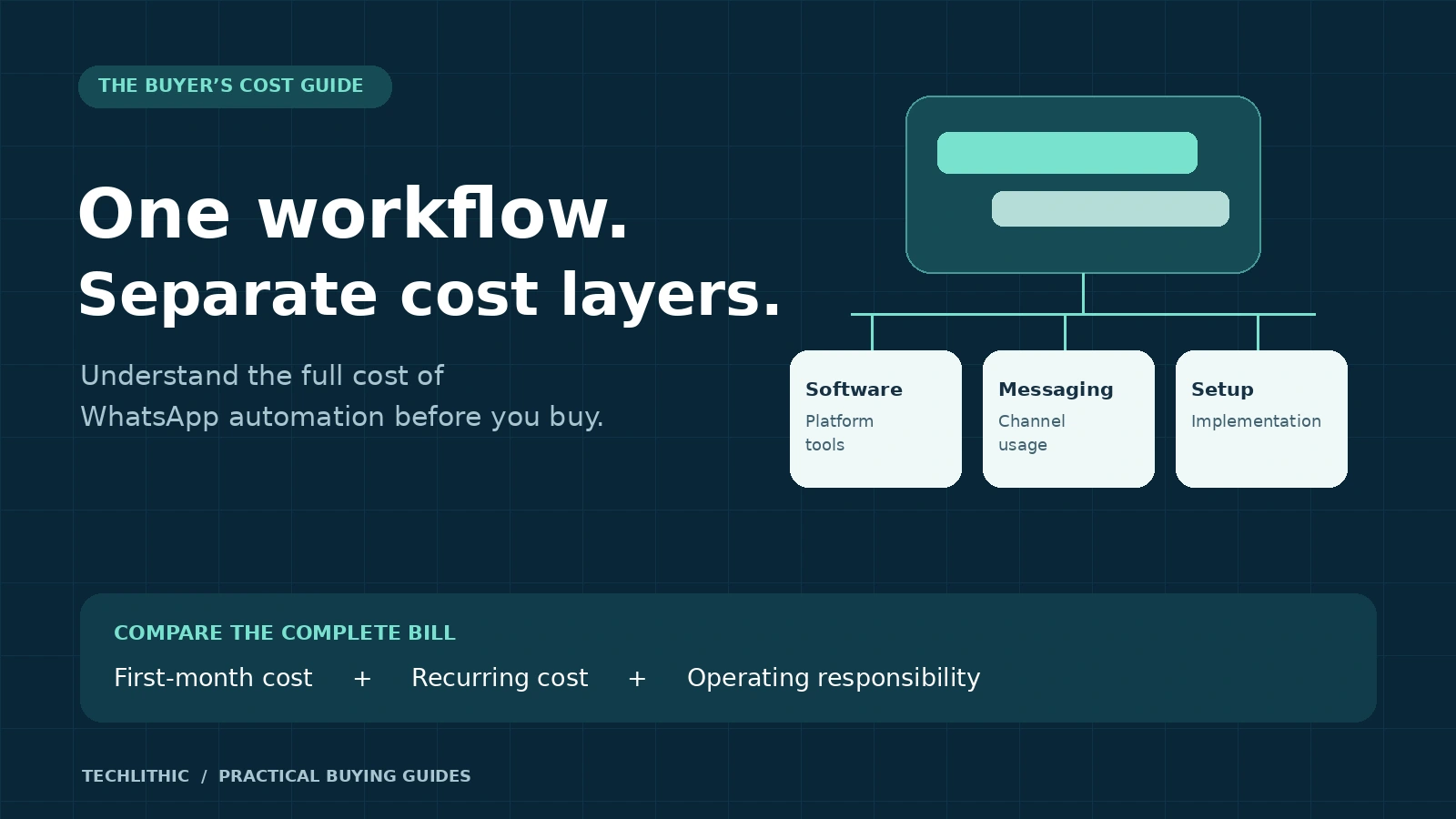
Compare the workflow, complete cost and operating responsibility using the same assumptions for every supplier.
What does WhatsApp API pricing actually include?
A WhatsApp automation subscription and a WhatsApp messaging bill pay for different things. Software gives your team an interface and operating tools. Messaging charges pay for applicable traffic on the underlying channel. Setup pays for connecting those pieces to your business. A quote is useful only when it makes all three visible.
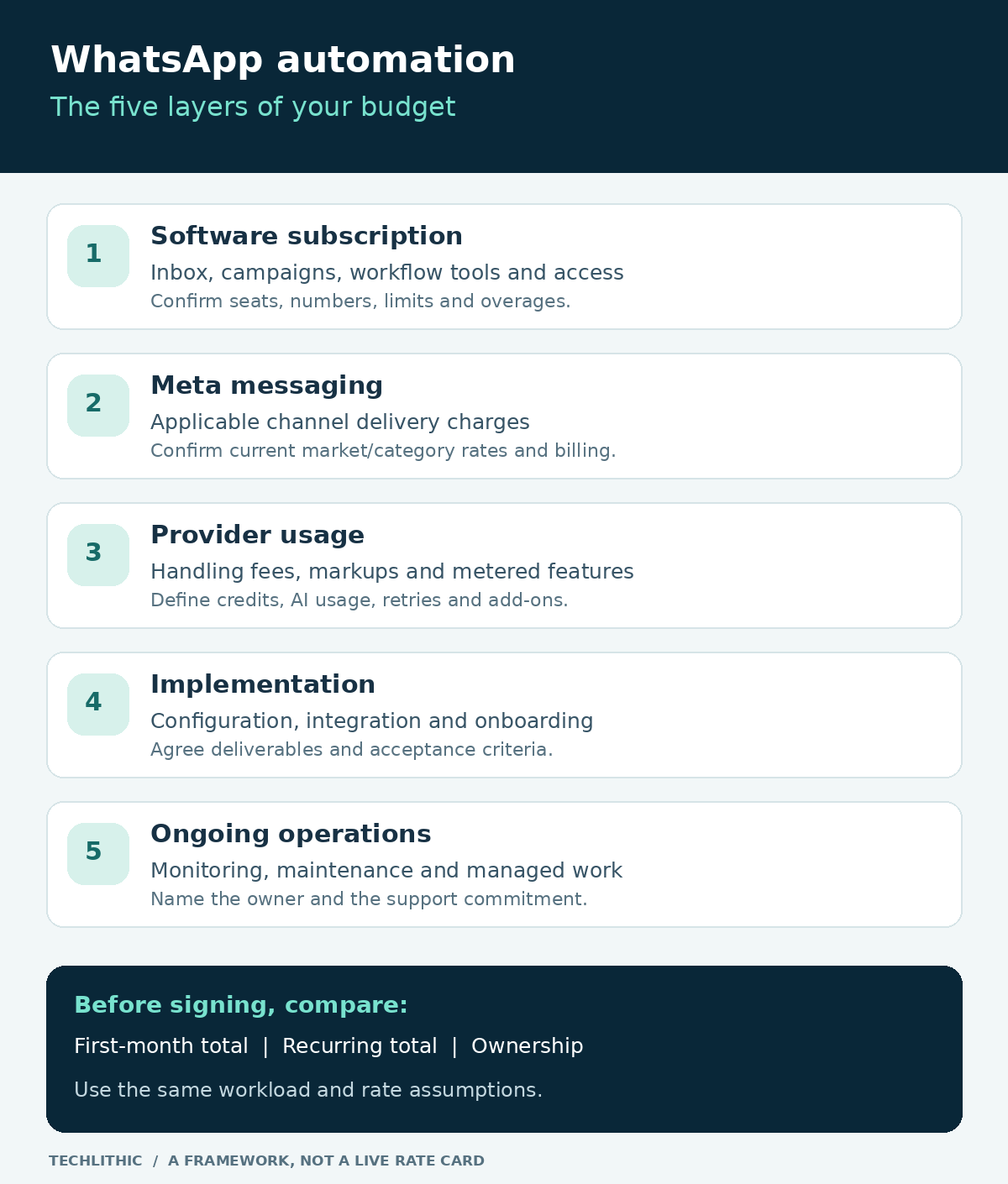
Think of your budget as five layers: platform access, channel usage, provider usage fees, implementation, and ongoing operations. Some vendors bundle several layers; others invoice them separately. Bundling is not inherently bad, but a bundle should still explain what happens when you exceed an allowance, add a teammate, or connect another number.
| Cost layer | What you are buying | What to confirm |
|---|---|---|
| Software subscription | Inbox, campaigns, automation builder, reporting and account access | Seats, numbers, contacts, workflows and plan limits |
| Meta messaging | Applicable WhatsApp message delivery charges | Current market/category rates and who pays Meta |
| Provider usage | Message handling, markup, AI consumption or other metered features | Charging unit, overages and inbound/outbound treatment |
| Implementation | Configuration, templates, integration, migration and training | Written deliverables and acceptance criteria |
| Operations | Maintenance, monitoring, campaign execution and support | Included support versus paid managed work |
Ask for the first-month bill and the steady-state monthly bill. A lower subscription can still produce a higher total bill when variable fees or internal effort are higher.
Understand Meta fees without relying on an old rate screenshot
Meta describes WhatsApp Business Platform pricing as message-based, with rates influenced by the recipient market and message category. Its public pricing material distinguishes marketing, utility, authentication and service messages. Use the current official pricing page and rate cards to establish the billable basis for your traffic. [1]
Do not treat a support conversation, a contact, a campaign recipient and a billable message as interchangeable units. One contact can generate several outbound messages. An automation can add confirmations, reminders and follow-ups beyond the initial campaign. Your forecast needs to reflect those events.
Pricing pages, documentation and vendor calculators can be updated at different times. Before approval, ask the provider to identify the rate-card version, effective date, message categories, customer-service-window rules, applicable allowances and any free-entry-point conditions used in its estimate. Do not assume a message is free because an older article said it was.
For a business serving more than one country, split the forecast by recipient market. Then split it by actual message purpose. If a quote assumes every message has the same price, ask why that assumption is reasonable for your specific campaign and support workload.
This guide deliberately uses hypothetical dollar amounts below rather than presenting an unverified universal Meta rate. The comparison method remains useful when rates change; replace its channel-cost input with your current applicable estimate.
Separate provider fees from the channel bill
Providers can monetize the same workflow in different ways. A subscription may cover access while usage is billed separately. A pay-as-you-go service may charge for handling messages in addition to passing through Meta fees. Twilio, for example, describes its WhatsApp price as its own per-message fee plus Meta charges. That is a billing-model example, not a recommendation or a claim that every provider uses the same structure. [2]
Translate the quote into ordinary units. If it includes credits, request a definition of one credit for a template, a reply, an AI answer and an automation action. Ask whether failed attempts, incoming messages or retries consume provider credits. A headline allowance is difficult to compare until you know what consumes it.
Zero markup also needs a precise definition. It can mean the provider adds nothing to Meta's published messaging charge, while software, AI, setup or support remain separately payable. It does not mean the entire service is free.
As one relevant product example, Sendwo's publicly indexed pricing page states that it adds no markup to official WhatsApp Business API pricing. Compare its current plan limits, usage allowances and support scope against your requirements, just as you would with any vendor. Verify the checkout terms before purchase. [3]
Build a workload forecast before requesting quotes
Create a simple worksheet before talking to vendors. Start with the workflows you intend to operate: lead qualification, order updates, appointment reminders, abandoned-cart follow-up or customer support. Give each workflow an owner and a measurable business purpose.
- Estimate monthly users or events entering each workflow.
- List the outbound steps each event can trigger, including reminders and escalations.
- Separate recipients by market and messages by purpose.
- Estimate how much traffic belongs to agents, templates and AI-assisted replies.
- Model normal activity and a realistic peak, such as a sale or seasonal booking rush.
For example, 2,000 booking requests do not automatically equal 2,000 outbound messages. A workflow with confirmation, reminder and rescheduling can create several sends per booking. Some users will exit early, and some will need human support. Build those paths into the forecast instead of multiplying your full contact list by a single assumed rate.
Keep the worksheet inspectable. Each estimate should show its source: historical event counts, campaign logs, order volumes or a stated planning assumption. If you have no baseline, use a small pilot to establish one. This makes later invoice differences diagnosable rather than surprising.
Compare two quotes using the same workload
Use a common scenario for every provider. The following figures are invented solely to explain the calculation. They are not current vendor prices, Meta rates, a promise of savings or an estimate for your business.
| Hypothetical monthly item | Quote A | Quote B |
|---|---|---|
| Platform subscription | $40 | $80 |
| Same assumed Meta usage | $120 | $120 |
| Provider usage charges | $60 | $0 |
| Recurring integration/support | $30 | $30 |
| Recurring total before tax | $250 | $230 |
| One-time setup | $100 | $300 |
| First-month total before tax | $350 | $530 |
Quote A is cheaper to start, while Quote B is cheaper each subsequent month under these assumptions. B costs $200 more in setup and saves $20 per recurring month. The incremental setup difference is recovered after ten months of those recurring savings. If the workload, features or support differs, this comparison no longer holds.
For a twelve-month comparison, A costs $100 + 12 × $250 = $3,100. B costs $300 + 12 × $230 = $3,060. The annual difference is only $40 before tax. A dramatic-looking subscription comparison can therefore become a small difference when you consider the complete bill.
Use the same currency and period for both offers. Show tax, foreign-exchange costs, minimum commitments and optional charges separately. Then add your internal operating effort as a distinct planning estimate, rather than pretending it appears on the vendor invoice.
What should the implementation and support scope include?
A platform purchase does not automatically include someone designing your workflows, cleaning your contact data or building custom integrations. Decide which responsibilities remain with your team before comparing offers. If you already have a capable operator and a simple workflow, self-service may be sufficient.
If you buy setup, ask for concrete deliverables: account connection, selected template configuration, one or more defined automation journeys, CRM field mapping, testing evidence and operating documentation. Name who supplies access, content, consent records and business approvals. Specify how changes after sign-off will be handled.
For support, distinguish product troubleshooting from training, campaign execution and custom development. Ask about channels, operating hours, response targets and escalation. A response target should not be described as a guaranteed resolution time unless the agreement actually promises that.
Write acceptance criteria around observable outcomes. A sample lead should enter the correct CRM record without duplication. An opted-out contact should be excluded from a follow-up. An agent should receive the conversation context on handoff. A failed integration event should appear in a recoverable queue or documented error process.
The WhatsApp API implementation scope and CRM integration scope are related workstreams, but your proposal should say precisely which parts are included. Do not pay twice for a task already included in the platform onboarding package.
Check billing ownership before the pilot
Ask who owns the WhatsApp Business account, the business number and the billing relationship. Confirm whether Meta bills your business directly or whether the provider manages channel billing through its own arrangement. Both the operating model and the exit process need to be clear.
If your setup requires a payment method on the Meta account, paying for software alone will not necessarily complete that requirement. Ask the provider to show where channel billing is configured and where you can inspect applicable usage. Treat the answer as a setup dependency, not as an assumption.
Test invoice visibility with a small, authorized pilot. Match the platform usage report with the relevant channel billing records and provider invoice. Check how templates, replies, errors and AI usage are represented. Retain the test record so finance and operations can use the same definitions later.
Before a larger launch, confirm spending controls, alerts, renewal dates, cancellation steps and data export. Ask whether unused wallet balances, prepaid commitments or credits have expiry or refund restrictions. Review the actual contract; do not infer a refund right from the availability of a trial.
Use a pilot to decide whether the platform is worth buying
Choose one narrow workflow with a clear result. A booking business might test reminder delivery and completed appointments. An ecommerce team might test a specific post-purchase notification and support handoff. Avoid launching several journeys simultaneously if you cannot attribute failures to a particular step.
Track three kinds of evidence: cost, workflow reliability and business outcome. Cost includes platform and usage charges. Reliability includes duplicate sends, failed actions and handoff completeness. Outcome means the result the customer needed, such as a confirmed booking or resolved request, rather than a message count alone.
For a sales workflow, calculate acquisition economics using attributable conversions and your actual margin assumptions. Do not treat revenue as profit or compare provider fees without considering operational effort. For support, define what counts as resolved and inspect a sample of conversations instead of trusting automation volume.
Keep permission and opt-out handling in the test. WhatsApp's Business Messaging Policy requires recipient permission for subsequent contact and respect for opt-out requests. A usable contact list is therefore more than a spreadsheet of phone numbers. [4]
When the pilot ends, document the go/no-go decision. You should know the observed cost for the workflow, remaining defects, ownership of fixes and what additional volume would change. A platform that fails a critical acceptance test should not win simply because its subscription is cheaper.
Questions to send every shortlisted vendor
- For our stated workload, what are the first-month and recurring totals?
- Which charges are Meta fees, your own fees and optional add-ons?
- What exactly consumes a credit, and what happens above each allowance?
- Who owns our business account, number, billing access and exportable data?
- Which workflows, integrations, training and support are included?
- What evidence will demonstrate that implementation is complete?
- How can we monitor spending, cancel renewal and migrate away?
Choose the offer you can reconcile with your workflow, budget and team's capability. If a vendor cannot explain the billing unit or demonstrate a required integration, pause the purchase until it can. An intelligible quote and a successful pilot are stronger evidence than a long feature list.
Frequently asked questions
Does a WhatsApp software subscription include Meta charges?
Only if the provider explicitly includes them in its written offer. Confirm the billing arrangement, included allowances and overages. Software access and channel usage are distinct cost layers.
Is zero markup the same as free WhatsApp messaging?
No. Zero markup concerns the provider surcharge on Meta fees. Applicable Meta charges, software fees, AI usage, setup and support can still be payable.
How should I compare monthly and annual plans?
Use the same forecast and calculate the total commitment, including setup, usage and add-ons. Check cancellation and renewal terms before accepting an annual discount.
Should a small team buy managed onboarding?
A team with a simple workflow and a capable operator may be able to start with self-service. Buy managed setup when the required integration, workflow design or rollout exceeds your available skills and time.
Sources and research notes
Sources checked on 2026-10-13. Pricing and policy documents can change; verify current terms before approving expenditure.
- Meta: WhatsApp Business Platform pricing
Message-based pricing framework and category/market distinctions. Check the current linked rate cards for an actual quote.
- Twilio: WhatsApp messaging pricing
A provider example separating its message handling fee from Meta charges.
- Sendwo: publicly indexed pricing information
Zero-markup positioning was visible in indexed pricing information. The live page returned an automated-access challenge; confirm current checkout terms directly.
- WhatsApp Business Messaging Policy
Recipient permission and opt-out responsibilities.
Public pricing descriptions were not fully consistent on service-message allowances at the time of research. This article therefore makes no universal free-message claim and uses clearly labelled hypothetical costs.