
AI buying guides
AI Chatbot vs AI Agent: Which Should You Buy?
Choose an answering assistant, a guided workflow or an AI agent by the business task it can complete. This guide helps you compare proposals using action boundaries, test evidence and operating cost.
Prepared with AI assistance and checked against the linked sources. Numerical comparisons are illustrative unless expressly sourced.
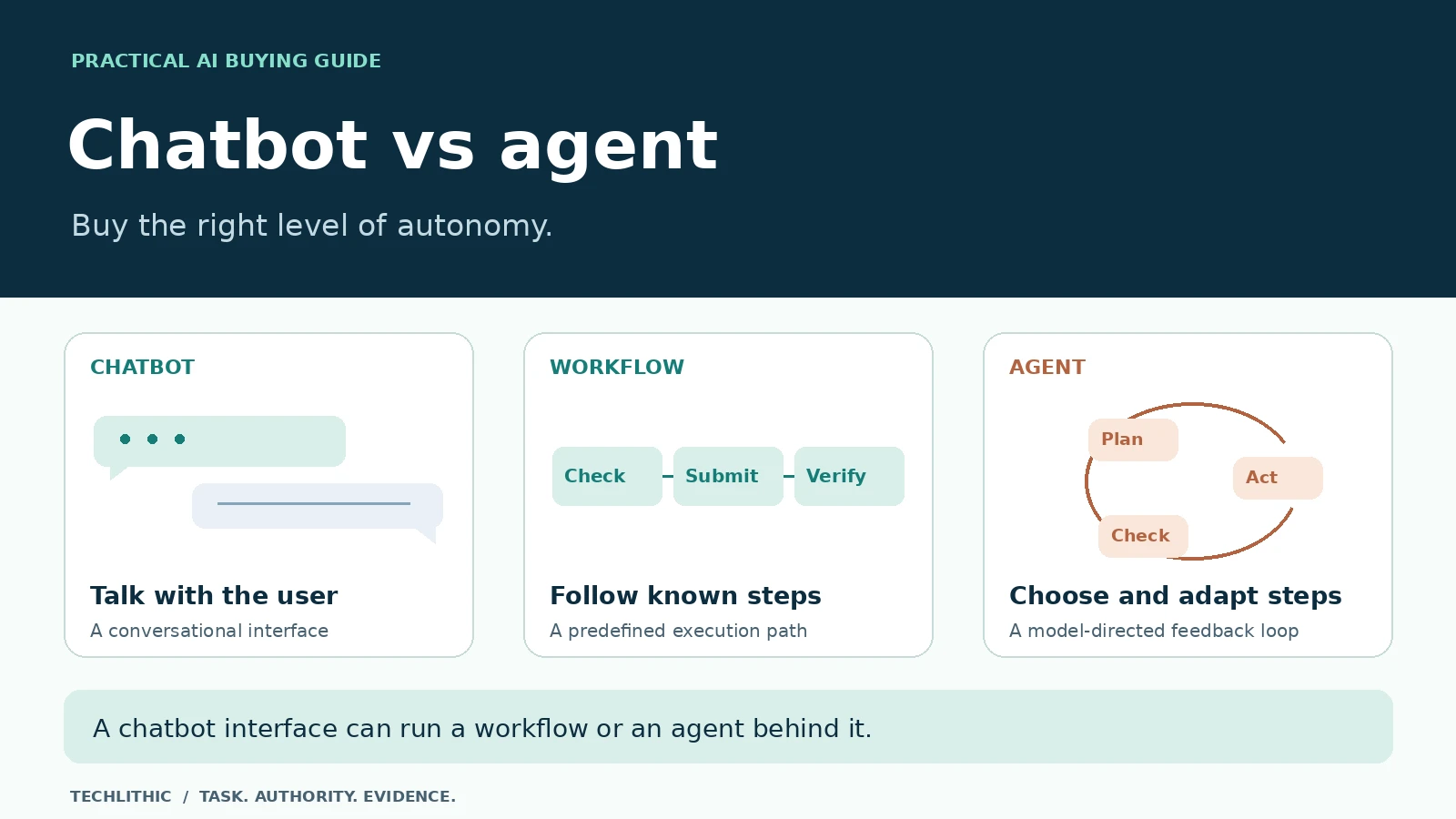
Choose the least complex approach that completes your task, then verify its knowledge, permissions, downstream results and operating cost.
AI chatbot vs AI agent: what are you actually buying?
An AI chatbot is a conversational interface: someone asks a question and receives a response. It may retrieve documents, collect information or call a predefined integration. An AI agent describes how a system controls its work: it can choose steps, use tools, inspect results and adapt its approach toward a goal.
These categories overlap. A chatbot interface can sit in front of an agent, and an agent can carry out research without changing a business record. A tool call or a CRM integration alone does not establish meaningful autonomy.
Anthropic distinguishes workflows with predefined execution paths from agents that dynamically direct their processes and tool use. Its engineering guidance recommends starting with the simplest approach that meets the requirement. That architectural distinction is more useful for buying than a product label. [1]
Ask a vendor to demonstrate who decides the next step: your configured rules, the model or a person. Then ask which business outcome the system can actually complete. A polished answer in a chat window does not prove that a booking, support escalation or CRM update happened.
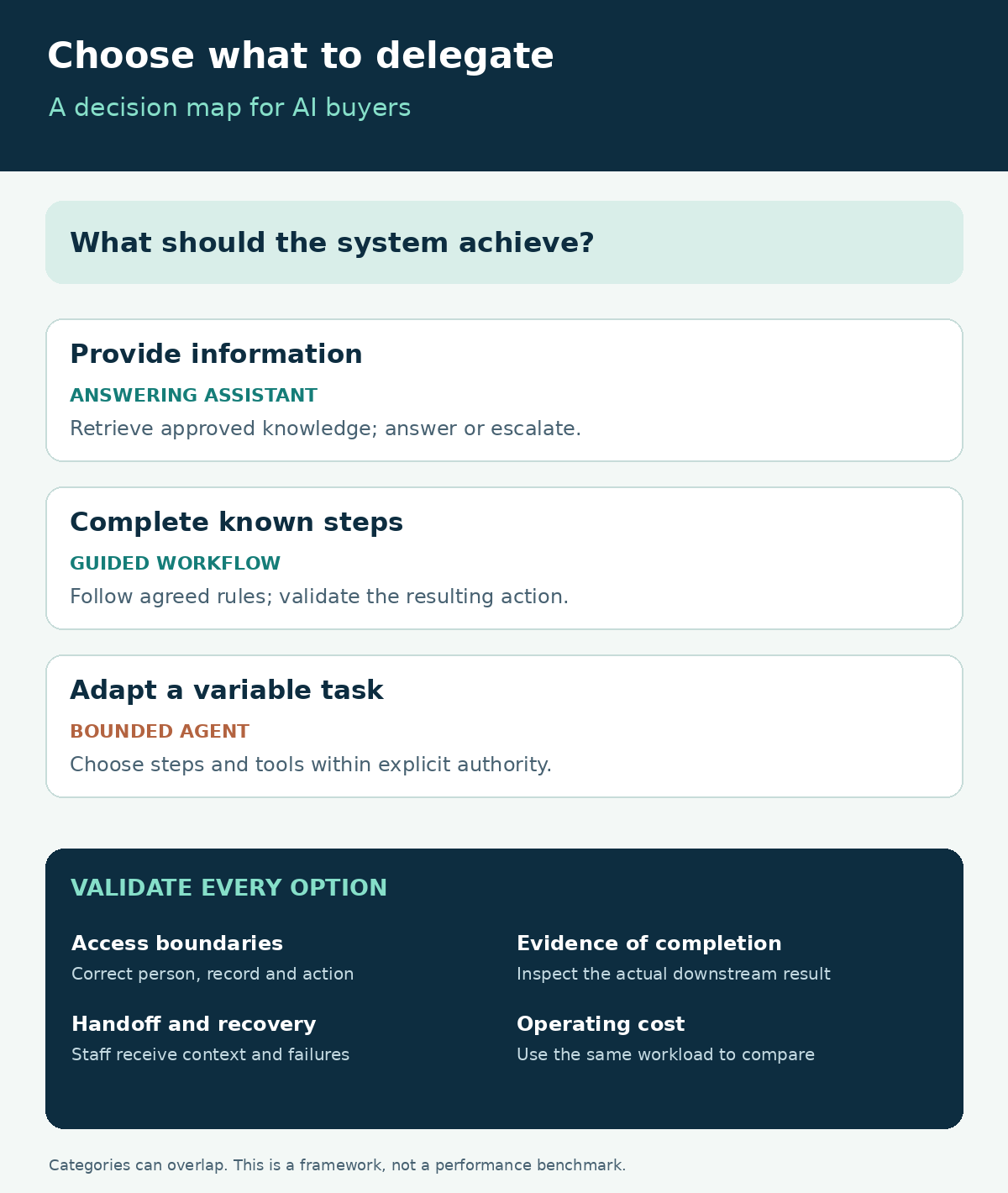
Compare three approaches, not just two labels
A fixed workflow is often the missing option in a chatbot-versus-agent discussion. You may need flexible language handling at the front, followed by a predictable sequence behind it.
| Approach | Best starting fit | What to verify |
|---|---|---|
| Answering assistant | Questions about documented products, policies and procedures | Grounded answers, access boundaries and escalation |
| Guided workflow | Known steps such as collecting booking details and submitting a request | Validation, duplicates, error recovery and handoff |
| Agent with bounded autonomy | Variable tasks requiring selection of tools or intermediate steps | Action scope, result verification, limits and operational ownership |
For an appointment business, answering opening-hours questions may only require an assistant. Collecting a service, date and phone number can follow a fixed workflow. Resolving a changing scheduling request across several calendars may justify more flexible orchestration, provided the permitted actions are defined.
Compare these approaches against the same workload. If a predefined flow completes the task reliably, extra autonomy is not automatically an improvement. Conversely, forcing a highly variable problem into a rigid flow can create repeated exceptions for your team.
Write the requirement as a task, data and authority boundary
Begin your brief with a sentence that specifies the outcome. For example: “Help authenticated customers find eligible appointment slots and submit a booking request; do not confirm a reservation until the booking system returns a valid record.” This is more testable than “Build an intelligent sales agent.”
Next, list the information required. Separate public knowledge, such as product descriptions, from private information, such as an individual customer's order or account history. Name the source of truth for each field, who maintains it and how the system should behave when information is missing.
Finally, define authority. Reading availability, drafting a request and confirming a booking are different permissions. Write down the actions the system can perform, the conditions for doing them and the decisions that remain with staff or the customer.
Microsoft's autonomous-agent guidance emphasizes narrow scope, staged rollout, least-privileged access and human oversight for critical actions. Use those ideas to request an operationally bounded proposal, rather than a vague promise of complete automation. [2]
Include the channel in the brief. A website widget, WhatsApp inbox and internal staff assistant may share business knowledge while requiring different identity checks and handoff processes. Do not assume a successful demo in one channel proves the complete customer journey in another.
Require specific permissions and visible controls
OWASP identifies excessive functionality, permissions and autonomy as causes of excessive agency. Its guidance recommends limiting available operations, enforcing authorization in downstream systems and requiring human approval for high-impact actions. Instructions in a prompt should not be the only protection around a sensitive operation. [3]
Ask for an action matrix in the proposal. The example below is an editorial planning framework, not a universal security standard or a ready-made policy for your organization.
| Capability | Proposed boundary | Evidence to request |
|---|---|---|
| Answer public FAQs | Use approved public material; disclose uncertainty | Answers linked to the relevant source content |
| Read an order | Only the authenticated customer's eligible record | Cross-customer access is rejected in testing |
| Create a support ticket | Approved fields and category; avoid duplicates | Ticket ID and independently inspectable record |
| Change a booking | Eligible booking, explicit confirmation and validated availability | Correct resulting booking plus an audit event |
| Delete records or commit money | Exclude from initial scope or use separately governed approval | Restricted tools and an enforced approval boundary |
Make exceptions visible. Ask what happens when the user changes their mind, the account cannot be verified or the tool returns an ambiguous response. An implementation should expose these states to the operator instead of hiding them behind a confident success message.
Test the integration and human handoff, not just the conversation
Use a complete journey in the demo. Start with a realistic customer request, continue through information gathering and inspect the downstream record. Ask the vendor to show what staff will see when the assistant hands over a conversation.
A booking handoff might include the customer's selected service, verified contact details, requested times, current status and the reason for escalation. A support handoff might include the relevant order reference, troubleshooting already attempted and unresolved question. Decide which fields belong in your workflow before buying.
Then introduce a failure. Make the scheduling service unavailable or supply an invalid reference in a safe test environment. The expected outcome may be a queued request, a retry with a defined limit or a staff escalation. It should not be an unsupported claim that the operation succeeded.
For integrations, discuss duplicate prevention, authentication, rate limits and recovery ownership. These are acceptance criteria for your particular system. You do not need to prescribe a vendor's architecture, but you should know how operators will detect and recover a failed business action.
Scope AI integration engineering separately from the conversational layer when the work requires custom connections. If an existing product already supports the required flow, verify that support with your actual fields and process before paying for a custom build.
Give every shortlisted vendor the same acceptance tests
Anthropic's evaluation guidance distinguishes an agent's recorded interaction from the resulting state in its environment. A statement that a task is complete is different from verifying the outcome. It also describes combining deterministic checks, model-based assessment and human review where appropriate. [4]
Turn that distinction into a buying exercise. Prepare a small test set from your actual workflow, remove personal information and agree expected outcomes before the demo. The following examples are proposed tests, not published performance results.
- Ordinary request: Answer a documented policy question accurately and show the relevant source.
- Missing information: Ask for the required detail instead of inventing it.
- Unauthorized request: Decline access to another customer's information.
- Successful action: Create the correct test record and return its reference.
- Tool failure: Avoid claiming success and route the unresolved request correctly.
- Repeated event: Do not create a second booking or ticket unintentionally.
- Human escalation: Transfer the conversation with the agreed context.
Measure answers and actions separately. An assistant could answer well but perform an action incorrectly. An agent could complete an action while communicating confusingly. Define what is critical, what can be corrected during the pilot and what blocks release.
A small sample reveals obvious gaps; it does not establish a general accuracy guarantee. Expand the test set as you learn real failure patterns, and repeat it after changes to models, knowledge, prompts or integrations. Make access to test results and operational evidence part of the handover.
Check what happens when documents or messages contain instructions
Business assistants may encounter content that should be treated as data, such as uploaded documents, emails or retrieved pages. That content can contain misleading instructions. Ask the vendor to demonstrate that a customer's message cannot expand the system's permissions or bypass its allowed operations.
OWASP's AI Agent Security Cheat Sheet discusses prompt-injection defenses, authorization checks at execution and structured security testing. A model's interpretation of an instruction does not itself authorize a tool to act. [5]
For a practical pilot, provide a test document containing a harmless instruction to ignore the configured process or access an unrelated record. Agree the expected rejection in advance. Inspect what was retrieved, what action was attempted and what the authorized system actually allowed.
Also ask who can change the knowledge base, tool configuration and approval settings. A deployment can meet the initial brief and later drift if those responsibilities are unclear. Keep administrative ownership and change review in the same scope discussion as the initial setup.
Compare total operating cost for the task you need
Do not assume an agent costs a fixed multiple of a chatbot. The bill depends on the product, model, processing pattern, integrations and service agreement. Request a first-month estimate and a recurring estimate using one agreed workload.
Separate platform access, model usage, channel charges, integration hosting, implementation and maintenance. For WhatsApp, the AI system's cost is only one part of the stack; see the WhatsApp API cost comparison guide for the separate messaging and software layers.
Compare cost per correctly completed task alongside latency and staff effort. An answer that avoids a ticket may be useful, but a wrongly closed ticket is not a saving. A more complex approach may also require additional monitoring or review. Include those responsibilities in the evaluation instead of assuming they disappear.
As a purely hypothetical calculation, suppose a pilot's monthly operating cost is $300 and it correctly completes 150 eligible tasks. That is $2 per completed task. If it correctly completes only 75, the same cost becomes $4 per task. Neither figure is a vendor price or a performance prediction; it shows why completion quality belongs in the cost model.
What should a vendor proposal contain?
A useful proposal explains the operating boundary as well as the technology. Request the following items in writing:
- The task, intended users and supported channel.
- Whether execution uses fixed rules, model-selected steps or a combination.
- Knowledge sources, update responsibilities and access restrictions.
- Available tools, permitted actions and confirmation or approval conditions.
- Integration deliverables, fallback behavior and handoff fields.
- Acceptance tests, evidence format and rollout criteria.
- Usage assumptions, recurring fees, support scope and change costs.
- Ownership of configurations, records, exports and operational documentation.
Use this checklist to compare a configured platform with a custom development proposal. They are different delivery models, and either can fit. Product configuration may suit a known, supported journey. Custom development may be justified when the required orchestration or integration cannot be met by the existing capabilities.
For chatbot development or agent development, ask for proof against the same brief. The provider's label should not decide which proposal wins.
Start with the smallest scope that proves the decision
Choose one journey with a clear end state, a maintained knowledge source and an accountable operator. Begin in a controlled environment. Set a limit on the pilot's users, duration, actions and expenditure, and specify who can stop it.
If your main need is reliable information retrieval, test an answering assistant first. If the steps are known, test a guided workflow. Introduce agentic selection when the variable task actually benefits from it and the acceptance evidence supports the added responsibility.
At the end of the pilot, record completed tasks, failure patterns, unresolved integrations, support effort and the cost under observed usage. Compare those results against the original requirement. Expand only the capabilities that have demonstrated a useful outcome.
The buying decision is therefore about the task you can safely and reliably delegate, the evidence you can inspect and the operating cost you can sustain. Start with those requirements and let the architecture follow.
Frequently asked questions
Can an AI chatbot call tools or update a CRM?
Yes, a conversational interface can trigger integrations or a predefined flow. Tool access alone does not prove agentic autonomy. Ask whether the model chooses and adapts the execution path, and verify the resulting record.
Does an AI agent need to change business records?
No. A research agent can select steps and tools while remaining read-only. Evaluate its control over the task and its permissions separately.
Is an AI agent always better than a guided workflow?
No. A known sequence may be easier to validate as a fixed workflow. Additional autonomy should have a demonstrated benefit for the specific task, not merely a more impressive product label.
What should I inspect during a vendor demo?
Use agreed test cases, inspect the actual downstream results, test missing information and failures, and verify staff handoff. A success statement in the conversation is insufficient evidence of a completed action.
Sources and research notes
Sources checked on 2026-10-14. Pricing and policy documents can change; verify current terms before approving expenditure.
- Anthropic: Building effective agents
Architectural distinction between predefined workflows and model-directed agents; simplicity as a design starting point. The article notes that its tooling landscape has evolved.
- Microsoft Learn: Design autonomous agent capabilities
Scope, permissions, staged deployment and human oversight guidance.
- OWASP: Excessive Agency
Risks from excessive functionality, permissions and autonomy; downstream authorization and approval controls.
- Anthropic: Demystifying evals for AI agents
Recorded interaction versus resulting environment state and complementary evaluation methods.
- OWASP: AI Agent Security Cheat Sheet
Prompt-injection defenses, execution authorization and security testing.
Definitions vary across vendors. This guide uses execution control and permitted actions as separate evaluation dimensions. The comparison matrix, proposed acceptance tests and $300 example are editorial frameworks, not vendor benchmarks or measured customer results.