
Integration buying guides
CRM and Ecommerce Integration: How to Scope the Work
“Connect our store to the CRM” is not a complete integration brief. Before comparing quotes, define which records move, which system owns each field, what happens when delivery fails and how your team will know the sync is correct.
Prepared with AI assistance and checked against the linked sources. Numerical comparisons are illustrative unless expressly sourced.
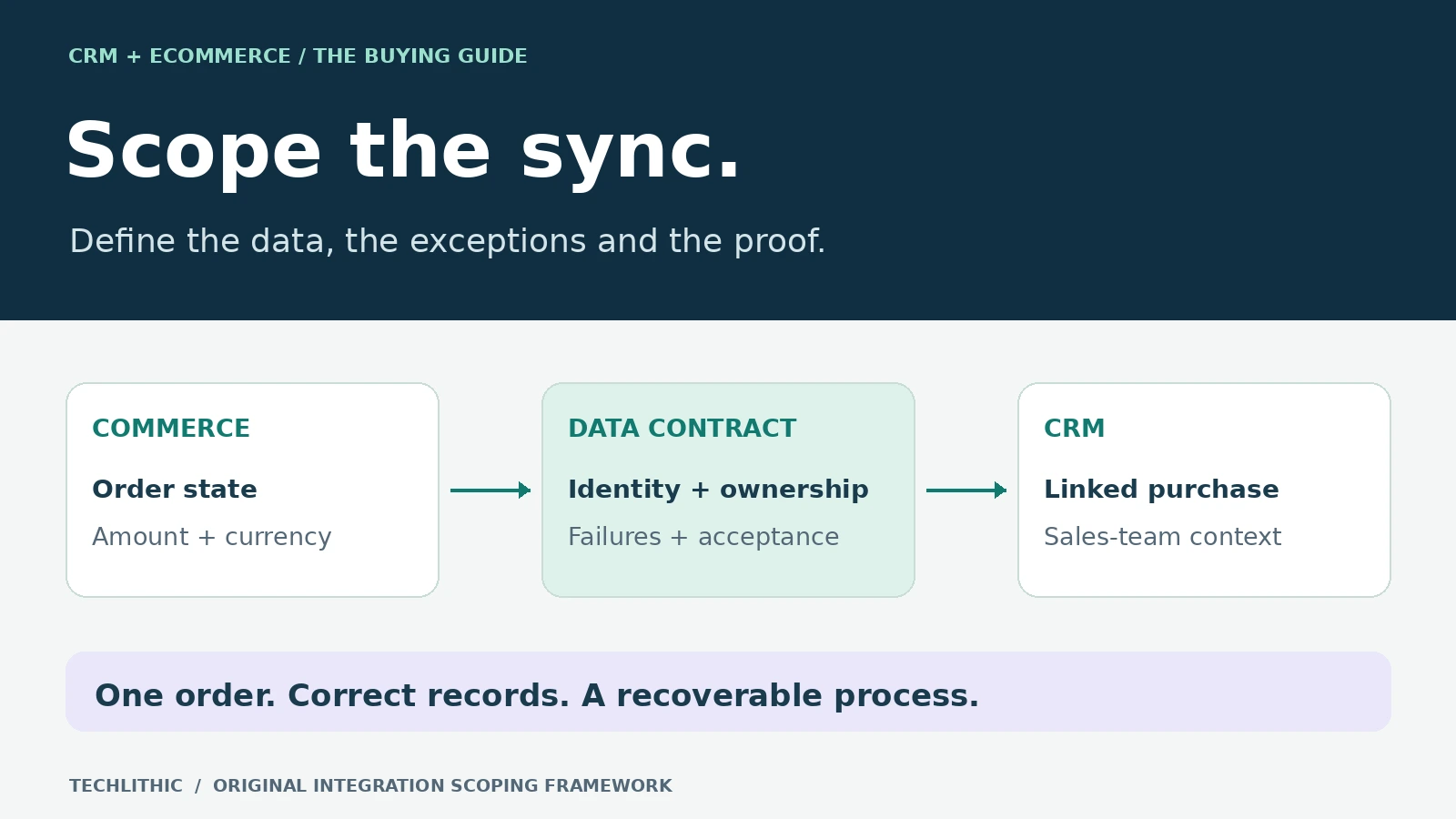
Buy a bounded business workflow, not an unspecified connection. Agree the data contract, identity rules, event handling, recovery owner and acceptance tests first. Use a native connector when it satisfies those requirements; commission custom work only for a demonstrated gap.
Choose the smallest workflow worth integrating
Describe the business outcome before listing applications. A useful first scope might be: when a qualifying order becomes paid, create or update the corresponding CRM purchase record so the account team can see it. That is different from synchronizing every customer, catalogue item, abandoned cart and refund in both directions.
Choose between a native connector, an automation platform and custom development by testing the required behavior. A native connector may be enough if its objects, matching rules, permissions and recovery controls fit. An automation platform may suit a bounded transformation. Custom engineering becomes more relevant when the workflow has unsupported mappings, complex state or specific operational requirements.
Ask the provider to demonstrate the missing capability before accepting a custom build. The presence of two application logos does not prove that a connector handles your required fields or exceptions. Confirm current plan entitlements and fees separately.
State exclusions early. A paid-order pilot might exclude historical imports, inventory writes, payment actions, outbound messages and two-way customer updates. Those exclusions make quotes comparable and keep the first release testable.
Assign a source of truth for each field
“Two-way sync” is not a conflict-resolution rule. Decide which system is authoritative for each business fact, and what happens when someone edits the same information elsewhere. The following is a proposed ownership matrix, not a rule imposed by every platform.
| Information | Example authority | Decision to document |
|---|---|---|
| Order amount and currency | Commerce system | Which total is copied and how refunds are represented |
| Account owner and sales notes | CRM | Store events must not overwrite sales-team work |
| Customer identity link | Agreed mapping record | Store ID, customer ID and destination record association |
| Communication preference | Designated preference authority | Channel, purpose, evidence and suppression precedence |
| Sync status | Integration operation log | Last attempt, last confirmed success and recovery owner |
Define identity separately from display fields. Names are unsuitable as a general matching rule. Email can be useful, but your scope still needs to handle changed addresses, guest purchases, shared addresses and multiple stores. A stable source identifier plus a destination association is often a better starting point.
Decide what happens to ambiguous matches: hold them for review, apply an approved merge rule or leave them unlinked. Silently guessing can attach a purchase to the wrong person.
Write a data contract before requesting a fixed quote
For each object, list the source field, destination field, direction, type, requiredness, transformation and failure behavior. Include one representative payload and the expected destination record using synthetic or appropriately protected test data.
For money, specify currency and whether the amount includes tax, shipping, discounts and refunds. For time, define the timezone and distinguish the event time from the time the integration received it. For statuses, map actual business states rather than treating similarly named labels as equivalent.
Specify whether a blank source value clears the destination, leaves it unchanged or raises a validation issue. Decide how missing required values, unfamiliar status values and deleted records are handled. These details affect both implementation effort and acceptance.
Keep the first mapping narrow. Copying every available property increases review work without necessarily improving the business process. For a CRM and ecommerce integration scope, ask for a reviewed mapping sheet and a list of intentionally excluded fields, not just a promise to sync “all customer data.”
Define events, ordering and historical imports
Identify the exact trigger and qualifying condition. Order creation, payment confirmation, fulfilment and refund are separate business moments. A sales workflow should not assume a newly created order has already been paid.
Shopify's webhook documentation states that ordering is not guaranteed and recommends reconciliation because deliveries can be missed or mishandled. Treat events as inputs to a state-aware process, not an infallible chronological ledger. [1]
Ask how the design recognizes stale updates and when it reads the current source record before writing. An older event arriving late should not blindly replace a newer business state. Record the comparison rule and how uncertainty is resolved.
Scope historical migration separately from ongoing sync. Define the import window, object count estimate, cutoff, overlap handling and reconciliation method. Agree how records that change during the import are brought current. Otherwise, a successful initial import can still leave a gap before live processing begins.
Separate duplicate delivery from duplicate business action
Shopify documents that the same webhook can arrive more than once. Its delivery ID helps detect repeat deliveries, while its event ID correlates deliveries from the same merchant action. These identifiers are not interchangeable with your order or customer identity. [2]
Ask for two controls: a durable receipt record and duplicate-safe destination writes. If an event is delivered again, the integration should not create another purchase. If a write succeeds but its response is lost, a retry must first use the agreed identity or reconciliation mechanism rather than assume nothing happened.
Stripe's API illustrates an explicit idempotency mechanism: a key identifies retries of an operation. Its documented behavior differs between API versions, so do not copy one provider's semantics into another API. Confirm support, retention and error handling for the actual destination. [3]
For a purchase record, an example business key is store plus source order ID. Enforcing that key safely may require an atomic uniqueness control or equivalent destination capability. A lookup followed by an unprotected create can still race when two workers act together.
Make failure recovery part of the purchase
A webhook acknowledgement proves receipt, not completion of the CRM update. Shopify's HTTPS guidance calls for prompt acknowledgement and discusses asynchronous queuing. Your agreement should identify when a received event is durably recorded and how later processing is tracked. [2]
Separate transient failures from records that need intervention. A temporary unavailable destination may justify controlled retries. A missing required field needs correction. An expired credential requires an authorized owner. A request with an uncertain outcome needs a safe check before replay.
HubSpot documents that API limits depend on factors including app distribution and account subscription, with some endpoints having their own limits. Excess usage can return a rate-limit error. Scope peak traffic and backfills against the applicable limits instead of assuming the daily average is sufficient. [4]
Request a failed-record queue, actionable alerts, an authorized replay procedure and reconciliation of the agreed source population against destination records. Define who monitors the queue, how quickly they respond and what happens outside support hours. Do not accept “automatic retry” as the complete recovery plan.
Protect access and preserve communication preferences
Separate storing an order in a CRM from enrolling its buyer in marketing. In your brief, identify the channel and purpose of any later communication, the approved preference authority and the evidence your business requires. Have the responsible owner approve the applicable privacy and messaging rules; this checklist is not a legal determination.
As a proposed safety rule, an ordinary order update should not resubscribe someone who opted out. Test that suppression survives imports, replays and customer-profile updates. If the systems disagree, specify which status wins and when an operator must review it.
Limit application permissions to the work in scope. Keep credentials out of ordinary handover documents, restrict access to failed-record payloads and define log retention. Record who owns credentials, authorizes rotation and removes access when the engagement ends.
Worked example: a one-way paid-order pilot
Consider an invented store that wants paid purchases visible in its CRM. The pilot copies a selected order summary into a purchase record; it does not initiate payments, modify stock or send messages.
The commerce system owns payment state and order totals. The integration maintains the association between store plus order ID and the destination record. CRM account ownership remains untouched. Ambiguous customer matches go to review rather than being merged automatically.
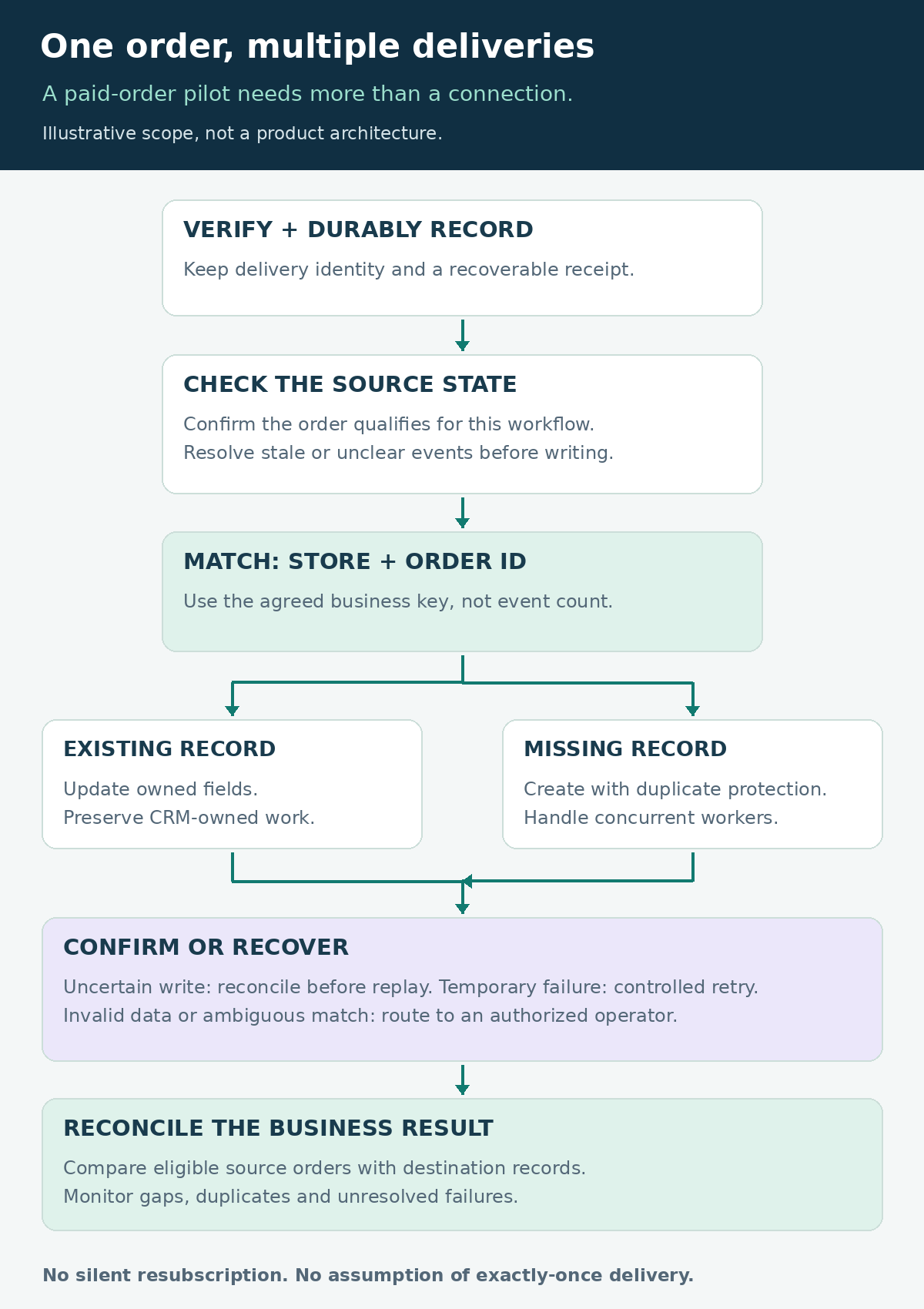
- Verify the incoming delivery and durably record enough information to recover processing.
- Check the qualifying state and resolve stale or ambiguous event data against the source.
- Use the agreed business key to update the existing destination record or create a missing one with duplicate protection.
- Confirm the write and record its outcome. For an uncertain result, reconcile before retrying.
- Route unresolved failures to an operator and compare the pilot's eligible source records with the destination.
Now test a paid event delivered twice, a destination timeout after a successful write and an older update arriving later. The expected result is one correct purchase record, not one record per event. This is a proposed acceptance target, not a claim that a connector provides it automatically.
Put acceptance tests in the statement of work
Accept the workflow by inspecting records and recovery evidence in both systems. A green automation run or a successful HTTP response alone is not enough.
| Scenario | Evidence required |
|---|---|
| Ordinary qualifying order | Correct customer association, fields, amount and currency |
| Repeated or concurrent delivery | One business record with no unintended repeat action |
| Late older event | Newer state preserved or source state safely rechecked |
| Uncertain write outcome | Record located or reconciled before replay |
| Invalid data or ambiguous match | Visible exception without a guessed association |
| Rate limit or outage | Controlled recovery and an observable backlog |
| Opted-out customer | No silent resubscription during sync or replay |
| Import and live-event overlap | No unexplained missing or duplicate records at the cutoff |
| Pause and resume | Writes stop as agreed; backlog recovery does not repeat actions |
For each test, save the expected result, actual result, relevant record identifiers and reviewer. Define release-blocking failures and who can pause the pilot. Agree a bounded observation period and the conditions for expanding traffic.
Compare complete scopes and require an operational handover
Compare setup, data cleanup, historical import, connector subscription, usage charges, hosting, monitoring and maintenance separately. Ask how billing units treat retries, searches and multi-step workflows. Do not assume every platform counts one order as one billable operation.
For an illustrative workload, 500 orders requiring four destination requests each mean 2,000 requests before retries, lookups or reconciliation. This is sizing arithmetic, not a vendor allowance or price estimate. Peak bursts and backfills require separate review.
Include version maintenance. HubSpot's March 30, 2026 explanation of date-based API versioning describes explicit release versions and a support lifecycle. Record the actual supported versions selected for your systems, who tracks changes and who pays for upgrade testing. [5]
The handover should include the mapping, configuration ownership, permissions record, test results, monitoring location, replay instructions and pause procedure. Define what post-launch support covers. A custom API integration is not operationally complete just because its developer can run a demonstration.
TechLithic offers related implementation services. Use the same criteria with any provider, and choose the smallest maintainable scope that passes your tests. The SaaS buying checklist covers broader vendor evaluation.
Frequently asked questions
Do we need a custom CRM integration?
Not necessarily. Test a native connector or automation platform against your mapping, identity, recovery and acceptance requirements first. Buy custom work for a demonstrated gap.
Is two-way sync always better?
No. It adds ownership and conflict decisions. Start with the direction needed for the business outcome and add reverse updates only where their value and rules are clear.
Why test duplicate and late events?
They reveal whether repeated inputs create repeated actions or older data overwrites newer state. Test the actual delivery and destination behavior rather than assuming ordering or exactly-once delivery.
What should remain with our team after handover?
Account and configuration ownership, the mapping, acceptance evidence, monitoring access and documented pause, recovery and maintenance responsibilities.
Sources and research notes
Sources checked on 2026-10-18. Pricing and policy documents can change; verify current terms before approving expenditure.
- Shopify developer documentation: About webhooks
Event-ordering limitations and reconciliation guidance. Check the current topics and permissions for the selected implementation.
- Shopify developer documentation: Verify webhook deliveries
HTTPS signature verification, repeat deliveries, delivery versus event identifiers, acknowledgement and queueing considerations.
- Stripe API reference: Idempotent requests
A concrete example of retry-safe operation keys. The current reference distinguishes API versions; its semantics are not universal across vendors.
- HubSpot developer documentation: API usage guidelines and limits
Account, app and endpoint-specific limits plus rate-limit error behavior. No numeric quota or plan entitlement is assumed in this guide.
- HubSpot developer blog: Date-based API versioning
Published March 30, 2026. Explains explicit API releases and their lifecycle; verify current support for the versions chosen in a project.
The ownership matrix, integration brief, paid-order pilot, acceptance tests and request-count illustration are original buying frameworks, not a client case study or measured outcome. Official sources were checked on October 18, 2026. No universal connector features, exactly-once guarantee, price, quota, delivery deadline or legal compliance conclusion is asserted.