
SaaS buying guides
SaaS Buying Due Diligence: A Practical Evaluation Checklist
Before subscribing to business software, prove that it fits your workflow, protects access, connects to your systems and lets you leave with usable data. This checklist turns a vendor demo into an evidence-based buying decision.
Prepared with AI assistance and checked against the linked sources. Numerical comparisons are illustrative unless expressly sourced.
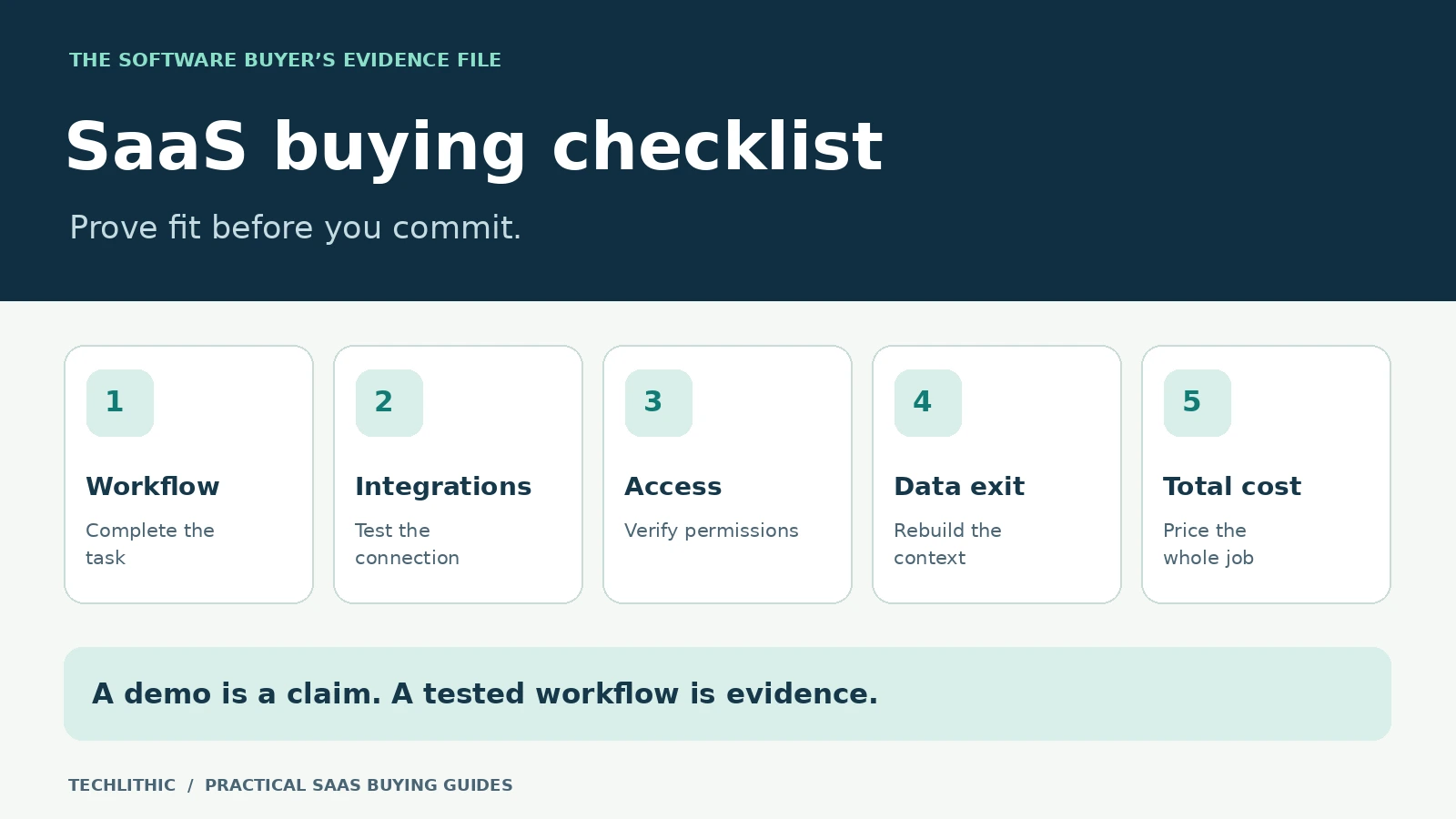
Choose SaaS by demonstrated workflow fit and complete operating cost. Treat critical access, data and integration requirements as pass-or-fail gates, not features to trade away for a discount.
What does SaaS buying due diligence cover?
This guide concerns subscribing to software for your team, not acquiring a SaaS company. The question is whether a product can deliver an agreed business outcome under acceptable operating, commercial and data-handling conditions.
Start with the process you want to improve. A CRM purchase might target reliable lead assignment and follow-up. A support platform might target accountable ticket resolution. A marketing tool might target a measurable campaign journey. Buying more features is not an outcome by itself.
Write a short decision brief: intended users, current process, expected improvement, essential systems, data involved and available budget. Name the person responsible for operating the software after onboarding. If nobody owns the process, a successful demo can still become an unused subscription.
Use the same brief for every shortlisted vendor. Separate must-have requirements from useful extras, and identify what would stop a purchase. For example, an inability to restrict customer records may be a blocker, while a missing dashboard theme probably is not.
Prove workflow fit with a realistic demo
Ask each vendor to complete the same sample journey using representative, non-sensitive test data. Start at the event that creates work and continue until the outcome appears in the system your team will actually use.
For lead management, that might mean submitting an enquiry, assigning an owner, updating a status, recording a follow-up and producing the required report. Include an exception such as a duplicate contact or an unassigned record. A series of screenshots is less useful than seeing how the process behaves.
| Requirement | Evidence to request | Decision question |
|---|---|---|
| Core task | A completed sample journey and resulting record | Can our operator repeat it? |
| Exceptions | A duplicate, incomplete input or failed step | Can we identify and recover the problem? |
| Reporting | A report reconciled with sample records | Does it measure the outcome we need? |
| Team usability | A task performed by a likely end user | What training and manual work remain? |
Record gaps as configuration work, integration work, custom development or unsupported functionality. Those categories have different costs and delivery risks. Do not count a roadmap promise as a feature available for your launch unless the dependency is explicitly accepted.
Test the integration behind the marketplace logo
A listed integration is a starting point, not proof that it supports your process. Specify the trigger, direction of transfer, fields, update frequency and system of record. Ask which plan enables the connector and whether another paid service is required.
Test creation and updates separately. A connection that adds new contacts may not synchronize later changes, associations or consent status. Decide how conflicts are resolved when both systems can edit a field. Use a repeated event to check whether the integration creates duplicates.
For a custom API connection, ask about authentication, relevant limits, webhook delivery, retry behavior and error visibility. The operator should know where a failed event appears, who receives an alert and who is responsible for recovery. Put those responsibilities in the implementation scope.
If the connection is business-critical, include a temporary outage in the pilot. Confirm whether work is queued, retried or escalated, and inspect the resulting records after recovery. For a more involved setup, scope the CRM integration work separately so it is not hidden inside a software price.
Separate sign-in, account lifecycle and audit access
Ask how employees join, change roles and leave. Test the permissions of an ordinary user, a team manager and an administrator. Confirm who can export records, change billing details or modify integrations. Use your actual roles rather than assuming a vendor's default labels match them.
Single sign-on and account provisioning address related but different tasks. Microsoft's Entra documentation describes automatic provisioning as creating, maintaining and removing application identities, using supported mechanisms such as SCIM. A successful sign-in demo therefore does not establish that onboarding and offboarding are automated. [1]
Ask for a concrete offboarding demonstration: remove or disable a test user through the intended process, then verify access to the application and relevant sessions. Confirm the expected timing and any manual steps. Requirements differ between organizations; not every small purchase needs an enterprise identity stack.
The NCSC's audit-information guidance highlights the records, format and retention needed to investigate activity. Request a sample audit event and establish what is logged, who can view it and how long it remains available. Check the actual plan and configuration rather than assuming every feature is included. [2]
Run a data-export test before committing
Ask for a sample export containing the records, relationships and history your operation needs. A contact list alone may not preserve the context needed to rebuild a sales or support process. Decide which attachments, custom fields, ownership records, timestamps and suppression preferences must travel with it.
Then inspect the files. Can you identify the same test customer across the exported objects? Are field names and date formats understandable? Can another person reconstruct the sample journey without access to the original application's interface?
HubSpot's export documentation is a useful concrete example: export methods differ across data types, and it explains that moving between accounts can involve importing objects or recreating data. This is not a judgment about HubSpot or a limitation shared by every vendor; it illustrates why an export button is not equivalent to a complete migration plan. [3]
Confirm export permissions, time limits after cancellation, assistance fees and any restrictions on volume or format. Ask whether configurations and automations can be transferred or must be rebuilt. Budget the work of validating the destination as well as extracting the files.
Review data handling and contract responsibilities
Map what information will enter the product, who will access it and which third parties may process it. Ask the provider for applicable security documentation, its incident-contact process, relevant service locations and the agreement governing data handling. Match evidence to the service you are actually buying.
When a vendor provides an assurance report or certificate, ask about its scope, covered service, review period and relevant exceptions. Route the evidence to the person responsible for security or procurement. Avoid turning a badge into an unqualified conclusion about your own deployment.
For UK GDPR controller-processor arrangements, the ICO's contract guidance covers responsibilities including sub-processors and end-of-contract handling. Its page currently notes that the guidance is under review following legislative changes. Treat it as a jurisdiction-specific reference, not a universal template or proof that a vendor is compliant. [4]
Have an appropriately qualified reviewer assess the obligations relevant to your data and jurisdictions. Separately clarify commercial responsibilities: service availability commitments, support channels, response versus resolution targets, notice periods and the process for material changes. Put unanswered questions in the decision record instead of assuming they will be resolved after payment.
Compare the full cost, not the headline subscription
Use one workload and commitment period for every quote. Include seats, usage, necessary add-ons, implementation, integrations, support and a reasonable estimate of exit work. Identify minimum commitments and renewal conditions. Show taxes and currency-conversion assumptions separately.
The following is an invented planning example, not a current vendor quote or a prediction of your costs. Suppose a product costs $50 per user per month for ten users. The licence component is $500 monthly or $6,000 over twelve months.
| Hypothetical first-year item | Amount |
|---|---|
| Ten licences for twelve months | $6,000 |
| One-time setup and migration | $1,500 |
| Integration service at $100 monthly | $1,200 |
| Additional support at $75 monthly | $900 |
| Exit-work allowance | $400 |
| Planning total before tax | $10,000 |
The difference from the licence-only figure is $4,000. The exit allowance is a planning provision, not necessarily a charge in that year. Staff time and internal change costs are excluded from this example; estimate them separately instead of implying they disappear.
Check what changes when usage grows or a plan is downgraded. Ask which capabilities depend on a higher tier. A discount is useful only if the complete commitment and required functionality still make sense.
Use a pilot scorecard without hiding critical failures
Choose a small pilot with named users, approved test data and observable outcomes. Agree the test set before starting, including the ordinary journey, a failure, a permission boundary, an export and an offboarding task. Assign an owner to inspect each result.
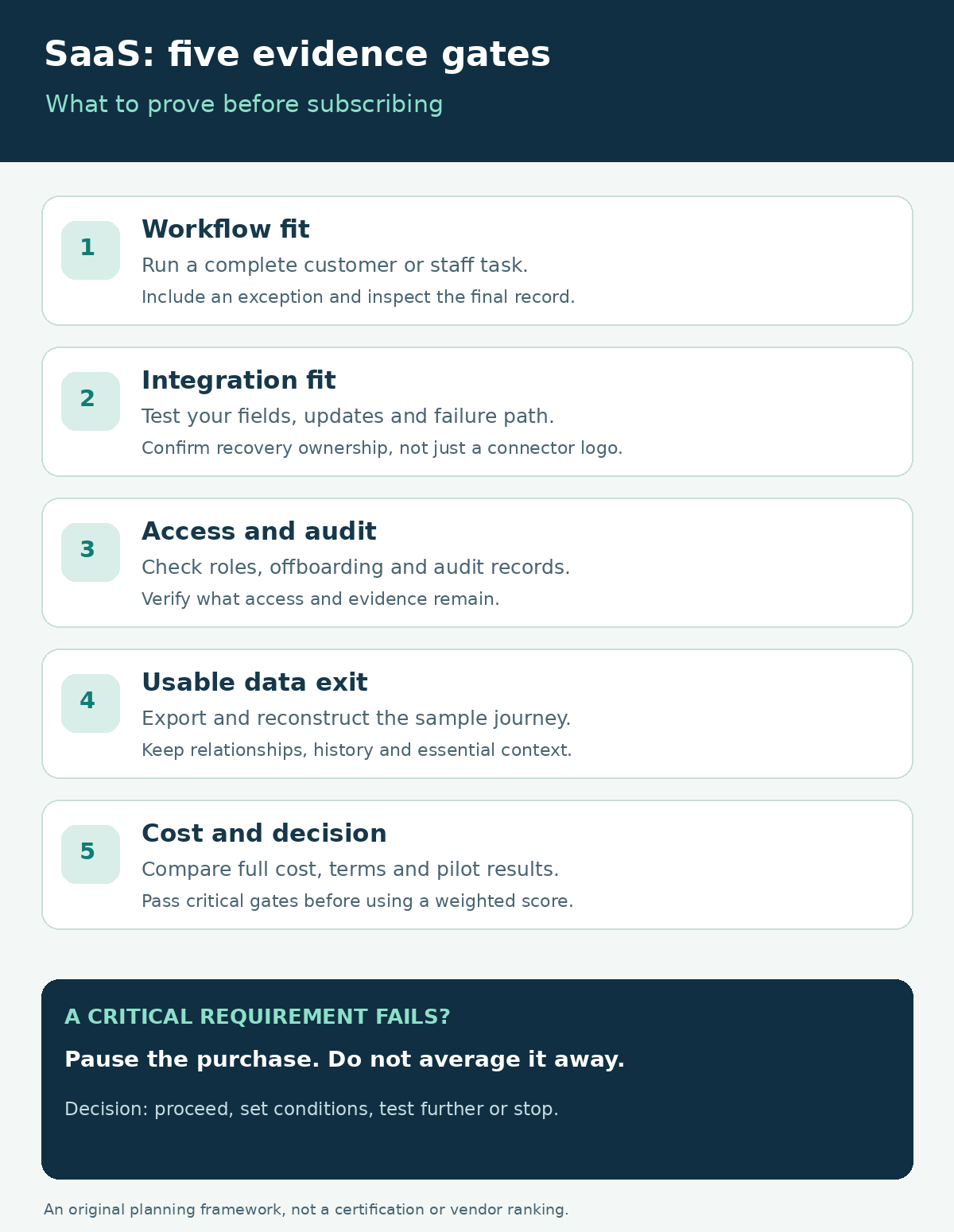
Use pass-or-fail gates for requirements you cannot compromise. For example, an unresolved access-control issue or inability to recover essential business records should not disappear inside an attractive average score.
For products that pass the gates, a weighted scorecard can help compare trade-offs. An illustrative allocation is 35% workflow fit, 20% integration fit, 15% data portability, 15% access and operational evidence, and 15% total cost. These weights are an editorial example, not a recognized standard; change them to reflect your requirements.
Give every score an evidence note. “Workflow fit: four out of five because duplicate handling requires a manual step” is more useful than a bare number. Record the remaining work, responsible person, expected cost and whether the gap is acceptable for launch.
Finish the pilot with a decision: proceed, proceed with explicit conditions, test further or stop. A free trial is an opportunity to gather evidence, not an obligation to subscribe. If adoption depends on capabilities that are still unproven, pause the purchase.
What to request from every shortlisted vendor
- A demonstration against your core task and exception scenarios.
- The exact plan, included limits and implementation responsibilities.
- Connector documentation and a test of your required fields and events.
- Access roles, offboarding steps and a sample audit record.
- A usable data export and an explanation of migration limitations.
- Relevant security and data-processing documentation.
- A complete cost estimate, renewal terms and cancellation procedure.
- A support and handover plan with named responsibilities.
Keep a simple decision register: requirement, evidence link, test date, gap, owner and decision. Recheck material gaps before signing and again before extending the deployment. This prevents a verbal assurance from quietly becoming an operational dependency.
Discovery and comparison resources such as HowToBuySaaS can help organize a shortlist. TechLithic operates that platform, so this reference is not an independent ranking. A listing or editorial comparison does not replace your workflow test, contract review or security assessment.
When standard products meet the need, buy the one your team can operate and leave responsibly. If none can support the essential process, consider changing the process or defining a focused integration or transformation scope before committing to more subscriptions.
Frequently asked questions
Is SaaS buying due diligence the same as acquiring a SaaS company?
No. This guide evaluates software subscriptions for an operating team. Buying a SaaS business requires a different investigation into ownership, financial records, liabilities and the acquisition itself.
What should a small business test first?
Start with the core workflow, required integration, access roles, a usable data export and the complete cost. Expand the review to match the sensitivity of your data and dependence on the service.
Does single sign-on prove that user offboarding is automatic?
No. Sign-in and account lifecycle management are different capabilities. Test the actual removal process and verify what access remains, rather than inferring it from an SSO feature.
Can a weighted score override a failed essential requirement?
It should not. Define critical pass-or-fail gates first. Use weighted scores only to compare acceptable trade-offs among products that meet those gates.
Sources and research notes
Sources checked on 2026-10-15. Pricing and policy documents can change; verify current terms before approving expenditure.
- Microsoft Learn: How application provisioning works in Microsoft Entra ID
Account creation, maintenance and removal through supported provisioning mechanisms, including SCIM.
- NCSC: Audit information and alerting for cloud customers
Audit availability, format and retention as evidence for investigating service activity.
- HubSpot: Export your content and data
A concrete vendor example of data-type-specific exports and the distinction between exporting and recreating a working environment.
- ICO: What needs to be included in a controller-processor contract?
Jurisdiction-specific contract guidance, including sub-processors and end-of-contract provisions. The page states that its guidance is under review following legislative changes.
This is a procurement education guide, not legal advice, an independent product ranking or an acquisition due-diligence report. The checklist, pilot weights and financial example are original planning frameworks. Verify current product capabilities, prices and applicable obligations before contracting.