
SaaS growth buying guides
SaaS Fundraising Readiness: What an Advisor Should Deliver
A fundraising-readiness engagement should leave a SaaS founder with claims that can be reproduced, materials that agree with the underlying records and a process the internal team can operate. It should not be sold as a guaranteed introduction, valuation or investment outcome.
Prepared with AI assistance and checked against the linked sources. Numerical comparisons are illustrative unless expressly sourced.
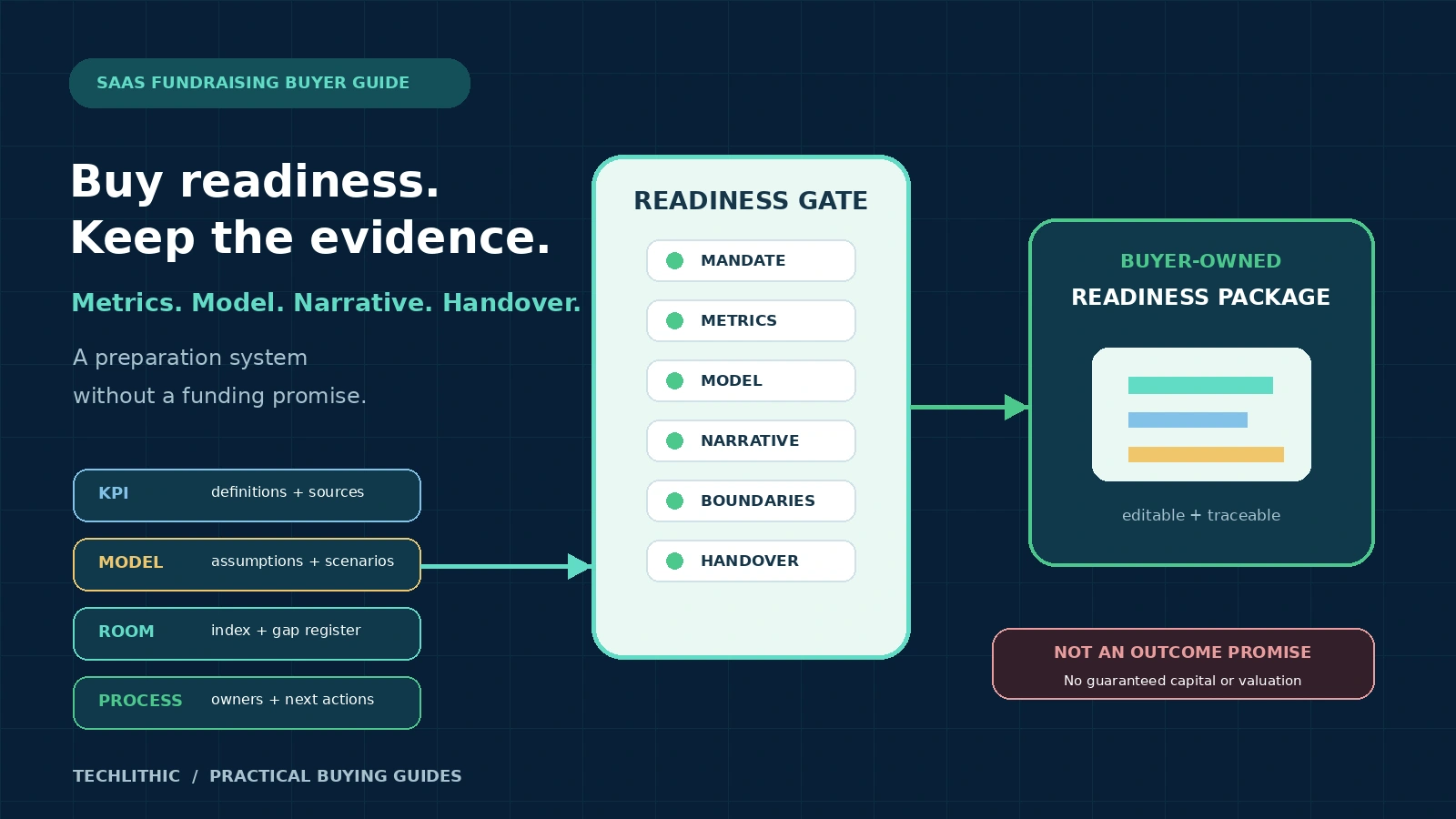
Buy a controlled preparation system, not a promise of capital. Require a written readiness diagnosis, KPI dictionary, source-linked model, claim-evidence map, staged data room, owned investor pipeline, decision log and explicit professional-service boundaries. Accept the engagement only when another team member can reproduce the key metrics, trace deck claims, locate unresolved risks and continue the process without permanent advisor access.
Separate readiness work from raising capital
Start by naming the purchase correctly. A readiness advisor can diagnose gaps, define metrics, organize evidence, challenge the story, prepare materials and help operate a controlled process. Those deliverables can improve the quality of management decisions even if the company postpones a round.
That is different from guaranteeing investor meetings, negotiating securities transactions or promising a close. In the United States, the SEC says activities such as finding investors, participating in solicitation or negotiation, and receiving compensation tied to a transaction can indicate broker activity that generally requires registration. [1] The exact analysis depends on facts and jurisdiction, so the proposal should say what the advisor will and will not do and direct legal questions to qualified counsel.
Reject language that makes payment contingent on a vague success claim without identifying the regulatory basis, responsible entity and permitted activity. Also reject the opposite problem: a preparation-only engagement presented as if it includes placement, legal advice, valuation assurance or investor due diligence.
Require a readiness baseline and written mandate
The first deliverable should record the intended decision, not merely announce that the business is fundraising. Ask the advisor to document the target instrument or round type under consideration, indicative amount, intended use of funds, runway assumptions, target timing, company jurisdiction, current ownership records, management capacity and known blockers. These are planning inputs, not validated deal terms.
The baseline should grade each workstream as ready, conditionally ready, blocked or outside scope. Every gap needs an owner, evidence request, dependency and decision date. A useful diagnosis might discover that the deck is not the constraint because subscription exports do not reconcile to the board model, the cap table is incomplete or a key IP assignment needs professional review.
Make the mandate versioned. If the founder changes the target amount, instrument, geography or investor profile, the advisor should log the change and show which model, deck, data-room and process items must be revised. Otherwise the team can approve materials built for a round it is no longer pursuing.
Make every important SaaS metric reproducible
Ask for a KPI dictionary before polishing charts. For each metric, record the business meaning, formula, source systems, included population, exclusions, currency treatment, reporting period, owner and refresh process. Distinguish recognized revenue, invoices, cash collected, bookings, annual contract value and monthly recurring revenue instead of using them interchangeably.
The same discipline applies to logo churn, gross revenue retention, net revenue retention, acquisition cost, payback, gross margin, active users and pipeline. If the company has multiple products, services, lifetime plans or reseller revenue, disclose how each is classified. Preserve the raw export and transformation steps so the chart can be rebuilt.
Acceptance is not a dashboard screenshot. Select several material numbers and have someone other than the preparer reproduce them from the approved source files. Record unexplained differences rather than forcing agreement. A fundraising advisor may structure this work, but accounting conclusions and assurance belong with appropriately qualified professionals.
Buy a model that exposes assumptions and decisions
The financial model should connect operating drivers to cash needs. Require an assumptions register, monthly historical period, forecast horizon, hiring plan, revenue build, gross-margin logic, operating expenses, cash movement and use-of-funds schedule. Separate management assumptions from historical facts and link material historical inputs to their sources.
At minimum, the buyer should be able to change a few named drivers and see the effect on cash runway, hiring and the next financing decision. Use a base case plus transparent downside and upside cases. Do not accept a forecast whose only control is a growth percentage buried in a formula or a valuation output presented as objective fact.
The advisor should explain model dependencies and limits in plain language. Legal terms, tax treatment, accounting policy and financing instruments can change outcomes and need relevant specialist review. The readiness model is a decision tool, not a fairness opinion, audit or guarantee that an investor will accept the assumptions.
Map the narrative and deck to evidence
Require a claim-evidence register covering the pitch deck, one-page summary and management talking points. Each material claim should have an owner, approved wording, source, period, qualification and review status. This is particularly important for market size, growth, customer counts, retention, product capability, security, competitive differentiation and use of funds.
The advisor should challenge conflicts between documents. The deck, model, KPI schedule, cap table summary and data room should not report different periods or definitions without explanation. A polished story cannot cure inconsistent records.
Ask for two versions of the narrative: a concise first-meeting package and a deeper diligence explanation. The first should create a clear decision path without disclosing sensitive information too early. The second should let an authorized reviewer trace important claims. Unsupported claims should be removed, narrowed or clearly labeled as management estimates.
Instrument templates do not replace legal advice. Y Combinator publishes current SAFE forms and a user guide, while the National Venture Capital Association maintains model documents for priced venture financings. [2] [3] These references can help teams identify questions, but counsel should select and tailor documents for the company and jurisdiction.
Stage the data room and preserve an honest gap register
The readiness scope should define a folder index, naming convention, document owner, version date, disclosure tier and access process. Common categories include corporate records, ownership, financing history, financials, tax, material contracts, customers, people, intellectual property, product, security and compliance. The actual list should be agreed with counsel and expected diligence needs.
Cooley GO provides a sample venture-capital due-diligence request list and explicitly recommends organizing corporate and legal records early, while warning that transaction documents must be tailored and professional advisers consulted. [4] Carta likewise describes investor data rooms containing financial, legal and operational records and recommends permissions, a master index and periodic review. [5]
Do not accept a bulk upload as completion. The advisor should identify duplicates, stale records, missing signatures, inconsistent dates and documents that require restricted access. A gap register should state what is missing, why it matters, who owns it and whether the issue blocks outreach, diligence or closing.
Sensitive credentials, unnecessary personal data and unrestricted customer records do not belong in a broad investor folder. Require staged access and obtain appropriate privacy, legal and security advice before disclosure.
Make regulated and professional boundaries testable
The proposal should include a responsibility matrix for founder, readiness advisor, legal counsel, accountant, tax adviser and any registered intermediary. It should state who approves claims, who reviews offering documents, who may contact investors, who negotiates terms and who handles funds or securities.
For a US offering relying on Regulation D, the SEC's January 2026 Form D FAQ says the issuer generally files the notice electronically through EDGAR within 15 calendar days after the first sale. [6] This is one example of why a generic checklist cannot replace jurisdiction-specific counsel or a filing calendar.
If a provider says it is a US broker-dealer or its personnel are registered, verify both the firm and individual through FINRA BrokerCheck and retain the result with the procurement file. BrokerCheck provides registration, employment, licensing and certain disclosure information. [7] Verification does not mean every proposed service or fee structure is suitable, so counsel should review the actual engagement.
Require the advisor to escalate questions outside its competence. A readiness engagement is stronger when it makes these boundaries visible instead of burying them in a general disclaimer.
Own the investor thesis and operating pipeline
If investor research is included, require a written fit thesis before accepting a long list of names. Useful fields can include stage, typical check range, geography, sector, business-model fit, portfolio conflicts, relevant partner, evidence source, relationship owner and reason for inclusion. Mark uncertain data and the date it was checked.
The operating tracker should record the current stage, last activity, next action, owner, materials shared, questions, feedback and decision. Stripe's current fundraising-pipeline guide recommends structured stages, a single relationship owner and consistent next-action tracking. [8] Use that as an operational reference, not evidence that a particular investor will engage.
Keep introductions, placement and transaction negotiation distinct from research and process administration. Define communication approval, confidentiality, conflict handling and record retention. The company should own the tracker, accounts and correspondence history, with no dependence on the advisor's private spreadsheet after handover.
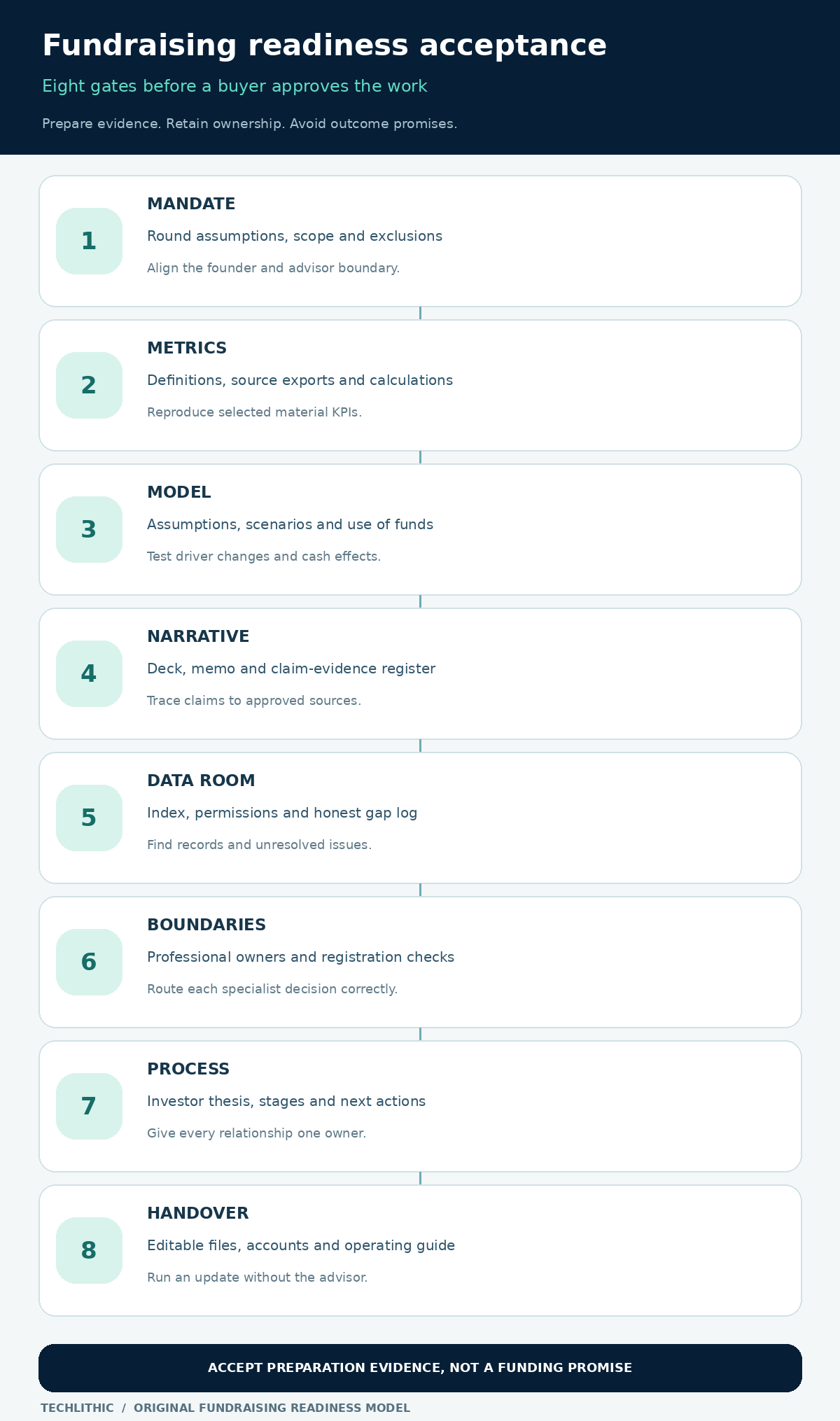
Use an eight-gate buyer acceptance matrix
| Gate | Evidence to retain | Acceptance test |
|---|---|---|
| Mandate | Round assumptions, scope, exclusions and responsibility matrix | A founder and adviser describe the same engagement boundary. |
| Metrics | KPI dictionary, source exports and transformation notes | A reviewer reproduces selected material metrics. |
| Model | Assumptions register, scenarios and use-of-funds bridge | Named driver changes flow through runway and hiring. |
| Narrative | Deck, memo and claim-evidence register | Material claims trace to approved sources and periods. |
| Data room | Index, permissions, freshness log and gap register | Requested records are findable and unresolved gaps are visible. |
| Boundaries | Professional handoffs, registration checks and filing calendar | Each regulated or specialist decision has an accountable owner. |
| Process | Investor thesis, pipeline stages, activity and next actions | Every active relationship has one owner and a documented next step. |
| Handover | Buyer-owned files, accounts, templates and operating guide | The internal team runs an update cycle without adviser access. |
Do not average the gates into one score. A strong deck should not offset an unreconciled metric, missing ownership record or unclear regulatory boundary. Define which gates block outreach and which can remain open with an accepted remediation plan.
Worked example: turn a retention claim into an accepted package
Consider a fictional B2B SaaS company preparing for a seed extension. Its deck says net revenue retention is 112 percent. The billing dashboard shows 109 percent because the deck includes service revenue and treats a reactivated account as continuous, while the dashboard excludes services and restarts the account.
The readiness advisor should not choose the larger figure. First, the team defines the intended metric, cohort, period, treatment of services, expansion, contraction, churn and reactivation. It preserves the billing export, rebuilds the calculation and asks the finance owner to review the reconciliation. Assume the agreed subscription-only method produces 109 percent for this invented example.
The advisor then updates the deck, model and KPI schedule to the same definition, adds a note about the old calculation and links the evidence in the claim register. The data-room index points to the approved schedule, while the gap register records any unresolved revenue-classification question for the accountant.
Acceptance occurs when a second team member reproduces the figure and finds the same wording across the materials. The corrected number does not predict funding, valuation or investor response. It demonstrates that the company can explain one material claim consistently.
Compare proposals by retained evidence and ownership
Ask every provider to price the same work packages: readiness diagnosis, KPI and model work, narrative, data room, investor research, process support, specialist coordination, revisions and handover. Record client inputs and turnaround dependencies. Separate optional introductions or transaction services and review them for legality and fit.
Clarify the number of workshops and revision cycles, which systems and historical periods are included, who approves final materials, and how disagreements are recorded. Require editable source files, exportable trackers, calculation notes and an end-of-engagement walkthrough. Do not accept permanent dependence on the provider's software or personal accounts unless that ongoing service is an informed choice.
A useful readiness engagement can end with a recommendation not to raise yet. The founder may need to correct evidence, extend runway, prove a repeatable acquisition motion or resolve governance first. That is a valid decision outcome, not necessarily a failed project.
TechLithic offers a SaaS fundraising readiness program, startup consulting and operates HowToBuySaaS. That relationship does not change the acceptance standard. Apply this checklist equally to TechLithic and competing advisers. For evidence-room preparation beyond a round, see the SaaS exit-readiness guide.
Use this checklist before signing
- The engagement distinguishes preparation, professional advice, introductions and transaction activity.
- The baseline names the target decision, assumptions, dependencies, blockers and out-of-scope work.
- Each material KPI has a definition, source, owner, period and reproducible calculation.
- The model exposes assumptions, scenarios, cash needs and limitations.
- Deck and memo claims link to approved evidence and consistent reporting periods.
- The data room has an index, staged permissions, freshness review and honest gap register.
- Legal, accounting, tax and regulated activities have qualified owners and escalation paths.
- Investor research follows a written fit thesis and records source dates and conflicts.
- The company owns the pipeline, editable materials, accounts and communication history.
- Payment milestones depend on accepted deliverables, not guaranteed capital or valuation.
- Handover includes an operating guide and a live internal update exercise.
Fundraising readiness is complete when the company can support its claims and operate the process it intends to run. It is not complete merely because the deck looks finished.
Frequently asked questions
Can a fundraising-readiness advisor guarantee investor meetings or funding?
No reliable readiness scope should guarantee capital, valuation, meetings or timing. Define preparation deliverables separately from any legally permitted placement or transaction activity.
Should an advisor be paid a percentage of funds raised?
That structure can raise broker-registration and securities-law questions, especially when paired with investor solicitation or negotiation. Obtain jurisdiction-specific legal advice and verify claimed registrations before agreeing to it.
What should be delivered before investor outreach starts?
At minimum, require approved engagement boundaries, a KPI dictionary, source-linked model, consistent core narrative, staged evidence room, gap register, investor-fit thesis, communication controls and named owners.
Does a complete data room mean the company is ready to close a round?
No. A data room organizes evidence. Investors and professional advisers still need to assess the company, documents, risks, terms and transaction-specific requirements.
Who should own the fundraising materials after the engagement?
The company should retain editable materials, source data, calculation notes, accounts, pipeline history and the operating guide needed to continue without permanent advisor access.
Sources and research notes
Sources checked on 2026-11-11. Pricing and policy documents can change; verify current terms before approving expenditure.
- US SEC: Broker-Dealers
Official overview of activities that can indicate broker activity, including finding investors, transaction participation and outcome-based compensation.
- Y Combinator: SAFE forms and user guide
Current source of YC SAFE forms and explanatory materials. Documents still require company-specific legal review.
- National Venture Capital Association: Model Legal Documents
Industry model documents for venture financings, with revision dates and commentary. Not a substitute for tailored legal advice.
- Cooley GO: Sample VC Due Diligence Request List
Law-firm educational checklist showing common diligence categories and explicit warnings to tailor documents and consult professional advisers.
- Carta: How to set up a virtual data room
Data-room categories, access controls, indexing and review practices from an equity-management provider.
- US SEC: Form D frequently asked questions
January 2026 SEC staff guidance on Regulation D Form D filing mechanics and timing. Jurisdiction and exemption-specific advice remains necessary.
- FINRA: BrokerCheck
Official US tool for researching broker and firm registration, background, licensing and certain disclosures.
- Stripe: How to track and manage a startup fundraising pipeline
Current operational guidance on investor stages, relationship ownership, activity, next actions and pipeline records.
Sources were opened and checked on November 11, 2026. US securities references are identified as US-specific and do not provide a universal legal conclusion. The eight-gate model, proposal checklist and numerical example are original educational frameworks. The example is fictional and does not represent a client outcome. No funding, meeting, valuation, timing or compliance result is promised.