
SaaS growth buying guides
SaaS Marketplace Listing: Evidence Buyers Expect
A marketplace profile earns attention only when a buyer can verify what the product does, who it fits, what it costs, how it connects and what risk it introduces. Prepare that evidence before paying for visibility, listing production or profile optimization.
Prepared with AI assistance and checked against the linked sources. Numerical comparisons are illustrative unless expressly sourced.
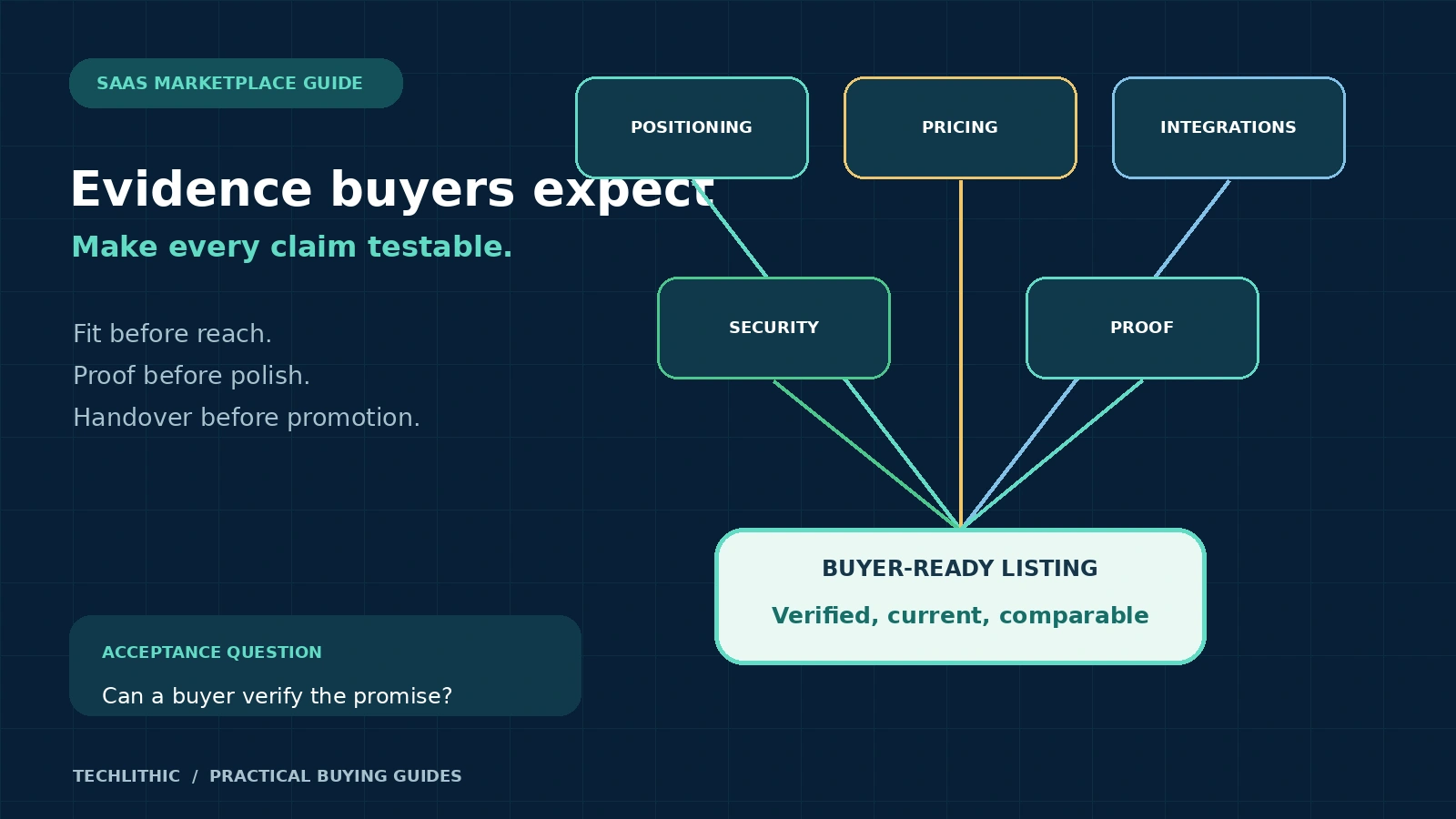
Treat a SaaS listing as a compact due-diligence interface, not an advertisement. Give every important claim an owner, source and review date. Make pricing, prerequisites, integrations, security, screenshots, support and review practices testable. Then accept the work only when the published profile matches the approved evidence pack and the handoff makes future updates possible.
Build the evidence pack before buying visibility
A marketplace listing can be a discovery page, a lead form, a procurement route or a transactable offer. Those are different jobs. A profile optimized for general discovery may need category fit and comparison context. A cloud marketplace offer may also need seller registration, billing integration, onboarding and platform review. Decide which job matters before comparing listing services.
Start with a claim register. For every statement you want published, record the exact wording, evidence link, evidence owner, applicable plan or version, geography and review date. Separate product facts from aspirations. "Connects to Salesforce" needs documentation and tested scope. "Simple to use" needs a defined task or should be rewritten as a factual workflow description.
Platform eligibility can be operational, not merely editorial. AWS requires free-product sellers to offer production-ready software, a support process and a way to keep software updated and free of vulnerabilities. [1] Google Cloud Marketplace likewise requires production-ready software, customer support and security practices, along with platform-specific organizational and hosting conditions. [5]
Do not pay for placement until the product can survive the buyer journey behind the listing. Visibility directed to an unclear offer, broken trial or unsupported product creates more leakage, not more evidence.
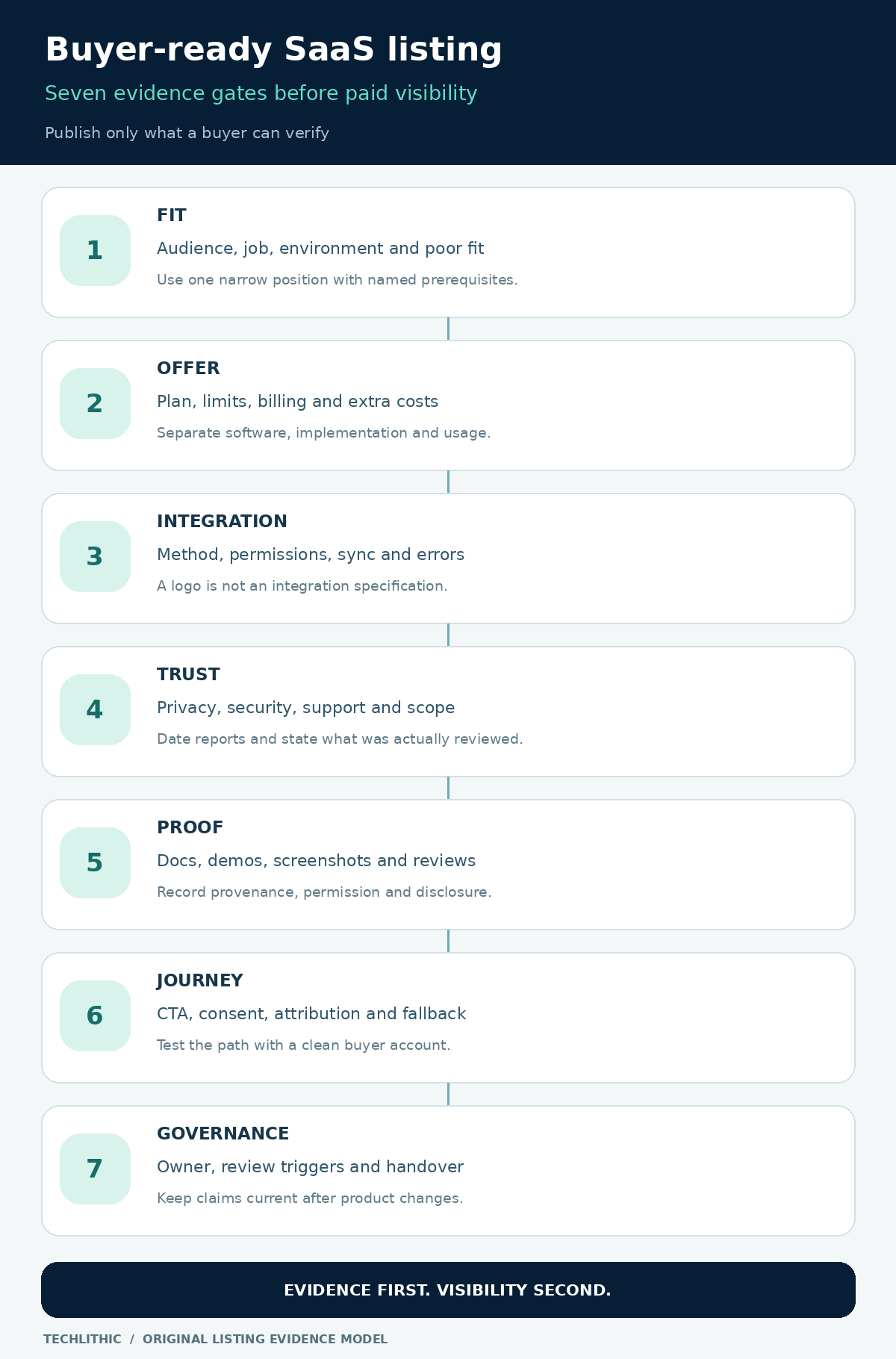
State positioning as a buyer can test it
A useful profile answers five questions quickly: who is this for, which job does it perform, what environment does it require, what outcome does the workflow produce and when is it a poor fit? The answer should narrow the audience. A broad category label such as "AI platform" is not a position.
Use a one-sentence fit statement: "For [role] managing [specific workflow], the product [observable action] in [supported environment], provided that [important prerequisite]." Follow it with three to five capability statements linked to documentation or a current demonstration. Name exclusions beside the claims, not in a remote disclaimer.
Microsoft's marketplace policies require listing descriptions to identify the intended audience, distinct value, supported Microsoft products or other software, and prerequisites. They also require categories and industries to accurately reflect the offer. [3] That is a sound evidence standard even when the chosen marketplace has looser rules.
| Listing claim | Evidence to attach | Boundary to state |
|---|---|---|
| Automates invoice approval | Current workflow documentation and demo path | Supported file types and exception handling |
| Integrates with a CRM | Connector documentation and field map | Edition, permissions and sync direction |
| Enterprise security | Specific controls and current reports | Scope, period and exclusions |
| Fast onboarding | Required steps and customer inputs | Typical dependencies, not a guaranteed duration |
Make the offer and pricing context comparable
A listing should explain what the buyer receives before it asks for a demo or payment. Identify the plan, billing unit, included limits, overage method, minimum commitment, implementation work, renewal, cancellation and taxes or infrastructure charges that sit outside the software fee. If the exact price is quote-based, explain which variables change the quote and what the buyer must supply.
Marketplace mechanics shape the offer. AWS supports subscription, contract and contract with pay-as-you-go SaaS offer types, and the selected model changes the required integration. AWS also asks sellers to prepare a EULA, registration URL, support information and product metadata before submission. [2] Microsoft distinguishes contact, trial, free and transactable listing paths, with plans defining scope, limits and price for transactable offers. [4]
Ask a listing provider to produce a price-context block, not invent a price or hide necessary costs. The block should distinguish marketplace software charges, vendor implementation fees, cloud consumption, third-party licenses and internal operating work.
Do not describe a limited trial as a free production plan. Do not label a starting price as the total cost if common requirements make the starting configuration unusable. Where pricing changes by geography, currency or contract, date the evidence and name the applicable market.
Show integration and onboarding evidence
An integration logo proves almost nothing. A buyer needs to know whether the connection is native, API-based, implemented through a third party or merely possible through custom work. For each important integration, show the supported product edition, authentication method, permissions, sync direction, objects or events, frequency, error handling and ownership.
Turn the onboarding journey into evidence. Map what happens from marketplace action to usable account: subscription or lead capture, identity matching, account creation, entitlement, administrator setup, data import, configuration, first successful task and support. Test the path with a fresh account, not an employee session with hidden privileges.
AWS directs sellers to test the subscription and purchase experience, payment options and links before public launch. [2] Atlassian checks that an app functions as described, remains compatible with the host product and has documentation and support information available on the listing. [6]
Require screenshots to match the current product and the stated plan. Each image should show one buyer-relevant task, readable interface text and a caption explaining what is real, illustrative or unavailable in a lower plan. Remove customer data, internal URLs and secrets. A polished mockup must never be presented as actual product UI.
Translate security claims into scoped evidence
Security language is where marketplace profiles often become vague. Replace "bank-grade" or "fully compliant" with named controls and documents: data collected, hosting regions, encryption boundaries, identity options, role model, logging, retention, deletion, subprocessors, vulnerability reporting, incident contact and available assurance reports.
Every certificate or report needs a scope, issuer and period. A SOC report covering one service does not automatically cover every integration or new product. A penetration-test statement should identify the tested surface and whether material findings were resolved without publishing sensitive details.
Salesforce requires managed packages submitted for AppExchange security review to include Code Analyzer scan reports, while making clear that teams should address violations they can fix and document false positives. [7] Atlassian's listing process checks security scans and asks cloud partners to complete trust, privacy, documentation and support work. [6]
A general SaaS directory may not conduct those reviews. State what the marketplace verified and what it did not. A paid listing, badge or editorial profile is not an independent security certification unless the platform actually performs and documents that assessment.
Govern proof, reviews and marketplace relationships
Use proof that a buyer can understand and trace. Product documentation, a live demo, public release notes and a dated integration page are usually stronger than an unsupported superlative. Customer logos require permission. A case example needs the customer's scope, measurement basis and material context, or it should remain a clearly labelled hypothetical.
Never buy positive reviews, manufacture testimonials or suppress criticism. The US Federal Trade Commission says businesses may not condition incentives on a particular review sentiment, and material relationships may require clear disclosure. It also prohibits misrepresenting a company-controlled review entity as independent. [8] Other jurisdictions and platform rules may add obligations, so obtain appropriate advice for the markets involved.
Ask the listing provider in writing: Is placement paid? Who writes the profile? Can the vendor approve factual edits? How are reviews collected, moderated and removed? Are sponsorships labelled? Does payment affect ranking, badges or editorial coverage? Who owns the final copy and media?
TechLithic operates HowToBuySaaS and offers SaaS marketplace listing and profile optimization services. That relationship means this article is not an independent assessment of those services. Apply the same evidence, disclosure and acceptance requirements to TechLithic, HowToBuySaaS or any other provider.
Design the next step and measurement before launch
The listing's call to action should match buyer readiness. A complex product may need a technical evaluation or scoped demo, while a simple tool may support self-service trial. Do not force every visitor into a generic sales form.
Document the transition: destination URL, required fields, consent language, attribution parameters, CRM source, response owner and failure state. Test the route when cookies are declined, the visitor is on mobile, the CRM is unavailable and the marketplace does not pass the expected parameter. Keep a fallback contact path.
Measure what the marketplace can actually influence. Track qualified listing visits, completed evaluations, sales-accepted opportunities and purchases where the evidence supports attribution. Do not present marketplace impressions as revenue. If multiple channels touch the account, retain the source events and report the attribution rule rather than claiming certainty.
Build an update cadence into the service. A profile can become misleading when pricing, screenshots, integrations, assurance reports or plan limits change. Google Cloud Marketplace requires vendors to notify Google and seek review when changes affect compliance or invalidate onboarding documentation. [5] Even where re-review is not mandatory, assign quarterly checks and immediate review triggers for material product or policy changes.
Worked example: a buyer-ready workflow SaaS listing
Consider an invented vendor called Northstar Approvals. It sells an invoice-approval workflow for mid-sized finance teams. This is an educational example, not a client result.
The first draft says the product is an "AI-powered automation platform for every finance team." The evidence review narrows it. The approved fit statement says the product routes emailed PDF invoices for approval in Microsoft 365 environments, with a named administrator and configured approval rules. Handwritten invoices and direct payment execution are excluded.
The listing team creates three capability rows. Invoice extraction links to supported fields and confidence handling. Approval routing links to a current workflow demonstration. ERP export identifies supported formats and states that a native connector is not included. The price block separates the annual software plan, a one-time configuration option and the customer's Microsoft licensing.
The trust section links to the current privacy notice, subprocessor list, data-retention settings and vulnerability contact. It describes single sign-on as optional on the enterprise plan, not universal. Two screenshots show rule configuration and an exception queue using synthetic records.
The listing provider publishes to a staging URL. The vendor tests a new visitor path, submits the form, confirms consent text, sees the correct CRM source and receives the promised response. The acceptance record contains URLs, screenshots, timestamps and owners. Only then is paid visibility activated. The revised profile is less dramatic, but a buyer can verify the fit and compare it honestly.
Compare listing providers on deliverables and exclusions
Ask each provider to mark the same scope matrix as included, optional or excluded. Separate research and copy from publication access, design, review collection, promotion, measurement and ongoing updates. A one-time profile build and an ongoing visibility package are different purchases.
| Deliverable | Acceptance evidence | Common exclusion to expose |
|---|---|---|
| Evidence and claim register | Approved source link for each material claim | Legal, security or technical verification |
| Listing copy | Character limits, factual approval and version history | Future marketplace policy changes |
| Pricing and plan block | Named plan, limits, extras and review date | Quote calculation or tax advice |
| Visual package | Current screenshots, captions, alt text and usage rights | Product UI production |
| Publication | Live URL, correct category and working call to action | Platform approval or ranking |
| Measurement | Test event and buyer-owned reporting access | Revenue attribution beyond available data |
| Handover | Editable copy, assets, access and update runbook | Ongoing maintenance |
Reject guaranteed rankings, review volume, buyer leads or sales. No provider controls marketplace algorithms or buyer decisions. Require a correction window for factual errors and a removal or exit path before payment.
Use a listing acceptance and go-live checklist
- Is the marketplace role clear: discovery, lead generation, procurement or transaction?
- Does every material claim have an evidence source, owner, scope and review date?
- Are target buyer, use case, prerequisites and poor-fit conditions explicit?
- Are the named plan, limits, billing unit, implementation work and recurring extras clear?
- Does each integration state method, edition, permissions, direction and limitations?
- Are screenshots current, readable, permissioned and free of real customer data?
- Are security and privacy statements specific, scoped and linked to current documents?
- Are paid placement, sponsorship, ownership and editorial relationships disclosed?
- Are reviews collected without fabricated experiences, sentiment conditions or suppression?
- Does the call to action work on a new account, mobile device and failure path?
- Does a controlled test reach the correct CRM or checkout state with consent and attribution intact?
- Are publication approval, factual correction, update cadence and removal rights documented?
- Will the buyer receive editable copy, source assets, account access and an update runbook?
- Does acceptance depend on verifiable deliverables rather than traffic, rankings or sales promises?
Do not buy a listing service when the product is not production-ready, pricing cannot be explained, the trial or demo is broken, material claims lack evidence, or no one owns follow-up. Fix the narrower readiness gap first. If a marketplace is suitable, start with one complete profile, test the buyer journey and update process, then decide whether additional placement is justified.
For broader product evaluation, use the SaaS buying due-diligence checklist. Vendors preparing ownership, operating and metric records for a transaction should instead begin with the SaaS exit-readiness guide.
Frequently asked questions
What evidence should a SaaS marketplace listing include?
Include a testable fit statement, current capability documentation, plan and pricing context, prerequisites, integration scope, security and privacy documents, current screenshots, support details, proof provenance and a working buyer journey.
Does paying for a marketplace listing guarantee leads or rankings?
No. A provider may deliver research, copy, profile production, placement or promotion, but cannot guarantee an algorithmic position or buyer outcome. Accept the engagement against controlled deliverables and measured events.
How should a vendor describe integrations?
State whether each connection is native, API-based, third-party or custom. Name supported editions, authentication, permissions, sync direction, objects or events, frequency, error behavior and important limitations.
Can a vendor pay customers for marketplace reviews?
Rules vary by jurisdiction and platform. In the United States, incentives cannot be conditioned on a positive or negative sentiment, and material relationships may require clear disclosure. Never purchase fabricated reviews or suppress legitimate criticism.
When should a SaaS company delay a listing?
Delay when the product is not production-ready, the offer or price cannot be explained, important claims lack evidence, the trial or onboarding path is broken, security statements are unsupported or no owner can maintain the profile.
Sources and research notes
Sources checked on 2026-11-04. Pricing and policy documents can change; verify current terms before approving expenditure.
- AWS Marketplace: Seller eligibility requirements
AWS requirements for production readiness, support, software updates, account standing and paid-seller eligibility.
- AWS Marketplace: Creating a SaaS product
AWS guidance on offer type, required assets, integration, testing and launch submission.
- Microsoft Marketplace certification policies
Microsoft policies for accurate titles, summaries, descriptions, audience, supported software, prerequisites, categories and offer operation.
- Microsoft Marketplace: Plan a SaaS offer
Microsoft documentation for listing options, plans, pricing models and technical preparation.
- Google Cloud Marketplace: Listing requirements
Google Cloud requirements for production readiness, operational support, security, platform fit and re-review after material changes.
- Atlassian Marketplace: Create your app listing
Atlassian guidance on functionality, security, performance, support, branding, privacy, documentation and listing review.
- Salesforce Developers: AppExchange security review reports
Salesforce instructions for generating and submitting Code Analyzer reports during AppExchange security review.
- US Federal Trade Commission: Consumer Reviews and Testimonials Rule Q&A
FTC guidance on fake reviews, sentiment-conditioned incentives, insider disclosures, review suppression and company-controlled review entities.
AWS, Microsoft, Google Cloud, Atlassian, Salesforce and US Federal Trade Commission primary guidance was opened on November 4, 2026. Marketplace eligibility and review rules change, so vendors should verify the current requirements of their selected platform before contracting or submission. The Northstar Approvals example is invented education, not a client result. This article does not provide legal, tax, security-certification or platform-approval advice.