
AI and automation buying guides
MLOps Service Scope: Monitoring, Releases and Incident Ownership
An MLOps service is not complete because a model endpoint is online or a drift chart exists. Buyers need an owned operating system for every production model: traceable versions, release evidence, useful signals, safe rollback, incident response and a clear handover when the supplier leaves.
Prepared with AI assistance and checked against the linked sources. Numerical comparisons are illustrative unless expressly sourced.
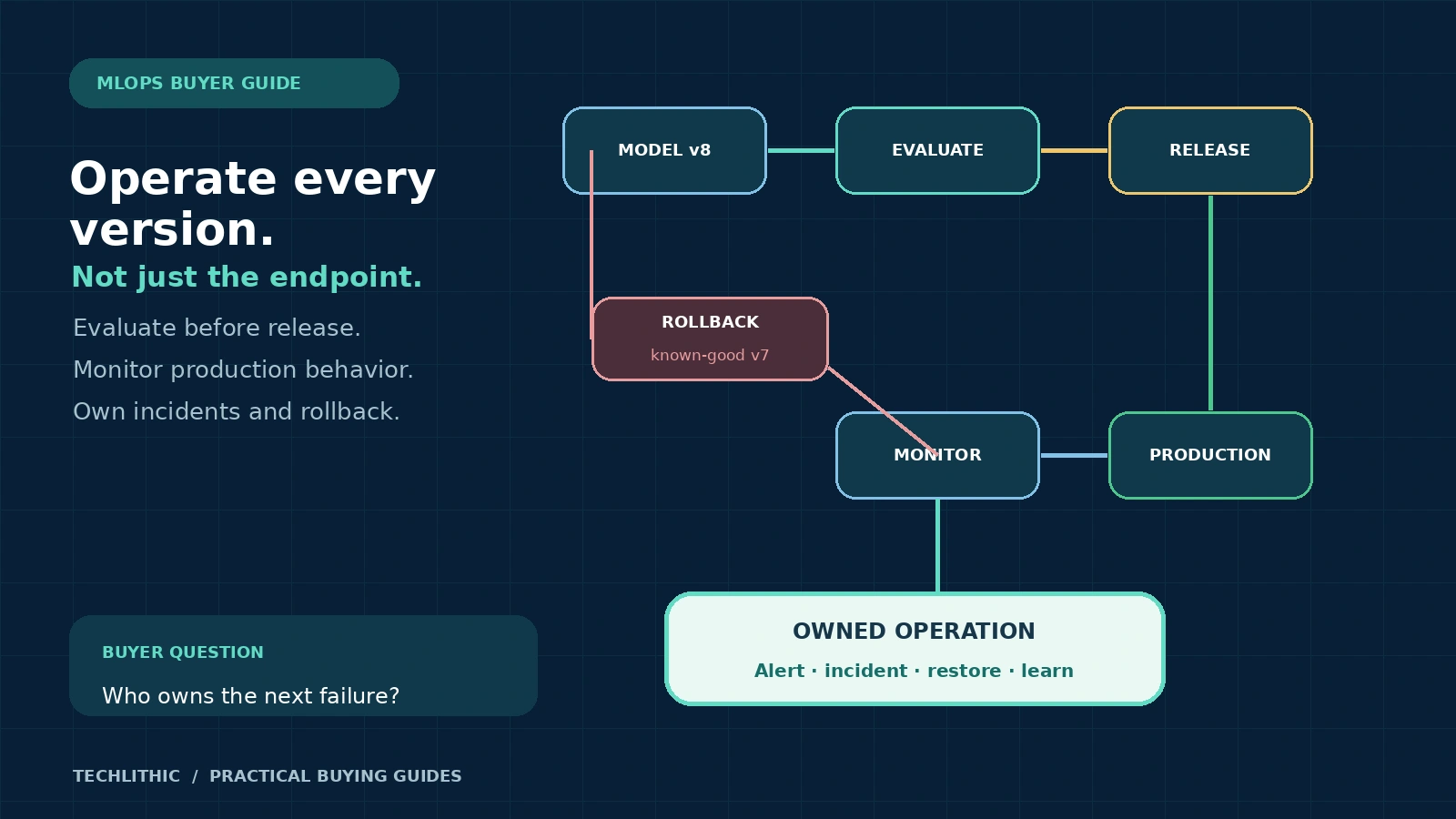
Buy a testable operating scope, not an unspecified promise to monitor AI. Acceptance should prove which models are covered, how a version is approved, what signals trigger action, who handles incidents, how rollback works and which evidence remains under buyer control.
Define the production outcome before buying MLOps
Start with the business process that depends on the model. Record who consumes its output, how quickly a result is needed, what happens when the model is unavailable, which errors matter and who may override it. A fraud score, document classifier, demand forecast and generative assistant need different operating controls.
Google describes MLOps as automation and monitoring across integration, testing, release, deployment and infrastructure, and notes that production ML includes far more than model code. [1] A proposal that covers only endpoint uptime leaves data, evaluation, registry, release and response ownership unresolved.
Choose a service depth deliberately. A small, stable batch model may need a versioned job, scheduled validation, failure alert and monthly review. A customer-facing real-time model may justify canary release, live service objectives, on-call response and frequent evaluation. Continuous training is not automatically more mature if labels are weak or approval cannot be automated safely.
Define success as an operating capability: an authorized person can identify the active model and its lineage, understand current health, approve or stop a release, respond to an alert, restore a known-good version and explain what changed.
Create a model inventory and service boundary
Require an inventory before tooling. For every production model, list purpose, owner, consumers, model type, data sources, features or prompt assets, training code, artifact location, runtime, endpoint or batch job, environments, active version, last approval, monitoring coverage, ground-truth source, risk tier, dependencies and retirement state.
Include third-party and foundation models even when the supplier does not train them. Record provider, model identifier, region, configuration, retrieval source, prompt version, safety controls, rate limits and fallback. For a composite AI workflow, identify the release unit: model, prompt, retriever, feature pipeline, guardrail, application code or a coordinated bundle.
Write exclusions. Does the service own data pipelines, feature computation, labeling, API infrastructure, cloud security, human review, vendor status monitoring and application releases, or merely observe them? Unowned dependencies become invisible gaps during an incident.
Ask for a responsibility matrix with one accountable buyer and one operational owner per model. Avoid shared wording such as "the team monitors". Name who approves thresholds, who receives alerts, who may roll back, who communicates impact and who closes corrective actions.
Turn model evaluation into release gates
Pre-release evaluation should compare a candidate against an approved baseline on representative data and failure cases. Define the metric, dataset version, segment breakdown, minimum sample rules, acceptance direction, threshold owner and evidence artifact. Include service latency, error behavior, privacy, security and integration tests alongside model quality.
The NIST AI RMF Playbook says organizations should select measures for significant risks, instrument systems for tracking and document risks that cannot be measured. It also calls for mechanisms, personnel and documentation to track risks over time in deployed contexts. [2] Translate that into an evaluation contract rather than a generic accuracy target.
For generative AI, use task-specific test cases, reference-supported checks where applicable, safety cases, refusal behavior, tool-use boundaries and human review. Separate deterministic tests from judge-based scores and record the evaluator version. For predictive models, preserve label definitions, time cutoffs and leakage checks.
Define the exception process. A business owner may accept a known limitation, but the waiver should state the affected segment, reason, duration, compensating control and expiry. A supplier should not silently lower a threshold to make a release pass.
Require registry, lineage and environment controls
Every deployable version needs an immutable identity and a trace back to code, configuration, data snapshot, dependencies, evaluation and approval. A registry should distinguish a candidate artifact from the version actually serving traffic.
MLflow's current registry workflow supports model versions, source runs, signatures, aliases, tags and descriptions. [3] The product is only an example; buyers should require the same operational evidence in any stack. A mutable label such as champion or production should point to a specific immutable version, while approval status and evidence remain auditable.
Separate development, test and production permissions. Data scientists may create candidates without gaining direct production deployment rights. The release mechanism should use a service identity with minimum access, and emergency privileges should be logged and reviewed.
Acceptance should prove that a buyer can answer five questions without asking the supplier: Which version is active? What produced it? Which tests passed? Who approved it? Which known-good version can be restored?
Specify release, traffic shifting and rollback
A release plan should define environments, approval gates, change window, deployment strategy, observation period, stop conditions, rollback target and decision owner. Do not accept "zero downtime" as a substitute for tested behavior.
For suitable online endpoints, a canary or blue-green release limits exposure while the team observes service and model signals. AWS documents blue-green, canary, linear and rolling model updates, with alarms and automatic rollback available for supported SageMaker endpoints. [4] Equivalent controls may be built elsewhere, but the proposal must state who owns the orchestration and alarms.
Rollback is more than switching a model file. Confirm compatibility with feature schemas, application contracts, prompt templates, retrieval indexes and stored outputs. A database or feature transformation change may make an older model unusable. Define forward-fix and rollback cases separately.
Test rollback before production acceptance. Release a controlled candidate, trip a stop condition, return to the approved version and verify traffic, outputs, logs and customer-facing behavior. Record the time, operator, commands or workflow, affected requests and final state.
Monitor service, data, model and business behavior
One drift chart is not an operating system. Build a signal map with four layers. Service signals cover availability, latency, errors, saturation and dependency health. Data signals cover missing values, schema, ranges, categories, freshness and feature computation. Model signals cover prediction distribution, quality, calibration, segment performance, safety or retrieval behavior. Business signals cover the downstream outcome the model is meant to influence.
Azure's model-monitoring documentation distinguishes data drift, prediction drift, data quality, feature-attribution drift and model performance, and recommends selecting reference data, frequency and thresholds for the use case. [5] It also requires ground truth for objective model-performance comparison. A drift alert without labels is an investigation signal, not proof that the model became worse.
For every signal, define data source, computation, window, baseline, segment, threshold, severity, alert destination, runbook and owner. Include the health of the monitor itself. Missing telemetry should alert rather than make a dashboard look healthy.
Control noise. Alerts should represent an action someone can take. A low-severity trend may create a review ticket; a user-impacting service failure may page the on-call owner; a risk threshold may stop automated decisions and invoke human review.
Make incident ownership and communication explicit
Define incident classes before launch: endpoint outage, corrupt input, stale feature, quality regression, unsafe output, unauthorized access, vendor failure, cost anomaly and failed release. Set severity using user impact and decision risk, not the drama of the technical symptom.
Google's incident-management guidance recommends reliable alerting, a defined on-call process, actionable symptom-based alerts, current playbooks and clear incident roles for coordination, communication and operations. [6] An MLOps statement of work should name these roles and coverage hours, plus the escalation route when the supplier cannot reach the buyer.
The runbook should include detection, triage, impact assessment, containment, rollback or disablement, customer or stakeholder communication, evidence preservation, recovery verification and closure. State who may suspend model-driven actions when confidence is uncertain.
After a material incident, require a factual, blameless review with one owner for the document and named owners and due dates for corrective actions. Google notes that missing ownership weakens postmortem follow-through. [7] Track action completion as part of the service, not an optional meeting.
Use a seven-gate MLOps acceptance matrix
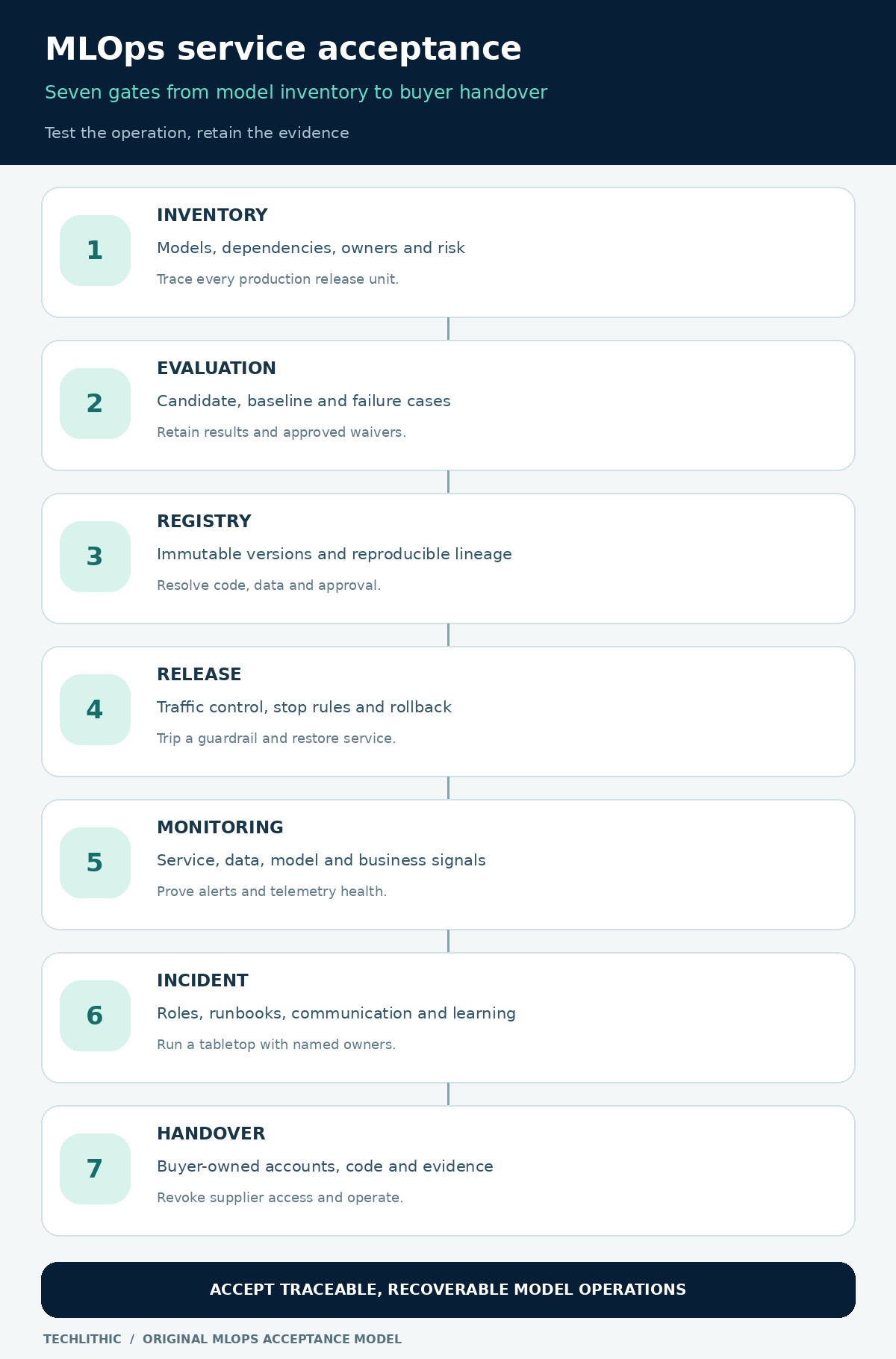
Convert the proposal into tests and retained artifacts. The matrix below is also the text equivalent of the infographic.
| Gate | Acceptance test | Buyer evidence |
|---|---|---|
| Inventory | Trace every production model and dependency | Owned inventory with accountable roles |
| Evaluation | Run candidate, baseline and failure cases | Versioned results and approved waivers |
| Registry | Resolve active version to code, data and approval | Immutable artifact and lineage record |
| Release | Deploy a controlled candidate and trip a stop rule | Traffic-shift and rollback record |
| Monitoring | Inject service, data and telemetry failures | Signal, alert, runbook and owner |
| Incident | Run a tabletop and restore a known-good state | Timeline, communication and action list |
| Handover | Remove supplier access and operate without them | Accounts, code, dashboards and runbooks |
Repeat relevant gates after changes to models, data, features, prompts, retrieval, infrastructure or policy. The buyer should retain raw evidence, not only a slide summarizing that tests passed.
Worked example: operate a renewal-risk model
Consider an invented subscription company using a weekly model to prioritize customer-success outreach. This is an educational example, not a client result. The model produces a renewal-risk band from product usage and account history. A human decides what outreach is appropriate, and the CRM records the eventual renewal outcome thirty days later.
The service inventory identifies the feature job, training pipeline, registry, weekly batch job, CRM import and dashboard. The approved baseline is model version seven. Candidate version eight must pass data-schema tests, time-based evaluation, segment review, CRM contract tests and a cost check before approval.
The illustrative release runs version eight in shadow mode for one weekly cycle. It writes comparison outputs but does not change agent queues. The team checks batch completion, score distribution, segment coverage and CRM join rate. These thresholds are created for this invented case and are not industry benchmarks.
After promotion, a monitor detects that a product-usage field has become mostly missing. The data-quality alert opens an incident, pauses new prioritization and keeps the previous week's queue visible with a stale-data notice. The data owner repairs the upstream export, the operator reruns validation and the business owner approves resumption.
Thirty days later, ground truth supports model-performance review. The team compares version eight with the baseline by agreed segments, documents limitations and decides whether to retain it. The handover pack contains the inventory, pipeline code, registry references, evaluation data definition, dashboards, alerts, runbooks, access matrix, cost view and incident record.
Compare proposals on coverage, effort and ownership
Ask each supplier to price discovery, inventory, pipelines, registry, environments, evaluation, release automation, monitoring, on-call response, incident reviews, retraining, security, documentation and support separately. Distinguish setup from recurring operation and planned changes from incident work.
Expose cloud and tool costs. Monitoring can add inference capture, storage, compute, observability, alerting and retention charges. Continuous retraining adds data preparation, training and evaluation cost. Require budgets, cost tags, usage reports and an owner for unexpected spend.
An MLOps and AI operations engagement should deliver the controls and evidence described here. Apply the same criteria to TechLithic or any other provider. Use the AI agent security review when models can call tools, and the RAG versus fine-tuning guide when the operating architecture is still undecided.
Do not buy a full managed service when there is no production model, no accountable business owner or no stable evaluation definition. A smaller readiness engagement may be the correct first scope. Conversely, do not accept a dashboard-only retainer for a model that makes time-sensitive or consequential decisions.
Use this buyer checklist before appointment
- Does the scope identify every production model, workflow and dependency?
- Is one business owner and one operational owner named for each model?
- Are predictive, generative, third-party and composite AI systems covered explicitly?
- Are data, feature, prompt, retrieval, application and infrastructure boundaries clear?
- Does each candidate have an immutable version and reproducible lineage?
- Are evaluation datasets, segments, thresholds and approvers documented?
- Can approved exceptions expire instead of becoming permanent hidden debt?
- Are development, test and production permissions separated?
- Does the release plan state traffic strategy, observation period and stop conditions?
- Has rollback been tested with compatible data and application contracts?
- Do monitors cover service, data, model, business and risk signals?
- Are ground-truth availability and label delay documented?
- Does every alert have a severity, destination, runbook and owner?
- Will missing telemetry alert instead of appearing healthy?
- Are on-call hours, response expectations and escalation routes contractual?
- Can authorized staff pause model-driven actions during uncertainty?
- Are incident communication and postmortem responsibilities named?
- Are cloud, monitoring, training and support costs visible?
- Does the buyer own accounts, code, artifacts, dashboards, data and runbooks?
- Can the buyer operate and revoke supplier access at exit?
For broader system integration, compare the AI integration engineering boundary. A credible MLOps proposal makes routine operation, failure and supplier exit equally testable.
Frequently asked questions
What should an MLOps service include?
It should include model inventory, lineage, evaluation gates, registry, controlled releases, rollback, service and model monitoring, incident response, cost visibility, documentation and buyer-owned handover evidence.
Is data drift proof that a model is failing?
No. Drift shows that a measured distribution changed relative to a baseline. It should trigger investigation. Objective performance assessment usually needs ground truth and the business context for the affected segment.
Does every model need continuous retraining?
No. Retraining should follow a justified trigger, trustworthy data, repeatable evaluation and approval. Scheduled review or manual retraining can be safer for low-volume, high-risk or slowly changing use cases.
What is the difference between model monitoring and service monitoring?
Service monitoring covers availability, latency, errors and infrastructure. Model monitoring covers data quality, drift, predictions, performance, safety or other model behavior. A production scope normally needs both.
Who should own an MLOps incident?
Use one incident coordinator, a technical operations owner and a communication owner, with a named business authority for pausing or resuming model-driven decisions. Exact roles can scale with incident severity.
Sources and research notes
Sources checked on 2026-11-08. Pricing and policy documents can change; verify current terms before approving expenditure.
- Google Cloud Architecture Center: MLOps continuous delivery and automation pipelines
Official guidance on the production ML system, CI, CD, continuous training, validation, release and monitoring.
- NIST AI RMF Playbook: Measure
Official risk-measurement guidance covering system instrumentation, metrics, deployed-context monitoring, roles and documentation.
- MLflow: Model Registry workflows
Official documentation for model registration, versions, source runs, aliases, tags, signatures and descriptions.
- AWS: Deployment guardrails for updating models in production
Official documentation for blue-green, canary, linear and rolling model updates, alarms and supported rollback behavior.
- Microsoft Learn: Model monitoring in production
Official guidance on data quality, drift, model performance, reference data, thresholds, frequency, ground truth and alerts.
- Google SRE: Incident management guide
Primary SRE guidance for actionable alerts, on-call preparation, playbooks, incident roles, communication and learning.
- Google SRE Workbook: Postmortem culture
Primary SRE guidance on factual blameless reviews, single ownership and corrective-action accountability.
Official NIST, Google Cloud, Microsoft, AWS, MLflow and Google SRE documentation were opened on November 8, 2026. Product availability and behavior can change, so buyers should verify current provider documentation and contractual coverage. The seven-gate model, thresholds and renewal-risk example are original educational material, not client results, benchmarks or guarantees.