
Performance marketing buying guides
Paid Marketing Proposals: Compare CAC, ROAS and Scope
A paid marketing proposal can look attractive because it promises a low acquisition cost or a high return on ad spend. Before choosing an agency, check what those numbers count, what the fee actually covers and whether the proposed activity can support your business economics.
Prepared with AI assistance and checked against the linked sources. Numerical comparisons are illustrative unless expressly sourced.
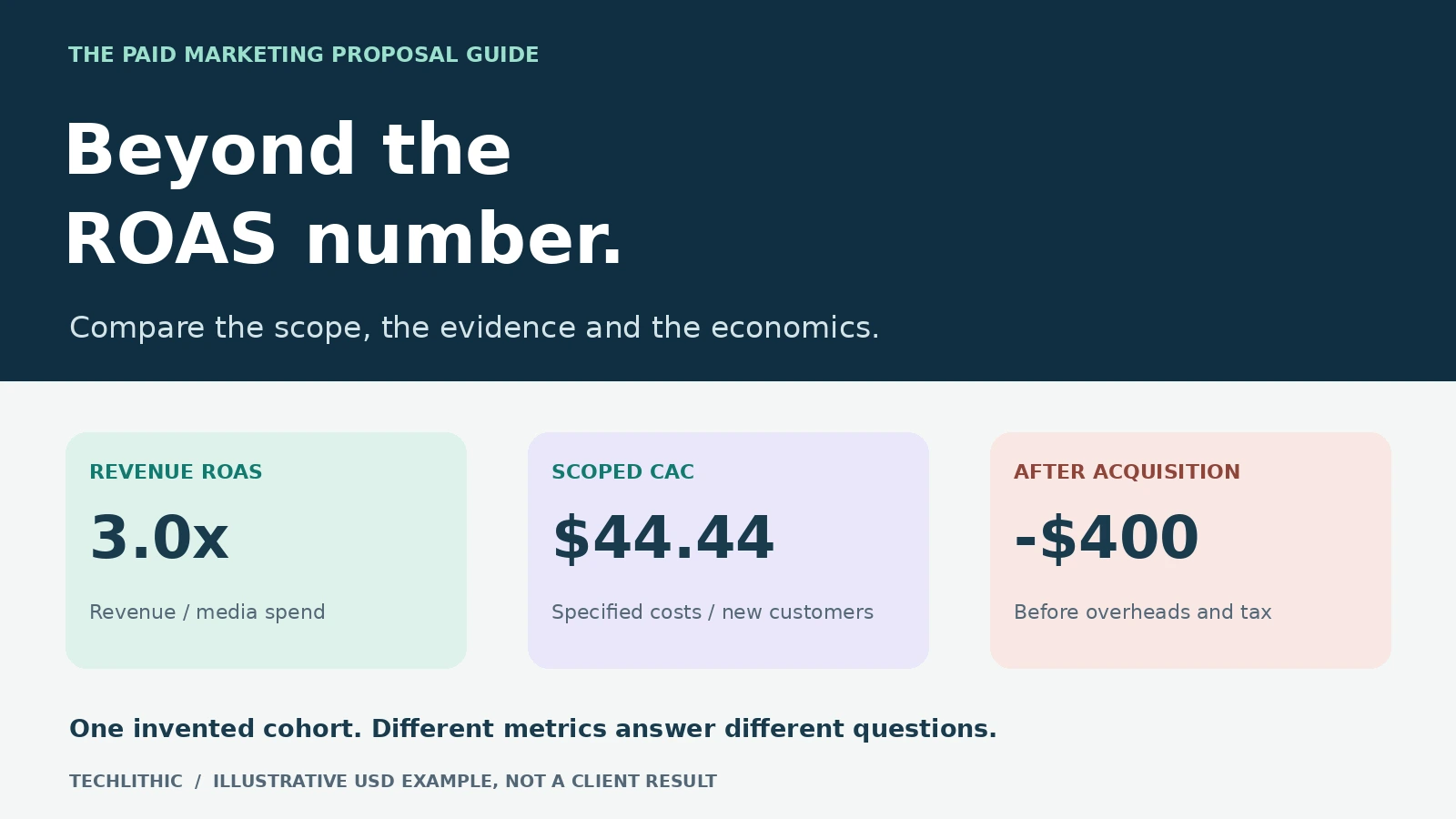
Compare the same outcome, cost boundary and measurement rules. ROAS describes attributed value relative to media spend, not profit. Buy a defined operating scope with tracking checks, creative responsibilities, a bounded test plan and clear spending authority.
Start with the outcome you are buying
“Manage our ads” can mean account maintenance, lead generation, ecommerce sales or a broader acquisition programme. Ask the provider to name the business outcome, target audience, channels, markets and responsibilities included. A proposal for form submissions is not equivalent to one measured against new paying customers.
Separate acquisition from retention, branded demand from prospecting, and a first purchase from a repeat purchase. These are useful reporting distinctions, not reasons to assume one campaign type is inherently worthless. The point is to understand what the proposal is expected to achieve.
Supply the commercial constraints: capacity, stock, service area, average sales cycle and the margin available before acquisition spending. If these inputs are unknown, an initial measurement or discovery phase may be more useful than an ambitious scale commitment.
Ask for assumptions beside projections. A forecast based on your historical conversion rate is different from a planning scenario based on an untested rate. Neither should be presented as a guaranteed result.
Define the numerator and denominator of every metric
Require a metric dictionary in the proposal. The following are practical comparison definitions; agree the exact cost allocation, customer cohort and reporting period with each provider.
| Metric | Comparison definition | Question to ask |
|---|---|---|
| Cost per lead | Defined spend divided by recorded leads | Are spam, duplicates and unqualified enquiries excluded? |
| Cost per acquisition or action | Defined spend divided by the named action | Is that action a form, trial, order or customer? |
| Scoped CAC | Agreed acquisition costs divided by new paying customers | Which fees, production and staff costs are included? |
| Revenue ROAS | Attributed revenue divided by media spend | Is the value net revenue, gross sales or something else? |
| Contribution after acquisition | Net revenue less specified variable and acquisition costs | Which remaining overheads are still excluded? |
Google Ads allows conversion values to represent different business values, including revenue or profit-related values. Therefore, a reported value-to-cost ratio needs its value definition attached; it is not automatically a revenue multiple. [1]
Do not label a media-only cost per customer as fully loaded company CAC. If a report excludes sales labour, software or agency fees, say so. Consistent labels are more useful than an apparently impressive but ambiguous number.
Agree attribution before comparing performance claims
Attribution determines how credit is assigned, not merely how a dashboard looks. Google's documentation explains that attribution models allocate credit across ad interactions and that the selected model affects conversion reporting and bidding. Ask which model and conversion actions underpin the proposal's numbers. [2]
A conversion window is the period after an ad interaction during which a conversion can be recorded. Google supports different windows for different actions and interaction types. Compare the actual settings rather than assuming every platform, campaign or report uses the same default. [3]
Record the reporting timezone, currency, treatment of view-based credit, revenue adjustments and date basis. Allow for the sales cycle before judging a recent acquisition cohort. A purchase completed later can change the interpretation of an earlier period.
Request a reconciliation view using agreed order or customer identifiers. Do not simply add together every platform's claimed revenue as though attribution guarantees exclusive credit. A claim of incremental growth requires an appropriate causal test; a credit-assignment report alone is not that test.
Worked example: why 3x ROAS can still lose money
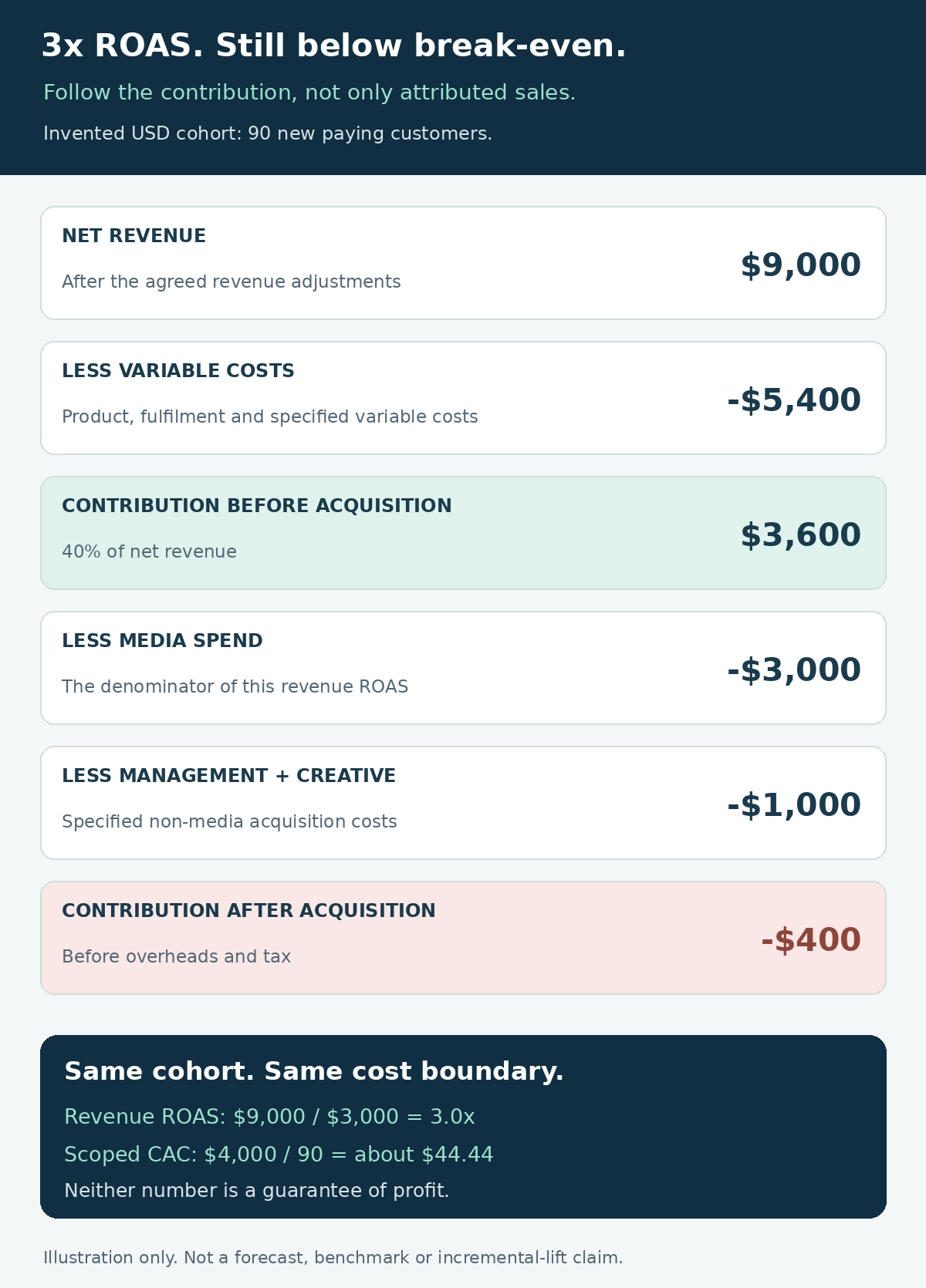
Consider an invented acquisition cohort with 90 new paying customers. Assume the order records have been reconciled, net revenue is $9,000 after the agreed adjustments, and the same cohort and cost period are used throughout. All amounts below are USD.
| Item | Illustrative amount |
|---|---|
| Net revenue | $9,000 |
| Product, fulfilment and other specified variable costs | $5,400 |
| Contribution before acquisition | $3,600, or 40% of net revenue |
| Media spend | $3,000 |
| Management and creative costs | $1,000 |
| Contribution after those acquisition costs | Negative $400, before overheads and tax |
Revenue ROAS is $9,000 divided by $3,000: 3.0x. Media-only cost per new customer is about $33.33. Adding the specified management and creative costs produces scoped CAC of about $44.44. This is not fully loaded company CAC because other acquisition costs, if any, remain outside the example.
At the assumed 40% contribution margin, $4,000 of acquisition costs requires $10,000 of net revenue to break even within this scope. Holding media spend at $3,000, that corresponds to approximately 3.33x revenue ROAS. The threshold changes if margin, fees or costs change.
These calculations are a comparison model, not a universal target. Future repeat purchases might matter, but do not insert an unsupported lifetime-value assumption to turn a current loss into a claimed profit.
Compare deliverables and commercial boundaries line by line
Put competing quotes into one scope matrix. Separate media paid to platforms from management fees, creative production, landing pages, analytics setup and optional tools. Confirm taxes, currency, minimum commitments and how percentage-based fees are calculated.
For creative, specify concepts, formats, variants, production inputs, revision rounds, approval ownership and usage rights. “Monthly creatives” could mean resizing supplied assets or developing new concepts and producing them. Those are different workloads.
For landing-page work, distinguish recommendations from design, development, copywriting and implementation. Name who fixes forms, checkout defects and tracking problems. If the client must supply product photography or approve claims, record that dependency.
A performance marketing scope should also explain campaign setup, monitoring, reporting, meetings and escalation. A lower fee may reflect a narrower service rather than better efficiency; a higher fee needs a defined reason, not an assumption of better results.
For lead generation, follow the funnel beyond the form
A low cost per enquiry does not establish a low cost per customer. Define the stages that matter: valid enquiry, qualified lead, accepted opportunity and paying customer. Assign a business owner to each definition and specify how duplicates and disqualifications are recorded.
Google's Data Manager guidance for enhanced conversions for leads recommends qualified-lead or converted-lead conversion goals. This is one documented way to connect advertising measurement with later funnel outcomes, not a guarantee that every CRM or agency package includes the integration. [4]
Agree who maintains status data and how often it is reviewed. If the sales team never records outcomes, the agency cannot reliably report customer acquisition from form submissions alone. Conversely, poor lead quality should not disappear behind a high submission count.
Include tracking readiness in the scope: event definitions, test records, data permissions, import responsibilities and error review. For the integration boundary, the CRM integration scoping guide provides identity and recovery checks. Have the responsible business owner approve applicable privacy and data-sharing requirements before activation.
Buy a bounded learning plan, not a vague testing budget
Ask what the first test is intended to teach you. A useful plan names the hypothesis, audience, variable, success measure, budget boundary and decision after the test. “We will optimize continuously” does not explain what will be tried or how the result will be interpreted.
Google's experiment guidance recommends a clear hypothesis, changing one variable at a time and choosing success metrics before the test. Apply that discipline when comparing proposals, while checking which experiment tools suit the actual channel and campaign. [5]
Do not spread a limited budget across so many audiences and variants that the agency cannot explain what any result means. Ask how the planned volume and conversion delay affect the evidence you can reasonably expect. No universal minimum spend or fixed number of days fits every business.
Record unsuccessful tests as well as winners. The deliverable should explain what was learned, what remains uncertain and what the next decision is. A promise to run many tests is less useful than a smaller set with clear conclusions.
Separate targets, spending authority and stop conditions
A performance target is not an outcome guarantee. Google's Target ROAS documentation describes bidding that tries to achieve an average value-to-cost target using reported conversion values. The name of the strategy does not promise that your campaign will deliver the requested return. [6]
Agree a media spending boundary separately from the agency fee. Define who can launch campaigns, increase budgets, change goals or approve additional production. State how changes are documented and who can pause activity if tracking breaks, stock runs out or lead quality becomes unacceptable.
Use explicit review triggers rather than reacting to every daily fluctuation. A trigger might require investigation, not automatic scaling or cancellation. Record whether a decision uses mature cohort results, a verified tracking issue or an unresolved hypothesis.
If the proposal depends on operational changes your team cannot yet deliver, such as sales follow-up capacity or a functioning checkout, delay scaling and fix that constraint first.
Use a buyer checklist before signing and at handover
Before signing, ask the provider to walk through one sample report and one proposed test. You should be able to trace the reported metric back to its definition, data source and business decision.
- Are acquisition, retention and branded-demand results separated where relevant?
- Are customer counts, value definitions, attribution settings and cost exclusions explicit?
- Are media, fees, creative, landing pages and tracking responsibilities itemized?
- Does the test plan define a spending boundary and decision criteria?
- Who owns accounts, assets, approvals, reporting access and incident response?
- What is transferred at exit, and what are the notice and additional-work terms?
Accept initial setup against observable work: correct account access, approved campaigns and assets, verified conversion events, a documented baseline and an accessible report. Evaluate commercial outcomes separately over the agreed measurement period.
At handover, retain account ownership, creative rights as agreed, configuration notes, tracking definitions, experiment history and unresolved issues. TechLithic offers related services; use the same checks to assess us or any other provider. If you need help defining the evidence first, review the marketing analytics scope before commissioning broader campaign management.
Frequently asked questions
Is a higher ROAS proposal always better?
No. Compare value definitions, attribution, customer mix, costs and contribution margin. A higher reported ratio can reflect different measurement rules rather than a better commercial outcome.
Is cost per lead the same as CAC?
No. A lead is not necessarily a paying customer. Define qualification stages, customer counts and the acquisition costs included before using a CAC label.
Should agency fees be included in ROAS?
For the media ROAS definition used here, the denominator is media spend. Show fees and other acquisition costs separately, then use a clearly labeled broader economics calculation.
When should we avoid a long campaign commitment?
When tracking, margins, delivery capacity or the initial hypothesis are unclear, a bounded readiness phase or pilot may be more appropriate than a large ongoing commitment.
Sources and research notes
Sources checked on 2026-10-19. Pricing and policy documents can change; verify current terms before approving expenditure.
- Google Ads Help: About conversion values
Conversion values can represent different business values. Confirm what the reported numerator represents before interpreting ROAS.
- Google Ads Help: About attribution models
How credit allocation relates to reporting and bidding. This guide does not assume one universal model across platforms.
- Google Ads Help: About conversion windows
Conversion recording depends on the selected action and interaction window. Verify actual settings rather than assuming defaults.
- Google Ads Help: Data Manager with enhanced conversions for leads
Official guidance includes qualified-lead and converted-lead goals. Confirm the current integration, permissions and scope for a particular account.
- Google Ads Help: Test with confidence with the Experiments page
Hypothesis-driven tests, isolated variables, predefined success metrics and experiment records.
- Google Ads Help: About Target ROAS bidding
A bid target is an optimization objective, not a guarantee. Campaign eligibility, labels and requirements can change.
Official documentation was checked on October 19, 2026. The metric dictionary, scope checklist, cohort economics and purchasing recommendations are original educational frameworks, not client results, benchmarks, forecasts or individualized financial advice. The example uses reconciled net revenue and a specified cost boundary; it does not establish incrementality or include unspecified overheads, taxes or future customer value. Google-specific features are examples, not claims about all advertising platforms.