
SEO audit buying guides
SEO Audit Deliverables: What a Buyer Should Expect
An SEO audit should help you decide what to change, why it matters and how to verify the work. Before buying one, ask for an evidence-backed implementation backlog, not simply a long list of warnings from a crawler.
Prepared with AI assistance and checked against the linked sources. Numerical comparisons are illustrative unless expressly sourced.
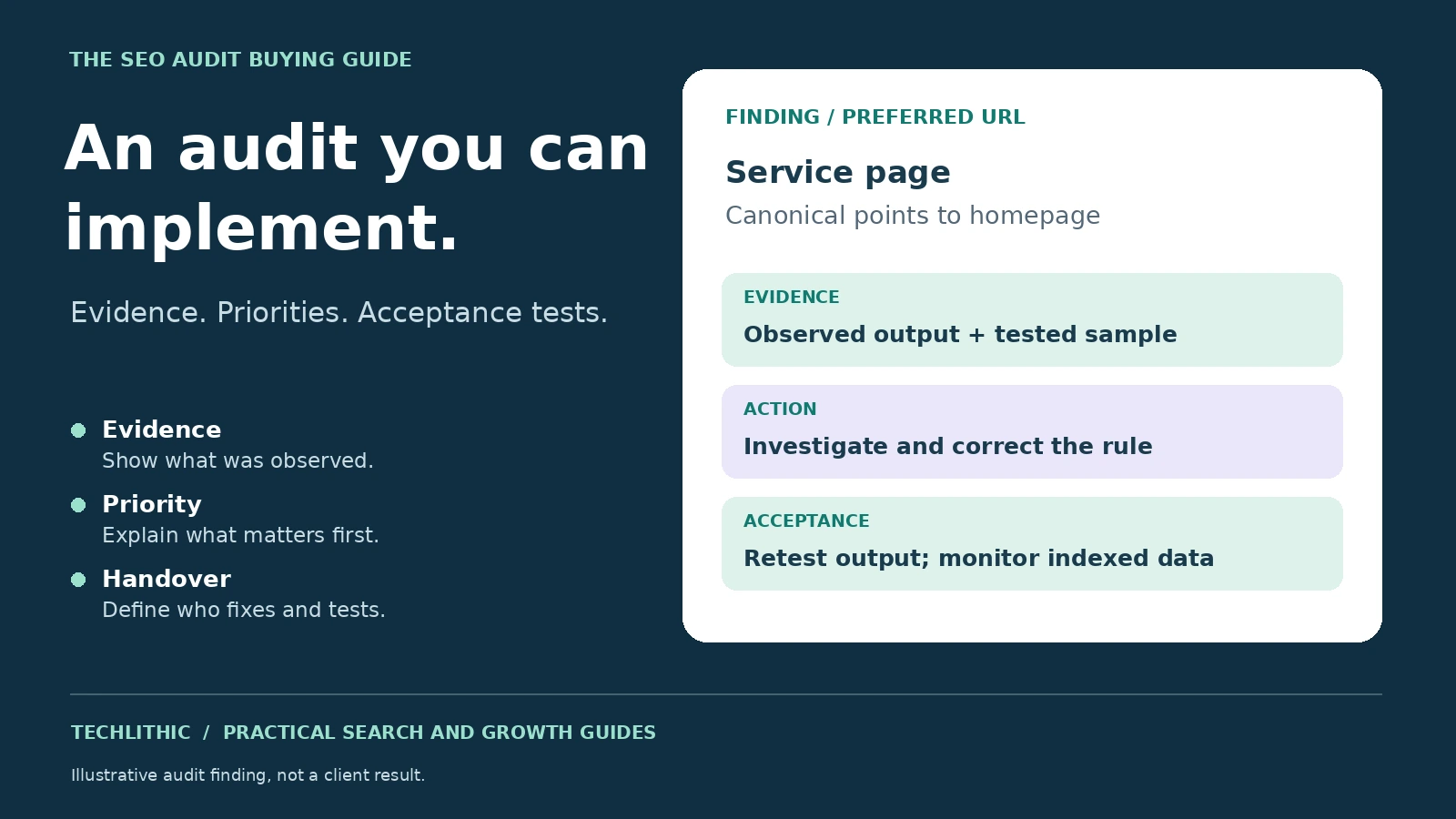
Buy a defined investigation and a usable handover. Every important finding should identify affected pages, evidence, business relevance, priority, an owner and a test for completion. Agree separately who implements and validates the fixes.
Define the decision and the audit boundary first
Start with the business question. Are important service pages missing from search, has a redesign changed organic enquiries, or does a large catalogue need a technical review? These questions require different investigations. An audit of a small marketing site is not equivalent to a multilingual ecommerce migration review.
Write down the domains, subdomains, markets, languages, templates and systems included. Specify whether the work covers technical access, content, internal links, search performance, structured data and competitor research. List exclusions such as log analysis, migration planning or backlink investigation when they are not included.
Agree what access is necessary. Google's hiring guidance recommends read-only Search Console access at the audit stage, realistic estimates of improvement and an estimate of the work involved. It also warns against guaranteed first-place rankings. Use that as a minimum safeguard, not a substitute for a scoped agreement. [1]
Have the provider state what it cannot conclude without analytics, Search Console or other requested evidence. A public crawl can still be useful, but it should not be presented as a complete diagnosis of private performance data.
Ask for a handover package, not just a PDF
The final presentation should be readable by a business owner, while the supporting files should let an implementer act without reconstructing the investigation. Request these outputs explicitly:
| Deliverable | What makes it usable |
|---|---|
| Executive summary | Main constraints, recommended decisions and material uncertainties |
| Scope and method | Included properties, dates, data sources, crawl settings and sampling limits |
| Evidence register | URL examples, observations, screenshots or exports and reproducible checks |
| Prioritized backlog | Issue groups, rationale, owners, dependencies and estimated effort |
| Implementation briefs | Expected behavior, affected templates and acceptance tests |
| Readout and follow-up | Clarification session, unresolved questions and an agreed validation boundary |
Keep exports as supporting evidence, not the whole product. A thousand flagged URLs may represent one template defect. Conversely, one high-value landing page may justify attention even if the tool classifies its warning as minor.
Ask for editable backlog and evidence files in an agreed format. A slide that says “improve internal linking” is not yet a task. A brief naming the relevant page groups, proposed link placements, editorial owner and review test is closer to something your team can deliver.
Require a clear evidence standard for each finding
A finding should distinguish an observation, an explanation and a hypothesis. “The response contains a noindex directive” is an observation. “That directive is unintended on this public service page” requires the owner's confirmation. “Removing it will increase enquiries” is a hypothesis, not a verified outcome.
Ask for the exact affected URL or template, observation date, test method, relevant response or rendered output and the expected state. Where access or sampling is limited, the finding should say so. Counts need a denominator: three tested pages out of forty inventoried pages are not proof that all forty share the problem.
Search Console's URL Inspection tool separates information about Google's indexed version from a live test. The live test does not cover every indexing condition or guarantee indexing, and it cannot predict Google's canonical selection. An audit should label these evidence types rather than treat a passing live test as proof that Google has processed a fix. [2]
Require a brief explanation of why the issue matters for your agreed objective. If the provider cannot connect a warning to a plausible user or search consequence, it belongs in a lower-confidence investigation list, not automatically in the urgent queue.
Evaluate coverage by page type and intent
Request representative checks across your commercial pages, articles, category pages and any other important templates. A homepage-only report cannot establish the condition of the whole site. The depth should match the agreed scope, with inaccessible areas and untested templates recorded.
Crawling and indexing: ask which intended public pages are discoverable and which exclusions are deliberate. Google's Page indexing guidance explains that not every URL needs to be indexed; duplicate or intentionally excluded pages can be normal. The report should classify reasons rather than promise to eliminate every non-indexed URL. [3]
Canonical consistency: ask whether preferred URLs, internal links and sitemap entries tell a coherent story. Google's documentation describes redirects and canonical annotations as strong signals, and sitemap inclusion as a weaker signal. They communicate preferences, not a contractual guarantee of Google's selection. [4]
Content and journeys: request examples showing whether a page answers the intended buyer question, supports its claims and offers an appropriate next step. Avoid blanket instructions to lengthen every page or repeat a keyword without explaining the actual information gap.
Experience and markup: ask for page-specific evidence behind performance recommendations. Google cautions that strong Core Web Vitals or third-party scores do not guarantee top rankings. Its structured-data guidelines also distinguish valid markup from guaranteed rich-result display and require markup to represent visible content. [5] [6]
If AI-search work is included, name the engine and test method. Google's current guidance treats its generative-search optimization as SEO and says special AI files or special schema are not required for Google Search. That is Google-specific guidance, not evidence about every other answer engine. [7]
Prioritize by consequence, confidence and effort
Do not accept a priority label without its reasoning. A useful backlog considers the importance of the affected journey, the reach of the issue, confidence in the diagnosis, implementation effort and release risk. This is a decision framework, not a Google scoring formula.
Use a few practical queues. Put confirmed blockers affecting intended commercial pages first. Next consider repeatable template improvements with clear acceptance tests. Separate editorial opportunities from lower-confidence hypotheses that need investigation before development begins.
Ask what should not change. Deliberate exclusions, required legal wording and working conversion flows need protection. The audit should not turn a low-value score improvement into an uncontrolled rewrite of business-critical pages.
Estimates should identify their basis and dependency owner. “Small change” may describe editing a tag but omit CMS limitations, release approvals and regression testing. Your SEO and search optimization scope should specify which of those responsibilities are included.
Worked example: turn a canonical warning into a ticket
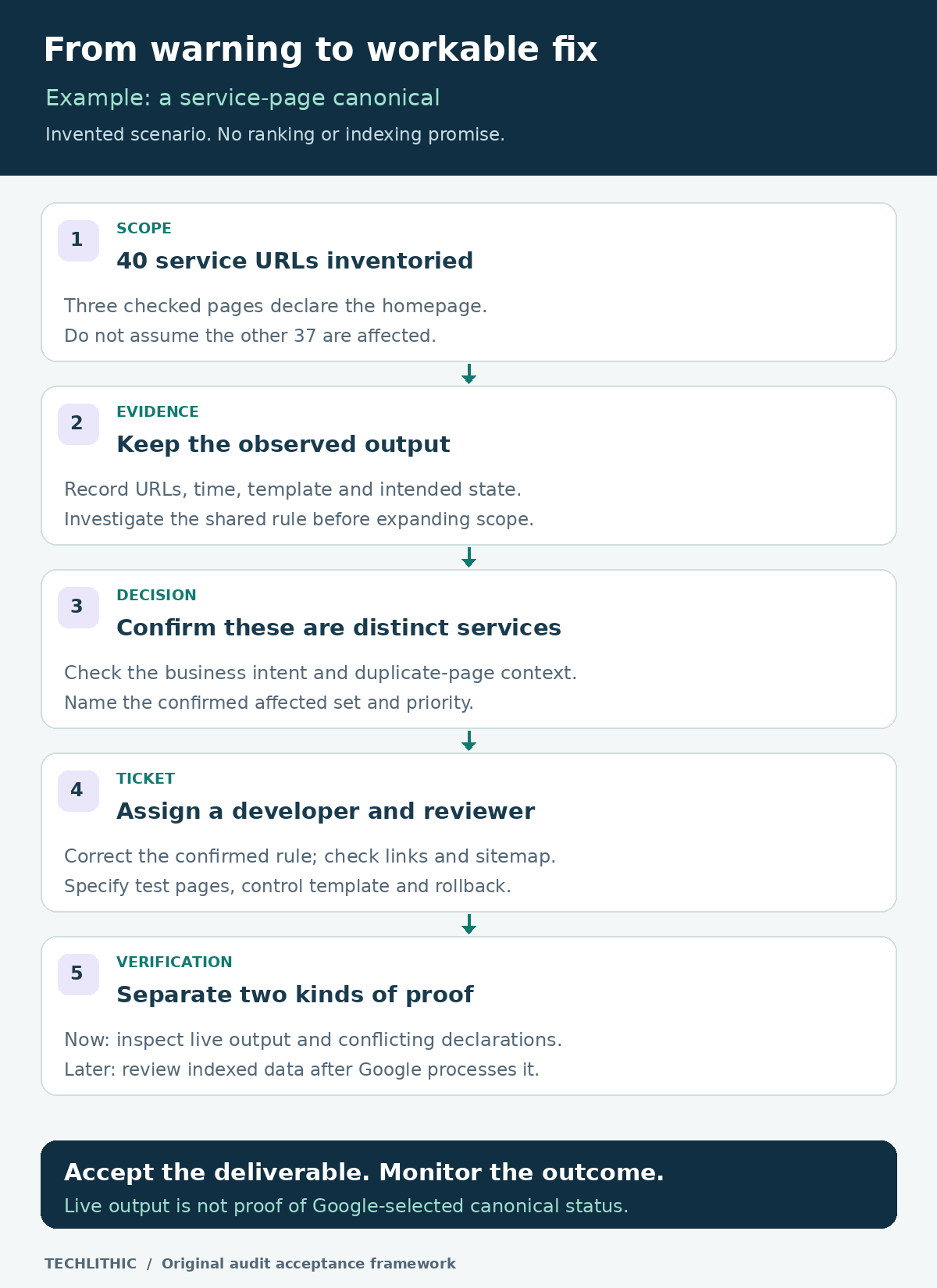
Consider an invented service website with forty service URLs. An auditor checks three pages and finds that each declares the homepage as its canonical. The owner confirms that these are distinct public services intended to have separate landing pages. Nothing here establishes that the other thirty-seven URLs are affected.
A useful finding would include the three URLs, captured canonical output, test date and template association. The auditor would investigate the suspected shared rule before expanding the affected count. If the pages are genuinely duplicates instead, the recommendation could change.
| Ticket field | Illustrative specification |
|---|---|
| Observed problem | Three distinct service pages declare the homepage rather than their intended preferred URLs |
| Investigation | Check the shared template and inventory the confirmed affected pages |
| Proposed change | Correct the confirmed canonical rule and align relevant links and sitemap entries |
| Owner and safety | Developer implements; SEO reviewer checks; retain a rollback path |
| Immediate acceptance | Test agreed service pages and a control template; inspect live output and check for conflicting declarations |
| Later observation | Review indexed data after Google's subsequent processing, separately from deployment acceptance |
The distinction matters: the team can verify that the intended output was deployed, but cannot promise when Google will select or display it. Canonical preferences remain signals. [4] Indexed-state evidence must not be confused with a fresh live response. [2]
Separate diagnosis, implementation and validation
A proposal saying “technical SEO audit” does not necessarily include production changes. Ask who writes tickets, who changes code or content, who approves release and who checks the result. Name the systems involved and define how additional discoveries affect scope.
A sensible audit-only engagement can end with a readout and accepted backlog. An implementation engagement needs an agreed subset of fixes, change controls, testing and handover. A recurring service needs its own ongoing tasks and reporting commitments.
Do not grant broad administrative access simply because someone is investigating. Arrange separately authorized access for implementation if it becomes necessary. Retain ownership of accounts and evidence, and agree how temporary access is removed when the work ends.
Set a baseline without inventing an ROI promise
Record the metrics relevant to the original decision before changes begin. For an enquiry-led site, that might include organic landing-page visits, qualified enquiries and the affected page group's search performance. Define the data source, period, filters and known tracking gaps.
Keep deployment evidence separate from outcome monitoring. A corrected response can be checked immediately; search visibility and business outcomes need later observation. Record release dates, concurrent campaigns, content changes and other factors that could affect interpretation.
For example, if an illustrative audit takes four staff hours to review and six to brief developers, a planning rate of $30 per hour adds $300 of internal effort to the quoted fee. This is budgeting arithmetic, not a market benchmark. Compare proposals on the same deliverables and implementation boundary, not on the fee alone.
Use a proposal and acceptance checklist
Before signing, ask for a redacted sample finding and a short walkthrough from evidence to recommendation. You should be able to identify the next action without buying a second diagnosis.
- Are properties, templates, markets and exclusions named?
- Are access requirements and client inputs proportionate?
- Will the evidence distinguish measured facts from hypotheses?
- Does each major recommendation have a priority rationale and completion test?
- Are implementation, validation, meetings and follow-up explicitly included or excluded?
- Are editable outputs, ownership and additional-work terms clear?
At delivery, select several important findings and trace them to their evidence, tasks and tests. Check that the summary agrees with the backlog and that limitations are visible. Accept the audit against those deliverables, not a promised ranking change.
If you already have a recent, usable backlog and the problem is delivery capacity, commission implementation or a focused second opinion instead of another broad audit. TechLithic offers related services; this framework is intended for evaluating any provider, including us. For wider procurement checks, see the software buying due-diligence guide.
Frequently asked questions
Is a crawler export an SEO audit?
It can supply useful evidence, but it does not by itself establish business relevance, confirm causes or define implementable fixes. Ask for interpretation, priorities and acceptance tests.
Should an audit include fixing every issue?
Only if the agreement says so. Separate investigation, implementation and validation so the fee and handover match the work you expect.
Should every non-indexed URL be fixed?
No. Review why the URL is excluded and whether it is intended to appear in search. Duplicate or intentionally excluded pages can be legitimate.
Can an audit guarantee rankings or AI citations?
Do not buy such a guarantee. Request a supported diagnosis, realistic estimates and a measurement plan, with search-engine outcomes kept separate from delivery acceptance.
Sources and research notes
Sources checked on 2026-10-17. Pricing and policy documents can change; verify current terms before approving expenditure.
- Google Search Central: Do you need an SEO?
Read-only audit access, realistic estimates, evaluating recommendations and avoiding ranking guarantees. Retrieved guidance states a June 5, 2026 update.
- Google Search Console Help: URL Inspection tool
Indexed information and live tests answer different questions; live tests do not guarantee indexing or predict canonical selection.
- Google Search Console Help: Page indexing report
Interpret exclusions by their reasons rather than assuming that every non-indexed URL is an error.
- Google Search Central: How to specify a canonical URL
Redirects, canonical annotations and sitemap inclusion communicate canonical preferences with different signal strengths.
- Google Search Central: Understanding page experience
Core Web Vitals and third-party scores are not guarantees of top rankings.
- Google Search Central: General structured data guidelines
Markup must represent visible content; passing a test does not guarantee rich-result display.
- Google Search Central: Optimizing for generative AI features
Current Google-specific guidance on foundational SEO and the absence of a requirement for special AI files or special schema. Do not generalize it to every engine.
The deliverable package, prioritization framework, checklist, forty-URL example and internal-effort calculation are original procurement illustrations, not client findings, market rates or measured results. Google guidance was checked on October 17, 2026. No prices, rankings, traffic gains, citation outcomes or implementation times are promised.