
WhatsApp implementation guides
WhatsApp Automation: Self-Service or Managed Setup?
You do not always need a managed service to launch WhatsApp automation. Choose the level of help by the workflow, your team's readiness and the evidence needed to accept the setup, not by the size of a feature list.
Prepared with AI assistance and checked against the linked sources. Numerical comparisons are illustrative unless expressly sourced.
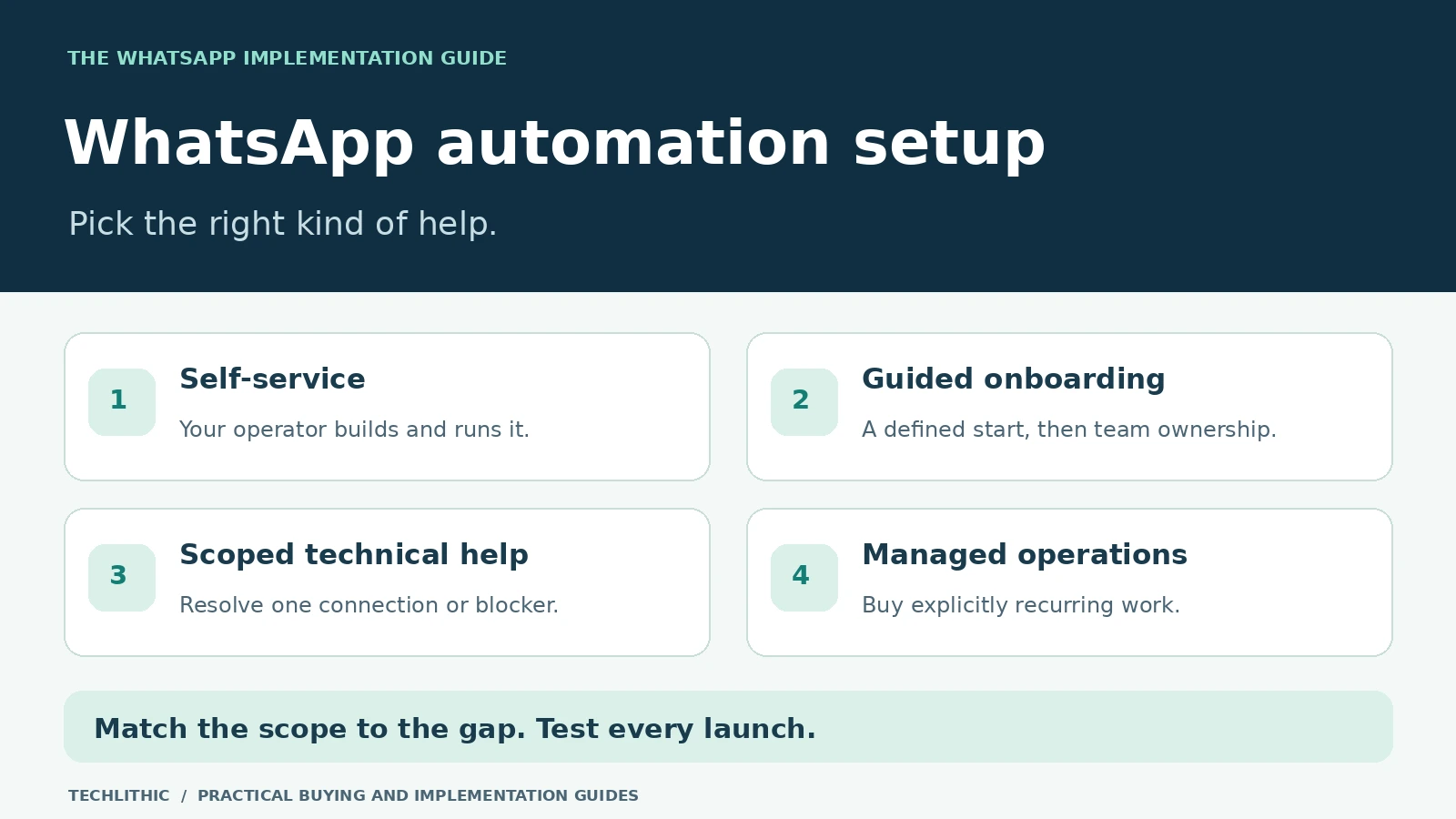
Use self-service when a capable operator can build and test a supported workflow. Buy defined onboarding or integration help for a specific gap, and ongoing management only when you need recurring operational work.
Start by separating four different kinds of help
A software subscription, an onboarding session, an integration project and an ongoing managed service solve different problems. Treating them as one purchase makes it difficult to compare proposals or decide whether the work is complete.
Self-service does not necessarily mean building an API application from scratch. It can mean configuring a supported workflow inside a product. Conversely, paying for software does not establish that someone will design your campaign or connect a custom CRM.
| Help model | What you are buying | Useful when |
|---|---|---|
| Self-service | Product access and available documentation | Your operator can configure and test the required journey |
| Guided onboarding | Defined training, configuration and handover | The workflow is supported but your team needs initial guidance |
| Scoped technical help | A specific connection, integration or diagnostic task | One identifiable blocker prevents launch |
| Managed operations | Recurring work such as monitoring, maintenance or agreed execution | You need an operator after implementation, not only during it |
A team can combine these models. You might configure the inbox yourself, purchase one integration and retain internal responsibility for daily conversations. Ask for that scope instead of accepting an unnecessarily broad package.
Use a readiness checklist before choosing a service
Answer the following questions for the first workflow, not for every automation you hope to build eventually:
- Outcome: Can you describe the completed task, such as an assigned enquiry or a submitted booking request?
- Access: Is there an authorized owner who can provide the required business and account access?
- Audience: Do you know who will receive messages and how permission and opt-outs will be handled?
- Content: Are the questions, response text and relevant business rules ready?
- Connection: Can the product support the required destination and fields without unplanned custom work?
- Operator: Is someone available to configure, test, monitor and maintain the journey?
If these answers are clear and the workflow is supported, self-service is a reasonable option to test. If a missing answer concerns business policy or ownership, hiring an implementer will not make that decision disappear.
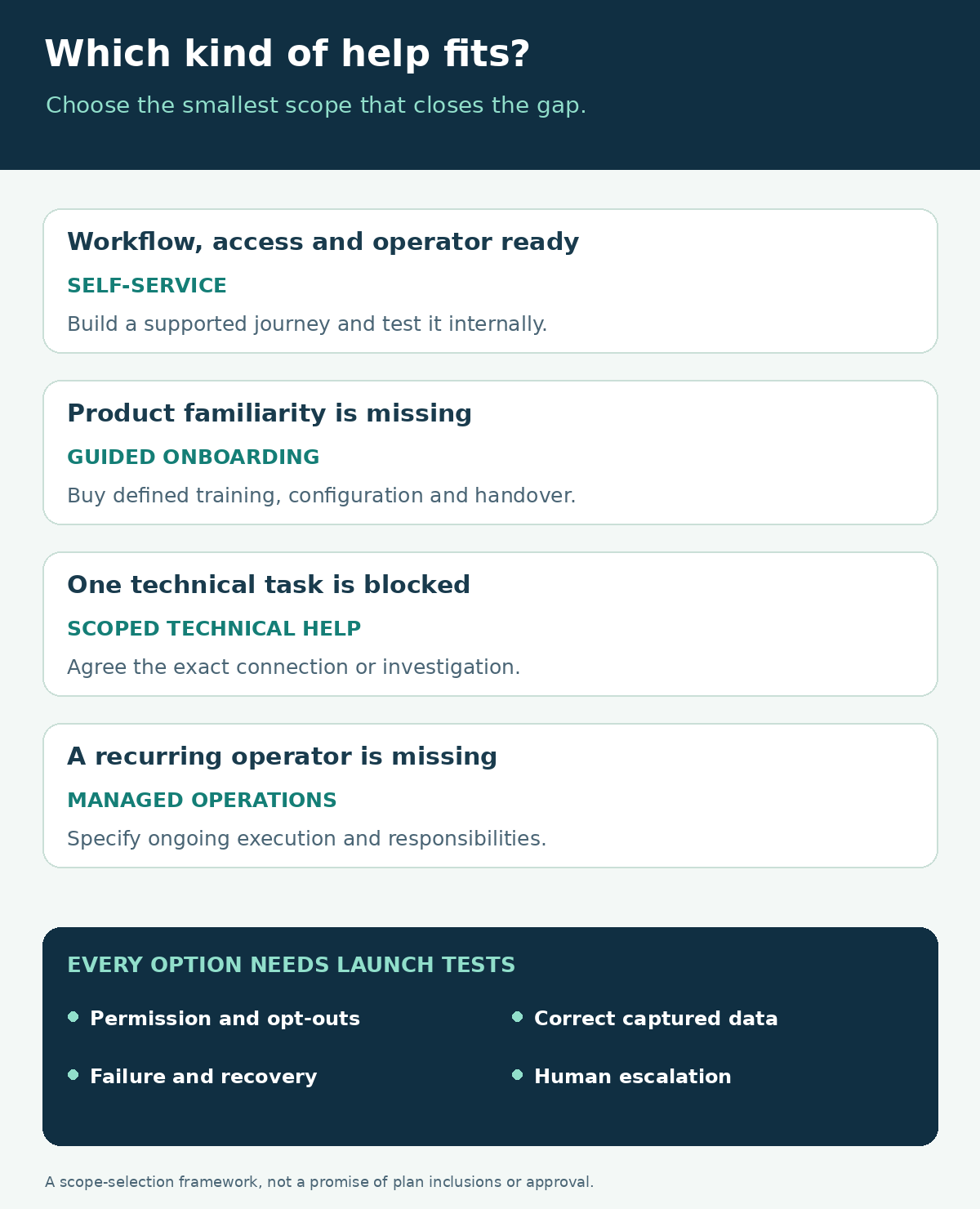
Classify gaps precisely. Lack of product familiarity may call for training. A failing event transfer may call for technical investigation. No available operator may justify recurring assistance. Choosing the smallest suitable intervention keeps the purchase aligned with the actual problem.
Check account readiness and messaging rules first
Before building the flow, establish who owns the business account, messaging number, product workspace and billing access. Use the onboarding route supported by your provider and current account situation. Do not assume every business must follow the same manual developer setup.
For example, Sendwo's connection documentation describes a route involving WhatsApp Cloud API configuration, a phone number and account connection. That is useful preparation material, but interface screens and available onboarding paths can change. Confirm the applicable route before altering an existing production number. [1]
WhatsApp's current Business Messaging Policy requires recipient permission and respect for opt-outs. It also distinguishes approved-template initiation from replies within the customer-service window. Review the applicable policy and template requirements before approving the journey. Paying for implementation does not bypass those rules. [2]
Keep platform access and channel billing separate in your checklist. Ask who pays which charges and where usage can be inspected. For the budgeting structure, see the WhatsApp API cost guide. This article does not assume a universal free-message allowance or quote a live message rate.
When self-service is enough
Self-service is worth trying when the journey is narrow, the product has the required components and a named operator can learn and maintain them. A simple enquiry flow might ask for a service category, collect a preferred callback time and route the conversation to a team member.
Sendwo's Bot Manager documentation describes a visual flow builder with connected components and keyword-trigger configuration. This illustrates a configuration task that an operator can evaluate without immediately commissioning custom development. It does not establish that every possible integration is available on every plan. [3]
Write the flow on one page before opening the builder. Include its entry condition, questions, branch decisions, completion state and fallback. Then reproduce it in a test workspace or another suitable controlled environment.
Use documentation to complete one ordinary path, then test an unexpected answer and a restart. If your operator can identify the relevant records, explain the configuration and change a response without breaking the journey, the case for self-service is stronger. If not, record the exact gap rather than assuming the entire platform needs to be outsourced.
What paid onboarding should define
Buy onboarding against a written deliverable. A statement such as “complete WhatsApp setup” leaves too much room for different expectations. Specify the workspace, number, workflow and team members involved, and identify the client inputs required before work begins.
A bounded onboarding scope might include an account-readiness review, configuration of one agreed journey, preparation of selected templates for submission, a test session, an operator walkthrough and a handover document. List exclusions such as custom CRM development, historical-data cleanup, campaign execution and additional workflows.
Distinguish deliverables from external dependencies. Preparing and submitting a template is not the same as promising approval by a deadline. Agree what happens if an approval or access dependency remains unresolved and who is responsible for the next action.
Confirm whether onboarding is included in the selected plan, purchased separately or subject to an agreed service package. Ask about session length, participants, recordings or notes, follow-up questions and additional-work charges. Product support, training and implementation need not have identical commercial terms.
The onboarding and training scope should leave your operator able to run the agreed process, not permanently dependent on the person who configured it.
Separate a technical blocker from ongoing operations
If the product works except for one connection, request a focused investigation. Supply a safe test case, expected result, observed error, relevant timestamps and the specific record or event that failed. Share access through an appropriate authorized process, not passwords in an ordinary chat.
For an integration, define the trigger, fields, destination, duplicate handling and recovery behavior. Ask who monitors failed events and whether recurring maintenance is included. A one-time implementation does not automatically provide an operator for future changes.
Human handoff also needs a testable design. WhatsApp's policy requires clear escalation paths when automation is used during the customer-service window; an in-chat agent is one option, not the only listed route. [2]
Sendwo's Live Chat documentation describes assigning conversations, pausing bot replies and unsubscribing a contact. Test the required combination in your own workspace instead of treating the presence of controls as proof of a complete handoff process. [4]
For your acceptance test, the human operator should receive the collected context and understand why help is needed. Decide whether automation pauses, when it may resume and what happens outside staff hours. These are operating decisions, not simply switches in an inbox.
Use the same launch tests for every delivery model
Whether your team or a service provider builds the flow, accept it against observable results. The following is a proposed test set, not a certification or a promise that every tool implements these behaviors automatically.
| Test | Evidence to inspect |
|---|---|
| Ordinary enquiry | The intended questions, captured fields and correct final status |
| Unexpected input | A useful clarification or fallback rather than a broken path |
| Repeated event | No unintended duplicate ticket, lead or booking request |
| Opt-out | The contact is excluded from the relevant subsequent messaging |
| Human escalation | The destination operator receives context and automation behaves as agreed |
| Integration failure | The failure is visible and has an agreed recovery owner |
| Operator handover | Your designated person can inspect, pause and maintain the workflow |
Keep a test record containing the scenario, expected outcome, actual result, evidence and responsible person. Inspect the destination system as well as the chat. An acknowledgement in a conversation is not sufficient evidence that the business task was completed.
Classify unresolved defects before launch. A cosmetic wording issue is different from sending an unwanted message or creating the wrong record. Define who can stop the pilot and how the affected journey will be disabled while a serious issue is investigated.
Compare cash cost, staff effort and ongoing responsibility
Self-service has an internal time cost; managed setup has a service cost and still requires your business input. Compare the same workflow and acceptance criteria. Keep product subscriptions, messaging usage and any separate integration expenses outside the service comparison unless explicitly included.
Consider an invented example. Your operator estimates six hours of setup work at an internal planning rate of $25 per hour: $150. A provider quotes $250 for the same bounded deliverable, while your team expects to spend two hours supplying inputs and reviewing it: another $50. The second option totals $300 under those assumptions.
The additional $150 is not automatically justified or wasteful. Ask whether the provider addresses a skill gap, deadline or operational risk that matters to you. These figures are illustrative, not market prices or promised delivery times, and both estimates could change once the scope is understood.
For recurring management, request the actual recurring tasks: monitoring, approved content changes, reporting, incident handling or campaign execution. Specify volume, turnaround, responsibilities and exclusions. If you only need one blocked step resolved, a continuing retainer may be the wrong purchasing unit.
Make the choice through a narrow pilot
Start with one workflow, a controlled set of authorized test contacts and a named operator. Establish a spending boundary and completion criteria before expanding traffic. Do not use a full contact-list import as the first proof that a journey works.
If self-service passes the launch tests, keep operating it internally and purchase help only when a specific gap appears. If training is the missing piece, buy a defined onboarding session. If a technical connection is failing, scope that connection. Choose managed operations when you need recurring execution that your team will not own.
At handover, retain a workflow map, configuration ownership, account-access record, test results and recovery instructions. Agree how changes will be reviewed and who maintains content or integrations when the business process changes.
TechLithic operates Sendwo and offers related implementation services. That relationship should not determine your buying decision. Use the same readiness questions and tests with any suitable provider, and choose the smallest service scope that gets your process working and maintainable.
Frequently asked questions
Does self-service mean writing WhatsApp API code?
Not necessarily. It can mean configuring a supported workflow inside an existing product. A custom connection or unsupported integration is a separate technical requirement.
Does a paid software plan automatically include training?
Do not assume so. Confirm the selected plan and service agreement, including the onboarding deliverable, sessions, follow-up and any additional charges.
Can a managed provider guarantee Meta template approval?
A provider can agree to prepare and submit templates, but Meta controls its review and approval process. Ask how the proposal treats external dependencies and unresolved approvals.
When is ongoing managed support unnecessary?
When your team can run the workflow and only needs a specific setup or technical problem resolved, a bounded engagement may be more appropriate than recurring operational management.
Sources and research notes
Sources checked on 2026-10-16. Pricing and policy documents can change; verify current terms before approving expenditure.
- Sendwo documentation: Connect Account
An example account-connection route. Product menus and onboarding methods can change; confirm the supported route for the current account.
- WhatsApp Business Messaging Policy
Current recipient-permission, template, customer-service-window and escalation requirements. The retrieved policy states a September 23, 2026 update.
- Sendwo documentation: WhatsApp Bot Reply
Visual flow configuration, connected components and keyword-trigger settings as an example of product-based configuration.
- Sendwo documentation: WhatsApp Live Chat
Documented conversation assignment, bot-pausing and contact-unsubscribe controls. Verify behavior in the selected workspace and plan.
The readiness questions, service-model comparison, acceptance tests and cost illustration are original buying frameworks, not measured customer outcomes. No provider prices, plan inclusions, approval timelines or universal free-message allowances are asserted. Technical documentation may show a particular connection route rather than every onboarding option.