
AI and automation buying guides
AI Model Evaluation: A Procurement Test Plan
A public benchmark cannot tell a buyer whether an AI system will handle the buyer's documents, users, policies, languages, integrations and failure costs. Procurement needs a controlled evaluation of the complete configured system, using representative cases, explicit failure gates, human review and operational evidence. The result should be a reusable test pack, not a one-time demo score.
Prepared with AI assistance and checked against the linked sources. Numerical comparisons are illustrative unless expressly sourced.
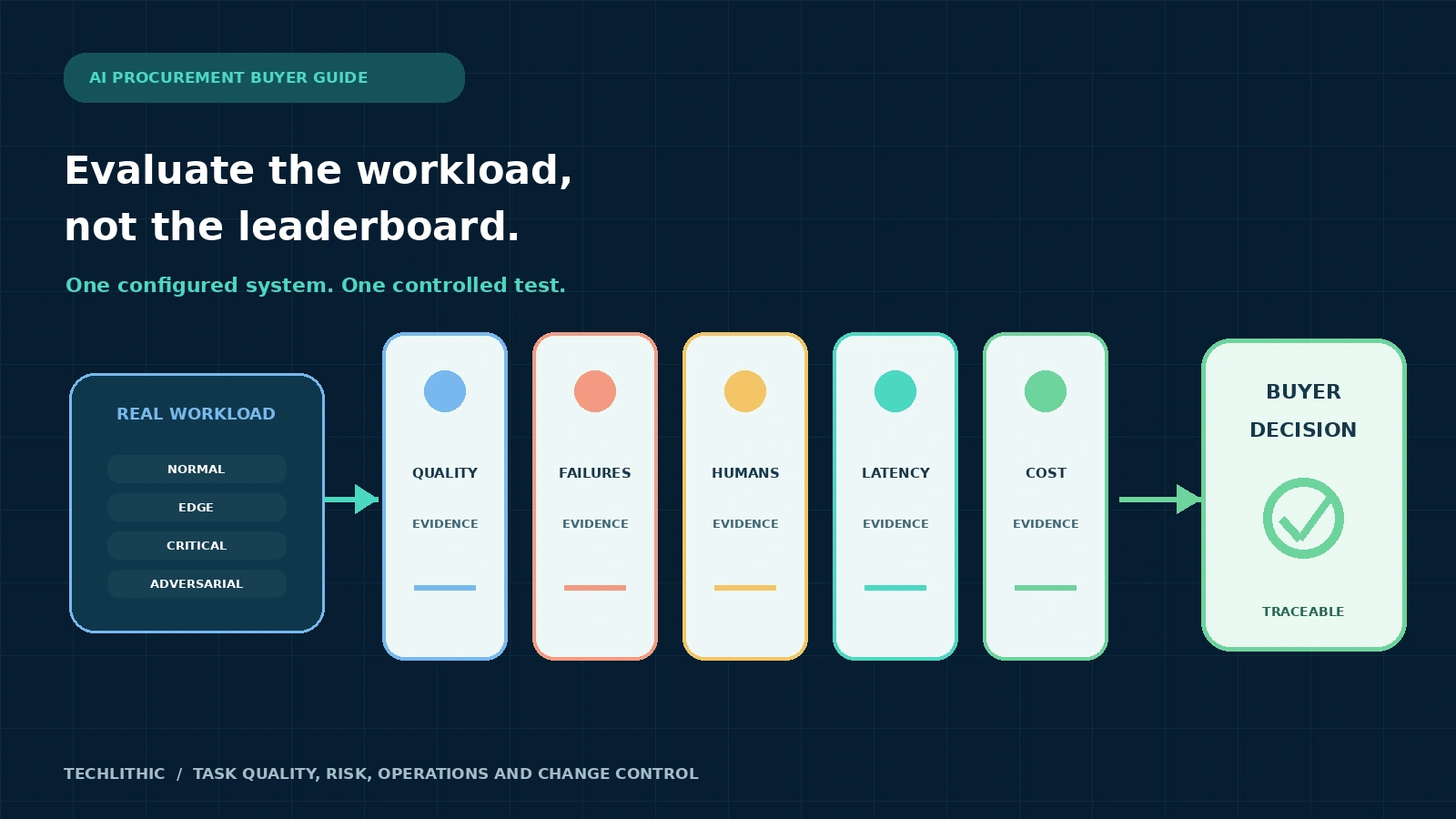
Define the decision, deployment conditions and unacceptable failures first. Freeze each candidate's model, prompt, retrieval, tools and settings; run the same held-out workload; adjudicate important outputs with domain reviewers; measure latency and actual usage; test misuse and fallback paths; then require re-evaluation when a material component changes.
Write the buying decision before testing models
Start with the operational decision, not a list of models. Name the users, task, input types, output consumer, business consequence, human oversight, prohibited uses and fallback. A support classifier, a contract-summary assistant and a credit decision aid need different evidence even if they use the same foundation model.
Turn the intended use into a short decision statement: Select a system that can classify eligible requests, extract the required evidence and draft a review note, while routing uncertain or high-impact cases to a trained operator. Add non-negotiable constraints such as data location, response time, accessibility, audit logging and integration format.
NIST's AI Risk Management Framework says evaluation should use quantitative, qualitative or mixed methods, document uncertainty and test conditions similar to deployment. It also calls for objective, repeatable or scalable testing, evaluation, verification and validation. [1] That makes the procurement question more useful than asking which model is best in general.
Evaluate the configured system, not only the model name
Record every component that can affect an answer: provider, exact model and version, region, prompt, sampling settings, retrieval index, source documents, reranker, tools, output schema, guardrails and application code. Two proposals using the same model can behave differently because their surrounding systems differ.
Give every candidate an immutable configuration identifier. Store the evaluation input, response, timing, usage, tool trace, source references and evaluator decision against that identifier. If a supplier changes the prompt halfway through, the revised candidate gets a new run. Otherwise the final average combines different systems and cannot support acceptance.
The NIST Generative AI Profile applies risk management across the AI lifecycle and describes acquisition as a relevant cross-sector setting. [2] Test the delivered application boundary, including retrieval and actions, while keeping model-only tests as diagnostic evidence.
Build a representative set and keep a holdout
Sample the real workload by task, language, document type, user group, input length, ambiguity and consequence. Include normal cases, rare but costly cases, malformed inputs, missing evidence, conflicting instructions and cases where the correct behaviour is to abstain or escalate. Remove personal or confidential data unless its approved use is necessary and protected.
Split examples into a development set and a held-out acceptance set. Suppliers can use the development set to improve the system. They should not see the acceptance answers before the final run. Preserve a separate regression set after launch. If synthetic cases are used, label their origin and check that they resemble the intended distribution.
OpenAI's evaluation guidance recommends task-specific tests that reflect real-world distributions, plus typical, edge and adversarial cases. It warns against generic metrics, unrepresentative datasets and impression-based evaluation. [3] Treat this as provider guidance, not a universal standard, and retain buyer-owned test data where contracts and privacy rules permit.
Separate useful quality from unacceptable failure
Create a scoring rubric with observable criteria and examples. For a summary, criteria might include factual support, required facts, prohibited claims, clarity and correct escalation. Define what a reviewer must see at each score. Avoid one vague rating such as quality.
Use averages for tradeoffs, but use pass or fail gates for events that cannot be offset by fluent answers elsewhere. Examples include disclosing restricted data, executing an unauthorized action, fabricating a required citation, misrouting a high-impact case or failing to escalate when evidence is missing. Report both the count and the affected cases.
Google's evaluation documentation distinguishes computation-based metrics from model-based metrics and describes pointwise and pairwise review. [4] Exact-match checks work for schemas and known labels. Pairwise review can help choose between acceptable drafts. A model judge may scale review, but it should be tested against domain-expert decisions and should not be the sole authority for critical failures.
Calibrate human review before accepting its scores
Select reviewers who understand the task and the harm of errors. Train them on the rubric, then have at least two reviewers independently score a calibration sample. Discuss disagreements, revise ambiguous definitions and repeat until the rubric produces decisions the buyer can defend. Keep an adjudication path for important disagreements.
Randomize candidate order and hide model identity where practical. Control obvious presentation differences so a longer answer or familiar brand does not win by default. Ask reviewers to cite the evidence that supports a failure decision. Measure agreement and report unresolved uncertainty rather than forcing false precision.
NIST's 2026 ARIA Evaluation Planning Manual combines model testing, red teaming and user testing to evaluate an AI application's trustworthiness. [5] A procurement test can use the same principle at an appropriate scale: technical scores, deliberate challenge cases and representative user tasks answer different questions.
Measure latency, capacity and cost on the same workload
Quality results need operational context. Run candidates with the expected prompt, retrieval depth, tool calls and output length. Record end-to-end latency at useful percentiles, timeout and error counts, throughput under a documented concurrency pattern, input and output usage, retrieval or tool charges and human-review time.
Calculate cost from the measured evaluation workload and the buyer's expected task mix. Keep provider prices and currency as dated inputs so they can be updated without rewriting the test. Include retry and fallback behaviour. A cheap first call can become expensive if long prompts, repeated tools or manual corrections are common.
Do not combine quality, latency and cost into an unexplained weighted score. Show the tradeoff table and the rule used to select. A slower system may be acceptable for overnight analysis but not for an interactive agent. A lower-cost candidate is not acceptable if it fails a critical gate.
Challenge misuse, privacy and control boundaries
Test inputs that attempt to override instructions, expose restricted context, misuse tools, cross tenant boundaries or produce disallowed content. For systems that retrieve documents or take actions, include poisoned or misleading content, malformed tool output, permission failures and unavailable dependencies. Confirm that the application logs the event, limits the action and provides a safe recovery path.
NIST's adversarial machine learning taxonomy covers attack lifecycle stages, attacker goals, capabilities and mitigations, including evasion, poisoning, privacy breach and abuse. [6] Use a threat model relevant to the purchased system instead of copying every attack category into a checklist.
Require evidence for data retention, training use, regional processing, subprocessors, encryption, access, deletion, incident handling and audit logs. Legal and security teams should review the applicable obligations. The UK's AI assurance guidance describes assurance as part of responsible development and deployment within a wider governance system. [7]
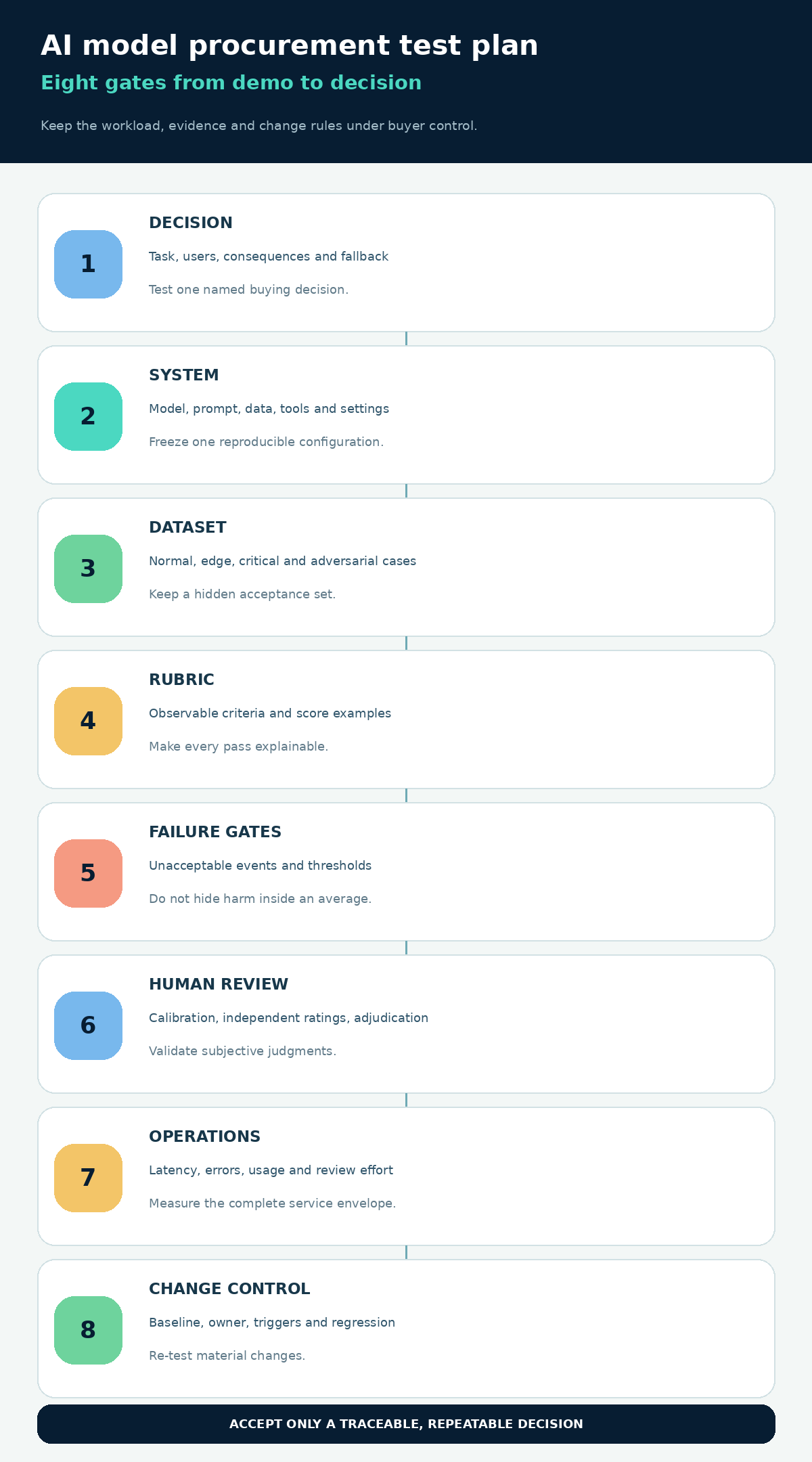
Use an eight-gate procurement acceptance matrix
| Gate | Buyer evidence | Acceptance question |
|---|---|---|
| Decision | Intended use, users, consequences, fallback and constraints | Does the test answer a named purchase decision? |
| System | Frozen model, prompt, data, tools, settings and version | Can every result be reproduced against one configuration? |
| Dataset | Representative development, holdout and regression cases | Does the set cover normal, edge and high-consequence work? |
| Rubric | Observable criteria, score examples and evaluator guide | Can reviewers explain why an output passed? |
| Failure gates | Unacceptable events with pass or fail thresholds | Can a critical failure be hidden by a strong average? |
| Human review | Calibration, independent ratings and adjudication | Are subjective judgments consistent enough to use? |
| Operations | Latency, errors, capacity, usage and review effort | Will the system meet the real service and cost envelope? |
| Change control | Baseline report, owner, triggers and regression process | Will a material change require re-evaluation? |
Each gate needs an owner and a retained artifact. Do not average a failed critical gate into a procurement score. The decision record should name accepted limitations, required remediation and the authority that approved residual risk.
Worked example: selecting a fictional support-triage system
Consider a fictional software company comparing two configured AI systems that classify support requests, extract account and product facts, and draft a note for an agent. The system must never close a case or change an account. Requests involving security, billing disputes or missing identity evidence must go to a specialist.
The buyer creates a development set and a hidden acceptance set from approved, de-identified historical patterns. The mix includes common setup questions, short multilingual messages, long log excerpts, contradictory instructions, missing account details and attempted prompt injection. Domain reviewers write the reference routing decision and required facts, then calibrate a rubric on examples outside the holdout.
Both candidates receive the same cases through the proposed production integration. Exact checks score the route and output schema. Reviewers score factual support and note usefulness without seeing the candidate name. Security, billing and identity errors are separate failure gates. The run also records end-to-end latency, errors, input and output usage, retrieval calls and reviewer correction time.
Candidate A produces more polished notes, but one hidden security case is routed to general support. Candidate B writes shorter notes, passes every critical route gate and needs fewer corrections. The buyer selects B conditionally, requiring a small clarity improvement and a repeat run on the affected cases plus the untouched regression set. This is a fictional procurement example, not a client result, model recommendation or universal threshold.
Make the test pack part of the contract and release process
Require the supplier to deliver the dataset schema, approved cases where transferable, rubric, grader or scoring code, configuration manifest, raw outputs, reviewer decisions, summary report and known limitations. Name who owns each artifact and which materials the buyer can reuse if the provider changes.
Define material changes that trigger evaluation: model or model-version change, prompt or policy change, retrieval corpus or embedding change, new tool, new language, altered user population, safety-control change, pricing or latency change, or an incident. Use a smaller regression run for routine releases and the full acceptance suite for high-risk changes.
A contract cannot promise that a variable AI system will never fail. It can require documented evaluation, defined gates, monitoring, rollback, incident response and transparent change notice. Connect the acceptance test to the ongoing operating scope described in the MLOps service guide.
Use this checklist before approving an AI model purchase
- The procurement decision names the task, users, output consumer and consequence.
- Intended, prohibited and fallback uses are documented.
- Every candidate has a frozen model, prompt, retrieval, tool and setting manifest.
- The development, holdout and regression sets represent the real workload.
- Important subgroups, edge cases, abstention and escalation cases are included.
- The rubric contains observable criteria and examples for each score.
- Critical failures are pass or fail gates, not weighted averages.
- Domain reviewers are trained, independently calibrated and able to adjudicate.
- Automated graders are checked against trusted human decisions.
- Latency, errors, concurrency, usage and correction effort are measured together.
- Security, privacy, permissions, tool misuse and fallback paths are challenged.
- Results retain configuration, raw output, evidence and evaluator decisions.
- Known limitations and residual risks have named owners and approvers.
- Material model or system changes trigger a documented re-evaluation.
- The buyer receives a reusable test pack and regression process.
TechLithic provides custom AI model training, AI transformation advisory, AI integration engineering and MLOps and AI operations. Apply this evaluation plan equally to TechLithic and competing providers. Use the RAG versus fine-tuning guide for architecture selection and the AI agent security guide when the system can use tools or take actions.
Frequently asked questions
Why are public AI benchmarks insufficient for procurement?
They test standardized tasks or isolated capabilities, not the buyer's configured application, real input distribution, critical failure costs, integrations, latency, price or human workflow. They can inform a shortlist but should not replace a buyer-owned acceptance test.
Should an AI model judge score the evaluation?
It can help scale pointwise or pairwise review, but the buyer should validate its agreement with domain experts and keep humans responsible for critical or high-impact decisions.
What belongs in an AI evaluation dataset?
Include representative normal work, important subgroups, rare and high-consequence cases, malformed or adversarial inputs, missing evidence, abstention cases and expected escalation. Keep a hidden acceptance set separate from supplier development.
How should buyers compare AI model cost?
Measure actual input, output, retrieval, tool, retry and human-review usage on the same representative workload. Apply dated provider prices and the expected task mix instead of comparing headline token prices alone.
When should an accepted AI system be re-evaluated?
Re-evaluate after material model, prompt, retrieval, tool, policy, data-distribution or user changes, and after incidents. Run regression tests routinely and reserve the full acceptance suite for higher-risk changes.
Sources and research notes
Sources checked on 2026-11-20. Pricing and policy documents can change; verify current terms before approving expenditure.
- NIST AI Risk Management Framework Core: Measure
Official NIST guidance on quantitative and qualitative measurement, deployment-like testing, uncertainty, documentation, independent review and repeatable TEVV processes.
- NIST AI 600-1: Generative AI Profile
Official cross-sector profile for applying the AI RMF to generative AI across lifecycle and acquisition contexts.
- OpenAI: Evaluation best practices
Primary provider guidance on task-specific evaluation, representative datasets, edge and adversarial cases, human calibration and continuous evaluation.
- Google Cloud: Define your evaluation metrics
Primary provider documentation comparing computation-based, model-based, pointwise and pairwise evaluation approaches.
- NIST AI 200-3: ARIA Evaluation Planning Manual
Official 2026 NIST manual describing holistic AI evaluation through model testing, red teaming and user testing.
- NIST AI 100-2e2025: Adversarial Machine Learning
Official taxonomy covering adversarial attack lifecycle stages, goals, capabilities, privacy breach, evasion, poisoning, abuse and mitigations.
- UK DSIT: Introduction to AI assurance
Official government guidance placing AI assurance techniques within responsible development, deployment and wider governance.
Primary sources were opened and checked on publication day. The article separates official risk-management and assurance guidance from vendor-specific evaluation methods and does not use public benchmark results, fabricated performance statistics or current provider prices.