
Software development buying guides
API Development Proposal: Compare Scope and Acceptance Tests
Two API quotes are comparable only when they describe the same contract, risk controls, operating model and acceptance evidence. Count more than endpoints. Lock behavior for identity, authorization, retries, limits, errors, versions, telemetry, documentation and handover before choosing a supplier.
Prepared with AI assistance and checked against the linked sources. Numerical comparisons are illustrative unless expressly sourced.
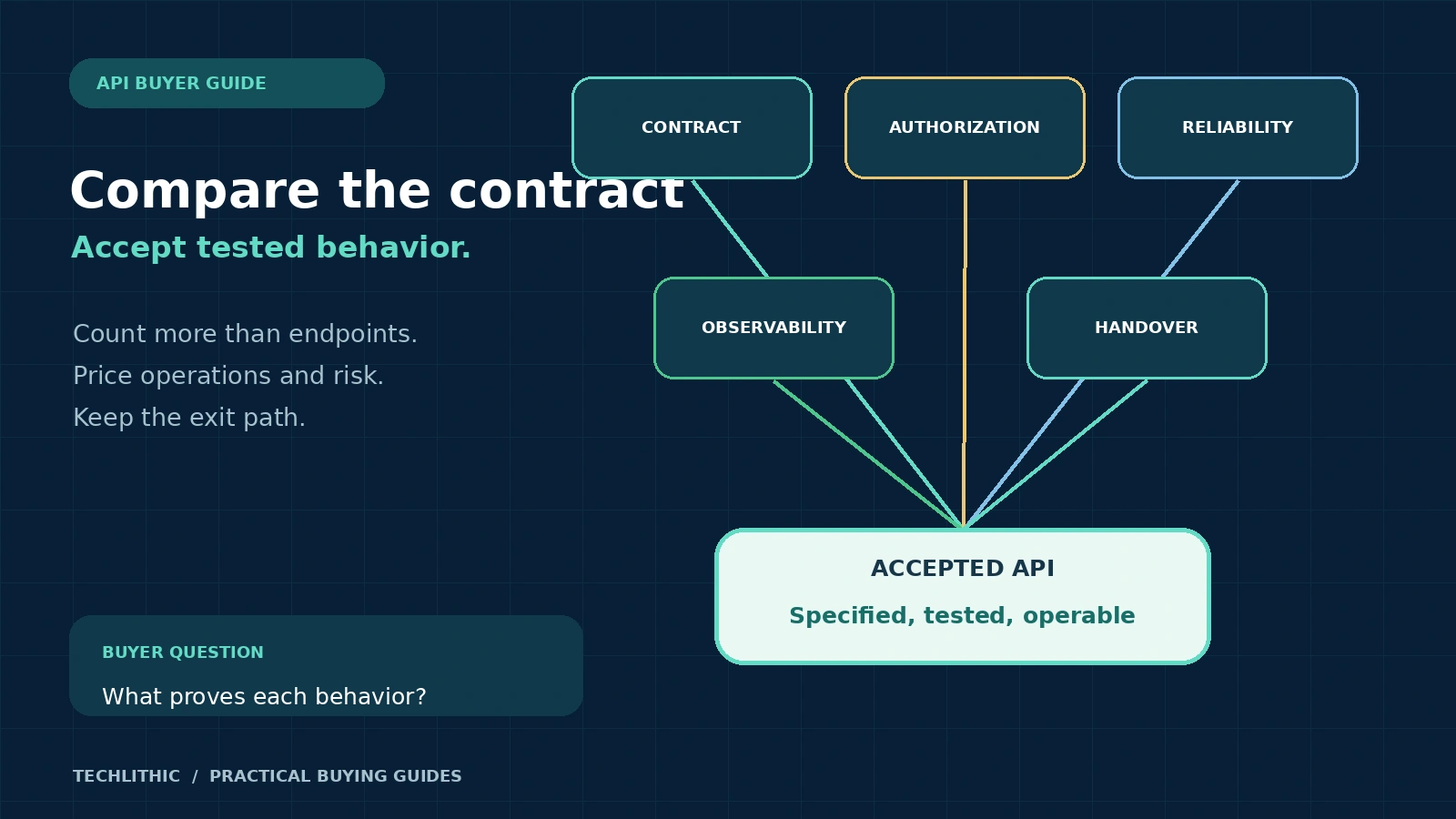
Make the API contract the center of the proposal. For every operation, define inputs, outputs, authorization, side effects, limits, errors, retry safety and observability. Price integrations and production operations separately from endpoint coding. Accept delivery through automated contract, security, failure and handover tests, not a happy-path demonstration.
Compare one API contract, not two endpoint counts
An endpoint count is not a stable unit of work. One proposal may treat POST /orders as a database insert. Another may include authorization, validation, duplicate prevention, inventory checks, asynchronous fulfillment, events, audit history and operational alerts. Both can call it one endpoint.
Start with consumer journeys and system boundaries. Name each caller, the business action it needs, the system of record, data classification, expected volume, latency need and consequence of failure. Then list operations with method, path, request, response, side effects, identity, permissions, errors and owning service. Mark unknowns as discovery work rather than hiding them inside development.
The OpenAPI Specification provides a language-neutral description of HTTP APIs so people and tools can understand operations without reading source code or inspecting traffic. Its response model expects documented success and known error responses, and it can describe security requirements per operation. [1] Require a version-controlled API definition as a deliverable, but do not assume generated documentation proves the implementation behaves correctly.
Ask every bidder to price the same contract baseline. Separate new operations, changes to existing operations, third-party connectors, data migration, gateway policy, consumer changes, cloud infrastructure and ongoing support.
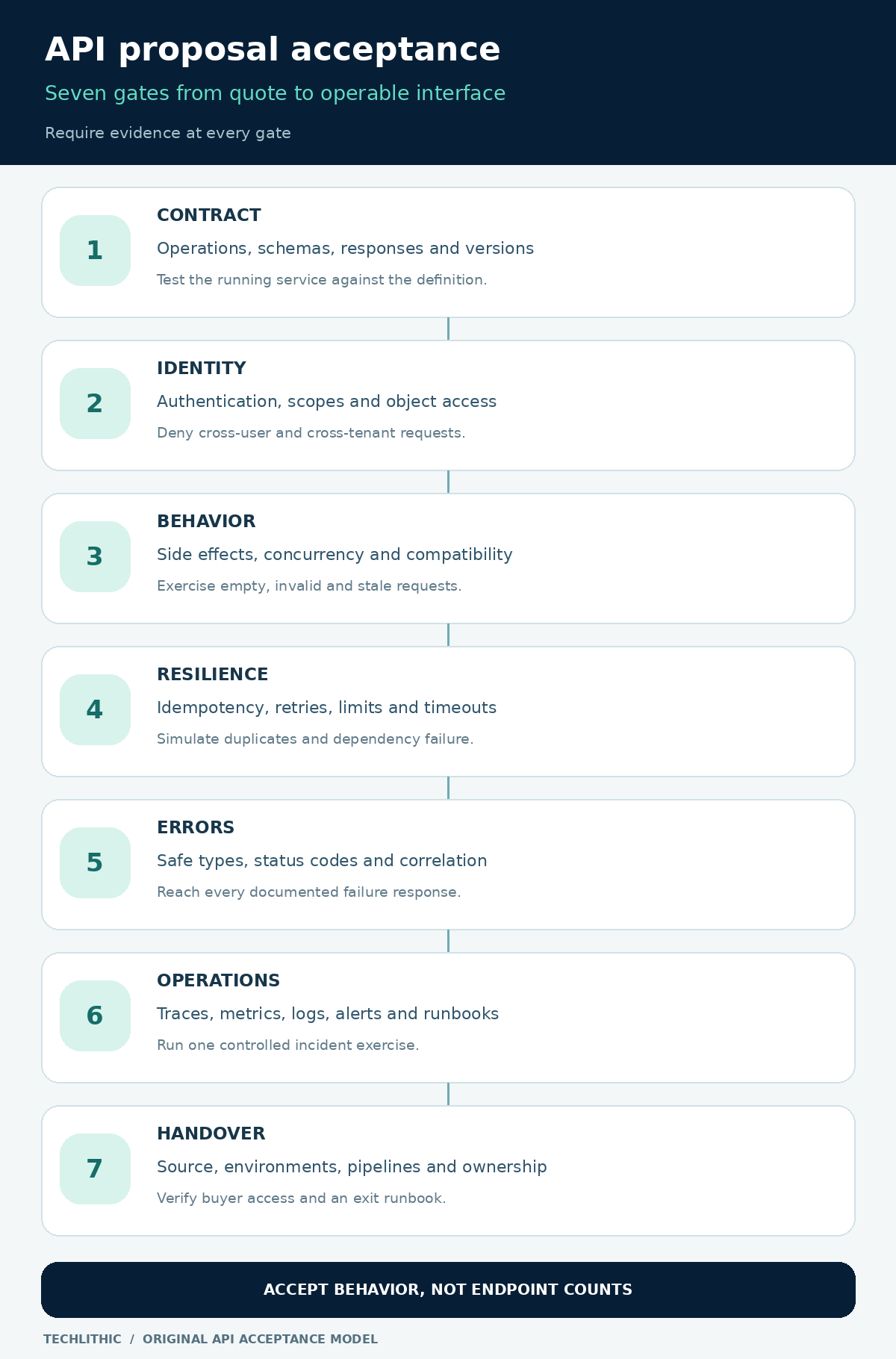
Specify request, response and compatibility behavior
For each operation, define required and optional fields, types, formats, validation, defaults, maximum sizes, pagination, filtering, sorting and field-level visibility. Use examples for normal, empty and boundary cases. State whether unknown fields are rejected or ignored and whether omitted fields differ from explicit null values.
Document status codes and headers as part of the contract. HTTP semantics give methods and responses shared meaning across clients and intermediaries. [2] An accepted asynchronous request is not the same as completed work. If an operation returns 202, define the status resource, terminal states, polling guidance, cancellation and result retention.
Choose a versioning and compatibility policy before build. State which changes are backward compatible, how breaking changes create a new version, how long supported versions remain available and how consumers are notified. Microsoft advises applying the selected versioning strategy consistently across application and gateway while preserving the contracts of supported versions. [3]
| Contract area | Proposal must state | Acceptance evidence |
|---|---|---|
| Input | Schema, limits, validation and examples | Boundary and invalid-request tests |
| Output | Schema, status, headers and empty states | Contract tests against the running API |
| Compatibility | Version rule and breaking-change policy | Old-consumer regression test |
| Async work | Status, retry, cancellation and retention | Failure and recovery test |
Lock retry, idempotency and concurrency semantics
Network timeouts create an uncomfortable question: did the request fail before the change, or did the change succeed while the response was lost? The proposal must say which operations are safe to retry and how duplicate effects are prevented.
GET, HEAD, PUT and DELETE have idempotent semantics, while POST and PATCH are not inherently idempotent. The implementation still has to preserve the intended behavior. Microsoft recommends documenting retry safety and using processed message identifiers when an operation is not naturally idempotent. [3]
For a state-changing request that supports an idempotency key, define key format, scope, retention window, conflict behavior and the response returned for a duplicate. Google's request-identification guidance says providing a request ID must guarantee idempotency and recommends returning the prior successful response when a duplicate is detected. [6]
Define retryable failures and backoff. Google's retry guidance says clients should retry only operations whose repetition does not cause unintended state changes and should not automatically retry transactional requests as isolated calls. [7]
Also define concurrent-update control. Use version values, entity tags or another explicit method when two callers can update the same record. Test stale writes, duplicate delivery, worker restart and timeout after commit.
Make limits and error behavior part of the product
Rate limits are not only gateway settings. Define the limited subject, such as client, user, tenant or operation, plus the window, burst allowance, concurrency, payload, batch and downstream-cost limits. Describe how clients learn the rule and recover.
OWASP identifies unrestricted resource consumption as a risk when APIs omit or misconfigure execution, memory, upload, batch, pagination, frequency or third-party spending limits. [8] Microsoft recommends rate, concurrency, payload and execution-time limits, using 429 for configured rate excess and 503 for temporary unavailability, with Retry-After where appropriate. [3]
Choose one machine-readable error model. RFC 9457 defines problem details for HTTP APIs using application/problem+json, including a problem type, title and occurrence-specific detail. It also warns against exposing implementation internals through error responses. [9]
Create an error catalogue that maps validation, authentication, authorization, conflict, limit, dependency and internal failures to status, type, safe message, retryability and support correlation ID. Test that every documented error is reachable and that stack traces, credentials, personal data and internal hostnames never appear.
Price observability and production ownership explicitly
An API is not complete when it returns a success response in development. Define how operators detect latency, errors, saturation, rejected requests, dependency failure and stuck background work. Name the production owner and escalation path.
OpenTelemetry describes traces, metrics and logs as complementary signals. Traces show a request path, metrics capture runtime measurements and logs record events. [10] The proposal should state which operations receive tracing, which fields correlate signals and how sensitive values are redacted.
Define service objectives only where the buyer can operate and measure them. Specify availability calculation, latency percentiles, excluded maintenance, data source, alert thresholds and response ownership. A vendor cannot guarantee an end-to-end target if the buyer or an external dependency controls an unmeasured part of the path.
Include dashboards, alerts, runbooks, retention, sampling and telemetry cost. Health checks should distinguish process health from dependency readiness without exposing secrets. Require a controlled incident exercise: inject a dependency timeout, confirm the client receives the documented response, verify trace and log correlation, observe the alert and follow the runbook.
Turn requirements into an executable acceptance plan
Write acceptance tests before development milestones are priced. A demonstration proves that one chosen sequence worked once. Acceptance needs repeatable evidence across normal, boundary, unauthorized and failure paths.
The minimum suite should include schema validation, consumer contract tests, authorization tests, idempotency and duplicate tests, rate-limit tests, dependency failure, concurrency conflict, version compatibility, performance under an agreed workload and documentation examples executed against a test environment.
Keep security testing proportional to exposure and data risk. Define static and dependency scanning, secret detection, threat-model review, authorization scenarios and penetration-testing responsibility. A penetration test is not a substitute for the supplier's own secure development and automated checks.
| Test group | Pass condition | Evidence retained |
|---|---|---|
| Contract | Implementation matches approved schemas and responses | Automated report and API definition |
| Authorization | Cross-user, cross-tenant and excess-scope requests fail | Test cases and safe audit events |
| Resilience | Retries, duplicates and timeouts follow documented behavior | Execution log and resulting state |
| Capacity | Agreed workload meets latency and error thresholds | Test profile, environment and result |
| Operations | Signals, alerts and runbook identify a controlled failure | Dashboard, alert and incident record |
Worked example: accepting an order-creation API
Consider an invented distributor that needs partners to create orders. This is an educational example, not a client result. The first quote says "build three order APIs". The buyer replaces that phrase with a contract and testable outcomes.
POST /orders accepts a partner reference, customer identifier and bounded list of items. The authenticated client requires the orders.write scope, but the service also checks that the customer belongs to the partner. The request uses an idempotency key scoped to partner and operation for an agreed retention period.
Validation failure returns a documented problem type. A duplicate key with the same payload returns the prior accepted result; the same key with a different payload returns a conflict. Accepted work returns 202 with a status URL because inventory and tax checks run asynchronously. The status resource has pending, completed and failed states and applies the same partner authorization.
The contract defines a maximum item count, per-partner request and concurrency limits, safe retry rules and a version policy. Telemetry records operation, outcome, latency, partner pseudonym and trace ID, but not order contents or tokens.
Acceptance creates one order, resends it after a simulated lost response, tries the key with changed content, requests another partner's order, exhausts the rate limit, interrupts the inventory dependency and confirms the alert. Supplier quotes can now be compared against the same behavior rather than a misleading three-endpoint label.
Compare commercial scope, dependencies and ownership
Require each supplier to mark deliverables as included, optional or excluded. Development effort depends on existing system quality, consumer readiness, data rules, environment access and third-party behavior. Price uncertain discovery and external integrations separately instead of forcing a false fixed estimate.
Milestones should produce evidence: approved contract, vertical slice, security and failure tests, production-readiness review and handover. Tie payment to accepted outputs, not a raw percentage of endpoints. Define the change-control method for new operations, schema changes and third-party surprises.
Name recurring costs for gateway, identity, secrets, telemetry, queues, data transfer, testing and support. Clarify who owns cloud accounts, domains, certificates, API definitions, source repositories, CI/CD, monitoring and vendor subscriptions.
A TechLithic API development proposal should be evaluated by the same evidence standard as any other supplier. If the work connects an AI provider or business system, review the separate AI integration engineering scope. For a larger product build, place the interface inside the software product engineering release and operating model.
Reject quotes that omit test environments, authorization, failure behavior, documentation ownership or operational handover. Also reject promises of zero downtime, perfect security or unlimited scale without explicit architecture, limits and buyer dependencies.
Use an API proposal and handover checklist
- Are callers, journeys, systems of record and data classifications named?
- Does every operation define schema, validation, response, status, headers and side effects?
- Is the OpenAPI definition version-controlled and tested against the running service?
- Are authentication, scopes, tenant rules and object-level authorization separate?
- Does each state-changing operation declare retry and idempotency behavior?
- Are duplicate keys, concurrent writes, timeouts and dependency failures tested?
- Are rate, concurrency, payload, batch and downstream-cost limits documented?
- Is there one safe, machine-readable error catalogue with correlation identifiers?
- Are version support, deprecation and consumer migration responsibilities explicit?
- Do traces, metrics, logs, dashboards and alerts cover business-critical operations?
- Are performance tests tied to an operation mix, environment and pass thresholds?
- Are gateway, cloud, identity, telemetry and support costs visible?
- Will the buyer own source, specifications, environments, pipelines and runbooks?
- Does final acceptance require automated evidence and an operational failure exercise?
Do not commission a custom API when a stable product connector, event export or bounded automation already satisfies the need. Do not build until the system of record, consumer and permission model are understood. A short discovery that produces a contract, threat model and acceptance plan is often the right first purchase when those decisions are missing.
For broader integration planning, use the CRM and ecommerce integration scope guide. If the API is part of a new product, compare development proposals with the MVP development scope checklist.
Frequently asked questions
What should an API development proposal include?
It should define consumers, operations, schemas, authentication, authorization, idempotency, limits, errors, versioning, observability, environments, testing, deployment, ownership, documentation, support and acceptance evidence.
Is endpoint count a good way to compare API quotes?
No. Endpoints vary greatly in authorization, side effects, integrations, retry safety, failure handling and operating needs. Compare proposals against the same operation contract and acceptance matrix.
Does an OpenAPI file prove the API is complete?
No. It is a valuable contract artifact, but generated documentation can drift from behavior. Run contract tests against the deployed service and execute documented examples in a controlled environment.
Which API operations need idempotency?
Document retry safety for every operation. Naturally idempotent methods still need correct implementation. State-changing POST or PATCH operations may need request identifiers or another duplicate-control design when clients must retry safely.
When should a buyer choose discovery before API development?
Choose discovery when callers, system ownership, schemas, permissions, third-party behavior or acceptance criteria are unresolved. The output should be a versioned contract, risk decisions and an executable acceptance plan.
Sources and research notes
Sources checked on 2026-11-05. Pricing and policy documents can change; verify current terms before approving expenditure.
- OpenAPI Initiative: OpenAPI Specification v3.2.1
Authoritative specification for language-neutral HTTP API descriptions, operations, schemas, responses and security requirements.
- IETF RFC 9110: HTTP Semantics
Standards-track HTTP semantics for methods, status codes, fields, representations and intermediaries.
- Microsoft Azure Architecture Center: RESTful web API implementation
Current implementation guidance for idempotency, validation, versions, limits, testing, documentation, gateways and observability, updated October 23, 2026.
- IETF RFC 9700: OAuth 2.0 Security Best Current Practice
IETF Best Current Practice updating OAuth 2.0 security recommendations, including PKCE and token replay protections.
- Google AIP-155: Request identification
Google API guidance for request identifiers, duplicate detection and idempotency guarantees.
- Google AIP-194: Automatic retry configuration
Google API guidance for distinguishing retryable, non-retryable and transactional operations.
- OWASP API Security: Unrestricted Resource Consumption
OWASP guidance for execution, memory, payload, pagination, batch, frequency and downstream-cost limits.
- IETF RFC 9457: Problem Details for HTTP APIs
Standards-track machine-readable HTTP error format and security considerations for safe problem details.
- OpenTelemetry: Signals
Official OpenTelemetry concepts for traces, metrics, logs and contextual signals used in observability.
The latest OpenAPI specification, IETF standards, Google API Improvement Proposals, Microsoft Azure Architecture Center guidance, OWASP API Security guidance and OpenTelemetry documentation were opened on November 5, 2026. The order API example is invented education, not a client result. Authentication, security, load and operating requirements must be tailored to the actual threat model, consumers and infrastructure.