
Software development buying guides
MVP Development Scope: Compare Quotes Without Guesswork
Two MVP quotes can name the same features and still describe different products. One may include production deployment, failure handling, security tests and source-code handover; the other may cover only happy-path screens. A fair comparison starts with the same user flows, evidence and ownership rules, not the same feature count.
Prepared with AI assistance and checked against the linked sources. Numerical comparisons are illustrative unless expressly sourced.
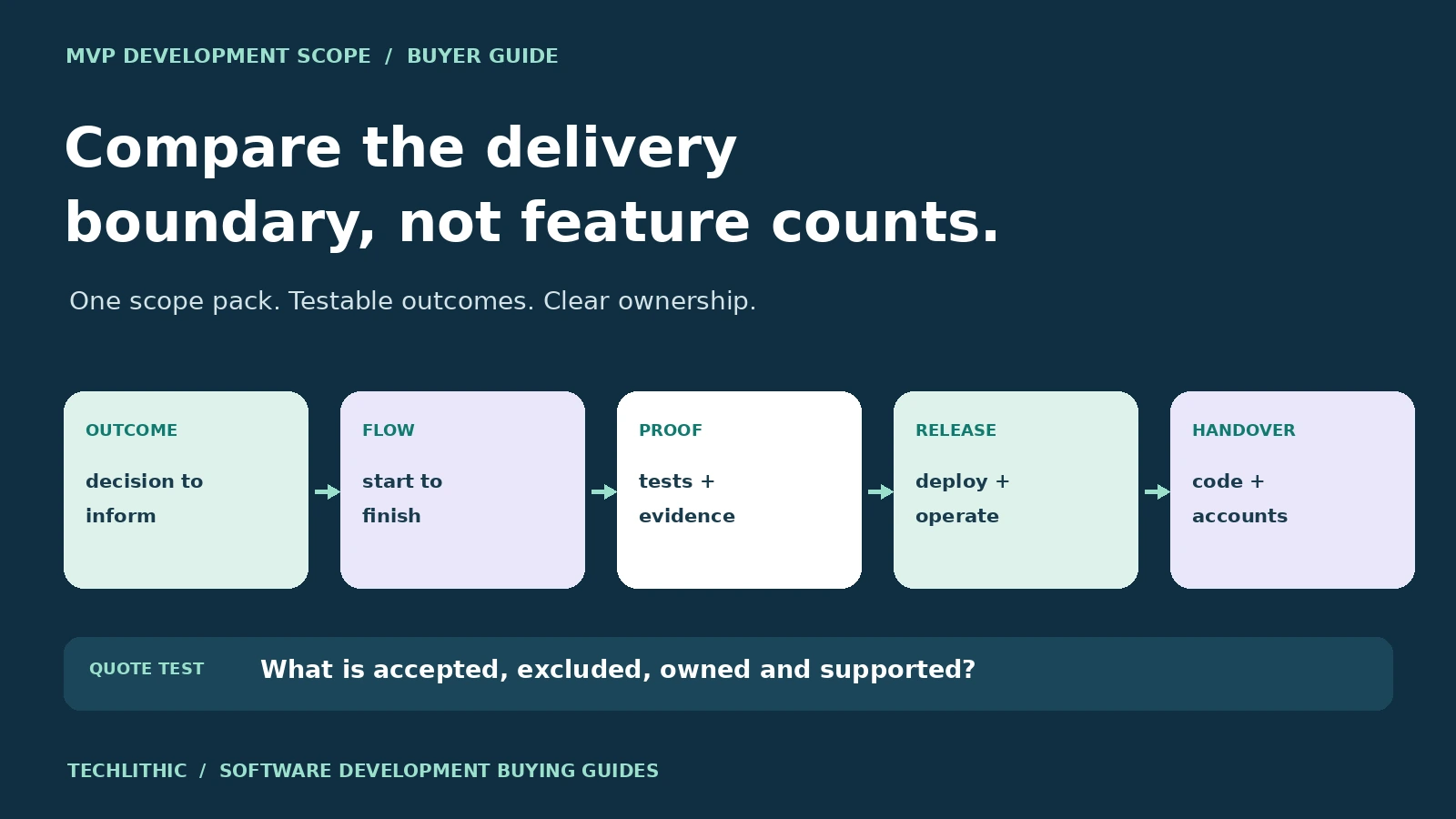
Give every provider one scope pack: target outcome, named users, end-to-end flows, testable acceptance criteria, data and integration contracts, non-functional requirements, deployment responsibilities, handover assets and a post-launch support boundary. Compare exclusions and risk assumptions beside price and schedule.
Define an MVP as a learning release, not a feature pile
An MVP should be the smallest releasable product that tests a business assumption with real users. Small does not mean incomplete. The release still needs a usable path, safe data handling and enough operational evidence to learn from.
Start with one decision: what should the team learn or prove? Examples include whether a buyer completes a self-service request, whether an operator can process that request efficiently, or whether a paid pilot reaches an activation milestone. Then name the user, starting condition, successful outcome and measurement event.
The official Scrum Guide describes an Increment as a usable, thoroughly verified step toward a product goal. It also defines a Definition of Done as the shared quality state work must meet before it counts as complete. [1] You do not need to use Scrum, but the principle is valuable in procurement: a feature is not complete merely because a screen exists.
Write explicit exclusions. If social login, native mobile apps, multilingual content, subscription billing or complex roles will wait, say so. Exclusions make a quote comparable and protect the MVP from accidental expansion.
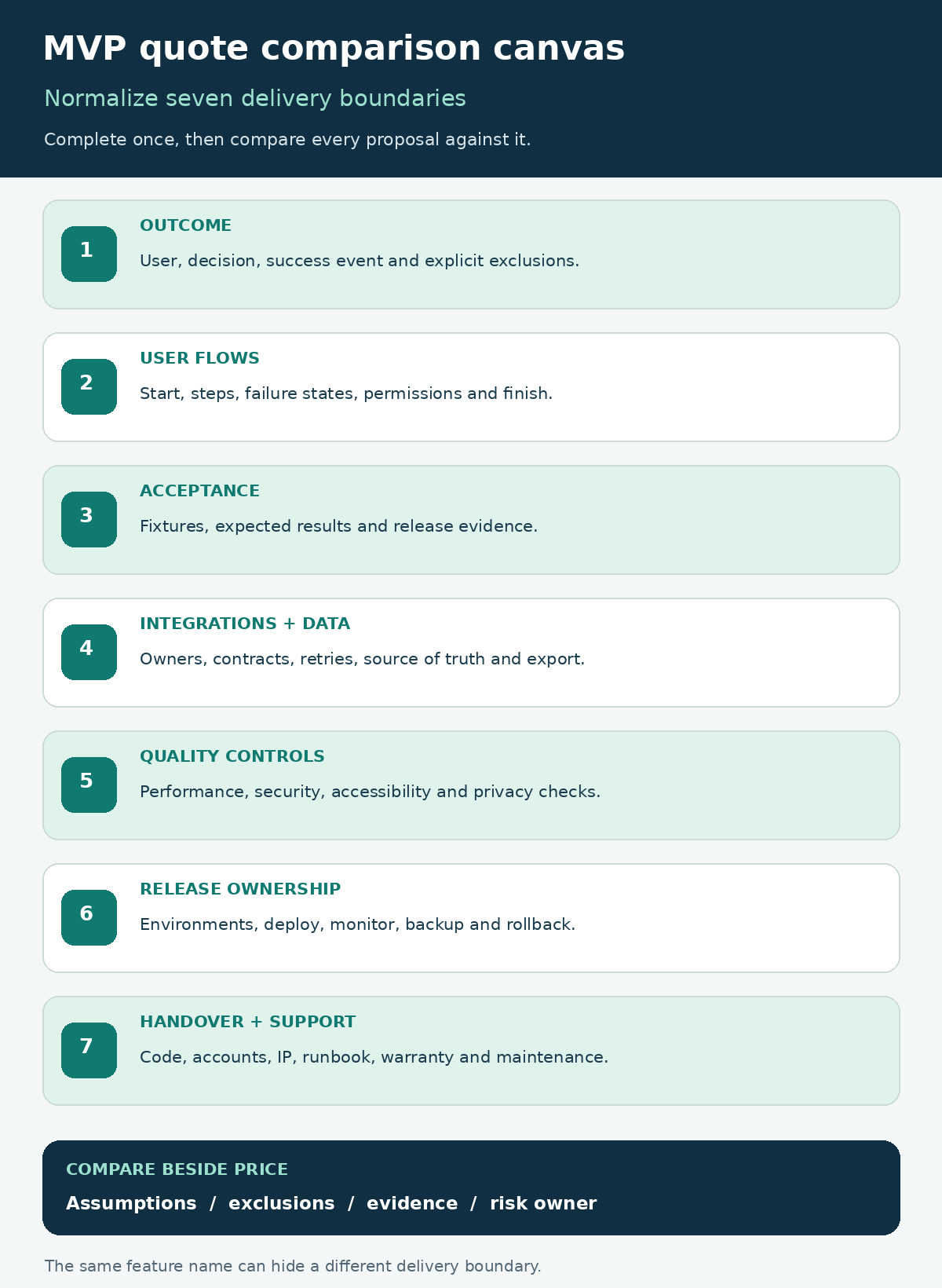
Give every provider the same scope pack
A vendor cannot price unknowns precisely. Reduce uncertainty with a compact source pack rather than a long wishlist. Include the business outcome, user types, priority flows, content owner, current systems, data sensitivity, required integrations, target devices, expected launch environment and known constraints.
For each flow, supply a start, steps, decisions, failure states and finish. A marketplace request may include account creation, form validation, duplicate detection, document upload, notification, operator review and status update. The quote should show which parts are custom, configured, purchased or deferred.
| Scope item | What the buyer supplies | What the proposal must answer |
|---|---|---|
| Outcome | One learning or business decision | How the release will produce evidence |
| Users | Named roles and permissions | Which roles and edge cases are included |
| Flows | Start, steps, exceptions and finish | Which flows are end to end |
| Systems | Current tools, APIs and owners | Dependencies, access and fallback |
| Release | Target environment and approvers | Who deploys, monitors and rolls back |
Ask providers to return questions and assumptions before final pricing. A quote with a large hidden assumption budget is not fixed merely because the total is fixed.
Turn each user flow into acceptance evidence
Acceptance criteria should describe observable behavior, not internal activity. Replace “build onboarding” with conditions such as: a new user verifies an address, an expired link is rejected safely, required fields show useful errors, a duplicate account does not appear and the owner can see an audit event.
Cover the happy path, expected mistakes, dependency failures and permissions. For every flow, record the test data, action, expected result and evidence. Evidence might be a test result, exported record, log entry, accessible interaction or controlled deployment.
Create a product-level Definition of Done that applies to every included flow. It can require review, automated checks, responsive behavior, agreed browser coverage, no unresolved critical defects, safe secret handling, analytics events, release notes and updated documentation. Keep it short enough to enforce.
Do not accept percentage-complete language without a rule for completion. A flow is either accepted, conditionally accepted with a recorded issue, or not accepted. Link invoice milestones to accepted outcomes or agreed delivery evidence rather than calendar dates alone.
Specify integrations and data ownership as contracts
Integrations create disproportionate uncertainty because another system controls authentication, rate limits, schemas, availability and change. Name the exact provider, account owner, environment, API or file interface, direction of data, trigger, latency target, retry rule and duplicate-prevention method.
For HTTP APIs, an OpenAPI description can make endpoints, operations, inputs and responses machine-readable. The current OpenAPI Specification describes a language-agnostic interface that lets people and tools understand an API without inspecting source code or network traffic. [2] The contract does not replace business rules, but it reduces guesswork about the interface.
Define a source of truth for each important record. State which system owns the customer, order, entitlement or status; how identifiers map; what happens on partial failure; and how a replay avoids duplicates. Include sample payloads with synthetic data and a named person who can grant sandbox access.
Clarify data residency, retention, deletion, backups and export. List personal, financial, health or confidential data separately. If the MVP does not need a sensitive field, leave it out. Require the buyer to own production accounts and approve access instead of allowing personal developer accounts to become permanent infrastructure.
Price quality, security and accessibility explicitly
“Production ready” is too vague for a contract. Define performance scenarios, supported devices, availability expectations, recovery behavior, logging, privacy controls, accessibility target and security verification that fit the risk.
OWASP ASVS provides testable web application security requirements and explicitly supports procurement and contractual verification. The latest stable ASVS shown by OWASP is version 5.0.0, published in May 2025. [3] Do not paste the whole standard into a small MVP. Select applicable requirements, record the version and require evidence for those controls.
NIST's final Secure Software Development Framework version 1.1 provides a common vocabulary for secure development and notes that software purchasers can use it in supplier acquisition discussions. [4] Use that vocabulary to ask who reviews code, manages dependencies, protects secrets, handles vulnerabilities and preserves release integrity.
For a web product, choose an accessibility target and test method. WCAG 2.2 provides testable success criteria with A, AA and AAA conformance levels, and W3C advises use of the current version for new or updated policies. [5] Automated checks are useful, but keyboard use, focus behavior, labels, errors and screen-reader flows also need human evaluation.
Separate build completion from release and handover
A demo on a developer laptop is not a production release. The proposal should identify development, test and production environments; hosting owner; domain and certificate owner; configuration method; database migration path; backup and restore process; monitoring destination; incident contact; and rollback authority.
Require a release rehearsal before launch. It should create the production build from the agreed repository, apply configuration without copying secrets into code, run migrations, execute smoke tests and show how to return to a known good version. Record the steps in a runbook that another qualified engineer can follow.
Handover should include source code and history, infrastructure configuration, database schema and migrations, dependency inventory, design source files, test fixtures and results, analytics definitions, environment-variable list without secret values, known issues, operating runbook and access map. Production credentials should move through approved account controls, not a document.
State intellectual-property terms in the contract: ownership of custom code, license to pre-existing components, third-party and open-source licenses, reuse rights and the point at which ownership transfers. Obtain legal review appropriate to the parties and jurisdiction. “Full source provided” does not by itself resolve licensing or ownership.
Normalize quotes before comparing price
Put proposals into the same cost structure: discovery, product design, interface design, engineering, integration, data migration, test automation, manual testing, security work, accessibility evaluation, infrastructure, launch, documentation, training, warranty and ongoing maintenance. Separate one-time work from recurring services and pass-through vendor fees.
For schedule, compare assumptions about response time, content delivery, API access, app-store or provider review and stakeholder acceptance. Ask for the critical dependencies and the consequence if the buyer supplies an item late.
| Comparison question | Quote A | Quote B |
|---|---|---|
| End-to-end flows included | List by accepted outcome | List by accepted outcome |
| Named exclusions | Record explicitly | Record explicitly |
| Acceptance evidence | Tests, demo and records | Tests, demo and records |
| Production release | Included owner and steps | Included owner and steps |
| Handover | Artifacts and access | Artifacts and access |
| Post-launch boundary | Warranty and maintenance | Warranty and maintenance |
Do not force every provider into the same technical approach. Normalize outcomes and obligations, then let providers explain architectural tradeoffs. A higher quote may carry less buyer risk; a lower quote may be correct for a disposable experiment. The exclusions decide which is true.
Worked example: scope a request-management MVP
Consider an invented B2B service that wants to test whether customers will submit structured requests and whether an operations team can process them without email. The first release has two roles: requester and operator.
The approved customer flow is account verification, new request, validation, document upload, confirmation and status view. The operator flow is queue view, assignment, request detail, status update and customer notification. Payment, chat, mobile apps, multilingual content and advanced reporting are excluded.
Acceptance fixtures include a valid request, missing required data, disallowed file, duplicate submission, expired verification link, unauthorized record access, unavailable notification provider and retry after a timeout. Each fixture has an expected customer message, stored state and log event.
The release uses buyer-owned hosting and email-provider accounts. Production acceptance requires the repository, deployment workflow, database migrations, monitoring alert, backup test, analytics events, accessibility review of both flows, selected security checks, runbook and access map. A two-week defect warranty covers behavior that fails an accepted criterion; new workflows enter a separately estimated backlog.
This example does not predict cost or schedule. It shows why “login, dashboard and request form” is not enough to compare proposals. The evidence, failure behavior and ownership items reveal the actual delivery boundary.
Use this MVP buyer acceptance checklist
Before signing, confirm the following:
- One target outcome and the decision the MVP should inform are written down.
- Every included user role and permission boundary is named.
- Each priority flow has a start, finish, exception paths and testable acceptance criteria.
- Integrations identify the real provider, account owner, interface, retries, limits and fallback.
- Important records have a source of truth, identifier, retention rule and export path.
- Applicable performance, browser, accessibility, privacy and security controls are versioned and testable.
- Production deployment, monitoring, backup, incident and rollback responsibilities are assigned.
- Custom IP, pre-existing components, open-source licenses, repositories and accounts have clear ownership terms.
- Handover artifacts, training, warranty, maintenance and change control are priced separately.
- Milestones depend on accepted evidence and record how rejected or conditional work is handled.
Delay the build if the target user cannot be reached, the core workflow still changes daily, the buyer cannot supply required system access or nobody owns product decisions. A prototype, service-assisted pilot or clickable test may answer the next question more cheaply.
A bounded SaaS product development scope or startup consulting engagement should withstand the same comparison. If APIs carry most of the risk, use a separate API development workstream. TechLithic offers these services, but the acceptance standard should apply equally to TechLithic and any competing provider.
For data movement and operational failure handling, see the CRM and ecommerce integration scoping guide. For the broader software selection process, use the SaaS buying due-diligence checklist.
Frequently asked questions
How detailed should an MVP scope be before requesting quotes?
It should define the outcome, users, priority flows, exceptions, integrations, data ownership, quality requirements, release responsibilities and handover. Providers can still propose the architecture and refine tasks during discovery.
Should an MVP quote be fixed price or time and materials?
Either can work. Fixed price needs bounded acceptance criteria and a change process. Time and materials needs a budget cap, prioritized backlog, frequent demonstrations and transparent burn reporting. Compare the risk allocation, not only the billing label.
What is normally excluded from MVP development?
Exclusions vary, but content production, data cleanup, third-party fees, legal review, app-store approval, advanced analytics, migration, penetration testing, ongoing cloud costs and post-launch support are often separate. Require every exclusion in writing.
Who should own hosting and production accounts?
The buyer should generally own the production domain, cloud, email, payment and analytics accounts, with role-based access for the delivery team. This reduces lock-in and makes handover safer.
When should a startup use a prototype instead of an MVP?
Use a prototype when the main uncertainty is comprehension, desirability or workflow shape and real production behavior is not yet required. Use an MVP when real users must complete a safe, measurable end-to-end task.
What should happen after MVP launch?
Define monitoring, incident ownership, a defect warranty, maintenance options, analytics review and the decision point for the next release. Do not let an unspecified support period become an assumed obligation for either party.
Sources and research notes
Sources checked on 2026-10-23. Pricing and policy documents can change; verify current terms before approving expenditure.
- Scrum Guides: The 2020 Scrum Guide
Primary framework source for the Product Goal, usable Increment and Definition of Done concepts used to make acceptance transparent.
- OpenAPI Initiative: OpenAPI Specification 3.2.1
Authoritative interface specification checked for its description of machine-readable, language-agnostic HTTP API contracts.
- OWASP: Application Security Verification Standard
Primary security standard source. OWASP identifies ASVS 5.0.0 as the latest stable release and explains its procurement use.
- NIST SP 800-218: Secure Software Development Framework 1.1
Current final NIST SSDF publication. NIST also lists version 1.2 as a draft, so this article cites the final 1.1 release.
- W3C: Web Content Accessibility Guidelines 2.2
Official W3C Recommendation used for testable web accessibility criteria and conformance levels.
Official Scrum Guides, OpenAPI Initiative, OWASP, NIST and W3C sources were checked on October 23, 2026. OWASP ASVS 5.0.0 is the latest stable release shown by OWASP. NIST SSDF 1.1 remains the final publication while version 1.2 is listed as a draft. The quote canvas, comparison table, worked example and acceptance checklist are original educational frameworks. Contract, IP, privacy and compliance terms require advice for the actual parties, product and jurisdictions.