
Performance marketing buying guides
Click-to-WhatsApp Funnel: What to Test Before Scaling Ads
A Click-to-WhatsApp campaign is not ready to scale because people start conversations. The ad, first message, routing, operator response, qualification, follow-up, measurement and recovery path must work as one controlled funnel.
Prepared with AI assistance and checked against the linked sources. Numerical comparisons are illustrative unless expressly sourced.
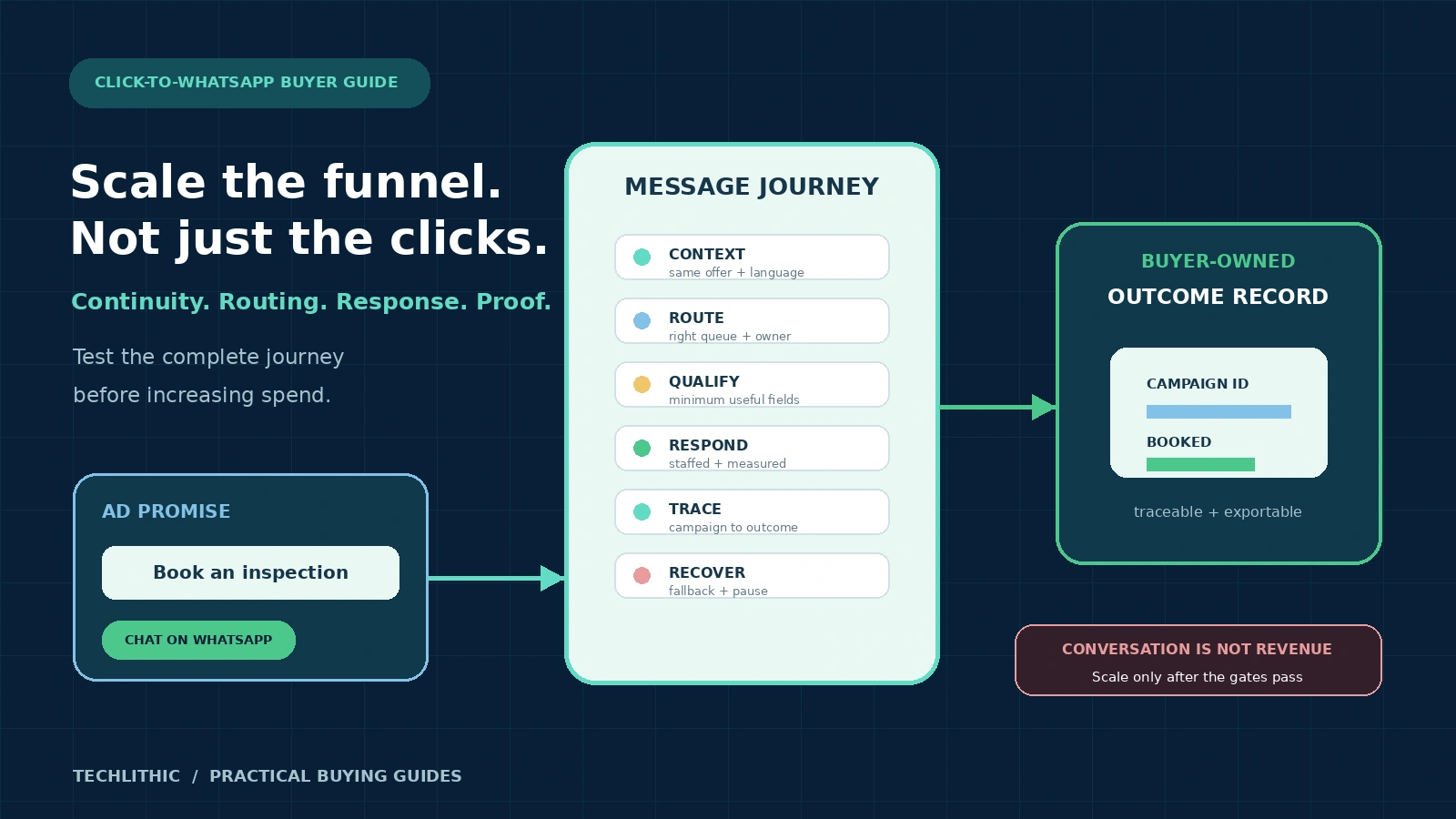
Scale only after a representative pilot proves eight linked gates: offer continuity, compliant messaging, reliable message capture, correct routing, usable qualification, staffed response, reconciled outcomes and tested recovery. Treat conversations as an intermediate event, not revenue. Keep campaign identifiers, consent evidence, CRM outcomes, response timestamps, exclusions and stop rules in buyer-owned systems so performance can be explained after the agency or platform changes.
Define the scale decision before buying traffic
Name the business outcome and the decision the pilot must support. A conversation-start objective can help attract people likely to interact, but it is not the same as a qualified lead, booked appointment, completed order or collected payment. Meta's current ad-set reference lists WhatsApp as a destination for engagement campaigns optimized around conversations or link clicks, and also lists WhatsApp conversion events under sales configurations. [1] The buyer still needs its own definition of success.
Write the funnel as observable states: ad impression, click, WhatsApp conversation start, first business response, qualification complete, offer or appointment, accepted outcome, revenue when applicable, and closed-lost reason. For each state, identify the source system, timestamp, stable identifier and owner.
Set a bounded pilot volume and duration based on operational capacity, not an invented universal benchmark. State what would justify scale, what requires another test and what pauses the campaign. If the team cannot process the expected conversations during the pilot, higher spend will only buy a larger queue.
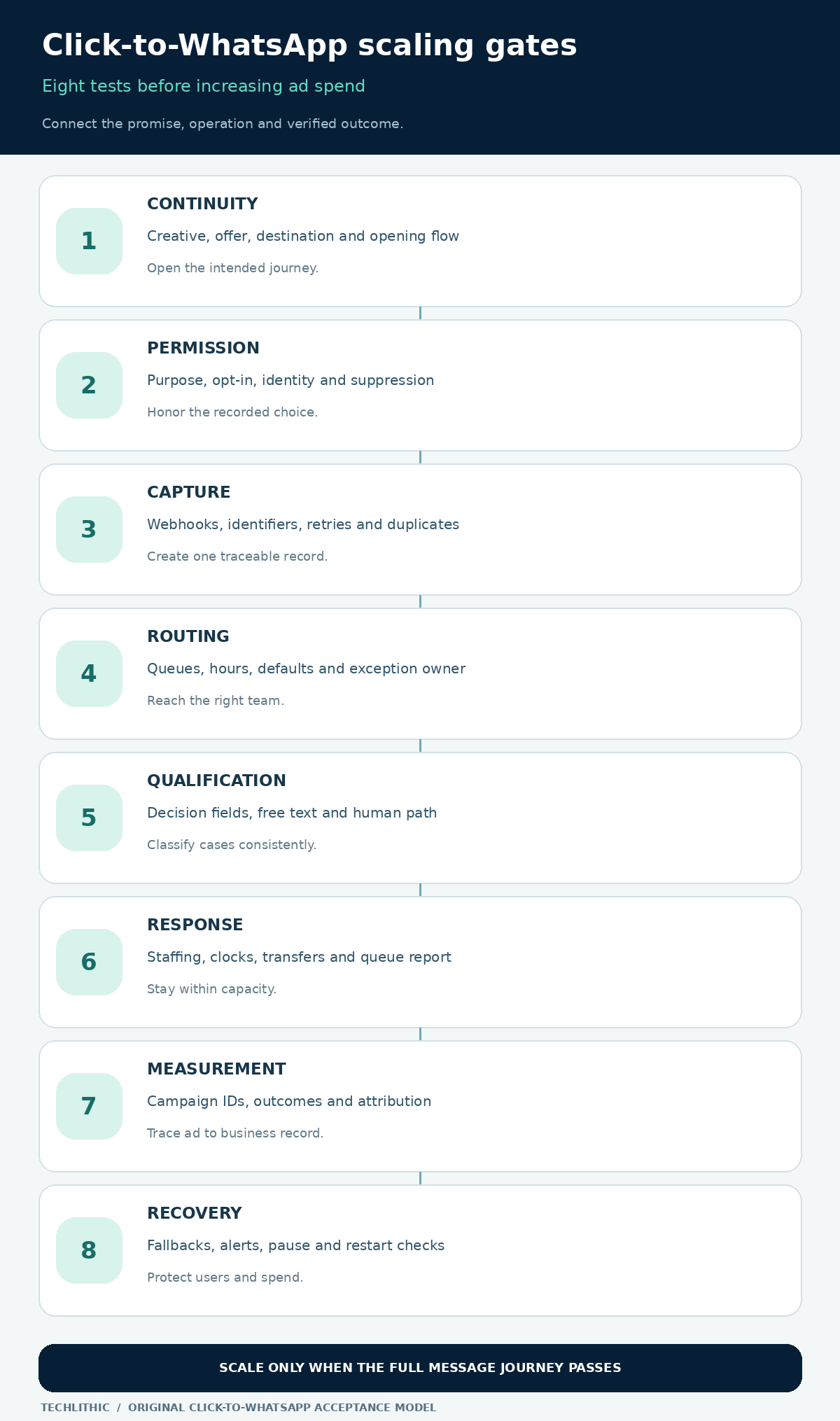
Keep the ad promise and first message continuous
The user should not have to reconstruct the ad after opening WhatsApp. Map every creative and audience to the exact destination number, prefilled text or welcome flow, offer terms, language and responsible queue. The first business response should acknowledge the same problem, product, location and next step shown in the ad.
Create a message-continuity sheet with campaign, ad set, ad, creative version, destination, opening prompt, routing tag, qualification script and expiry date. Test every live combination on actual supported devices. A generic hello that discards the offer or asks the user to repeat information adds avoidable friction and makes creative-level diagnosis harder.
Meta's Marketing API documentation treats campaigns, ad sets and creatives as separate managed objects and supports advertising across Facebook, Instagram, Messenger and WhatsApp. [2] Preserve those identifiers beside the conversation record. Names alone are weak keys because teams rename, duplicate and archive ads.
Separate the incoming conversation from future marketing permission
A person clicking an ad and sending a message creates a user-initiated conversation. Do not automatically treat that interaction as unlimited permission for unrelated future promotions. Define what the user requested, what follow-up is needed to fulfill it, which additional message categories require an explicit choice, and how opt-out requests are enforced across tools.
The WhatsApp Business Messaging Policy, updated September 23, 2026, requires accurate business identity, explicit opt-in before subsequent business messaging, clear disclosure of the business name and respect for requests to stop communications. It also distinguishes the customer-service window from business-initiated template messaging and requires clear escalation routes for automation. [3]
Acceptance evidence can include the source and timestamp of permission, disclosed purpose, business identity, categories selected, withdrawal status and suppression propagation. Legal requirements vary by location and use case, so policy compliance is a floor, not a complete legal analysis.
Prove that every message is captured and routed once
Document how inbound messages reach the inbox or CRM, how retries behave, how duplicates are prevented and what happens when the integration is unavailable. Meta describes webhooks as a core part of the WhatsApp Business Platform. [4] Its general webhook guidance requires a secure HTTPS endpoint, verification and event notifications delivered as POST requests. [5]
Define routing using observable fields such as language, location, product, existing-customer status, operating hours and agent skill. Keep a default queue for missing or conflicting data. The user should receive a truthful acknowledgement that reflects current staffing, not a promise of an immediate reply when the team is offline.
Run controlled tests for new leads, existing customers, unsupported regions, after-hours traffic, duplicate webhook delivery, delayed events, malformed payloads and a temporarily unavailable CRM. Check that one user does not create several competing records and that a failed route appears in an exception queue with an owner.
Qualify with the minimum information needed for the next decision
Qualification should reduce wasted handling without turning WhatsApp into a long form. Ask only what changes the next action: intended product, location, timeframe, quantity, budget band or eligibility where appropriate. Explain why sensitive information is needed and move regulated or confidential data to a suitable secure channel.
Design paths for button selection, free-text reply, ambiguous answer, no response and a request for a human. Save both the normalized field and the original message context where permitted. A forced chatbot path should not trap a high-intent user whose answer does not fit the menu.
Agree the qualified-lead rule before launch and test it with representative examples. Separate invalid, unqualified, duplicate, existing-customer, support and sales conversations. This prevents the media team from calling every message a lead while operations reports a much smaller usable pipeline.
Match spend to response capacity and ownership
Forecast conversations by hour and map them to staffed capacity, languages and escalation coverage. Define the timestamp that starts the response clock, what counts as a meaningful response, when ownership transfers and how unattended conversations surface. An automated acknowledgement is not a completed sales response.
Require queue-level evidence: unassigned count, age of oldest conversation, median and tail response times, transfer rate, abandonment, qualification outcome and unresolved exceptions. A single average can hide the campaign that arrives outside operating hours or the queue where routing fails.
Assign one owner at each point. Media owns creative and spend controls, the messaging team owns journey configuration, operations owns response, sales owns disposition, analytics owns definitions and the business owner approves scale. The provider may perform several roles, but the responsibility matrix should still exist.
Reconcile platform metrics with conversation and business records
Build three layers of reporting. The ad layer records delivery, spend, clicks and platform-attributed actions. The conversation layer records starts, valid inbound messages, response, qualification and routing. The business layer records appointments, orders, revenue, cancellations and refunds where applicable. Reconcile the layers without assuming they count the same event or use the same attribution rules.
Where a website or intermediate landing page exists, Google recommends consistent UTM parameters such as source, medium and campaign, with content values that distinguish creatives. [6] WhatsApp journeys may also carry platform-provided referral context. Preserve available identifiers through the inbox and CRM rather than relying on an agent's memory.
Attribution is a rule for assigning credit, not proof that an ad alone caused an outcome. Google Analytics documents that reporting models and lookback windows change which touchpoints receive credit. [7] Record the model, window, time zone, counting rule and date of changes. Compare platform reports with buyer-owned outcome records and explain differences instead of forcing totals to match.
Use an eight-gate scaling acceptance matrix
| Gate | Evidence to retain | Acceptance test |
|---|---|---|
| Continuity | Creative, offer, destination and opening-flow map | Every ad opens the intended message journey. |
| Permission | Purpose, opt-in, business identity and suppression record | Future messaging follows the recorded choice. |
| Capture | Webhook logs, identifiers, retry and duplicate rules | One test message creates one traceable record. |
| Routing | Queue rules, default path, hours and exception owner | Representative cases reach the right queue. |
| Qualification | Decision fields, examples, free-text and human path | Two reviewers classify the same cases consistently. |
| Response | Staffing plan, clocks, ownership and queue report | Traffic remains within agreed operating capacity. |
| Measurement | Campaign IDs, outcomes, attribution rules and reconciliation | A sample outcome traces from ad to business record. |
| Recovery | Fallbacks, alerts, pause authority and recovery log | Simulated failures protect users and stop waste. |
Do not average these gates into a single readiness score. A low cost per conversation cannot compensate for missing permission, unstaffed queues or untraceable outcomes. Define which gates block spend and which can remain open under a dated remediation plan.
Worked example: test a regional appointment campaign
Consider a fictional home-services company testing Click-to-WhatsApp ads for inspection bookings in one city. The pilot uses two creative messages but one offer, one number and a prefilled prompt carrying a campaign code. The team staffs the sales queue from 09:00 to 18:00 and shows an accurate after-hours response.
A test set covers a new eligible lead, an existing customer, an address outside the service zone, free text instead of the menu, duplicate webhook delivery and a CRM outage. The eligible lead reaches the sales queue once, receives a human response, supplies the minimum address and timing details, and books through the approved workflow. The out-of-area user receives a truthful alternative. Existing customers route to support without inflating lead counts.
The team samples records and traces campaign ID, first message, response timestamp, qualification, appointment and final disposition. It compares ad-reported conversations with unique valid inbound conversations and booked inspections. Differences remain visible with reasons such as duplicates, support contacts or attribution-window rules.
The numbers in this example are deliberately omitted because the right threshold depends on capacity and economics. Scale is approved only if the eight gates pass and the team can handle the next spend level. Otherwise the campaign pauses, the failed gate gets an owner, and the pilot repeats.
Test failure paths before they consume media budget
Simulate the destination number being unavailable, a disconnected ad account link, webhook delay, CRM rejection, exhausted agent capacity, a broken booking link, missing campaign context and an operator who cannot transfer a conversation. For each failure, specify detection, user message, queue behavior, data preservation, escalation and the person authorized to pause ads.
Create spend stop rules around operational failures, not only media metrics. If messages are not entering the inbox, no responder is available or outcome data stops reconciling, continued spend can make the funnel worse. The pause owner needs access and an out-of-hours contact path.
Keep a recovery log with incident start, affected campaigns, user impact, spend exposure, mitigation, restored time and follow-up work. After recovery, run a controlled message through the complete path before restarting every campaign.
Use this buyer checklist before increasing spend
- The pilot names the business outcome, observable funnel states and scale decision.
- Every creative maps to the intended number, opening message, language, offer and queue.
- User-initiated service and future marketing permission are recorded separately.
- Inbound events preserve identifiers and handle retries, duplicates, delays and malformed data.
- Routing covers operating hours, languages, existing customers, unsupported cases and a default queue.
- Qualification asks only decision-relevant questions and provides a free-text and human path.
- Staffing, response clocks, ownership, transfers and queue exceptions are measurable.
- Ad, conversation and business outcomes are reconciled under documented counting and attribution rules.
- Campaign and outcome records remain exportable in buyer-owned accounts.
- Failure tests define user communication, alerts, fallbacks, pause authority and restart checks.
- The next spend step fits proven response capacity and unit economics.
- Handover includes campaign maps, flow versions, routing rules, consent fields, reports and unresolved risks.
Compare providers against the same pilot, data boundary and acceptance tests. A self-managed setup may be sufficient when the team already owns media, messaging and sales operations. Buy implementation or managed support when the missing capability has a defined output and owner.
TechLithic offers Click-to-WhatsApp funnel setup, Meta ads management and marketing analytics. Apply this checklist equally to TechLithic and competing providers. For broader commercial assumptions, use the paid marketing proposal guide; for event-level validation, see the conversion tracking acceptance plan.
Frequently asked questions
Is a WhatsApp conversation the same as a qualified lead?
No. A conversation is an intermediate interaction. Define qualification using decision-relevant fields and keep support, duplicate, invalid and unqualified contacts separate.
Does clicking a WhatsApp ad provide permission for future promotions?
Do not assume it does. Record the user's request and obtain explicit, purpose-specific permission for subsequent business messaging as required by WhatsApp policy and applicable law.
What response time should a Click-to-WhatsApp campaign promise?
Use a target the staffed operation can meet during disclosed hours. Define when the clock starts, what a meaningful response is and what the user sees after hours.
Why can platform conversation counts differ from CRM lead counts?
The systems may use different identifiers, event definitions, filters, attribution windows and counting rules. Reconcile sample records and explain duplicates, support contacts and missing outcomes.
When should the buyer pause spend?
Pause when a blocking acceptance gate fails, such as broken capture, unavailable responders, misleading user messages, missing permission controls or untraceable outcomes.
Sources and research notes
Sources checked on 2026-11-14. Pricing and policy documents can change; verify current terms before approving expenditure.
- Meta for Developers: Ad Set reference and ODAX mapping
Current Meta reference mapping WhatsApp destinations to engagement and sales configurations, optimization goals and supported events.
- Meta for Developers: Marketing API overview
Official overview of campaign, ad-set, creative, management and measurement capabilities across Meta technologies.
- WhatsApp Business Messaging Policy
Policy updated September 23, 2026 covering business identity, explicit opt-in, customer-service messaging, templates, opt-outs and automation escalation.
- Meta for Developers: WhatsApp Business Platform overview
Official platform overview covering messaging, templates, webhooks, permissions and Cloud API capabilities.
- Meta for Developers: Get started with webhooks
Official webhook setup guidance for HTTPS endpoints, verification requests and event notifications.
- Google Analytics Help: Collect campaign data with custom URLs
Official guidance on UTM campaign parameters, consistent naming and creative-level differentiation.
- Google Analytics Help: Select attribution settings
Official explanation of attribution models, eligible channels, lookback windows and reporting effects.
All seven sources were opened and checked on November 14, 2026. Meta product and policy documentation can change, so buyers should verify current account options and terms before launch. The eight-gate model, regional-services scenario and acceptance tests are original educational frameworks. The example is fictional and contains no client result, universal benchmark or performance promise.