
Performance marketing buying guides
Conversion Tracking Implementation: A Buyer Acceptance Plan
A tracking setup is not finished because a tag fires or a dashboard shows conversions. Buyers need evidence that the right business event was recorded once, under the right consent state, with a stable identifier, usable value and a documented reporting boundary.
Prepared with AI assistance and checked against the linked sources. Numerical comparisons are illustrative unless expressly sourced.
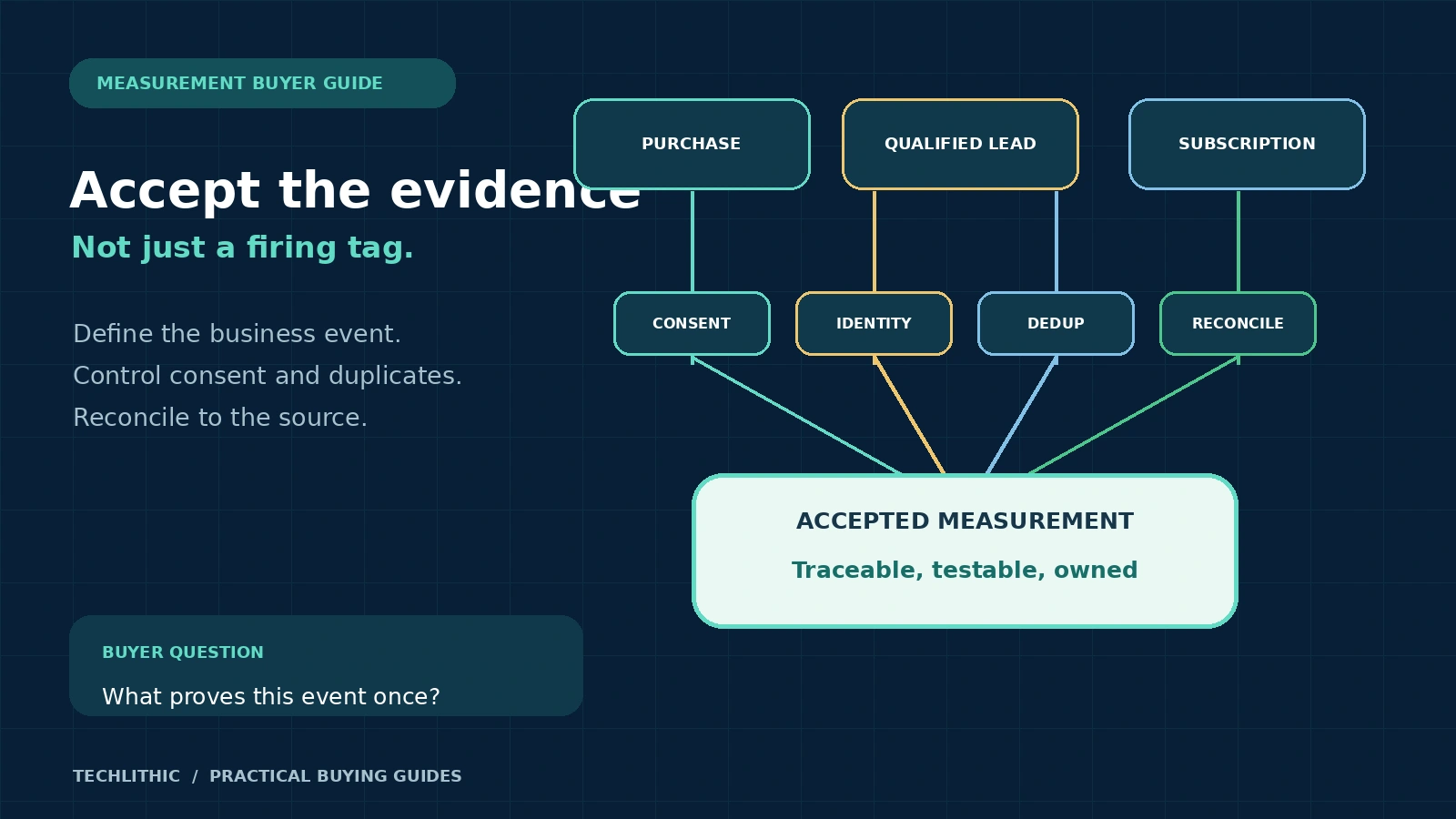
Buy a measurable event contract and an executable acceptance pack, not a list of installed tags. The final handover should prove event meaning, consent behavior, deduplication, reconciliation, access, monitoring and recovery across the systems that will use the data.
Define the business event before choosing tags
Start with the decision the measurement must support. A purchase event for campaign bidding, a qualified lead for sales planning and a trial activation for product analysis have different owners, fields and acceptance rules. A provider cannot make an ambiguous business milestone reliable by adding more tags.
Create an event contract before implementation. For every event, name the trigger, business definition, source system, required parameters, value and currency rule, unique identifier, consent dependency, destinations, retention owner and expected delay. Mark whether the event is diagnostic, a reporting key event or a primary bidding signal.
Use platform-recommended names where they genuinely match the business action. Google's ecommerce guidance defines events such as view, cart, checkout, purchase and refund, and illustrates purchase fields including transaction ID, value, currency and items. [1] The buyer should still document its own meaning for completion, cancellation and partial refund rather than copying a name without a business rule.
Keep micro-events out of the primary optimization set unless they represent a real objective. A button click may help diagnose a funnel, but it does not prove that a form was accepted, an order was paid or a lead was qualified.
Draw the measurement architecture and sources of truth
Ask the supplier to draw the route from user action to business record and every reporting destination. A typical path can involve a browser data layer, consent manager, tag manager, analytics property, advertising platforms, server endpoint, CRM, payment system and warehouse. Name the accountable owner at every boundary.
Choose one authoritative source for each fact. The order system can own paid amount and refund state, while the CRM can own qualification and closed revenue. The browser should not invent a completed order merely because a thank-you page loaded. Server events can improve resilience, but they introduce credentials, queues, retries and duplicate risk that belong in scope.
Google says its Measurement Protocol is intended primarily for trusted server-side or offline communication and warns that exposing an API secret can allow arbitrary events to corrupt a property. [2] Acceptance should therefore include secret storage, access restrictions, rotation ownership and a test showing that browser code cannot read server credentials.
Decide whether a client-only, server-assisted or hybrid design fits the risk and systems. Hybrid is not automatically better. It is useful only when browser and server events share identity and deduplication rules, and when the team can operate the added infrastructure.
Make consent behavior an acceptance gate
Consent is a functional requirement, not a banner styling task. The business owner and legal adviser should determine applicable regions, purposes, lawful basis, retention and withdrawal behavior. The tracking supplier should translate those decisions into an explicit test matrix without presenting implementation advice as legal clearance.
Google's current consent-mode guide requires a default state before measurement commands and an update when the user changes a choice. It also says the update should occur on the page where consent changes, before a transition. [3] Test first visit, accept, reject, category-level choice, return visit, withdrawal and a delayed consent platform. Inspect network requests and stored identifiers, not only the banner state.
Regulatory requirements vary. As one concrete example, Ireland's Data Protection Commission says targeted advertising and conversion-tracking cookies are not within its two listed consent exemptions. [4] Use the rules applicable to the buyer's markets and technology, and keep the approved consent matrix with the handover.
Acceptance fails if non-essential tags fire before the approved state, if withdrawal does not change later behavior, or if a newly added tag bypasses the consent controls. Include a regression test that can be rerun after container, banner or website releases.
Specify identity and deduplication across channels
A conversion can reach the same platform through a browser tag, a server API, an offline import or a partner connector. Define which combinations are allowed and the key used to recognize the same business event. Otherwise improved coverage can become double counting.
For purchases, use a stable, non-personal transaction identifier generated by the order system. Google Ads requires a dynamic unique transaction ID for each order, warns that reused IDs can undercount, and says the same ID must match exactly across additional sources for deduplication. [5] Test refresh, back-button, retry, duplicate webhook, delayed server delivery and two genuinely different orders.
Lead events need their own rule. A form submission ID, CRM record ID and later qualified-lead event may represent different stages, not duplicates. Keep a mapping between the original lead and downstream status. Never use an email address, phone number or another direct identifier as the transaction ID.
Write the collision and missing-ID behavior. A blank, static or unresolved test value should fail validation or enter a quarantine queue instead of silently becoming a conversion. Retain a test record that lets the buyer trace one accepted event across every destination without exposing personal data in screenshots.
Separate event accuracy from attribution credit
Event collection answers whether an action was recorded. Attribution assigns credit to interactions under a platform's model and window. A successful tracking test does not prove that a channel caused the action, and different platforms can legitimately claim credit for the same order.
Document the attribution model, click and view treatment, conversion window, timezone, currency, count setting and date basis in each reporting destination. Google's data-driven attribution uses an advertiser's account data to distribute credit across supported ad interactions. [6] That model is not the same thing as a neutral source-of-truth revenue ledger.
Choose primary and secondary conversion actions deliberately. A primary bidding action should be stable, meaningful and hard to trigger accidentally. Diagnostic actions can remain available without steering automated bidding. Require change control before an agency changes goals, imports, windows or attribution settings.
For commercial evaluation, use the paid marketing scope guide to align value, cost and attribution definitions. Do not add platform-reported revenue totals together. Reconcile them against unique business records and report overlap separately.
Reconcile recorded conversions with business outcomes
Define a recurring reconciliation that compares the source-of-truth records with analytics and advertising destinations. Use the same date basis, timezone, currency, event definition and maturity window. Record known exclusions such as denied consent, ad blockers, failed imports, late events and unsupported destinations.
A warehouse export can help the buyer retain event-level evidence and manage access. Google states that GA4 raw events can be exported to BigQuery and that the customer owns the exported data and controls permissions. It also notes that raw exports can differ from the Analytics interface because the interface adds processing and modeling. [7] Reconciliation must therefore explain which dataset is being compared, not demand artificial equality between unlike reports.
Plan for cancellations, returns and later qualification. Google Ads supports restating a value or retracting a conversion, with specific consequences for counts and bidding metrics. [8] The implementation scope should say who sends adjustments, on what schedule, how failures are retried and how the buyer verifies the result.
Use thresholds as investigation triggers, not universal truth. The acceptable gap depends on consent, channel, sales cycle and system latency. Require the supplier to explain each material gap with evidence and assign corrective ownership.
Turn the specification into an executable acceptance matrix
Acceptance needs repeatable tests in a controlled environment and a limited production verification. Google's Measurement Protocol documentation says malformed requests may not produce normal HTTP errors and recommends using the validation server before production. [9] Apply the same principle to every integration: validate payloads, then verify the real destination and business record.
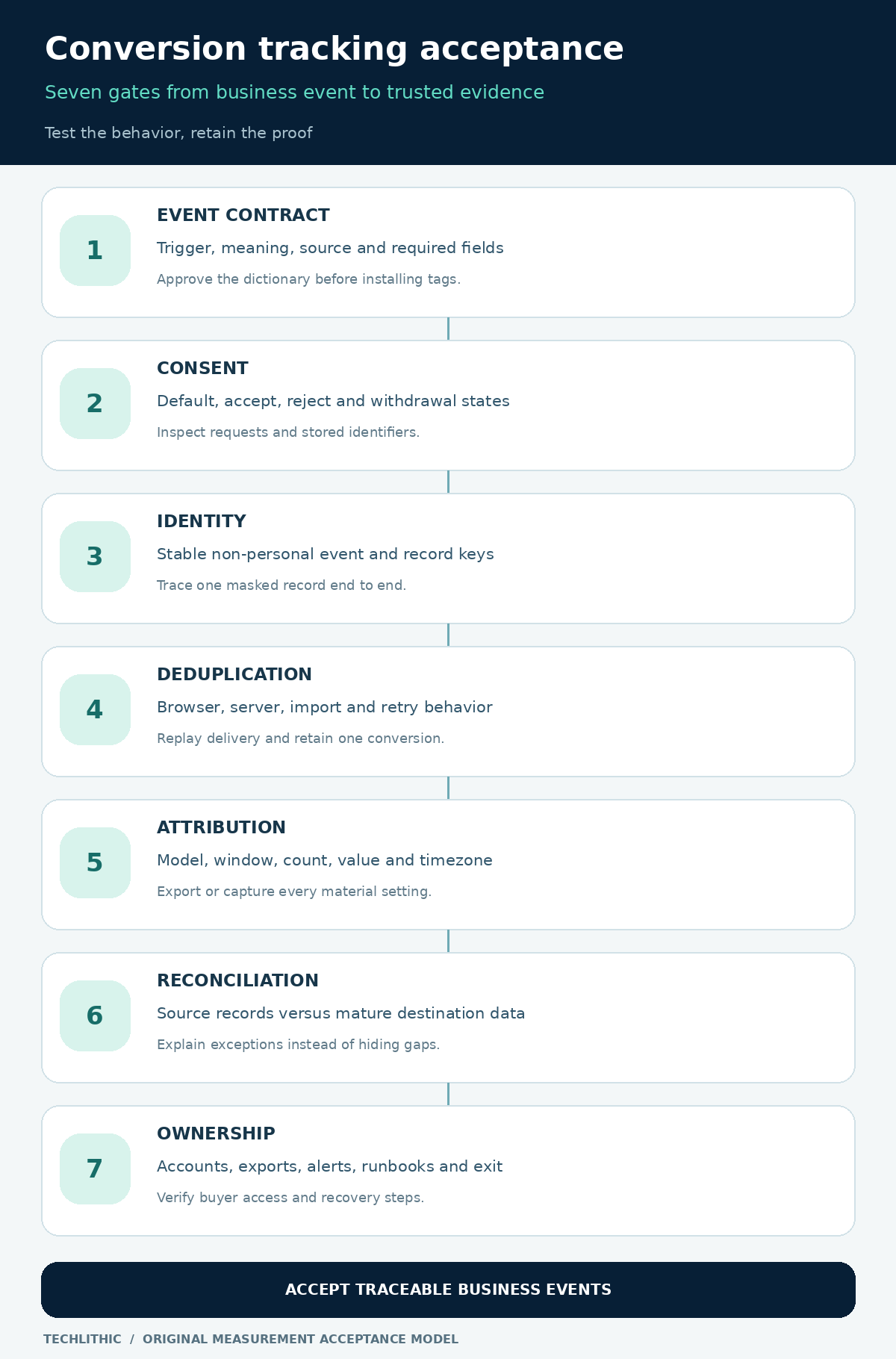
| Gate | Test | Evidence |
|---|---|---|
| Event contract | Trigger valid, invalid and boundary actions | Approved dictionary and captured payloads |
| Consent | Accept, reject, partial choice and withdrawal | Network and storage observations by state |
| Identity | Trace one event across browser, server and CRM | Masked identifier map |
| Deduplication | Replay refresh, retry and duplicate delivery | One accepted business conversion |
| Attribution | Check model, window, value and count settings | Configuration export or dated screenshots |
| Reconciliation | Compare a mature test cohort by unique ID | Exception report with explanations |
| Operations | Disable a tag, expire a secret and fail an import | Alert, owner and recovery record |
Include negative tests. Confirm that test orders are excluded or reversed, personal data is not placed in prohibited fields, duplicate events do not multiply value, and failed events can be replayed safely. Record browser, device, consent state and release version for each test.
Worked example: accepting an ecommerce purchase event
Consider an invented online store. This is an educational example, not a client result. Its order service creates order TL-10482 after confirmed payment. The approved purchase event carries that transaction ID, net item value of 120.00, currency INR and two item records. Tax and shipping are kept in their named fields.
The browser sends the event after the approved consent state. A server worker receives the payment confirmation and sends the same business event to the allowed destinations. Both routes carry the same transaction ID and agreed event time. The thank-you page can be refreshed, and the webhook can be replayed, but each destination must retain one purchase with value 120.00.
The tester then creates a second real test order with a different ID, rejects analytics consent in an applicable region, withdraws consent after acceptance, submits a malformed server payload and simulates an expired API secret. The expected behavior for each case is written before execution.
After the return window, the first order receives an invented partial refund of 20.00. The source-of-truth order value becomes 100.00. The scheduled adjustment process restates supported advertising conversions, while the warehouse records both the original purchase and refund. The reconciliation report explains timing and platform differences rather than overwriting history.
The acceptance pack contains the event contract, consent results, masked payloads, destination screenshots, source-to-destination row counts, duplicate test, adjustment evidence, account access list and recovery runbook. A dashboard screenshot alone would not be enough.
Compare implementation scope, ownership and ongoing cost
Ask each supplier to mark discovery, data-layer work, tag configuration, consent integration, server hosting, CRM mapping, platform setup, testing, documentation, monitoring and support as included, optional or excluded. Separate one-time implementation from recurring cloud, consent-platform, warehouse, connector and maintenance costs.
Require buyer-owned accounts or documented transfer rights for the tag manager, analytics property, advertising accounts, cloud project, source repository and dashboards. Grant the supplier least-privilege access and define removal at handover. Store secrets in the appropriate server-side system, never in a shared document.
A marketing analytics implementation should leave behind the event contract, data flow, consent matrix, test fixtures, configuration inventory, reconciliation query, alert ownership and runbook. Apply these standards to TechLithic or any other supplier. If later-funnel data comes from the CRM, define that boundary through the CRM and ecommerce integration scope.
Reject fixed claims of perfect attribution or zero data loss. Browsers, consent choices, platform processing and offline systems create real limits. A credible proposal states those limits and defines how the buyer will detect material drift.
Use a buyer checklist before sign-off
- Does every event have a business owner, trigger, source of truth and required field list?
- Are primary bidding events separated from diagnostic events?
- Is consent behavior approved for each relevant region and purpose?
- Do tests cover accept, reject, partial choice, withdrawal and delayed consent loading?
- Are browser, server, CRM and import routes shown in one data-flow diagram?
- Is one stable non-personal identifier shared wherever deduplication requires it?
- Do refresh, retry, duplicate webhook and delayed delivery tests produce one conversion?
- Are attribution model, windows, timezone, currency, count and value rules recorded?
- Can a buyer trace a masked test record from the source system to every destination?
- Are cancellations, refunds, rejected leads and later qualification handled?
- Does reconciliation compare like-for-like data and explain known exclusions?
- Are malformed payloads, expired credentials and destination outages observable?
- Does the buyer own accounts, raw exports, documentation, code and runbooks?
- Are recurring platform, warehouse, hosting and maintenance costs visible?
- Can the complete acceptance suite be rerun after a release?
Delay campaign scaling when business events are not defined, consent is unresolved or source systems cannot produce stable identifiers. A short measurement discovery phase is often the correct first purchase. For broader campaign responsibilities, compare the performance marketing scope; for funnel changes, separate measurement from the conversion rate optimization work.
Frequently asked questions
What should a conversion tracking implementation include?
It should include an event contract, data-flow map, consent controls, identifiers, deduplication, destination configuration, attribution settings, validation, reconciliation, monitoring, access ownership and a repeatable acceptance pack.
Is a firing tag proof that tracking works?
No. A firing tag proves only that a request was attempted. Acceptance must confirm the business trigger, payload, consent state, destination record, duplicate behavior and reconciliation with the source system.
Should browser and server events both be sent?
Only when the use case justifies the extra coverage and the team can operate shared identity, deduplication, consent, credentials, retries and monitoring. A simpler design can be safer when those controls are absent.
Why do analytics and advertising reports disagree?
They can use different attribution models, windows, consent behavior, processing, timezones and date bases. Reconcile unique business records and document expected differences instead of forcing unlike reports to match.
Who should own the tracking accounts?
The buyer should normally own the business accounts, properties, cloud projects, source repositories and raw exports, while granting suppliers the minimum access needed and removing it at handover.
Sources and research notes
Sources checked on 2026-11-06. Pricing and policy documents can change; verify current terms before approving expenditure.
- Google Analytics: Measure ecommerce
Official event and parameter examples for ecommerce actions, including purchase, transaction ID, value, currency and items.
- Google Analytics: Send Measurement Protocol events
Official guidance for trusted server-side event delivery, including the risk of exposing an API secret.
- Google Tag Platform: Set up consent mode on websites
Official implementation order, default state, update behavior, withdrawal and timing guidance.
- Google Ads Help: Use a transaction ID to minimize duplicate conversions
Official requirements for unique, dynamic, non-personal transaction IDs, multi-source matching and implementation verification.
- Google Ads Help: About data-driven attribution
Official explanation of how account data is used to assign conversion credit across supported ad interactions.
- Google Analytics Help: BigQuery Export
Official documentation for raw-event export, ownership and access control, plus differences from processed Analytics reports.
- Google Ads Help: About conversion adjustments
Official behavior for restating conversion value and retracting conversions after returns, cancellations or other changes.
- Google Analytics: Validate Measurement Protocol events
Official validation-server workflow and the limits of relying on ordinary HTTP responses for payload correctness.
Official Google product documentation and Irish Data Protection Commission guidance were opened on November 6, 2026. Platform behavior and privacy requirements can change. The buyer must verify current product terms and obtain appropriate legal guidance for its markets. The ecommerce example, acceptance model, thresholds and implementation advice are original education, not a client result, benchmark, legal opinion or guarantee of attribution accuracy.