
Startup consulting buying guides
Customer Journey Consulting: What the Map Must Change
A customer journey map is useful only when it changes a product, process, channel or operating decision. A strong consulting engagement begins with a bounded customer task, gathers traceable evidence, connects visible touchpoints to the systems and teams behind them, prioritizes changes and leaves the buyer with owners, measures and an implementation handoff. This guide explains what to require before approving the work.
Prepared with AI assistance and checked against the linked sources. Numerical comparisons are illustrative unless expressly sourced.
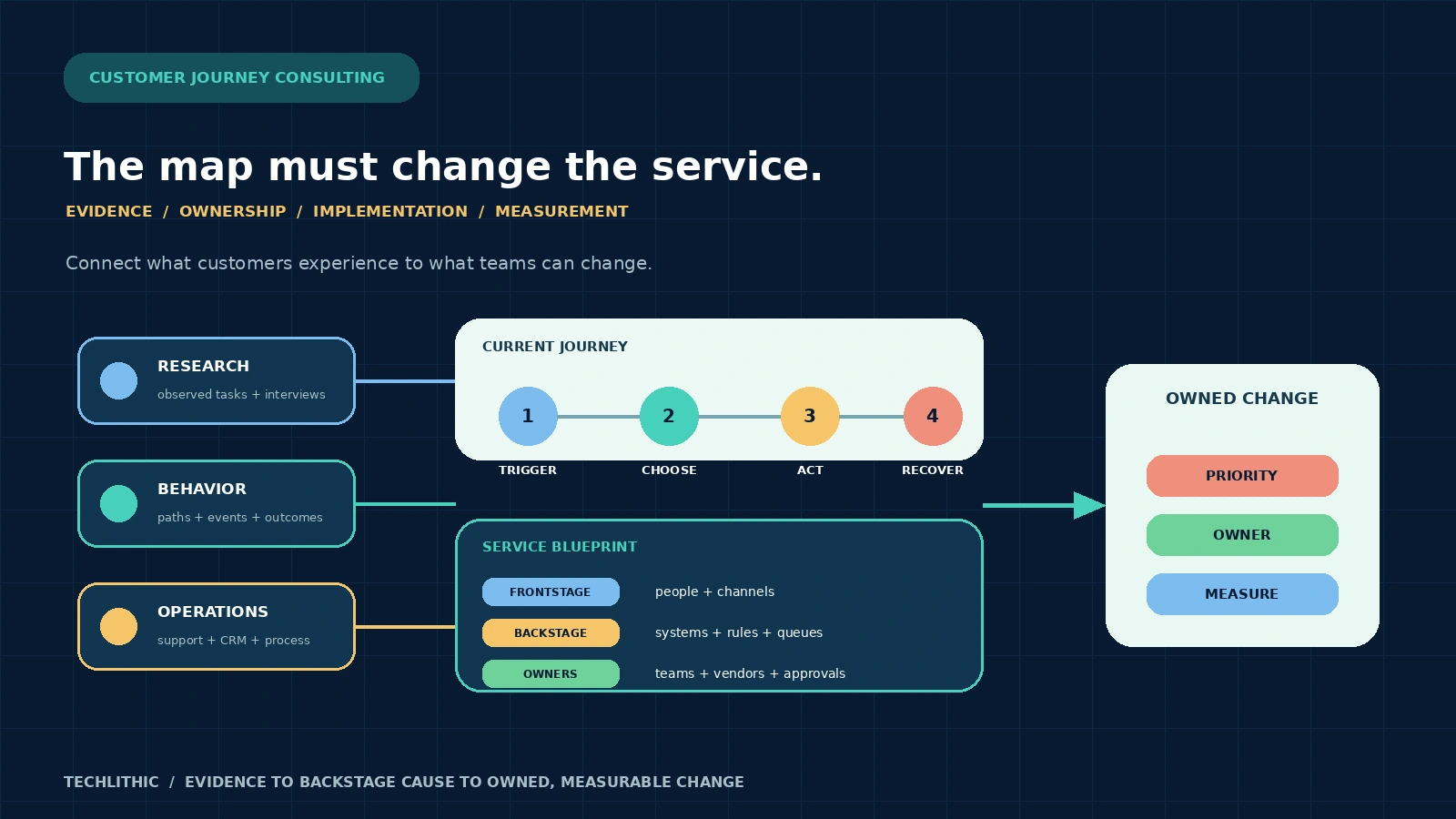
Buy a decision and change system, not a polished wall graphic. Require a defined journey and user groups, an evidence register, current-state journey map, service blueprint, issue and opportunity backlog, prioritization method, future-state hypotheses, measurement contract, implementation owners and buyer-owned handoff. Accept the engagement when findings trace to evidence and the first changes can be implemented, tested and reviewed without depending on the consultant.
Start with the decision, not the map format
Write the business decision the engagement must support. Examples include reducing failed onboarding handoffs, deciding which support journey to redesign, joining an advertising-to-sales path, or removing repeat contacts during a billing change. Name the journey start and finish, user groups, channels, markets, products and exclusions. A map of “the customer lifecycle” is usually too broad to research and change in one engagement.
Define who owns the journey inside the buyer's organization and which teams can change its parts. Complex journeys often cross organizational boundaries, and GOV.UK guidance recommends identifying the people and organizations involved before mapping. It also says the resulting understanding can help prioritize what delivery teams work on next. [1]
Ask the consultant to state the output-to-decision chain: this evidence will reveal these problems; these problems will be ranked by agreed criteria; accepted priorities will become these experiments or service changes; and the owner will review these measures. If the proposal ends at a presentation, the implementation gap already exists.
Require traceable evidence instead of workshop consensus
A kickoff workshop can align stakeholders, but it cannot establish the customer experience by itself. Require a research plan that names questions, participant groups, recruitment criteria, existing evidence, methods, access dependencies, consent process, sample limitations and expected outputs. Relevant inputs may include interviews, observed tasks, support conversations, complaint themes, surveys, search data, web or product analytics, CRM stages and operational records.
The evidence register should record the source, period, population, method, owner, limitation and finding ID. Mark assumptions separately from observed evidence. The USA.gov case study combined web analytics, satisfaction data, search behavior, contact-center usage and stakeholder sessions, then moved the resulting priorities into an improvement queue rather than treating the map as the finish line. [2]
Research data needs a defined privacy boundary. GOV.UK guidance treats notes, recordings and prototype entries as research data, calls for informed consent, minimum necessary collection, secure access, retention rules and anonymized extracts where possible. [3] The buyer should approve the lawful basis and privacy process for its jurisdiction. The proposal should name any recruitment, recording, transcription or analysis vendors and state where raw data will be stored and deleted.
Separate the customer journey from the service blueprint
The current-state journey should represent the user's attempt to complete a meaningful task. At minimum it should show stages, actions, questions or needs, touchpoints, channels, evidence, friction, success or failure, and the source behind each important finding. Do not merge materially different user groups into one smooth path. GOV.UK's experience-mapping guidance recommends separate maps when groups pass through significantly different stages or steps. [4]
A service blueprint answers a different question: how does the organization produce that experience? Digital.gov distinguishes the user-perspective journey map from a blueprint that connects user steps to frontstage interactions, backstage actions and support processes. [5] Require the blueprint to identify people, systems, queues, rules, data exchanges, vendors, approvals, failure handling and owners behind priority moments.
This distinction prevents cosmetic recommendations. If customers repeat information after moving from chat to sales, the visible symptom belongs on the journey. The cause may sit in identity matching, CRM fields, routing rules, permissions, training or an integration. The blueprint makes those dependencies reviewable and assigns the problem to something the organization can change.
Cover the whole task and meaningful variants
Map from the customer's trigger to a defensible end condition, not from the first page view to the purchase button. Include discovery before the owned channel and the operational experience after conversion when those moments affect the decision. Record offline, assisted and partner touchpoints as well as web, app, email, messaging and sales activity. GOV.UK recommends examining online and offline touchpoints, backstage processes and evidence users must provide, then looking at the journey from the user's point of view. [1]
Specify the variants that matter: new and returning customers, self-serve and assisted paths, device or channel changes, different permissions, language needs, failed payment, missing documentation, cancellation, support escalation and recovery. Do not demand a diagram for every possible combination. Require evidence-backed variants where the steps, risk or owner materially changes.
Accessibility must be included in recruitment and the journey, not added as a generic note. W3C advises involving people with disabilities early and throughout design, using a range of users and combining user involvement with standards evaluation. [6] Ask how assistive technology, keyboard-only operation, cognitive load, captions, language, device constraints and staff-assisted alternatives affect the priority task.
Turn findings into an owned change backlog
Every significant finding should connect to evidence, affected users, journey stage, backstage cause, consequence, confidence and owner. The consultant should cluster duplicates without erasing differences between segments. Then apply a visible prioritization method agreed with the buyer.
A practical score can consider customer severity, frequency or reach, business or operational consequence, confidence, effort, dependency, reversibility and risk. Do not hide these judgments in a proprietary score. Keep the inputs visible so stakeholders can challenge them. Separate a high-severity accessibility or compliance blocker from an optimization idea that has a larger audience but less harm.
For each accepted priority, require a change card with the problem, evidence, hypothesis, affected journey, proposed intervention, owner, dependencies, acceptance test, measure, guardrail, target review date and rollback or containment where relevant. GOV.UK notes that mapping should lead to quick fixes and larger improvements, while warning that there is little value in an improved journey if the changes are never made. [1]
Create a measurement contract before redesign
Choose measures that match the journey and the proposed change. Useful measures may include task completion, time or effort, repeat contact, unresolved cases, error or recovery rate, handoff completion, qualified progression, activation, cancellation reasons and operational cost. Define event meaning, numerator, denominator, exclusions, source, owner, reporting delay and known blind spots.
Do not rely on digital analytics alone. GOV.UK recommends combining performance metrics with user research and using sources such as user feedback, call-center data and financial information. For end-to-end journeys it recommends repeated usability benchmarking across representative tasks. [7]
Analytics tools still help when their limits are understood. Google Analytics path exploration visualizes multiple paths through page, screen and event data, while funnel exploration measures defined sequential steps and distinguishes open from closed entry. [8] [9] The consultant should explain which behavior is observable, what identity and consent rules apply, and which offline or cross-device moments require other evidence. Capture a baseline before the change when feasible, then set a review cadence and decision rule.
Use an eight-part journey consulting acceptance matrix
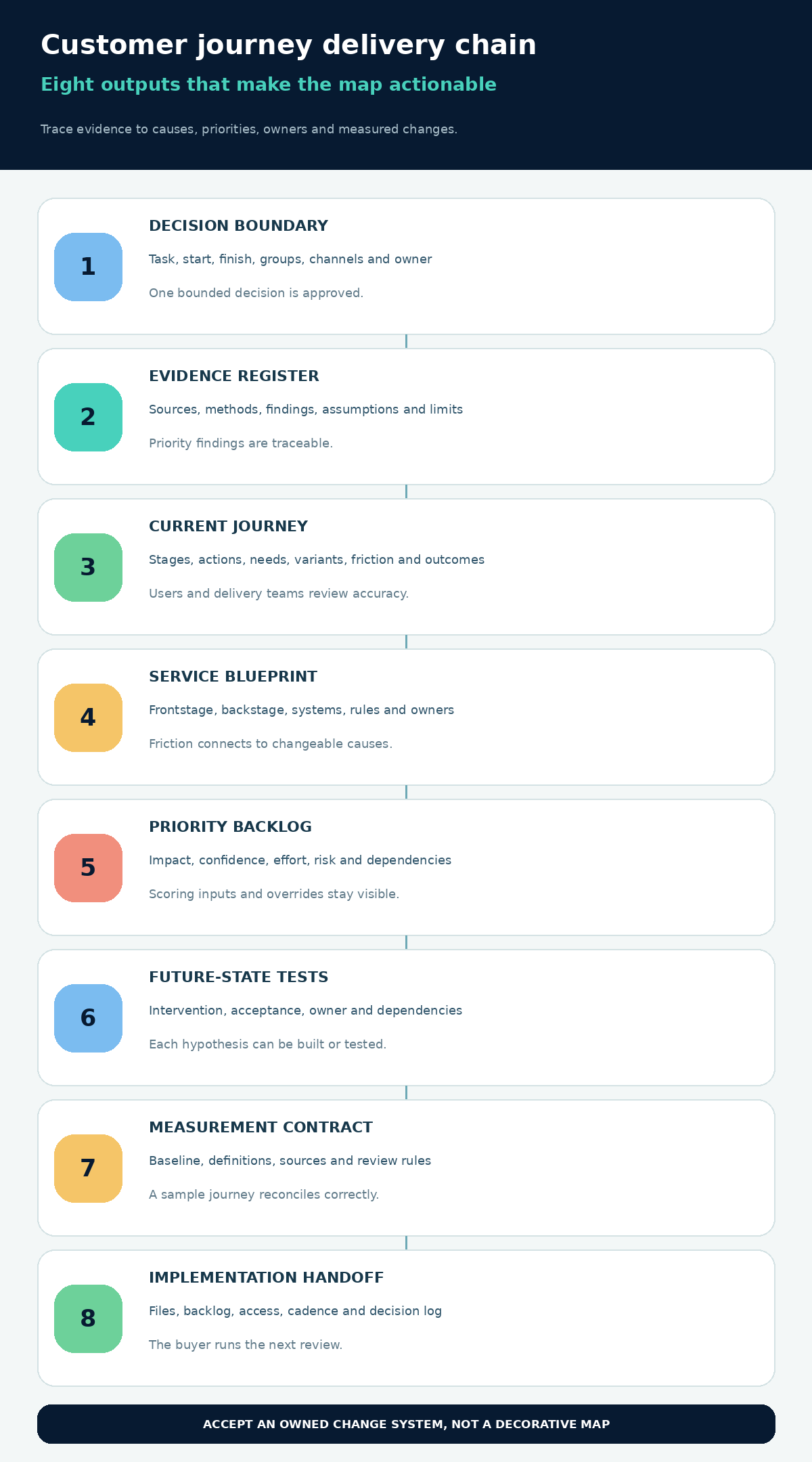
| Deliverable | Minimum content | Acceptance evidence |
|---|---|---|
| Decision boundary | Task, start, finish, groups, channels, markets, exclusions and owner | Stakeholders approve one bounded decision. |
| Evidence register | Questions, sources, methods, periods, findings, assumptions and limits | Priority findings trace to permitted evidence. |
| Current journey | Stages, actions, needs, touchpoints, variants, friction and outcomes | Representative users and delivery teams review accuracy. |
| Service blueprint | Frontstage, backstage, systems, data, rules, queues, vendors and owners | Priority friction connects to changeable causes. |
| Priority backlog | Issue, impact, confidence, effort, risk, dependency and rank | Inputs and overrides are visible and approved. |
| Future-state hypotheses | Change cards with intervention, acceptance, owner and dependencies | Each proposal can be built or tested. |
| Measurement contract | Baseline, metric definitions, sources, guardrails and review rule | A sample journey reconciles across agreed sources. |
| Implementation handoff | Editable files, backlog, access, privacy actions, cadence and decision log | The buyer runs the first review without consultant dependency. |
Use pass, conditional pass and blocked states. A beautiful map cannot compensate for absent evidence, unnamed owners or unmeasurable changes. Every conditional item should name the remediation, owner and decision date.
Worked example: a fictional B2B onboarding journey
Consider a fictional B2B software company that sees many demo requests but inconsistent activation. This is an original teaching example, not a client result. The buyer asks a consultant to map the customer journey, but the engagement is narrowed to one decision: which onboarding handoff should be changed first for small teams buying through a sales-assisted path?
Research combines consented interviews, observed setup tasks, support themes, CRM stage history, product events and staff interviews. The current journey shows that prospects expect to import their data immediately after purchase, while the onboarding email asks them to schedule another call. Some users contact support; others wait. The evidence register distinguishes what was observed from what staff believe.
The service blueprint traces the delay to three causes: the CRM does not pass the purchased package to the onboarding queue, access to the import tool is created by a daily batch, and support cannot see whether an account is waiting for access. The team ranks the issue highly because it blocks the core task and crosses sales, operations and product ownership.
The approved change card proposes passing the package field at purchase, creating access when the account becomes eligible and displaying the access state to support. Acceptance tests cover the normal path, missing data, duplicate events and manual recovery. The measurement contract records eligible accounts, time to first successful import, unresolved access contacts and activation within the agreed observation window. The buyer assigns owners and pilots the change with a bounded group.
The consultant hands over the editable map and blueprint, evidence register, issue backlog, event definitions, test results, decision log and next review agenda. The outcome is not “a better journey” as a slogan. It is a traceable decision with implemented changes, exceptions, owners and evidence for the next iteration.
Compare scope, price and tradeoffs on equal assumptions
Ask providers to price the same work packages: discovery and scope, evidence review, participant recruitment, research sessions, analysis, mapping, blueprinting, prioritization, measurement design, change workshops, prototype or pilot support, handoff and follow-up review. List buyer-supplied access and staff time. Separate research incentives, travel, tools, transcription and implementation costs.
Clarify the number of journeys, segments, markets, channels, participants, workshops and revision rounds. State who owns recruitment, privacy review, analytics access and stakeholder scheduling. Define editable file formats, data retention, intellectual property, access removal and the use of subcontractors. A low quote may cover only facilitated workshops and a presentation, while another includes research and implementation support.
Do not buy a full mapping engagement when the decision is already narrow and the evidence is sufficient for a focused usability test, analytics diagnosis or process fix. Delay it when nobody can authorize cross-team changes, the customer group cannot be researched ethically, the requested journey is unbounded or the buyer has no capacity to implement and measure priorities. In those cases, a short discovery or single-journey pilot may be the better purchase.
Buyer checklist before accepting the engagement
- The engagement supports one named operational or commercial decision.
- The journey has an explicit start, finish, user groups, channels and exclusions.
- A buyer owner can coordinate the teams that deliver the journey.
- Research questions, methods, recruitment, access and limitations are documented.
- Customer evidence is separated from stakeholder assumptions.
- Research consent, storage, access, retention and deletion are approved.
- Important findings trace to an evidence register.
- Different user groups receive separate paths when their steps materially differ.
- Online, offline, assisted, failure and recovery moments are considered.
- People with disabilities and relevant assistive technologies are included appropriately.
- The customer journey and internal service blueprint are distinct but linked.
- Backstage systems, data, rules, queues, vendors and owners are visible.
- Priority criteria and any overrides are inspectable.
- Every accepted issue becomes an owned change card or an explicit no-action decision.
- Future-state ideas remain hypotheses until tested.
- Measures combine behavioral, qualitative and operational evidence where needed.
- Metric definitions, sources, exclusions, baseline and review rules are documented.
- Implementation dependencies and buyer capacity are assessed before recommendations.
- Editable files, evidence, backlog, decisions and access remain with the buyer.
- Completion includes a buyer-led review of the first implemented change.
TechLithic offers customer journey consulting, revenue funnel consulting and digital transformation consulting. Apply this checklist equally to TechLithic and competing providers. For adjacent decisions, use the conversion tracking acceptance guide, landing-page experiment guide and automation discovery deliverables guide.
Frequently asked questions
What should a customer journey consultant deliver?
Require a decision boundary, evidence register, current-state journey map, service blueprint, prioritized issue backlog, future-state change hypotheses, measurement contract, implementation owners, editable files and a buyer-owned review process.
What is the difference between a journey map and a service blueprint?
A journey map describes the user's steps, needs, touchpoints and experience. A service blueprint connects those steps to frontstage interactions, backstage work, systems, data, rules, partners and owners that produce the experience.
Can analytics replace customer research?
No. Analytics can show observable paths, events and funnel progression, but it may not explain intent, unmet needs, offline activity, accessibility barriers or the reason behind failure. Combine behavioral data with appropriate qualitative and operational evidence.
How many customer journeys should one engagement map?
There is no universal number. Start with the smallest set needed for the named decision. Create variants when user groups, stages, risk or operating ownership materially differs, and price additional journeys separately.
When should a company not buy customer journey consulting?
Do not buy a broad engagement when a narrow test can answer the decision, when no owner can implement cross-team changes, when ethical access to relevant users is unavailable or when the scope is too broad to measure and act on.
How do you know a journey mapping engagement is complete?
It is complete when priority findings trace to evidence, accepted changes have owners and tests, measurement is working, editable artifacts and access are transferred, and the buyer can run the next review without consultant dependence.
Sources and research notes
Sources checked on 2026-11-28. Pricing and policy documents can change; verify current terms before approving expenditure.
- GOV.UK Service Manual: Map and understand a user's whole problem
Official guidance on cross-organizational journeys, current delivery, online and offline touchpoints, prioritization and ensuring larger changes are implemented.
- Digital.gov: Journey mapping the customer experience, a USA.gov case study
Official GSA case study on multi-source evidence, cross-channel mapping, improvement queues and follow-through after the map.
- GOV.UK Service Manual: Managing user research data and participant privacy
Official guidance on research data, informed consent, minimum collection, secure storage, retention, deletion, vendors and anonymized outputs.
- GOV.UK Service Manual: Creating an experience map
Official guidance on evidence from several users, distinct user-group maps, stages, touchpoints, channels, needs and collaborative review.
- Digital.gov: Map your users' and system's journeys
Official GSA guidance distinguishing user-perspective journey maps from service blueprints across user, frontstage, backstage and support-process layers.
- W3C Web Accessibility Initiative: Involving users in web projects
Standards-body guidance on involving people with disabilities early, using a range of users and combining user involvement with accessibility standards.
- GOV.UK Service Manual: Measuring the success of your service
Official guidance on combining performance metrics, user research, operational sources and repeated usability benchmarking for end-to-end journeys.
- Google Analytics Help: Path exploration
Primary platform documentation on exploring multiple paths through page, screen and event data.
- Google Analytics Help: Funnel exploration
Primary platform documentation on defined funnel steps, open and closed funnels, sequence conditions, elapsed time and breakdowns.
All nine supporting sources were opened on publication day. Official government, standards-body and primary platform documentation supports the external claims. The worked example is explicitly fictional and no client result, fabricated statistic, ranking promise or guaranteed outcome is used.