
Performance marketing buying guides
Landing Page Optimization: How to Scope an Experiment
A landing page experiment is not a request for a new headline and a conversion lift. It is a controlled decision process. Before traffic is split, the buyer and provider should agree who is eligible, what will change, which event decides the result, what must not get worse, how assignment will be checked and what happens when the result is inconclusive.
Prepared with AI assistance and checked against the linked sources. Numerical comparisons are illustrative unless expressly sourced.
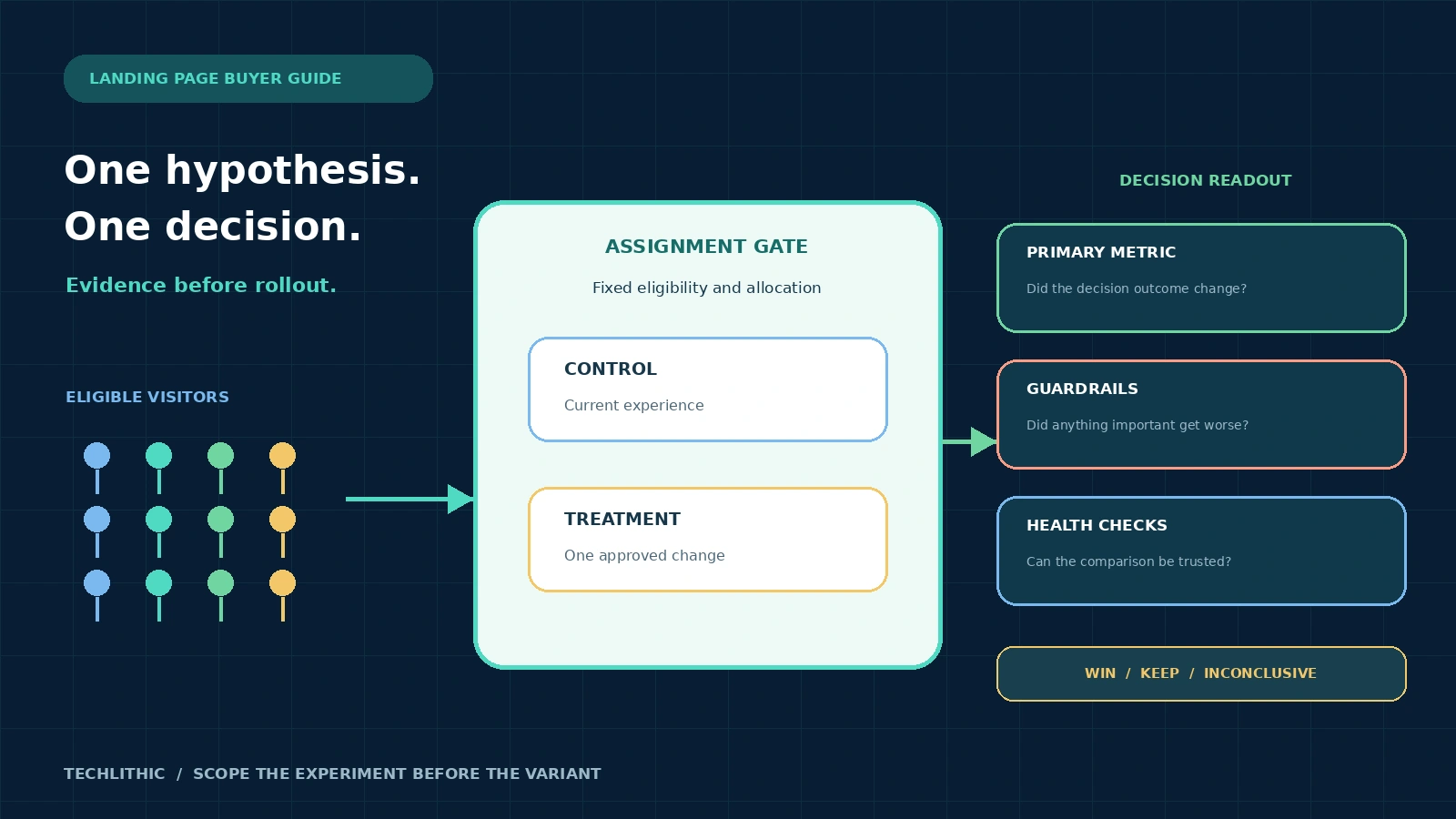
Buy an experiment contract, not a page variant. Approve the business decision, population, hypothesis, allocation, primary metric, guardrails, detectable-effect plan, implementation QA, stopping rule and evidence handover before launch. Keep discovery signals separate from causal evidence, and allow the honest outcome that neither version has proved better.
Start with the decision, not the design
Write the decision the experiment will inform. For example: should qualified paid-search visitors see a shorter demo-request page, or should the current page remain? Name the owner who can implement the result and the date by which the decision is useful. A test without an adoption decision can produce a dashboard but no operational value.
State the audience, traffic sources, devices, regions, page versions and conversion path in scope. Exclude employees, automated traffic, quality-assurance sessions and other populations that cannot represent the decision. If returning visitors can see a different experience across visits, define how persistence will work.
The US National Institute of Standards and Technology describes experimental design as a detailed plan created in advance so valid, objective conclusions can be drawn. [1] Treat the brief as that plan. It should also record what the experiment cannot answer, such as long-term customer value when only a form submission is measured.
Turn the proposed change into one testable hypothesis
Use a causal statement: for a named population, changing one decision variable from control to treatment is expected to change one primary outcome because of a stated mechanism. A useful hypothesis could say that replacing a generic hero with role-specific proof will increase completed demo requests among eligible software buyers because it reduces uncertainty about fit.
Google's experiment guidance recommends a clear hypothesis tied to a business goal, testing one variable at a time and selecting one or two success metrics before the experiment starts. [2] If the treatment changes the headline, form length, pricing language, layout and offer together, a result can support adopting the package but cannot explain which element caused it.
Heatmaps, recordings, interviews and support logs are useful for finding friction and generating hypotheses. Microsoft Clarity explains that its heatmaps aggregate behaviours such as clicks and scrolling. [3] These observations do not replace randomized comparison when the question is whether a treatment caused an outcome.
Define eligibility, random assignment and traffic stability
Specify where assignment occurs, the unit assigned and how that assignment persists. The unit may be a browser, signed-in account or organization, depending on the purchase journey. If colleagues from one organization influence the same purchase, assigning individual sessions can allow treatment information to cross into control. Document the limitation or use a more suitable unit.
Set the intended allocation and list routing layers that may interfere, including ad-platform experiments, personalization, redirects, consent tools, geographic rules and caching. NIST notes that randomization is needed for conclusions that are correct, defensible and unambiguous, while blocking can balance known sources of variation. [4] Do not alternate visitors by time or send one campaign to control and another to treatment, because source and time effects become mixed with the page change.
Confirm that traffic volume, source mix and the conversion event are stable enough to support the planned decision. A provider should not promise a duration before reviewing eligible traffic and baseline behaviour. Campaign launches, budget shocks, tracking migrations and seasonal events may require postponement, segmentation or an explicit limitation.
Lock the metric contract and planning assumptions
Choose one primary metric that directly informs the decision, define its numerator and denominator, and specify the observation window. A completed qualified demo request per eligible assigned visitor is more precise than conversion rate. Define qualification, duplicate treatment, test submissions, late conversions, time zone and the system of record.
Add guardrails for harms that could make an apparent win unacceptable. Relevant guardrails may cover lead validity, error rate, page performance, accessibility defects, consent state and downstream sales acceptance. Core Web Vitals provide field measures for loading, responsiveness and visual stability, but the service threshold and monitoring approach must be agreed for the actual page and audience. [5]
Require a written sample plan containing the baseline estimate, smallest effect worth acting on, allocation, statistical method, power or precision target, expected exclusions and minimum run window. Optimizely's experiment setup documentation likewise treats the primary metric and minimum detectable effect as configuration decisions. [6] The provider should explain the method used by the selected platform. There is no universal sample size, significance setting or number of days suitable for every funnel.
Make implementation and ethics part of acceptance
Approve both variants against a written quality-assurance matrix before real visitors enter. Test supported browsers and devices, responsive breakpoints, navigation, forms, validation, confirmation states, CRM delivery, analytics events, accessibility, consent behaviour, localization, page speed and rollback. Compare the control rendered through the experiment system with the production control so the testing layer itself is checked.
Record screenshots, build identifiers, configuration exports and event traces. Use synthetic test traffic that can be excluded from analysis. Verify that server-side and client-side systems agree on exposure and conversion identifiers without placing sensitive form data in analytics payloads.
Do not improve a metric with a deceptive interface. The US Federal Trade Commission describes dark patterns that can obscure choices or steer people into sharing more data. [7] Treatment review should reject hidden costs, false urgency, preselected consent, obstructed cancellation or claims that lack evidence. Legal and privacy requirements vary by market, so obtain appropriate review for the audience and data flow.
Monitor health and predefine the stopping decision
Once launched, monitor whether the experiment is operating as designed. Check exposure events, assignment persistence, actual allocation, event latency, exclusions, error logs and the balance of important pre-treatment characteristics. Keep a change log for campaign, page, analytics and infrastructure changes.
Statsig's monitoring guidance recommends checking event receipt, experiment unit identifiers, balanced exposure, sample ratio mismatch and crossover before trusting results. [8] A persistent difference between expected and observed allocation is a data-quality warning, not evidence that one page is better. Investigate routing, logging, filtering and eligibility before interpreting outcomes.
The runbook should state the planned analysis point, minimum and maximum duration, early-stop conditions for severe harm or technical failure, and treatment of disrupted periods. Do not repeatedly inspect the primary metric and stop when it looks favourable. Report the assigned and analyzed populations, exclusions, actual allocation, quality checks, uncertainty, incidents and deviations. Preserve an inconclusive result as a valid outcome.
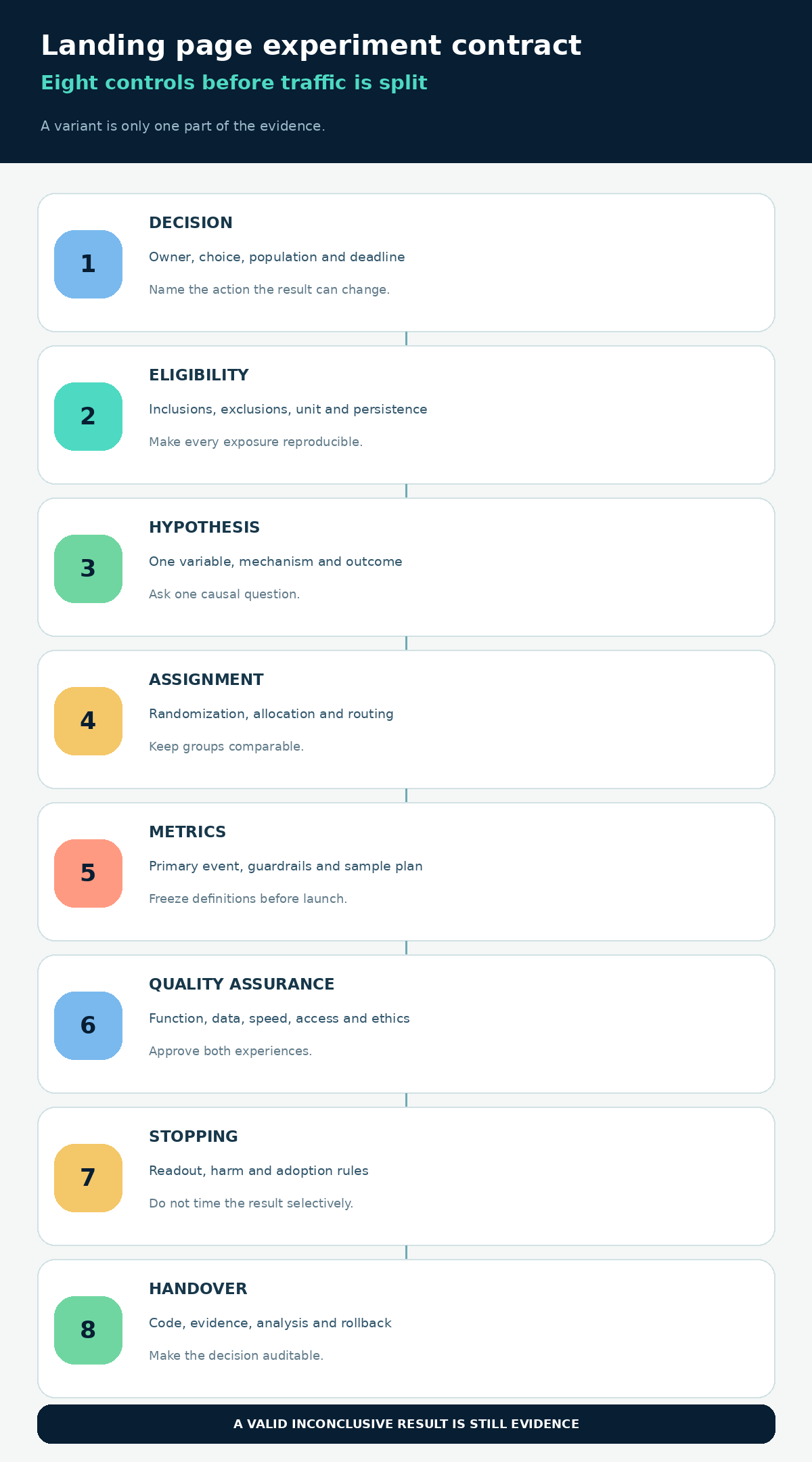
Use an eight-part experiment acceptance matrix
| Control | Minimum requirement | Acceptance evidence |
|---|---|---|
| Decision | Owner, choice, population and deadline | A result can change a named action. |
| Eligibility | Inclusions, exclusions, unit and persistence | Eligible exposure can be reproduced. |
| Hypothesis | One variable, mechanism and outcome | Control and treatment answer one question. |
| Assignment | Randomization, allocation and routing map | Groups are comparable before treatment. |
| Metrics | Primary event, guardrails and sample plan | Definitions and planning inputs are frozen. |
| Quality assurance | Functional, data, performance and ethics checks | Both variants pass the approved matrix. |
| Stopping | Readout point, harm rules and adoption criteria | The result cannot be timed selectively. |
| Handover | Code, configuration, evidence and rollback | Another team can audit and operate the result. |
Price and accept these controls as deliverables. A polished variant without assignment, data and decision evidence is design work, not a completed experiment.
Worked example: a fictional B2B demo page
A fictional software company wants to test a shorter demo page for paid-search visitors. Its decision is whether to replace the current page for English-language visitors who arrive on approved commercial-intent campaigns. Existing customers, employees, bots and test sessions are excluded. Assignment occurs at the browser identifier and persists for the planned observation window.
The control has a long capability overview and six-field form. The treatment keeps the same offer and form but replaces the overview with role-specific proof. The hypothesis is that clearer fit evidence will increase completed qualified demo requests because eligible visitors can judge relevance sooner. Only that content block changes.
The primary metric is qualified demo requests per eligible assigned visitor. Guardrails cover form errors, lead rejection, Core Web Vitals, accessibility defects and consent failures. Baseline, minimum worthwhile effect, allocation and sample calculation are stored in the protocol rather than invented after launch.
Prelaunch tests confirm assignment, persistence, event deduplication, CRM delivery and equivalent performance. During the run, the team monitors allocation and event health but follows the approved readout rule. If neither variant meets the decision threshold, the result is recorded as inconclusive. The company retains the control, archives the evidence pack and plans a different hypothesis.
Use this checklist before approving an experiment
- The business decision, owner and adoption deadline are named.
- The eligible population, exclusions, assignment unit and persistence are explicit.
- One causal hypothesis links one treatment variable to one primary outcome.
- Control and treatment differ only as described in the protocol.
- Traffic sources, routing layers and concurrent campaigns are mapped.
- The primary metric has a numerator, denominator, window and system of record.
- Guardrails cover quality, errors, performance, accessibility, consent and downstream value.
- Baseline, worthwhile effect, allocation and statistical method are approved before launch.
- Both variants pass functional, visual, analytics and CRM quality assurance.
- Allocation, crossover, exclusions and event latency are monitored.
- Stopping, harm, disruption and inconclusive-result rules are written.
- Code, configuration, evidence, analysis and rollback are handed over.
TechLithic offers landing page optimization, conversion rate optimization, landing page design and marketing analytics. Apply this checklist equally to TechLithic and competing providers. Use the conversion tracking acceptance guide to specify the event contract and the paid marketing scope guide to align acquisition and campaign ownership.
Frequently asked questions
How long should a landing page experiment run?
There is no universal duration. Plan from eligible traffic, baseline behaviour, the smallest effect worth acting on, allocation, observation window and the statistical method.
Can heatmaps prove that a landing page change increased conversions?
No. Heatmaps can identify friction or generate hypotheses. A causal decision needs suitable assignment and trustworthy outcome measurement.
What should be the primary metric for a landing page test?
Use one metric that directly supports the decision, with an exact numerator, denominator, observation window and system of record. Add guardrails for harms and quality.
What is sample ratio mismatch?
It is a meaningful difference between expected and observed allocation. Treat persistent mismatch as a data-quality warning and investigate before reading the outcome.
Should a provider guarantee a conversion-rate increase?
No. A provider can guarantee defined work, controls and evidence, not user behaviour. The contract should allow treatment, control or an inconclusive result.
Sources and research notes
Sources checked on 2026-11-18. Pricing and policy documents can change; verify current terms before approving expenditure.
- NIST Engineering Statistics Handbook: What is experimental design?
Official US standards guidance on planning experiments in advance to support objective and valid conclusions.
- Google Ads Help: Test with confidence with the Experiments page
Official guidance on hypotheses, single-variable tests, success metrics and experiment records.
- Microsoft Clarity: Heatmaps overview
Official documentation on aggregated click, scroll, area and attention heatmaps.
- NIST Engineering Statistics Handbook: Process Improvement glossary
Official definitions covering randomization and blocking in experimental design.
- web.dev: Web Vitals
Official Chrome team guidance on field measures for loading, responsiveness and visual stability.
- Optimizely documentation: Steps to create an experiment
Primary vendor documentation on primary metrics, secondary metrics and minimum detectable effect.
- US Federal Trade Commission: Bringing Dark Patterns to Light
Official report on interface patterns that obscure choices, mislead users or subvert privacy decisions.
- Statsig documentation: Monitor an experiment
Primary vendor documentation on exposure checks, unit identifiers, sample ratio mismatch, crossover and pre-readout health review.
All eight sources were opened and checked on November 18, 2026. NIST, Google, Microsoft, Chrome and FTC materials provide primary standards or platform guidance. Optimizely and Statsig describe their own platforms, so their settings are not presented as universal rules. The experiment contract, acceptance matrix and B2B demo scenario are original educational frameworks. The scenario is fictional and contains no client result, fabricated statistic, ranking promise or guaranteed lift.