
Digital transformation buying guides
Digital Transformation Roadmap: Pilot Before a Full Rollout
A digital transformation roadmap should not be a list of tools or a promise to automate everything. It should define one valuable operating change, prove it with a representative pilot and make the next investment decision from observed evidence. This guide shows buyers how to scope that pilot, compare providers and decide whether to scale, extend, redesign or stop.
Prepared with AI assistance and checked against the linked sources. Numerical comparisons are illustrative unless expressly sourced.
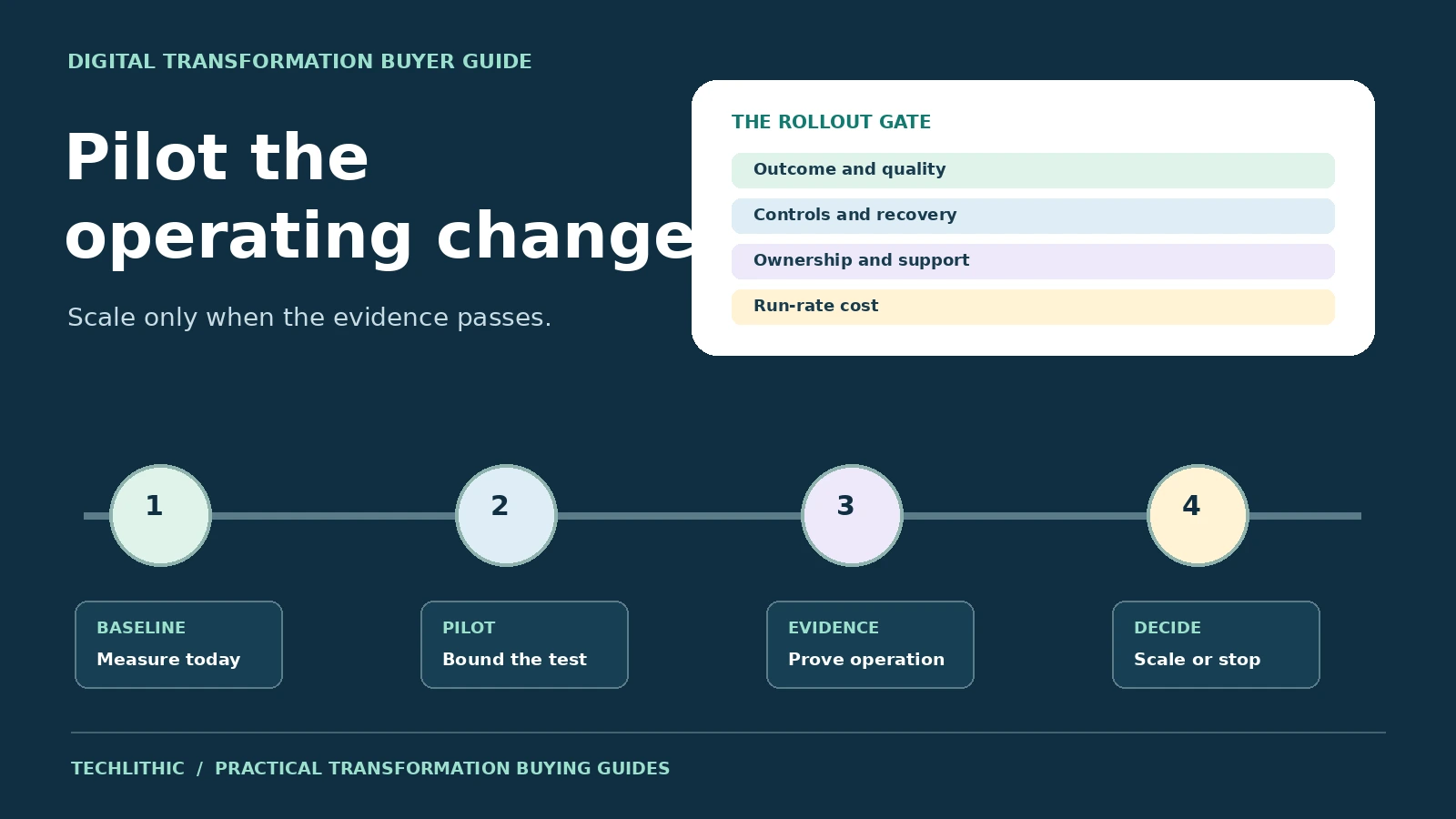
Buy a decision-ready pilot, not an open-ended transformation programme. Record the current process, choose a bounded workflow and representative users, map every dependency, assign operational owners, measure quality and run-rate cost, and agree the rollout gates before implementation begins. A successful pilot proves that the new service can be supported safely at the intended scale, not merely that a demonstration works.
Start with the operating baseline, not the software
Define the business service that must improve before selecting technology. Name the users, the task, the present channels, the process owner and the decision the roadmap must support. “Digitise operations” is not testable. “Reduce manual re-entry in supplier invoice approval while preserving finance controls” is specific enough to investigate.
Document the current path from request to outcome. Record volumes, elapsed time, active handling time, completion rate, rework, error categories, exception routes, support contacts and the full cost of people plus technology. Segment the baseline where user groups or channels behave differently. Averages can hide that one location, accessibility need or exception type carries most of the failure.
The UK Government Service Manual recommends designing metrics from the service purpose, choosing a small number that answer whether the service works, and combining digital analytics with user feedback, operational and financial data. It also advises establishing a baseline across channels and measuring over time rather than relying on snapshots. [1]
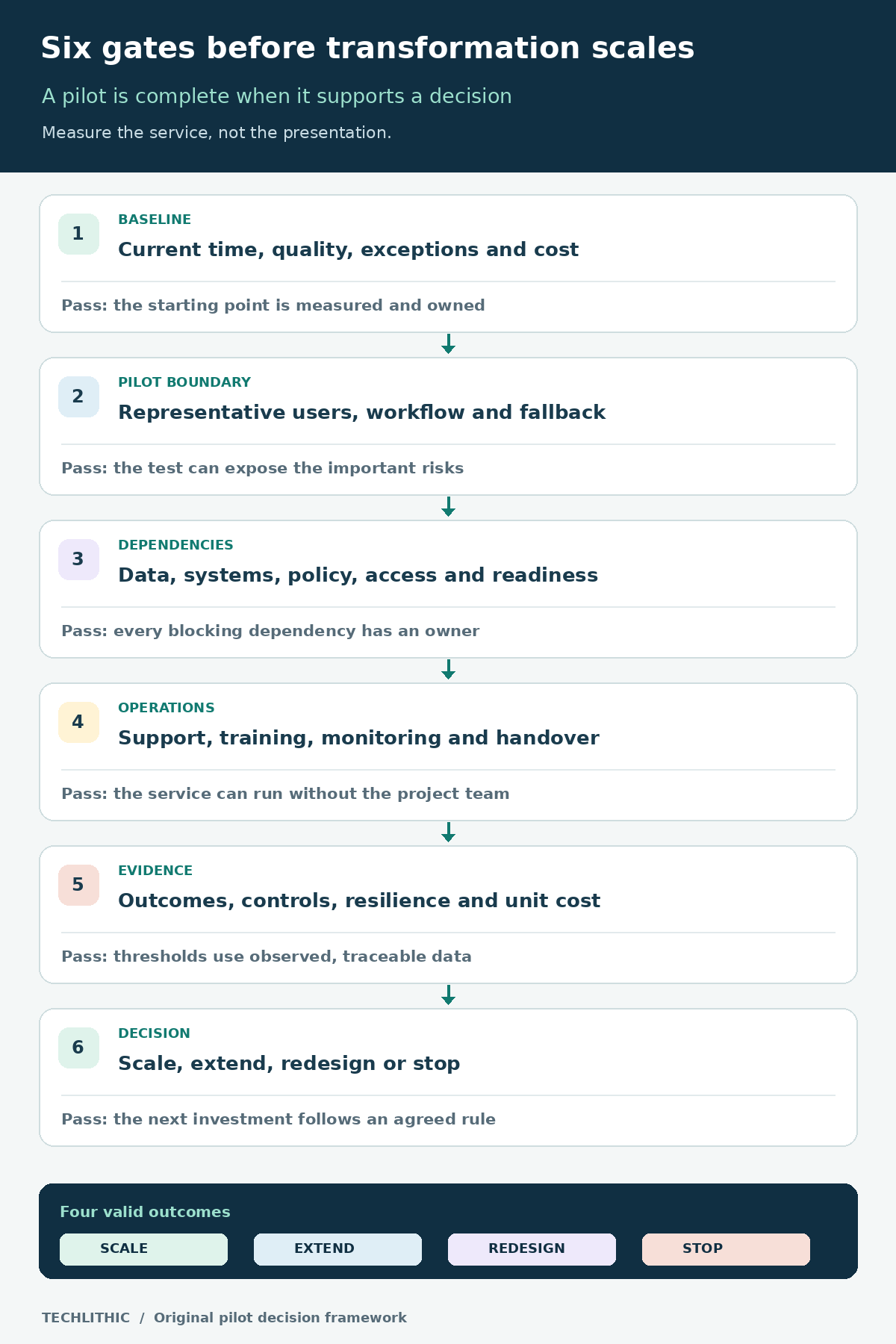
Choose a pilot that can answer the scale decision
A proof of concept asks whether a technology can work. A pilot should ask whether a service can work for real users inside real operating constraints. Define the pilot by workflow, cohort, locations, transaction types, integrations, duration and excluded cases. It should be large enough to expose the important risks but small enough to reverse safely.
The UK Digital, Data and Technology Playbook says testing should be proportionate to size, complexity and uncertainty, with clear objectives, scope, resources, timescales and success criteria. It also treats the pilot as a final testing stage before full-scale rollout in many projects and calls for a representative user group plus a comparison control where appropriate. [2]
A convenient team is not always a representative cohort. Include the users, devices, network conditions, data quality, approval levels and exception cases that will exist after rollout. Deliberately exclude high-risk cases only when the roadmap records how and when they will be tested. Otherwise the pilot may pass because the hard work was moved outside its boundary.
Specify the fallback. Decide whether the old process runs in parallel, how records stay consistent, who can switch traffic back and what triggers that action. UK service guidance starts beta with a limited group and recommends keeping a replaced legacy service running until the new service reaches live operation. [3] That is not a universal migration rule, but it is a useful prompt for continuity planning.
Map dependencies before promising a timeline
Create a dependency map that follows the workflow, not the organisation chart. Include identity, source systems, master data, integrations, devices, networks, security reviews, legal or records obligations, reporting, support, training, vendors and downstream teams. For each dependency, record an owner, readiness date, test evidence and consequence if it fails.
Separate assumptions from confirmed facts. “The ERP has an API” is incomplete until the team knows which objects and events are available, the authentication method, rate limits, error behaviour, test environment, data owner and change window. The CRM integration scoping guide provides a deeper acceptance pattern for source of truth, retries and duplicate prevention.
Use production-like data early, with appropriate permissions and safeguards. The UK playbook warns that complex data projects may need information from several applications and says risk remains until realistic data is tested. [2] Synthetic data is valuable for safe development, but it may not reveal inconsistent identifiers, missing fields, unusual characters, legacy status values or real exception rates.
Assign ownership for the service after launch
Transformation fails operationally when every decision still returns to the project team. Name an executive sponsor, service owner, process owner, product or delivery lead, data owner, security and privacy contacts, support owner, finance owner and an approver for the rollout gate. One person can hold several roles in a small organisation, but the decisions must still be explicit.
Define who owns policy, configuration, access, model or rule updates, incident response, supplier management, training and continuous improvement. Record service levels and escalation paths for normal work as well as failure conditions. A pilot that depends on a consultant manually correcting records each night has not proved a sustainable operating model.
The U.S. Government Accountability Office describes Agile delivery as incremental development that is continuously evaluated for functionality, quality and customer satisfaction, and its assessment guide covers adoption, execution, monitoring and control. [4] Use short delivery increments, but do not confuse frequent demos with accepted business outcomes. Each increment needs a product decision and evidence.
Test security, privacy and resilience inside the pilot
Do not postpone controls until the scale phase. The pilot should use the intended identity pattern, least-privilege roles, audit logging, data retention, backup, recovery, monitoring and incident route wherever practicable. Temporary shortcuts must be listed with owners and removal dates rather than quietly becoming production design.
NIST’s Cybersecurity Framework 2.0 provides outcomes across Govern, Identify, Protect, Detect, Respond and Recover for organisations of any size or maturity. [5] Use those functions as coverage prompts, then select controls that match the service context and applicable obligations. A generic framework does not replace a risk assessment or jurisdiction-specific advice.
Test failure deliberately. Revoke an account, interrupt an integration, supply a duplicate record, delay an upstream response and restore from backup. Measure detection and recovery, not only the happy path. Include accessibility and assisted-support users in the pilot because late remediation can change workflows, interface components and training.
Add AI-specific gates only where AI is justified
Do not add AI simply to label the roadmap modern. Compare the proposed AI step with rules, search, workflow redesign and human handling. Use AI when its capability creates enough value to justify variable behaviour, evaluation, oversight and ongoing monitoring.
For an AI-enabled pilot, define the intended use, prohibited use, users, decisions influenced, input data, output consumers, human review, appeal route and safe fallback. Build an evaluation set from representative and difficult cases. Measure task success, harmful errors, unsupported claims, overrides, latency and cost in conditions similar to intended deployment.
NIST’s AI Risk Management Framework organises work around Govern, Map, Measure and Manage. It calls for clear roles, regular monitoring, documented testing in deployment-like conditions and a decision on whether a system achieves its intended purpose and should proceed. [6] It also asks organisations to consider viable non-AI alternatives and ways to disengage systems that behave inconsistently with intended use.
Put those obligations in the commercial scope. Specify who supplies evaluation cases, who approves thresholds, how third-party model changes are detected, which logs are retained, who can disable the feature and what ongoing review costs. TechLithic provides AI transformation advisory, but the same evidence and stop criteria should apply to TechLithic or any other provider.
Measure the steady-state cost, not only the build fee
Compare proposals using a common cost boundary. Include discovery, implementation, licences, usage, cloud and data services, integration, migration, security work, testing, accessibility, training, support, monitoring, change management and exit. Separate one-time transition cost from monthly or per-transaction operating cost.
The FinOps Foundation says technology estimates should compare scenarios and include shared platform, support and operational impacts. It recommends carrying an estimate through decision gates and comparing it with actual outcomes. [7] Its allocation guidance also connects costs to projects, applications, cost centres and owners so unallocated spend becomes visible. [8]
During the pilot, capture actual consumption and labour. Record infrastructure, software, model or API usage, vendor support, internal support tickets, manual reviews, exception handling and the time needed to maintain rules, prompts, data or integrations. Extrapolate in ranges for expected, peak and failure scenarios rather than multiplying a quiet-week average.
Worked example: invoice approval pilot
Consider an invented company replacing emailed supplier invoices and spreadsheet approvals. Its objective is to reduce manual re-entry and improve approval visibility without weakening finance controls. The pilot covers one business unit, two invoice types and 12 representative users for six weeks. Foreign-currency and disputed invoices remain in the existing process during this stage.
The baseline is measured for four weeks before launch. It includes median and upper-range approval time, touch time, first-pass completion, duplicate rate, exception rate, support contacts and cost per completed invoice. The new workflow integrates with the supplier master and finance system, uses existing single sign-on, records an audit trail and keeps a parallel fallback.
| Gate | Illustrative evidence | Decision use |
|---|---|---|
| User outcome | Representative users can submit, approve and correct invoices without project-team intervention | Confirms the workflow solves the intended task |
| Data quality | Required fields, supplier matches, duplicates and exceptions reconcile with finance records | Shows whether the data design is reliable |
| Control | Roles, approvals, audit events, fallback and recovery tests pass | Limits operational and compliance risk |
| Operations | Named support staff resolve agreed scenarios using the runbook | Tests the operating model, not only the build |
| Economics | Actual cost per completed invoice is reported with usage and human handling | Supports an affordable scale forecast |
The numbers and duration are illustrative, not a benchmark. The steering group reviews evidence against thresholds agreed before launch. It can scale the tested scope, extend the pilot for a named uncertainty, redesign the workflow, or stop. New invoice types are not assumed to be safe merely because the initial cohort passed.
Set rollout gates and contract breakpoints in advance
Write the decision matrix before the pilot starts. Each gate needs a measure, baseline, threshold or tolerance, evidence source, owner and decision rule. Cover user outcomes, data quality, security and privacy, accessibility, reliability, support readiness, cost, training, unresolved dependencies and residual risk.
Avoid one blended “success score” that can hide a critical failure. Some gates should be mandatory. For example, a material access-control defect or an untested recovery path may block rollout even when users like the interface. Other measures may justify a limited extension with a specific test.
The UK playbook recommends contractual breakpoints that allow pilot assessment, limited extension or expansion, and clear rules for down-selection. [2] Put payment milestones, evidence delivery, intellectual property, data return, transition assistance and termination rights around those breakpoints. Define which reusable artefacts the buyer receives if the pilot stops.
Scale in stages. Increase cohort, locations, volume or process complexity one dimension at a time where possible. Recheck baseline assumptions, cost forecasts and risk controls at each stage. Full rollout is a new operational commitment, not an automatic reward for completing the pilot timetable.
Use this buyer checklist before appointing a partner
- Is the target service and user outcome stated in one testable sentence?
- Are current volumes, time, quality, exceptions and full costs baselined?
- Is the pilot cohort representative of intended scale and clearly bounded?
- Are exclusions, fallback, rollback and legacy-operation rules explicit?
- Does every system, data, policy and organisational dependency have an owner?
- Are decision rights, support ownership and knowledge transfer defined?
- Will security, privacy, accessibility, resilience and recovery be tested in the pilot?
- If AI is used, are non-AI alternatives, evaluation thresholds, human oversight and disablement covered?
- Does the commercial model include transition, usage, support, internal labour and exit costs?
- Are evidence sources and scale, extend, redesign or stop rules agreed before work begins?
- Will the buyer receive configurations, documentation, data and reusable artefacts if the pilot stops?
Compare providers on the same pilot brief, not on slide decks with different assumptions. Ask each one to identify buyer dependencies, exclusions, evidence, operating roles and post-pilot cost. A credible proposal will say what the pilot cannot prove.
Do not commission a transformation programme when the real problem is a broken policy, unclear ownership, missing data or a single manual handoff that can be corrected locally. When a pilot is justified, TechLithic’s digital transformation consulting and custom software delivery should be judged against this same roadmap. The MVP scope guide can help compare implementation quotes once the pilot boundary is fixed.
Frequently asked questions
How long should a digital transformation pilot run?
Long enough to observe representative work, exceptions, support and cost, but short enough to remain reversible. Define the evidence and decision date from transaction cycles and risk, not a universal week count.
What is the difference between a proof of concept and a pilot?
A proof of concept tests whether an idea or technology can work. A pilot tests whether a bounded service can work for real users with realistic data, controls, support and operating costs.
Should the old process run during the pilot?
Keep a fallback when service continuity or reconciliation requires it. Define parallel-running scope, data consistency, rollback authority and a plan to retire the old process if the new service earns rollout.
Which metrics should determine rollout?
Use a small set tied to the service purpose, plus mandatory risk gates. Typical evidence covers completion, time, quality, exceptions, user experience, support, reliability, security and cost per useful outcome.
What if the pilot meets business targets but fails a security gate?
Treat critical security, privacy or recovery gates as blockers. Redesign or extend only with a specific remediation and retest plan rather than averaging the failure into a positive overall score.
Can a successful pilot be rolled out everywhere immediately?
Not automatically. Confirm that the cohort, data, volume, locations and exception types represent the next stage. Scale in controlled increments and recheck support capacity, costs and risks.
Sources and research notes
Sources checked on 2026-10-27. Pricing and policy documents can change; verify current terms before approving expenditure.
- GOV.UK Service Manual: How to Set Performance Metrics for Your Service
Primary public-service guidance on purpose-led metrics, data sources, baselines, segmentation and continuous measurement.
- UK Government: The Digital, Data and Technology Playbook
Primary procurement guidance on testing, pilots, representative cohorts, realistic data, success criteria, contractual breakpoints and scaling decisions.
- GOV.UK Service Manual: How the Beta Phase Works
Primary guidance on limited private beta, learning with real users, support capacity and transition from legacy services.
- U.S. Government Accountability Office: Agile Assessment Guide
Primary public-sector assessment guide describing incremental development, continuous evaluation and programme monitoring.
- NIST: Cybersecurity Framework 2.0
Primary cybersecurity framework covering Govern, Identify, Protect, Detect, Respond and Recover outcomes.
- NIST AI Resource Center: AI Risk Management Framework Core
Primary AI risk guidance on governance, deployment-context testing, monitoring, accountability and proceed-or-stop decisions.
- FinOps Foundation: Planning and Estimating Capability
Primary practitioner framework guidance on scenario estimates, shared costs, operational impacts, lifecycle cost and comparison with actual outcomes.
- FinOps Foundation: Allocation Capability
Primary practitioner guidance on mapping technology costs to projects, applications, cost centres and accountable owners.
UK Government, U.S. GAO, NIST and FinOps Foundation guidance was checked on October 27, 2026. The invoice pilot, cohort, duration, measures and decision matrix are original procurement illustrations, not client results or universal benchmarks. Frameworks are used as planning prompts and do not replace service-specific legal, security, privacy or accessibility assessment. No cost saving, delivery or performance outcome is promised.