
SaaS growth buying guides
Lifecycle Email Automation: What to Build Before You Buy
Lifecycle email automation fails when a team buys a journey builder before defining the events, identities, permissions and business outcomes that make the journeys work. A practical buying process starts with a small operating design, then asks each platform or implementation partner to prove it.
Prepared with AI assistance and checked against the linked sources. Numerical comparisons are illustrative unless expressly sourced.
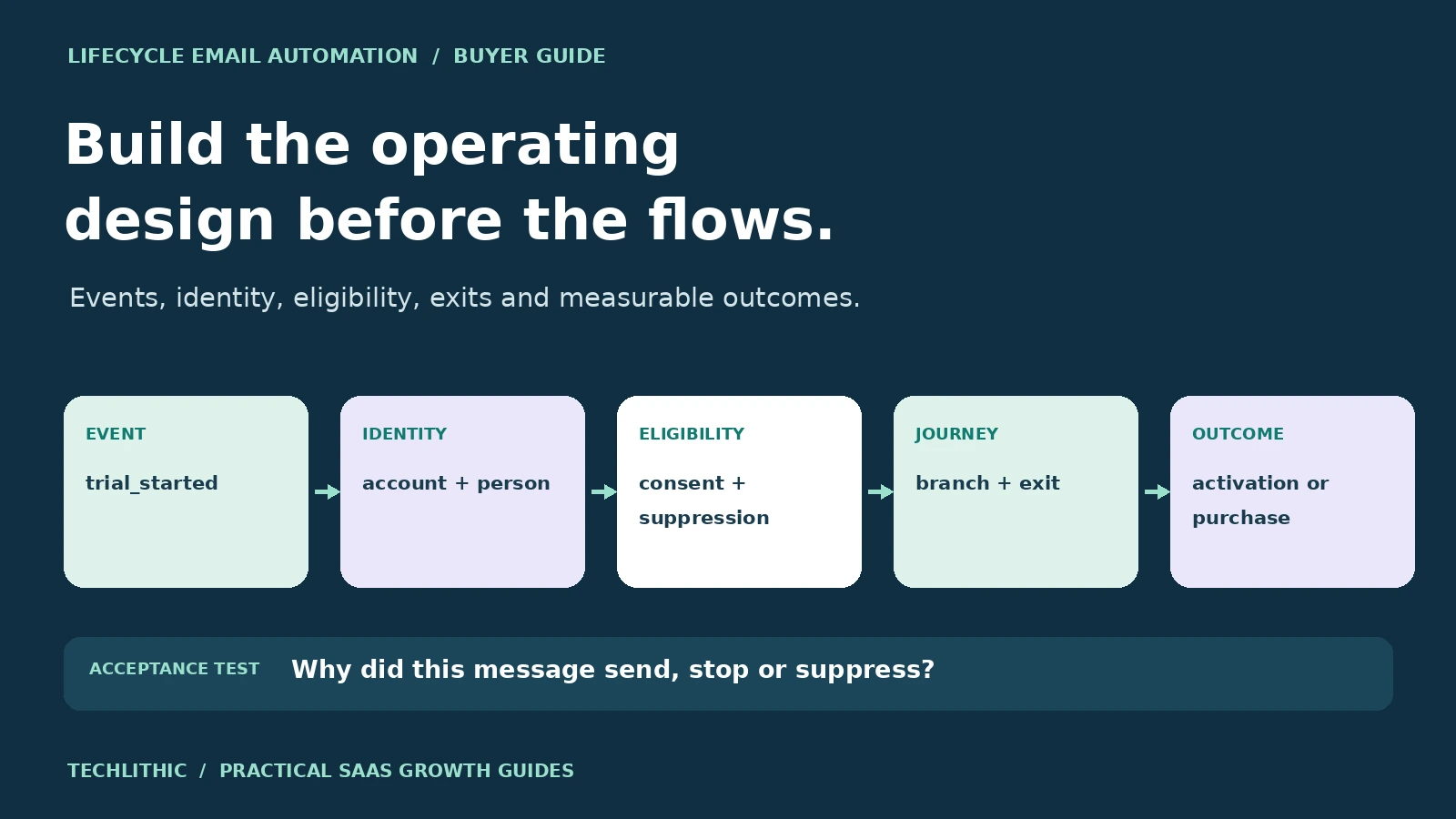
Build the event contract, identity and consent rules, suppression logic, deliverability foundation, initial journeys and measurement plan before comparing software. Accept the deployment only when real events enter once, ineligible contacts stay excluded, goal events stop reminders and the team can diagnose every send.
Buy automation after the lifecycle design
An email tool can schedule messages, evaluate conditions and report delivery activity. It cannot decide which business event is trustworthy, whether two records represent the same person, which communication is permitted or what outcome matters. Those decisions belong in the operating design.
Map the customer states before building a canvas: prospect, activated user, trial user, subscriber, lapsed customer and any business-specific state. For each state, name the event that enters it, the event that leaves it and the system that owns that fact. Do not use an email open as proof that a person completed a product action.
Choose a narrow first release. A welcome sequence, trial guidance and lapsed-user journey are usually easier to govern than dozens of overlapping campaigns. The right starting set depends on the product and data, not a vendor template.
A buyer should compare platforms against this lifecycle map. Ask whether each required trigger, eligibility check, delay, exit, suppression and goal is supported with observable logs. Features that are not connected to an approved use case should not drive the decision.
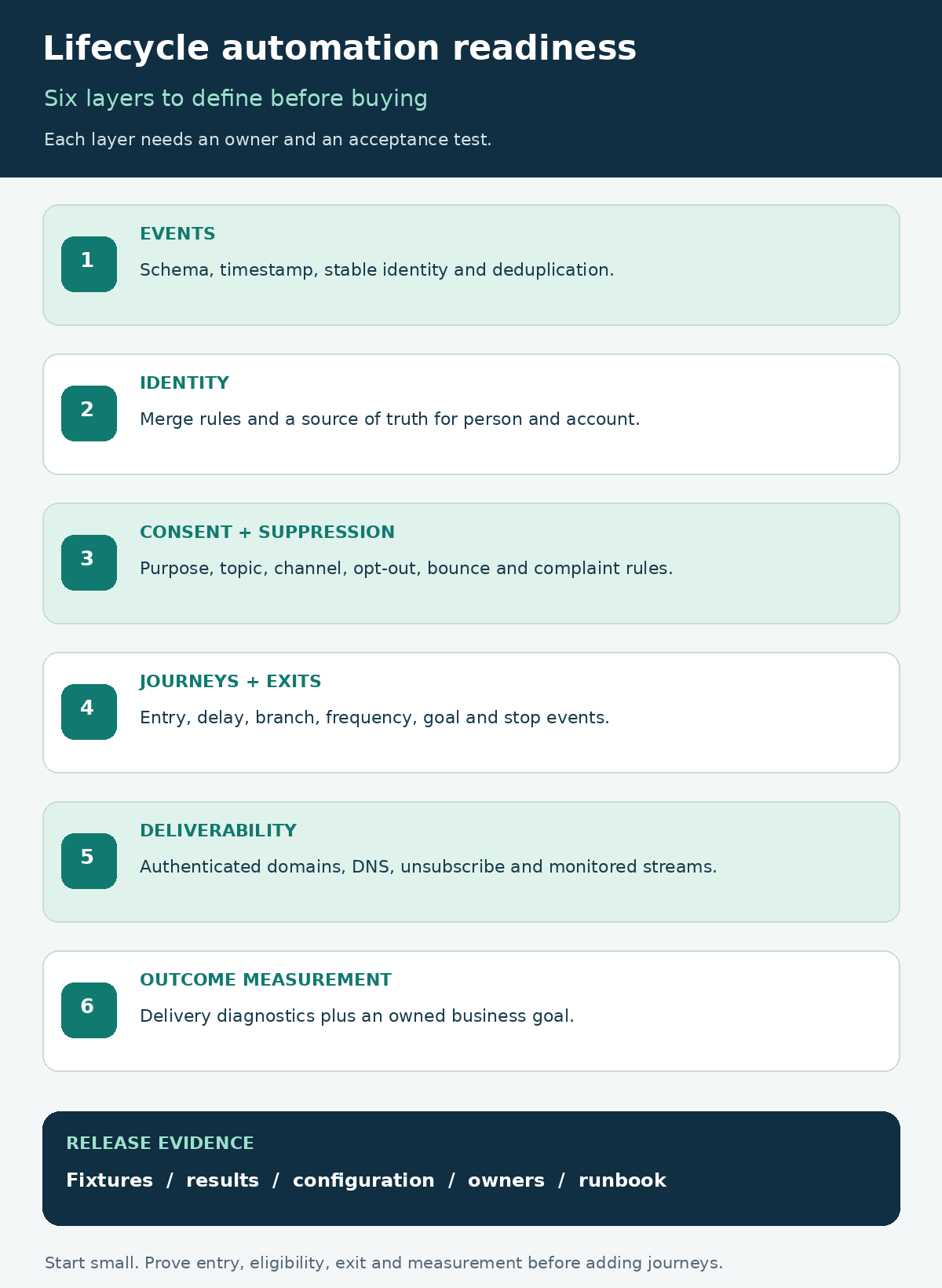
Define the event contract before the journey
A trigger needs more than a friendly name. Define an event contract containing the event name, producer, occurrence time, stable person or account identifier, required properties, version, deduplication key and owner. State what happens when the event is late, duplicated, missing a field or delivered out of order.
Microsoft's trigger-based journey documentation separates action-triggered journeys from segment-based journeys and shows an abandoned-cart flow using distinct cart and purchase events. It also uses purchase as an exit so a buyer who completes the goal stops receiving reminders. [1] The example is vendor-specific, but the design lesson is portable: start and stop events both need reliable definitions.
| Event field | Buyer question |
|---|---|
| Identity | Which customer or account does this event belong to? |
| Occurrence time | When did the action happen, not merely when was it received? |
| Deduplication key | Can a retry create a second journey entry? |
| Properties | Which values are required for rules and personalization? |
| Owner | Who fixes a broken producer or schema? |
Test events from the real source system. A manually fired test proves the canvas can run, not that production data will reach it correctly.
Separate identity, consent and sending eligibility
Decide whether the primary record is a person, an email address, an account or a combination. Document how anonymous visitors become known, how duplicate profiles merge and which source wins when CRM, billing and product records disagree. Preserve an audit trail for important changes.
Consent and preferences need their own model. Record the communication purpose, topic, channel, status, source and effective time. Microsoft documents consent-based segments that evaluate purpose, topic, channel, recipient and enforcement model, with aligned evaluation at segment calculation and journey execution. [2] That is one implementation pattern, not universal legal guidance.
Create one eligibility service or rule order that checks consent, global unsubscribe, topic preference, hard bounce, spam complaint, invalid address, account state and internal exclusions before every marketing send. Transactional and marketing streams should be classified deliberately rather than mixed to bypass preferences.
Obtain advice for the jurisdictions and message types you use. The US FTC states that CAN-SPAM applies to commercial email, including business-to-business messages, and requires accurate headers, non-deceptive subjects, a postal address and an opt-out process. [3] Other regions can require a different basis or stricter consent.
Make suppression a shared control
Suppression should sit across journeys, not be copied into each one. Keep distinct reasons for global unsubscribe, topic unsubscribe, hard bounce, spam complaint, invalid address, temporary block and internal hold. Define which reasons are permanent, which can expire and who may reverse them.
Twilio SendGrid distinguishes recipient unsubscribes from system suppressions and documents global and group-level unsubscribe choices. Its guidance also lists bounces, invalid addresses and spam reports as suppression reasons. [4] The exact objects vary by provider, but buyers should require equivalent behavior and exportability.
Test suppression latency. Submit an unsubscribe, process a complaint fixture and mark an address invalid, then confirm that queued and newly triggered marketing messages do not send. Test a topic unsubscribe separately from a global unsubscribe. Confirm that an approved password reset is not accidentally treated as a promotion.
Avoid routine suppression bypasses. An administrator switch that silently ignores an opt-out is a risk, not a convenience feature. Require an auditable exception path tied to a defined message class and appropriate approval. The implementation partner should document how suppressed records migrate if the sending provider changes.
Complete sender foundations before scaling volume
Verify sending domains, From addresses, reply handling, bounce processing and tracking domains before judging copy. Keep marketing and critical transactional traffic separated where the architecture and volume justify it, so a campaign problem does not unnecessarily affect important service messages.
Google's current Gmail sender guidelines require SPF or DKIM for all senders to personal Gmail accounts and SPF, DKIM and DMARC for bulk senders. They also describe aligned authentication, valid DNS, TLS and one-click unsubscribe requirements for applicable marketing and subscribed messages. [5] These are Gmail requirements, not a promise that authentication alone produces inbox placement.
Ask the provider to show authenticated test results for every sending domain and stream. Record who controls DNS, the return path, DKIM keys, DMARC reporting, link tracking and any dedicated IP. Decide how a domain or provider change will be handled.
Plan a controlled ramp using recipients who expect the messages. Do not import purchased contacts merely to create volume. Define alert thresholds for bounces, complaints, unusual deferrals and sudden changes, but set them from current provider guidance and your risk tolerance rather than copying an arbitrary industry number into the contract.
Specify each journey as a testable state machine
For every initial journey, document entry, eligibility, delay, branches, frequency rule, exit, goal, content owner and fallback. The journey should answer what happens when data arrives late, a contact qualifies twice, a goal happens during a delay or a send is suppressed.
| Journey | Entry | Exit or goal | Essential guard |
|---|---|---|---|
| Welcome | Verified signup | Activation milestone | Enter once per approved account |
| Trial guidance | Trial started | Paid conversion or trial end | Stop promotional reminders after purchase |
| Lapsed user | No qualifying use for the defined period | Return event or opt-out | Exclude ineligible account states |
Treat these as examples. An ecommerce business, marketplace and B2B SaaS product will use different states and goals. Keep the first scope small enough that owners can inspect every branch.
Content must degrade safely when optional data is missing. Use approved fallback text, validate links and include a plain-text version. Personalization should improve relevance, not expose account data or reveal an inference the recipient did not expect.
Measure delivery, behavior and business outcomes separately
Do not compress performance into one dashboard percentage. Record message processing, delivery, bounce, complaint, unsubscribe, click and the business goal as different events. A delivered message is not necessarily an inbox placement, and an open can be affected by client behavior and privacy features.
Amazon SES documents event destinations for sends, deliveries, opens, clicks, bounces and complaints, and allows bounce and complaint notifications to be published for operational handling. [6] Whatever provider is selected, require an export or webhook path, event definitions and retention information.
Connect each journey to a product or revenue event such as activation, qualified request, retained subscription or purchase. Store attribution rules, window and denominator. Compare eligible contacts, entrants, sends and goal completions so exclusions and failed events are visible.
Use a holdout or phased release when a causal estimate matters and the audience is large enough to support it. Otherwise report association honestly. Protect against double counting by choosing one conversion identifier and a rule for repeat outcomes. The buyer should be able to reproduce a weekly journey report from exported event data rather than depend on a screenshot.
Worked example: scope a trial lifecycle release
Consider an invented SaaS business with a fourteen-day trial. It chooses three approved events: trial_started, key_action_completed and subscription_started. Each carries a stable account ID, user ID, occurrence time, plan, locale and event ID.
The first release has one journey. A verified trial start enters eligible users. A useful guide sends after signup, a second message sends only if the key action is still incomplete, and every remaining reminder exits immediately after subscription. Global suppression, topic preference, hard bounce and spam complaint are checked before each send.
The acceptance set contains duplicate trial events, a late key-action event, a purchase during a delay, an unsubscribed address and an invalid address. It also includes a missing locale to test approved fallback content. The expected result for each fixture is written before the implementation is demonstrated.
The business goal is subscription_started within the stated window, while delivery and engagement remain diagnostic measures. The team records eligible trials, journey entrants, sends, suppressions, goal completions and exceptions. This is an educational design, not a benchmark or forecast.
Only after the flow passes does the business add another journey. That sequence makes failures diagnosable and prevents a large canvas from hiding weak source events or conflicting rules.
Compare proposals using the same operating scope
Give each vendor the same event list, identity model, audience size, message volume, journey specifications, consent requirements, sending domains, integrations, environments, reporting needs and support period. Ask for assumptions and exclusions in writing.
Separate costs for discovery, data integration, template production, journey configuration, testing, platform subscription, message volume, dedicated infrastructure, data retention, monitoring and ongoing optimization. A low license price can hide expensive event work, while a large implementation quote can include content or analytics another proposal excludes.
A bounded email marketing and lifecycle automation scope should leave behind the event dictionary, identity and suppression rules, journey specifications, templates, test fixtures, results, dashboards and operating runbook. If source records need reconciliation, include a defined CRM integration scope. Measurement work can be separated into a marketing analytics deliverable.
Do not buy a complex platform when a single permitted newsletter and basic transactional service meet the need. Do not automate a journey whose entry event, audience authority or owner is unresolved. TechLithic offers related services, but the same evidence and acceptance requirements should apply to TechLithic or any other provider.
Accept the system through evidence, not screenshots
Run the following checks in the deployed environment using controlled fixtures:
- Every required event has an owner, schema, occurrence time, stable identity and deduplication behavior.
- Duplicate, late and out-of-order events produce the documented result.
- Consent, global suppression, topic preferences, bounces, complaints and internal exclusions are evaluated before send.
- Goal and exit events stop pending reminders without manual cleanup.
- SPF, DKIM, DMARC, DNS, TLS and unsubscribe behavior meet the applicable provider and business requirements.
- Fallback content, links, plain text and rendering pass review without exposing unexpected data.
- Delivery and engagement events reach the agreed monitoring destination, while the business goal uses a defined identifier and attribution rule.
- The team can trace one contact from source event through eligibility, journey decision, send, suppression or outcome.
- Exports, configuration ownership, incident handling and provider migration steps are documented.
Record the release configuration, test evidence, known limitations and owners. Define which changes require a full regression run. An email automation system is ready when the team can explain why a message sent, why another did not and what business event ended the journey.
For paid acquisition feeding these journeys, the paid marketing proposal guide explains how to keep attribution and contribution assumptions visible.
Frequently asked questions
How many lifecycle email journeys should a first release include?
Use the smallest set that covers a valuable, measurable customer transition and can be fully tested. One to three well-defined journeys are often more manageable than a large template library, but the right number depends on the business and data readiness.
Should marketing and transactional email use the same stream?
Classify them separately and assess whether domains, subdomains, IP pools, permissions and suppression behavior should be isolated. The answer depends on volume, criticality, provider architecture and applicable requirements.
Are opens a reliable lifecycle goal?
Treat opens as a diagnostic engagement signal, not proof of a product or revenue outcome. Prefer an owned event such as activation, purchase, renewal or a qualified request for the journey goal.
What should the implementation partner hand over?
Require the event dictionary, identity and consent rules, suppression logic, journey specifications, templates, test fixtures and results, reporting definitions, credentials ownership map and operating runbook.
When should lifecycle automation wait?
Wait when the trigger cannot be trusted, audience permission is unclear, suppressions are fragmented, sender authentication is incomplete or no owner can maintain the journeys and respond to failures.
Sources and research notes
Sources checked on 2026-10-22. Pricing and policy documents can change; verify current terms before approving expenditure.
- Microsoft Learn: Create a trigger-based journey
Primary product documentation illustrating action triggers, journey goals and exit events. Used as an implementation example, not a recommendation of a specific platform.
- Microsoft Learn: Build segments using consent-based criteria
Primary product documentation on evaluating purpose, topic, channel, recipient and enforcement settings in consent-aware segments and journeys.
- US Federal Trade Commission: CAN-SPAM Act compliance guide
Official US guidance for commercial email. It is jurisdiction-specific and does not replace advice about other laws or the buyer's circumstances.
- Twilio SendGrid documentation: Suppressions
Primary provider documentation distinguishing unsubscribes and system suppression reasons, including global and group choices.
- Google Gmail Help: Email sender guidelines
Current Gmail requirements and guidance covering authentication, DNS, TLS, alignment, wanted mail and unsubscribe behavior. Requirements vary by sender class and recipient provider.
- Amazon SES documentation: Using configuration sets
Primary provider documentation on publishing send, delivery, engagement, bounce and complaint events and separating sending infrastructure.
Official Microsoft, FTC, Twilio, Google and AWS sources were checked on October 22, 2026. Provider-specific capabilities are used as examples, not universal features or endorsements. The event contract, readiness map, comparison model and trial example are original educational frameworks. Legal requirements and deliverability controls depend on jurisdiction, message purpose, volume, recipients and provider rules; obtain appropriate advice for the actual program.