
LLM search buying guides
LLM Search Optimization: How to Evaluate an Agency Proposal
An LLM search proposal should make your website easier to discover, understand, verify and cite. It should not sell a secret switch for AI answers. Use this guide to compare agencies on auditable work, measurable coverage and a pilot your team can accept without buying a ranking promise.
Prepared with AI assistance and checked against the linked sources. Numerical comparisons are illustrative unless expressly sourced.
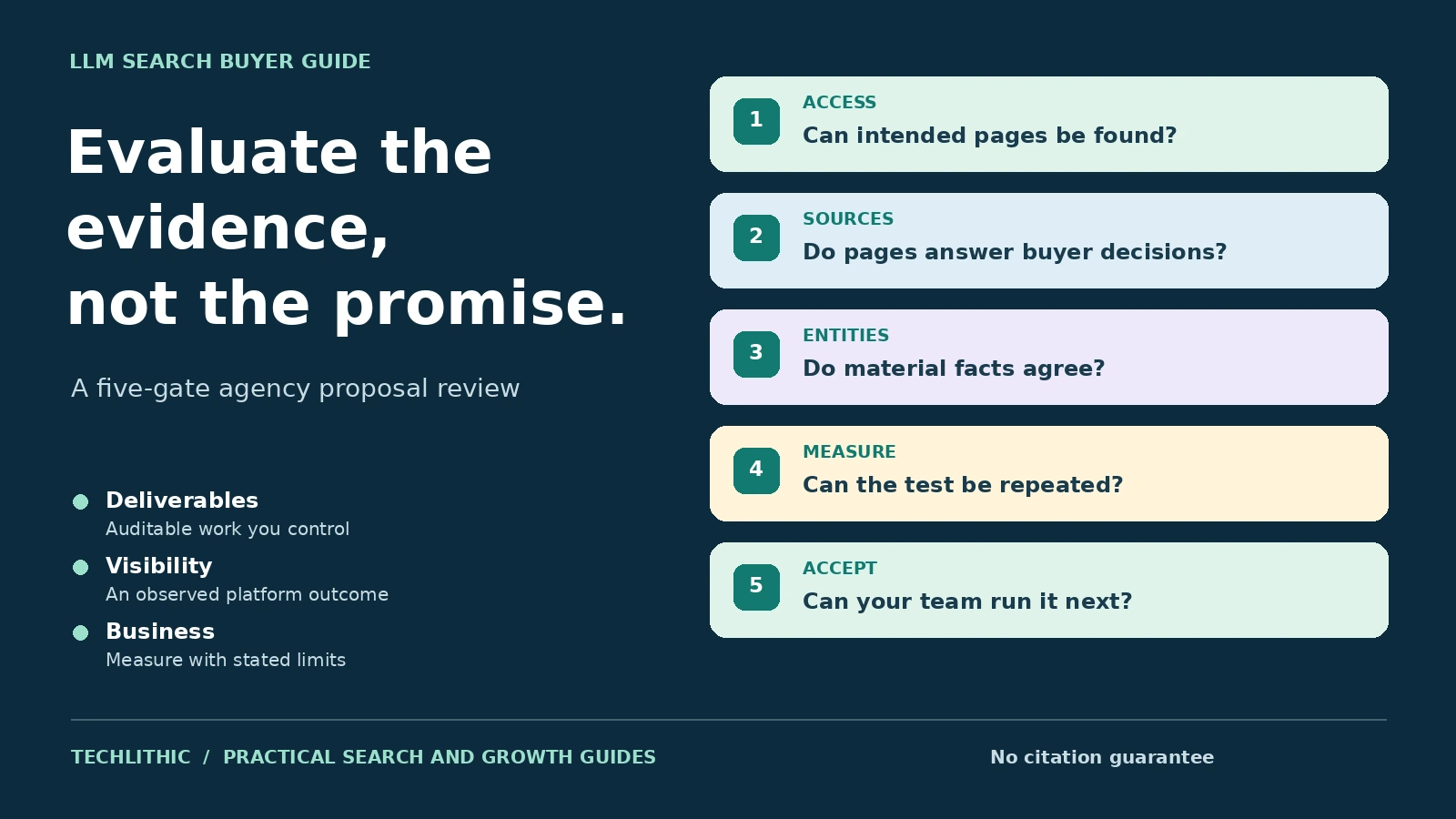
Buy a defined visibility system, not a guaranteed citation. A credible proposal names the engines and page groups in scope, proves crawl and index eligibility, improves useful source pages, resolves contradictory business facts, establishes a repeatable measurement set and separates completed work from outcomes no agency controls.
Start with the buyer decision, not the new label
LLM search optimization, answer engine optimization and generative engine optimization are labels for work intended to improve visibility in AI-assisted discovery. The useful question is not which label sounds newest. Ask what business decision the engagement should support and which discovery surfaces matter.
A B2B software company might need its product to be considered in comparison questions, while a local provider may care about accurate service, location and contact information. A publisher may prioritize source citations. These require different page sets and evidence.
Google currently describes optimization for its generative AI features as part of SEO. Its guidance says the same foundations still matter, including technical access and useful, original content, and warns that special AI files, forced content chunking and AI-only rewrites are not required for Google Search. [1] That statement is specific to Google. A proposal should name each engine it covers instead of treating every AI product as one system.
Write one sentence into the scope: “Help qualified buyers find verifiable answers about these products, in these markets, across these named search experiences.” Then list the page groups, languages, competitors and exclusions. If the agency cannot translate “increase AI visibility” into a bounded investigation, the proposal is not ready to price.
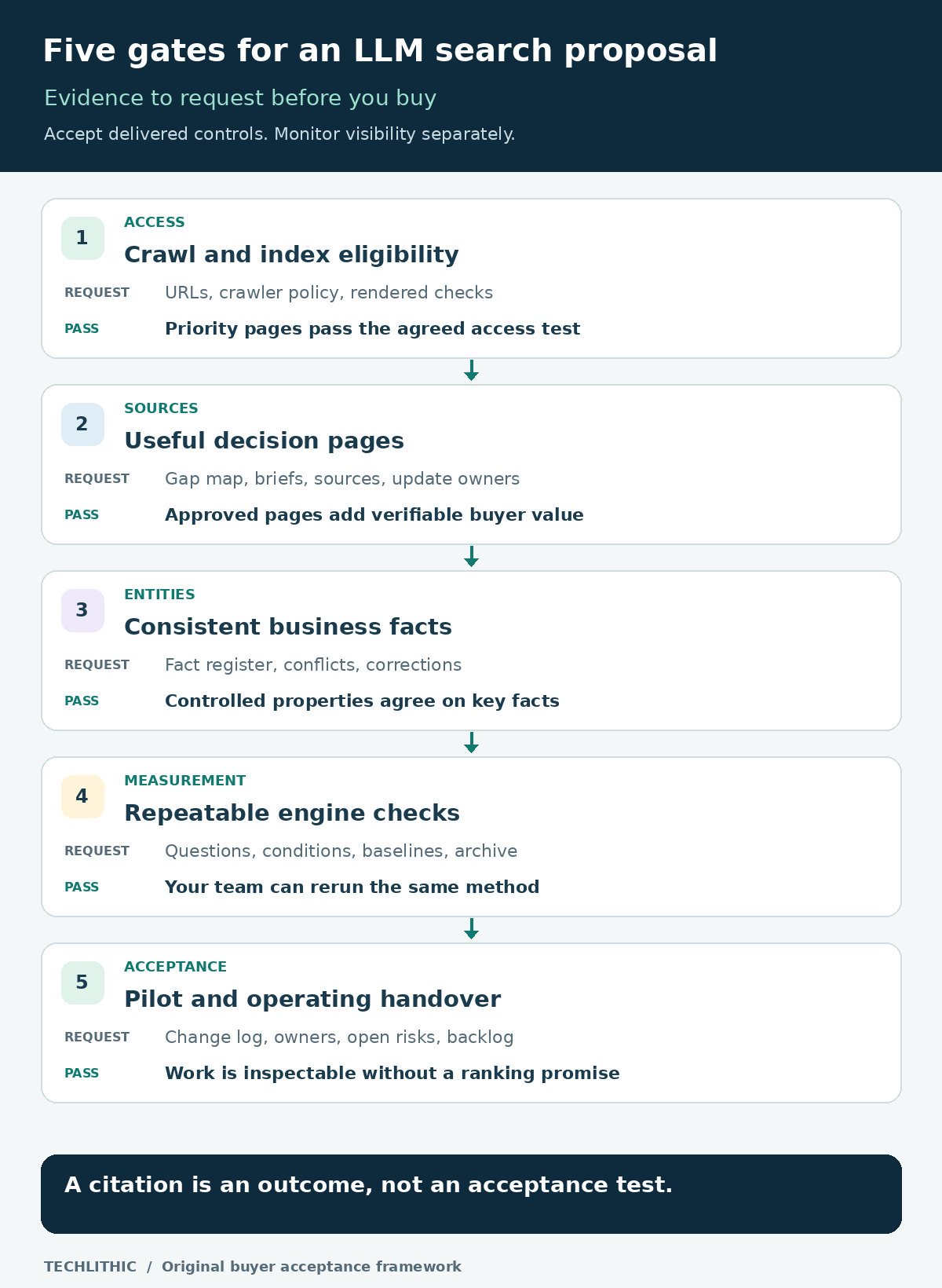
Gate one: prove that intended pages are accessible
Before producing more content, require a technical eligibility check. Important pages should return the intended response, be internally discoverable, use coherent canonical URLs and avoid accidental robots, noindex, authentication or rendering barriers. The sitemap should list preferred public URLs, but sitemap submission is not a guarantee of selection or visibility.
For Google AI Overviews and AI Mode, Google says a supporting page must be indexed and eligible to appear in Search with a snippet. It lists no additional technical requirement for those features. [2] An agency should therefore show evidence from the actual page, Search Console where authorized and the rendered result, rather than claim a private AI submission route.
Engine controls differ. OpenAI documents OAI-SearchBot for surfacing websites in ChatGPT search and treats it separately from GPTBot, which concerns potential model training. A site can allow the search crawler while disallowing the training crawler. [3] Ask the agency to record the current robots policy, CDN or firewall behavior and the business decision behind any change. “Allow all AI bots” is not an acceptable default.
The deliverable is a tested access matrix: crawler or engine, policy, affected page group, observed status, owner and proposed action. This is more useful than a generic screenshot saying the site is “AI ready.”
Gate two: fund source pages that deserve to be cited
Crawl access only creates eligibility. The proposal should identify where your site can offer information that is specific, current and useful enough to support a buyer’s answer. Ask for a page inventory tied to real decisions: comparisons, implementation requirements, limitations, pricing structure, integration details, policies, evidence and frequently misunderstood terms.
Require the agency to distinguish three work types. A factual correction fixes an inaccurate statement. A content gap adds information buyers need. An evidence gap adds support for a claim that is currently asserted without proof. Publishing twenty lightly rewritten articles is not equivalent to closing one material decision gap.
Each recommended page should have an intended audience, primary question, evidence owner, source inputs, update trigger and conversion path. For original experience or data, state how it was obtained and what it does not prove. Google’s current generative-search guidance favors non-commodity, people-first content and warns against scaled pages created mainly to manipulate search systems. [1]
Ask for examples before signing. A useful brief might specify an implementation comparison using your real integration requirements and maintained documentation. A weak brief says only “write an authoritative article about the best tools.” The former can be checked; the latter invites unsupported summaries.
Gate three: reconcile the facts that identify the business
Buyers and search systems encounter your company across the homepage, product pages, profiles, app listings, documentation and third-party references. A proposal should inventory material facts such as legal name, brand name, product names, ownership, locations, service areas, support contacts and current capabilities. Contradictions should become owned correction tasks.
Structured data can provide explicit clues about a page, but it must describe visible content. Google explains that markup classifies page information and should not contain facts absent from the page. [4] Schema.org defines sameAs as a URL that unambiguously identifies the item, such as an official profile. [5] Neither source promises an AI citation. Treat markup as a consistency and eligibility aid, not a ranking product.
Ask for an entity register showing each important fact, its authoritative owner, the approved wording, the pages or profiles where it appears and the review date. The agency should not invent awards, customer counts, certifications or founder biographies to make an entity appear stronger.
If the proposal includes digital PR or third-party mentions, require publication standards and disclosure rules. Inauthentic profiles or paid mentions presented as independent proof create reputational risk. Correct first-party facts and earned, relevant references are a safer foundation.
Compare deliverables, responsibilities and evidence
Convert every proposal into the same comparison table. Activities describe effort; deliverables describe what you can inspect and reuse.
| Proposal area | Evidence to request | Acceptance question |
|---|---|---|
| Discovery | Named engines, markets, question clusters and baseline date | Can your team reproduce the scope? |
| Technical access | URL samples, rendered checks, crawler policy and issue register | Are intended pages reachable under the agreed policy? |
| Content | Decision-gap map, briefs, sources and update owners | Does each page add verifiable buyer value? |
| Entity work | Fact register, conflict list and approved corrections | Do first-party properties agree on material facts? |
| Measurement | Saved question set, collection method and result archive | Can the same test be repeated without the agency? |
| Handover | Editable files, change log, access removal and next backlog | Can your team operate the system after the pilot? |
Name who writes, approves, publishes and verifies each change. Clarify whether engineering, design, subject-matter review, outreach and analytics setup are included. Your SEO and LLM search optimization scope should be evaluated against the same standard, including when TechLithic is the provider.
Google’s guidance for hiring an SEO warns against ranking guarantees and providers who will not explain their methods. [6] Apply that warning to AI citations too. A provider can commit to research, implementation and measurement quality, but not to a third party’s future answer.
Measure coverage without manufacturing a ranking score
Measurement should begin with a saved set of realistic buyer questions grouped by journey stage, market and product. Record the engine, account or location conditions where relevant, test date, answer presence, cited domains, your cited page, factual accuracy and referral traffic. Archive enough context to explain changes, but respect each platform’s terms and avoid pretending one sample is universal.
Bing Webmaster Tools now provides an AI Performance report describing how site content is used in AI-generated answers across Microsoft Copilot and partner experiences. [7] Google’s current guidance points site owners to its generative AI reporting in Search Console. [1] ChatGPT can return current web answers with source links, while OpenAI separately documents the crawler used for search visibility. [8] These are different evidence streams, so a single proprietary “AI rank” should not replace platform data, referral analytics and manual verification.
Agree which outcomes are directional. Citation presence can vary by wording, time, model and user context. Referral sessions may be small or partially attributed. Assisted conversions need an agreed analytics model. Report these limitations beside the numbers.
A credible dashboard separates completed inputs, observable visibility and business outcomes. For example: pages corrected, source briefs published and facts reconciled are controlled inputs; citation coverage is observed visibility; qualified enquiries are a business outcome influenced by many factors.
Worked example: specify a six-week evaluation pilot
Consider an invented B2B software company evaluating a six-week pilot. The company selects forty buyer questions across four clusters: category comparison, integration, implementation and risk. The agency checks the baseline across the named engines, audits twelve priority pages and identifies six decision gaps and three contradictory product facts.
The pilot scope includes correcting the confirmed facts, improving four existing pages, publishing two evidence-led pages, validating crawler access and setting up a repeatable result archive. This is an illustrative scope, not a universal workload or timeline.
| Acceptance point | Pass condition |
|---|---|
| Access | Agreed priority pages are fetchable under the approved crawler policy |
| Content | Six approved changes are live, sourced and connected to relevant journeys |
| Facts | Three confirmed contradictions are corrected on controlled properties |
| Measurement | Forty questions, conditions and baseline results are saved in an editable file |
| Handover | Owners, update triggers, open risks and the next backlog are documented |
Do not make “gain ten citations” a delivery acceptance condition. The team can verify that the agreed system and content shipped. Citation change belongs in the monitored outcome section, with no guaranteed direction or timing.
Compare the pilot fee together with internal review time, development effort, publishing capacity and ongoing measurement. The cheapest proposal may be expensive if it leaves your team with unapproved drafts, inaccessible dashboards or no way to repeat the test.
Use this proposal and acceptance checklist
Before signing, trace one promised recommendation from diagnosis to evidence, implementation owner and acceptance test. Then confirm the full boundary:
- Are the engines, markets, languages, page groups and exclusions named?
- Does the baseline preserve exact questions, dates and collection conditions?
- Are crawler access and training permissions treated as separate decisions where applicable?
- Does the content plan close specific decision or evidence gaps?
- Are material business facts assigned to authoritative owners?
- Does structured data match visible content and use appropriate types?
- Are production changes, outreach, design and subject review included or excluded?
- Are platform reports, analytics and manual checks kept distinct?
- Are ranking, citation and traffic guarantees absent?
- Will you receive editable files, access ownership and an operating handover?
At delivery, sample the work. Fetch agreed pages, inspect visible facts and markup, trace sources, repeat part of the question set and reconcile the change log. Accept the engagement on completed evidence and controls, then monitor discovery outcomes over the agreed observation period.
If your site is not technically accessible, buy a focused SEO audit with implementable findings first. If the website lacks reliable product information, content and subject review may be the real need. If you already have those foundations and want a controlled cross-engine pilot, this framework can help you compare search and LLM visibility programs without confusing marketing language with proof. The broader SaaS buying checklist covers security, portability and total-cost questions for supporting tools.
Walk away from guarantees and hidden methods
Reject proposals that guarantee placement, cite a secret relationship with an engine, promise hundreds of instant mentions, add unsupported claims, or refuse to show the question set and work log. Be cautious when the entire strategy is an AI-only file, schema on invisible content, mass-produced FAQs or profiles created only to manufacture authority.
Also reject overbroad access requests. An initial assessment rarely needs ownership of your analytics, Search Console, CMS or business profiles. Use least privilege, retain account ownership and record when temporary access will be removed.
Do not buy a separate LLM search engagement merely because the label is fashionable. A focused technical repair, product-documentation project or editorial program may solve the actual constraint. The right proposal makes that diagnosis visible, even when it reduces the work being sold.
Frequently asked questions
Can an agency guarantee that an LLM will cite my website?
No. An agency can commit to auditable research, technical corrections, content delivery and measurement. Citation and answer selection are controlled by third-party systems and can vary by query, time and context.
Do I need an llms.txt file for Google AI Overviews?
Google says llms.txt and other special AI files are not required and do not improve visibility in Google Search. Other services may have different documentation, so evaluate each named engine separately.
Is structured data required for LLM search optimization?
There is no universal special schema for AI citations. Use appropriate structured data when it accurately represents visible content and supports normal search features, but do not treat markup as a citation guarantee.
How long should an LLM search pilot run?
Set the duration from the work involved, publishing capacity and observation needs. The six-week example in this guide is illustrative, not a benchmark. Define deliverables separately from later visibility monitoring.
What should an agency report every month?
Request completed changes, unresolved access or fact issues, content and entity work, engine-specific observations, referral data, limitations, and the next prioritized backlog. Preserve the underlying question set and evidence.
When should I buy ordinary SEO instead?
If the main problem is crawling, indexing, duplicate URLs, weak commercial pages or a missing content process, foundational SEO and implementation may be the more direct scope. AI discovery depends on many of the same foundations.
Sources and research notes
Sources checked on 2026-10-25. Pricing and policy documents can change; verify current terms before approving expenditure.
- Google Search Central: Optimizing your website for generative AI features
Google-specific guidance on foundational SEO, useful non-commodity content, technical clarity, measurement and unsupported AI-search shortcuts.
- Google Search Central: AI features and your website
Eligibility for supporting links in AI Overviews and AI Mode relies on normal Search indexing and snippet eligibility, with no additional technical requirement.
- OpenAI developer documentation: Overview of OpenAI Crawlers
Official distinction among OAI-SearchBot, GPTBot and user-triggered ChatGPT-User access, including separate site controls.
- Google Search Central: Introduction to structured data markup
Structured data gives explicit clues about visible page information and should describe the content of that page.
- Schema.org: sameAs property
Defines sameAs as a URL that unambiguously indicates an item's identity. It does not make a visibility guarantee.
- Google Search Central: Do you need an SEO?
Official buyer guidance warning against guaranteed rankings, secret methods and alleged special relationships.
- Bing Webmaster Tools: AI Performance
Official reporting documentation for how site content is used in AI-generated answers across Microsoft Copilot and partner experiences.
- OpenAI Help Center: Searching the web with ChatGPT
Official overview of current web search answers and source links in ChatGPT.
Official Google, Microsoft, OpenAI and Schema.org sources were checked on October 25, 2026. Platform guidance is attributed to its provider and is not generalized to every answer engine. The five-gate framework, forty-question pilot, six-week duration, page counts and acceptance table are original procurement illustrations, not client results, market benchmarks or promised outcomes. No ranking, citation, traffic or revenue result is guaranteed.