
Product video buying guides
Product Explainer Video Brief: What to Ask a Production Team
A product explainer video is not just a polished animation. It is a controlled explanation of one decision for one audience, delivered in formats that work where the audience will see it. A useful production brief makes the message, proof, approvals, rights, accessibility, variants and acceptance tests explicit before expensive editing begins.
Prepared with AI assistance and checked against the linked sources. Numerical comparisons are illustrative unless expressly sourced.
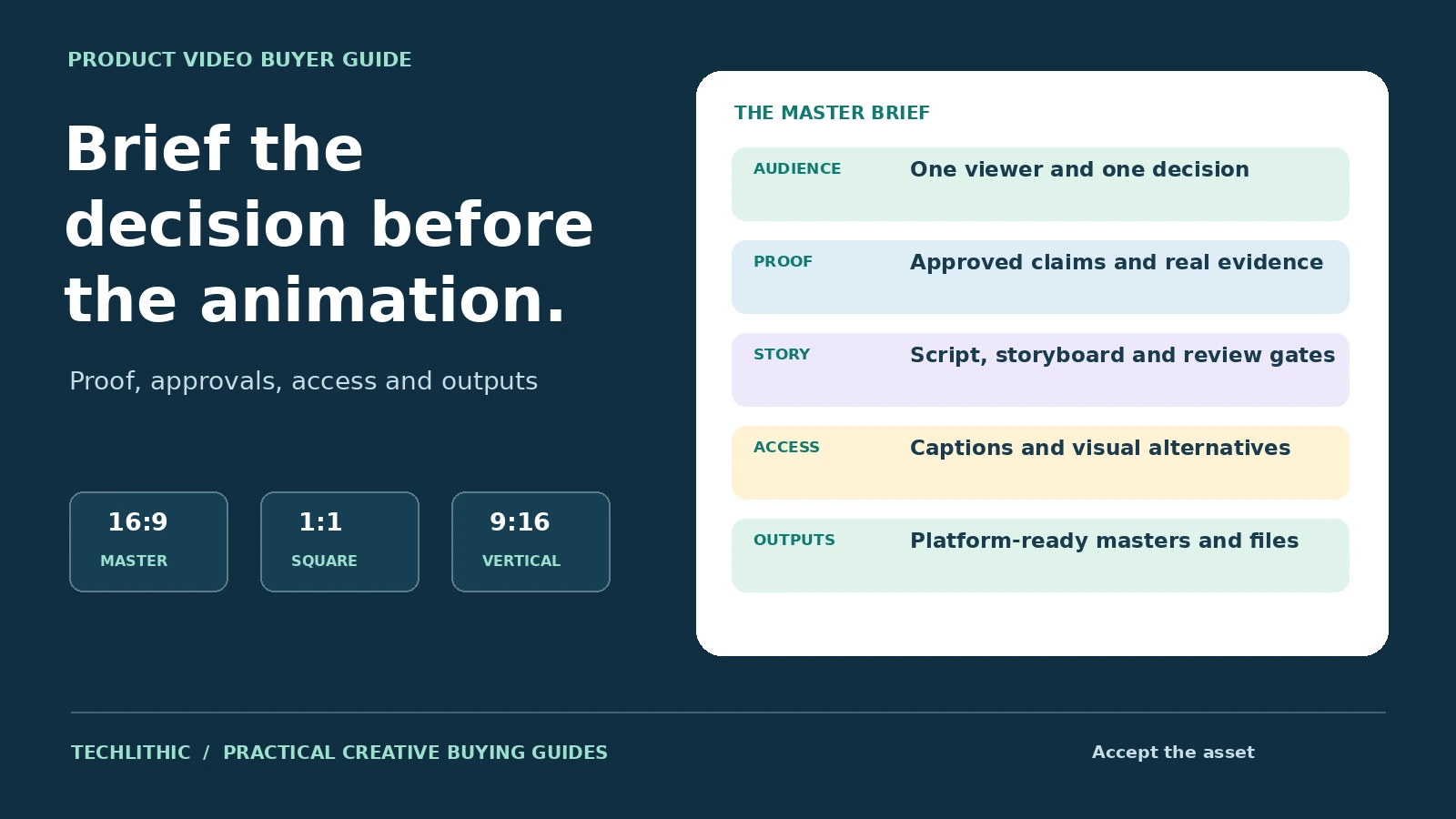
Buy a repeatable communication asset, not an unspecified number of video minutes. Approve the audience, decision, claim evidence, script and storyboard in stages. Specify accessibility and channel variants before production, define what files and rights transfer, and accept the work against objective delivery checks rather than views or conversions the production team cannot control.
Start with one audience decision
Begin with the person who will watch, the situation they are in and the decision the video should make easier. “Explain our platform” is too broad. “Help an operations lead understand how approved requests move from intake to assignment, so they can decide whether to book an integration review” is testable.
Name the primary placement before choosing length or visual style. A homepage explanation, sales follow-up, onboarding walkthrough, event loop and paid social ad serve different attention states. One master concept can support several outputs, but a single edit rarely performs every job without adaptation.
Write a one-page message frame with five fields: audience, current problem, promised understanding, proof and next action. Add a non-goal. If the video is for initial evaluation, it may not need to teach every configuration step. If it is onboarding content, brand atmosphere cannot replace task accuracy.
W3C recommends planning accessibility requirements, responsibilities and outsourcing decisions at the start of an audio or video project. [1] Apply the same principle to distribution and measurement. Late requirements create re-editing, while early constraints guide the script, framing and deliverables.
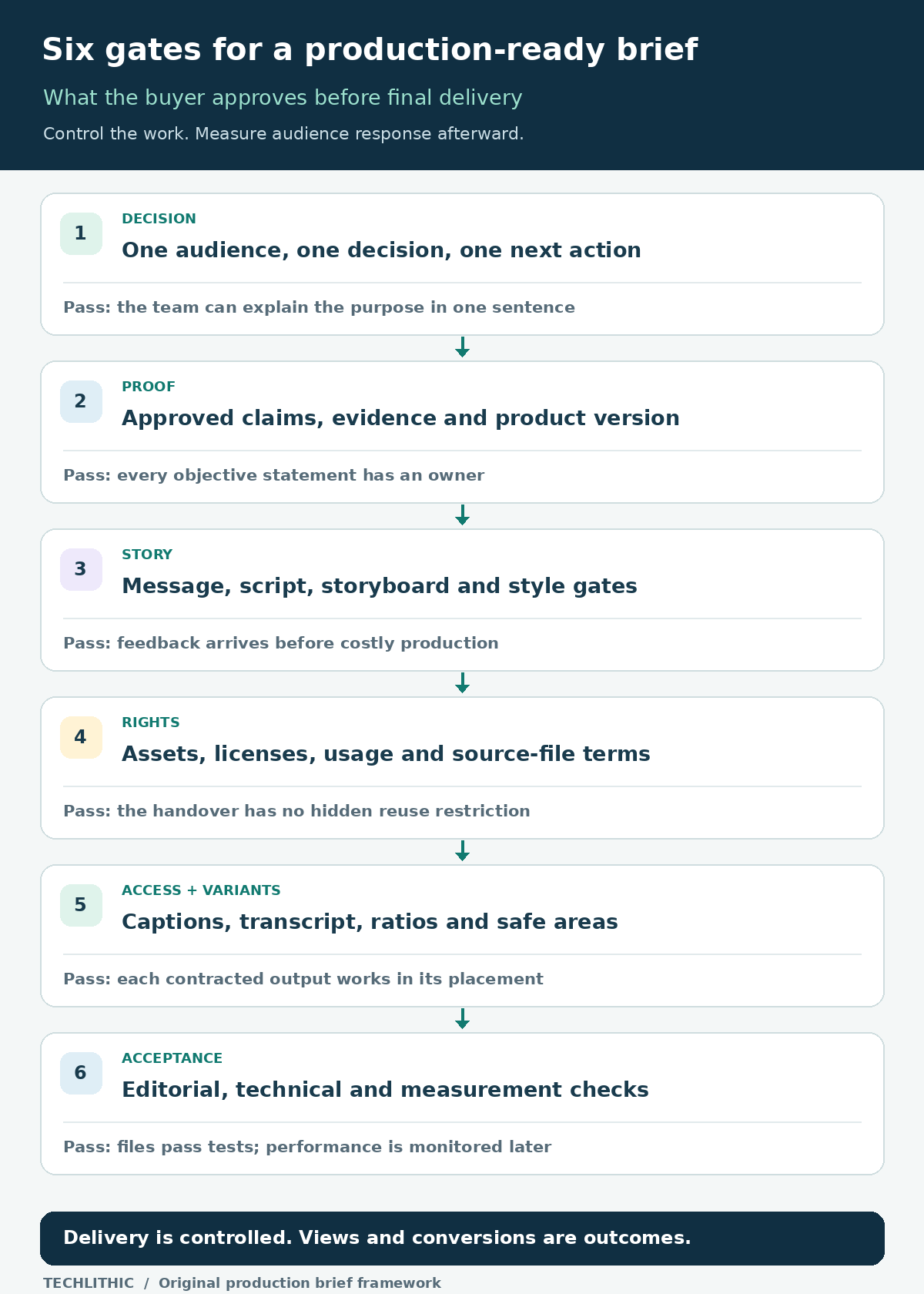
Approve proof before the script makes claims
Create a claim register before copywriting. For every performance, customer, security, integration or savings statement, record the approved wording, supporting evidence, evidence owner, date checked and any qualifier that must remain visible or audible.
The United States Federal Trade Commission states that advertising claims must be truthful, not deceptive or unfair, and evidence-based. Its substantiation policy says advertisers and agencies need a reasonable basis for objective claims before dissemination. [2] [3] Other jurisdictions can impose different obligations, so the brief should identify the markets and legal reviewer rather than treating this as universal legal advice.
Ask the production team to flag unsupported superlatives, composite testimonials, unverified interface states and demonstrations that hide required steps. A polished animation of a capability that does not exist is still inaccurate. If the product UI will change during production, name the version, capture environment and owner who approves the final screens.
Proof does not need to mean a numerical claim. A faithful product demonstration, documented integration, verified workflow, customer quotation with permission or clearly labeled conceptual illustration can support the story. The key is to distinguish what is real, what is illustrative and what is still planned.
Separate script, storyboard and production approvals
Do not jump from a kickoff call to a nearly finished edit. Divide approval into stages so feedback arrives when it is still inexpensive to use.
| Gate | Buyer checks | What becomes costly afterward |
|---|---|---|
| Message outline | Audience, problem, decision, proof and call to action | Changing the strategic story |
| Script | Spoken words, on-screen text, claims, pronunciation and timing read | New narration and timing changes |
| Storyboard | Scene purpose, visual source, UI state, transitions and accessibility plan | Redesigning scenes and compositions |
| Style frame | Typography, colors, illustration or capture treatment and brand fit | Rebuilding the visual system |
| Rough cut | Pacing, narration, sequence, music level and missing information | Structural editing after finishing |
| Final master | Accuracy, technical quality, captions, variants and file package | Reopening the whole project |
Define who can approve each gate and how conflicting feedback is consolidated. One client owner should return a single review, not forward unfiltered comments from multiple departments. State the number of revision rounds, the review window and what counts as a change of scope.
Ask for a timed table read before recording. Estimated word count is only a planning aid because pauses, emphasis and product demonstrations change pace. Approve a natural read, not a script squeezed into a purchased duration.
List every asset, permission and handover right
The brief should inventory logos, fonts, UI captures, product data, customer marks, stock footage, illustrations, music, sound effects, voice talent and source files. For each asset, record who supplies it, who clears it, where it may be used, for how long and in which territories or media.
Commissioning work does not automatically answer every ownership question. The U.S. Copyright Office explains that work-made-for-hire status depends on specific conditions, including the employment relationship or certain commissioned categories with an express signed agreement. [4] Applicable law differs, so use a written contract and obtain appropriate legal advice for the markets involved.
Specify whether the fee covers a license or an assignment, and whether it includes paid advertising, organic social, websites, events, broadcast, localization and future edits. Ask whether stock and music licenses transfer, remain with the producer or require your own account. Record restrictions on synthetic voices, AI-generated visuals and training use.
The handover list can include final masters, channel variants, caption files, transcript, thumbnail files, clean version without burned-in text, audio stems, editable project files, linked fonts or substitutes, source artwork and a license register. If editable files are excluded, say so before comparing quotes.
Design accessibility into the narration and visuals
Do not treat auto-captions as the complete accessibility plan. W3C’s WCAG guidance calls for synchronized captions for prerecorded audio in synchronized media and notes that captions include dialogue, speaker identification and meaningful non-speech information. [5] Request an editable caption file and a human accuracy review for names, product terms and timing.
Important information shown only on screen can exclude viewers who cannot see it. WCAG guidance for prerecorded video describes audio description for visual information not conveyed by the main soundtrack, while noting that extra description is unnecessary when the existing audio already communicates all important visual information. [6]
An efficient explainer can reduce remediation by making the narration carry the essential meaning. For example, say “the approved request moves to the finance queue” rather than relying on an animated arrow without explanation. Keep on-screen text readable, avoid essential meaning through color alone and leave enough time to understand charts or interface steps.
Agree on transcript delivery, caption languages, burned-in versus selectable captions, audio-description approach and the applicable accessibility standard. Test the final video with sound off and, separately, without looking at the screen. Each test should still preserve the agreed core message through the relevant alternative.
Build variants from a distribution matrix
Ask for a matrix that maps each placement to audience state, aspect ratio, maximum or recommended duration, safe area, opening hook, call to action, thumbnail, captions and destination. Check specifications on publication day because platforms change them.
Google Ads currently documents horizontal, vertical and square video ratios, including 16:9, 9:16 and 1:1, and directs advertisers to the specific campaign format for length requirements. [7] LinkedIn currently accepts horizontal, square and vertical video-ad ratios, recommends 15 to 30 seconds for broad placement eligibility, and requires SRT captions when a caption file is supplied. [8]
These are platform specifications, not universal creative recommendations. A 90-second homepage explainer does not become an effective vertical ad by cropping the sides. The shorter variant may need a new opening, fewer proof points, larger text and an earlier call to action.
Request a master script map that identifies which scenes can be removed, reframed or reordered. Keep critical faces, UI and text inside placement-specific safe areas. Approve at least one actual export for every contracted ratio, because automated reframing can cut off menus, captions and visual evidence.
Compare quotes on the same production boundary
A quote should separate strategy and scripting, pre-production, filming or screen capture, design, animation, narration, music, editing, accessibility, variants, project management, travel, licensing and handover. A low price can exclude the work that makes the asset usable.
Ask what the production method actually is. Live action needs locations, crew, casting, releases, contingency and reshoots. UI-led video needs a stable staging environment, realistic sample data and capture ownership. Custom animation needs a style system and source artwork. Template or AI-assisted production may reduce some effort but still requires claim review, brand control and licensing clarity.
Define assumptions that trigger a change order: script changes after voice recording, new product screens, an additional language, a different presenter, new aspect ratios or more approval rounds. State the day rate or fixed price for additional work and who can authorize it.
Compare total usable output, not cost per finished minute. If a proposal includes only one compressed master while another includes a website version, paid variants, captions, source files and licensed assets, they are not equivalent. For broader creative procurement, TechLithic’s creative and media scope should be judged by the same boundary, including when TechLithic is the provider.
Worked example: a B2B workflow explainer
Consider an invented workflow product preparing a homepage explainer. The primary viewer is an operations leader comparing request-management tools. The single decision is whether the product can enforce approvals without creating another manual handoff. The next action is to request an integration assessment.
The approved proof consists of real staged product capture showing intake, approval, assignment and an audit record. No time-savings claim is used because the company has not validated one. The production plan includes a 75-second horizontal master, a 30-second square cut and a 15-second vertical cut. These lengths are illustrative choices, not platform rules or performance benchmarks.
| Brief item | Illustrative decision |
|---|---|
| Opening | Show a delayed request and name the approval problem within the first scene |
| Proof | Use approved staging data and the current product version |
| Accessibility | Narration carries essential steps; reviewed captions and transcript are delivered |
| Variants | Short cuts use new openings and reframed product evidence, not simple crops |
| Rights | Contract lists product captures, music license, voice usage and editable-file terms |
| Measurement | Tagged destinations separate placements and record assessment requests |
The production team is accepted on accurate, accessible, technically valid files and a complete handover. Completion rate, click-through and qualified requests are monitored after release. They are not promised outcomes.
Accept the asset, then measure the audience response
Before final payment, test editorial accuracy and technical delivery separately. Editorial checks cover the approved script, claims, UI, brand, pronunciation, captions, transcript, call to action and legal qualifiers. Technical checks cover resolution, ratio, frame rate, audio, caption timing, file names, thumbnails, playback and destination links for each placement.
Ask the producer for a change log and a clean delivery index. Spot-check the final exports rather than approving only a review link. Confirm that source files open with the documented software and that linked assets are present if those files are included.
Measurement belongs in the brief because it affects calls to action and variants. Define placement-specific links, campaign parameters and the events that represent meaningful progress. Google Analytics documents using event parameters and event-scoped custom dimensions to analyze details such as clicked links or video engagement. [9] Validate collection before using the data for decisions.
Keep delivery acceptance separate from outcomes. The production team can deliver an accurate video and still encounter weak distribution, poor targeting or an unattractive offer. Review watch starts, meaningful progress, completion, click-through, destination behavior and qualified actions in context. Use findings to revise the opening, evidence or placement, not to invent certainty from a small sample.
Use this buyer checklist before signing
- Is one primary audience, decision and next action defined?
- Are the placements and required variants named before production?
- Does every objective claim have an evidence owner and approved wording?
- Are script, storyboard, style and edit approvals separate?
- Is there one client owner for consolidated feedback?
- Are revision rounds, review windows and change-order triggers clear?
- Are all brand, customer, stock, music, voice and AI asset rights documented?
- Are captions, transcript and visual-description needs specified?
- Does each contracted ratio receive an actual export and safe-area check?
- Are final masters, caption files, thumbnails, source files and license records listed?
- Are technical acceptance and campaign performance measured separately?
A simple screen recording may be enough when a sales representative will narrate live, the product changes weekly or the audience needs a task walkthrough rather than a persuasive story. A written comparison may work better when buyers need dense specifications. Commission a full explainer when the message is stable enough to reuse and the cost of repeated misunderstanding is material.
Use the same brief with any provider. TechLithic offers product explainer video production and related video services, but that commercial relationship does not change the acceptance standard. The paid marketing proposal guide can help define distribution ownership after the asset is delivered.
Frequently asked questions
How long should a product explainer video be?
Choose length from the audience, placement and proof required. Approve a natural timed read, then create shorter variants when another placement needs a different opening or structure.
Should the production company write the script?
It can, but the buyer must supply product facts, evidence, audience context and one approver. Keep message, script and storyboard approvals separate.
Do we need vertical, square and horizontal versions?
Only request formats in the distribution plan. Different ratios often require reframing or re-editing so product UI, evidence and captions remain readable.
Are automatic captions enough?
Treat automatic captions as a draft. Request a reviewed caption file with correct terms, speakers, meaningful sounds and timing, plus the agreed transcript.
Who owns the project files and music?
The contract should define ownership or licensing for the final video, sources, music, stock and voice. Obtain appropriate legal advice where rights matter.
Can the producer guarantee views or conversions?
No. The producer controls the agreed deliverables. Results also depend on distribution, targeting, placement, offer and product-market fit.
Sources and research notes
Sources checked on 2026-10-26. Pricing and policy documents can change; verify current terms before approving expenditure.
- W3C Web Accessibility Initiative: Planning Audio and Video Media
Primary accessibility guidance on identifying caption, description and transcript needs and assigning production responsibilities early.
- U.S. Federal Trade Commission: Advertising and Marketing Basics
U.S. guidance that advertising claims must be truthful, not deceptive or unfair, and evidence-based. Other jurisdictions may differ.
- U.S. Federal Trade Commission: Advertising Substantiation Policy Statement
Primary U.S. policy explaining the reasonable-basis requirement for objective advertising claims before dissemination.
- U.S. Copyright Office: Circular 30, Works Made for Hire
Primary U.S. explanation of employee and commissioned-work conditions. It is used as a contract-planning example, not jurisdiction-specific legal advice.
- W3C WCAG 2.2: Understanding Captions for Prerecorded Media
Primary guidance on synchronized captions, including dialogue, speaker identification and meaningful non-speech audio.
- W3C WCAG 2.2: Understanding Audio Description for Prerecorded Media
Primary guidance on describing important visual information not already conveyed in the audio track.
- Google Ads Help: Video Ad Specifications
Current Google video-ad ratios, technical specifications and direction to check the selected campaign format for length requirements.
- LinkedIn Marketing Solutions: Video Ad Specifications
Current LinkedIn video-ad ratios, durations, formats, caption-file requirements and destination specifications.
- Google Analytics Help: Event-scoped Custom Dimensions
Primary guidance on using event parameters and custom dimensions to analyze details such as clicked links or video engagement.
W3C, Google, LinkedIn, U.S. FTC and U.S. Copyright Office guidance was checked on October 26, 2026. Platform specifications are current provider rules and should be rechecked before delivery. The B2B workflow example, output lengths and acceptance choices are original procurement illustrations, not client results, universal prices or performance benchmarks. Legal sources are identified by jurisdiction and do not replace local legal advice. No views, conversions or revenue results are promised.