
SaaS growth buying guides
SaaS Comparison Content: A Neutrality and Evidence Checklist
A SaaS comparison page can help a buyer shortlist products, or it can disguise a paid placement as research. The difference is not tone. It is whether the publisher declares the decision, applies the same method to each product, preserves evidence, discloses commercial relationships and keeps the result current.
Prepared with AI assistance and checked against the linked sources. Numerical comparisons are illustrative unless expressly sourced.
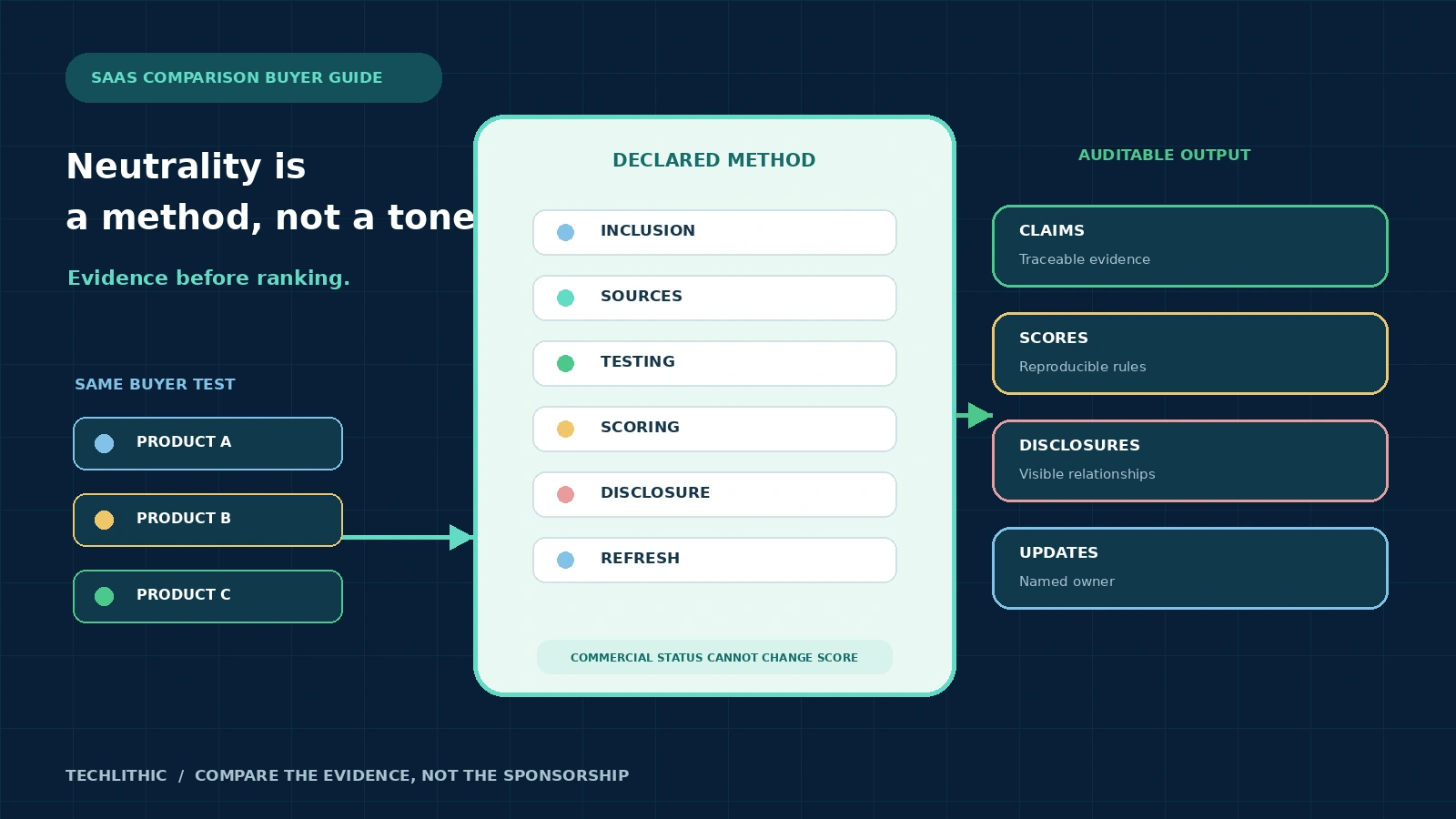
Commission a reproducible comparison, not a predetermined winner. Approve the audience, decision criteria, inclusion rules, evidence hierarchy, test protocol and scoring method before products are evaluated. Require claim-level sources, clear sponsorship and affiliate disclosures, a correction process, dated refresh ownership and an acceptance pack that another editor can audit.
Define the buyer decision before naming products
Start with one audience, one job and one decision. A useful brief might compare shared inbox platforms for a ten-person support team that needs WhatsApp, email, role-based access and CRM synchronization. It should not begin with a request to rank a sponsor first or to position one product as the universal best.
Write the reader's operating context: company size, channels, required integrations, security or compliance constraints, implementation capacity, budget basis and purchase horizon. Then state what the comparison will not decide. A product that is strong for a regulated contact centre may be unnecessarily complex for a small sales team.
Distinguish a comparison from a customer-review collection. A comparison is an editorial analysis using declared criteria. Customer reviews are accounts from users and need separate collection, verification and moderation controls. Combining them without labels makes evidence provenance unclear.
Approve the method before research begins
The commissioning brief should contain inclusion and exclusion rules, the research date, market or region, plan tier, billing basis, test environment, evidence cutoff and treatment of unavailable information. Decide whether the set covers category leaders, close functional alternatives, a buyer shortlist or a disclosed sample. Do not imply that three sponsored vendors represent the whole market.
Define criteria before seeing the scores. Google recommends reviews that evaluate from a user's perspective, provide first-hand evidence, measure relevant performance, explain differentiators, cover alternatives and discuss benefits and drawbacks from original research. [1] These are useful editorial principles, not a promise of search ranking.
Require a methods box on the page. It should say who researched the products, what was tested, what relied on documentation or vendor confirmation, when the work occurred, how products were selected and how commercial relationships were handled. A reader should not need to inspect the terms page to understand the comparison.
Build a claim-level evidence register
Every material claim should point to a retained source. Use an evidence hierarchy: observed test result, current official documentation or contract, vendor-provided answer with date and contact, clearly labelled customer evidence, and finally unverified third-party reporting. Do not convert a vendor claim into an editorial fact by removing its attribution.
The register should contain product, claim, criterion, source URL or file, access date, plan or environment, evidence type, researcher, confidence, screenshot or test artifact where permitted and refresh trigger. Record unavailable evidence as unavailable. Silence is not a failing score unless the published method makes non-disclosure a criterion.
Pricing needs special care. Capture currency, billing period, minimum seats, included usage, overages, implementation, support, taxes and whether the price was public or quoted. Do not compare a monthly entry plan with another product's annual enterprise package as though they are equivalent.
Use equal test conditions and show what was observed
Create a small, representative test protocol for the decision. Use the same task, dataset, user roles, time window and success criteria for every product where possible. For a support platform, tests might cover channel connection, permissions, assignment, collision handling, search, export, CRM update, failure recovery and agent handoff.
Separate capability from usability and implementation effort. A feature may exist but require a higher plan, partner work or custom API. Label a test as passed only when the agreed evidence supports the buyer's required outcome. If a trial excludes a capability, report not tested rather than failed or passed.
Preserve original screenshots, recordings, configuration notes and result files with dates and product versions. Google specifically encourages evidence of first-hand experience and quantitative measurements relevant to the category. [1] A screenshot proves only what was visible in that environment at that time; it does not establish every plan, region or future release.
Make scoring reproducible and resistant to sponsorship
Use pass-or-fail gates for non-negotiable requirements, then score only the remaining differentiators. Publish criteria definitions, scale anchors and weights. Set weights before product results are known. A five-point scale is meaningless if one editor treats three as acceptable and another treats it as poor.
Keep factual evidence separate from editorial judgment. The record might say that export completed with all required fields in a test account. The judgment might say that the workflow is suitable for teams needing regular portability. Readers should be able to disagree with the judgment without questioning the underlying observation.
Do not create a precise overall number from weak inputs. If security documentation is unavailable, a formula should not silently replace it with an average. Report the gap and explain how it affects the shortlist. Sponsored status, affiliate payout and sales priority must never alter editorial weights or scores.
Disclose sponsorship, affiliate links and ownership where readers see them
List every material relationship that could affect how a reader weighs the content: sponsorship, affiliate commission, free access, vendor-provided research support, ownership, partnership or a publisher's related service. Put the disclosure near the title or recommendation and beside affected links where needed, not only in a footer.
The US Federal Trade Commission says disclosure of a reviewer relationship helps readers decide how much weight to give the review, and its guidance stresses that adequacy depends on context. [2] UK ASA guidance says affiliate content should be obviously identifiable and warns that a bottom-of-page or ambiguous disclosure may be insufficient. [3] Requirements differ by jurisdiction, so obtain appropriate legal review.
Commercial involvement does not automatically invalidate analysis. Hidden involvement does. Separate commercial approval from editorial approval. A sponsor may verify factual information and supply evidence, but it should not remove a documented drawback, change another product's score or approve the final recommendation.
Keep customer reviews and testimonials genuine and labelled
If the page includes customer reviews, require collection and moderation rules. The FTC advises review platforms to use reasonable processes for authenticity, treat positive and negative reviews equally, disclose material connections and explain how reviews and overall ratings are collected and displayed. [4]
Do not invent users, rewrite negative feedback into praise or condition incentives on positive sentiment. The FTC's consumer reviews rule addresses fake reviews, sentiment-conditioned incentives, undisclosed insider reviews, company-controlled review sites presented as independent and review suppression. [5] UK CMA guidance likewise tells businesses and agencies not to write or commission fake reviews or offer inducements for positive reviews. [6]
Label vendor case studies, supplied testimonials, verified customer reviews and editorial tests as different evidence types. Permission to quote a customer does not prove that the experience is typical, and a vendor case study should not be presented as independent validation.
Give vendors a correction route without giving them editorial veto
Offer every included vendor the same factual-review window. Ask for corrections supported by current documentation, product access or a named response. Keep a decision log showing the request, evidence, editor decision and date. Do not promise advance approval or removal of accurate criticism.
Publish a correction contact and distinguish a factual correction from a preference dispute. Correct plan names, prices, availability and broken links promptly. For contested judgments, review the evidence and method, then retain, revise or add context. Material changes should update the modification date and change note.
Assign a content owner and a refresh cadence based on volatility. Pricing, packaging, integrations, ownership, security status and product discontinuation should trigger review. At each refresh, revalidate decisive claims and affected scores rather than merely changing the page date. Archive the prior evidence pack so the publication history remains explainable.
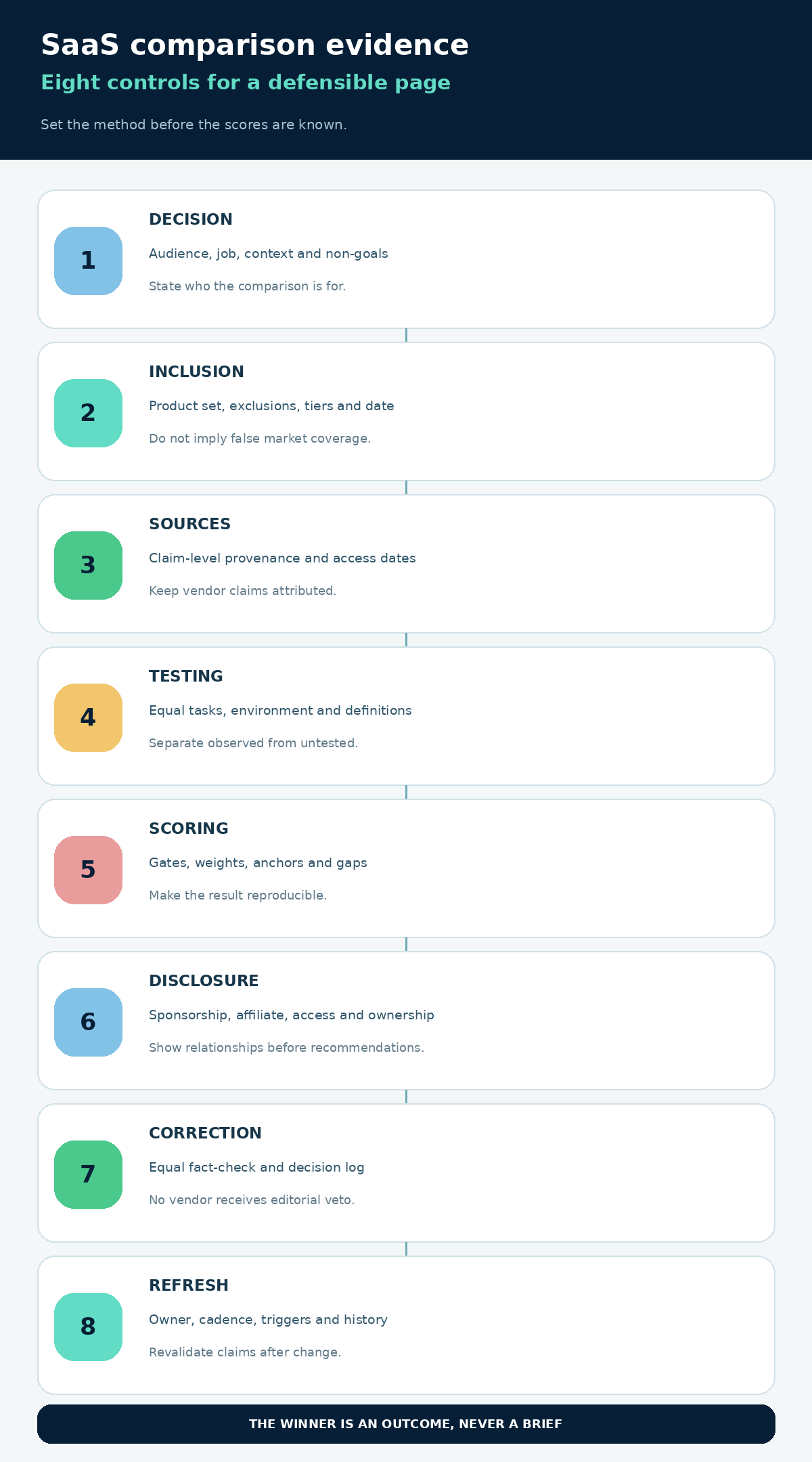
Use an eight-part comparison acceptance matrix
| Control | Minimum requirement | Acceptance evidence |
|---|---|---|
| Decision | Audience, job, context and non-goals | A reader can identify whether the comparison applies. |
| Inclusion | Product set, exclusions, tiers and research date | The page does not imply false market coverage. |
| Sources | Claim-level provenance and access dates | Material claims trace to retained evidence. |
| Testing | Equal tasks, environments and result definitions | Observed and untested outcomes are separated. |
| Scoring | Gates, weights, anchors and gap treatment | Another editor can reproduce the result. |
| Disclosure | Sponsorship, affiliate, access and ownership | Relationships are visible before recommendations. |
| Correction | Equal vendor review and evidence-based decision log | Corrections do not become editorial veto. |
| Refresh | Owner, cadence, triggers and change history | Decisive claims are revalidated after change. |
Require the publisher to deliver the method, evidence register, test artifacts, score sheet, disclosure map, vendor correspondence, correction log and refresh runbook. The public page is only one output of a defensible comparison process.
Worked example: comparing three shared inbox platforms
Consider a fictional comparison for a ten-person ecommerce support team. The buyer requires WhatsApp and email, role-based permissions, collision prevention, Shopify context, export and a staffed escalation workflow. Products enter the comparison only if official information confirms the two required channels and a test account can be obtained.
Before testing, the editor makes channel support and data export pass-or-fail gates. Assignment, agent context, setup effort and reporting receive published weights. Each product is tested with the same customer thread, two agent roles, an order lookup, a simultaneous reply attempt and an export request. One enterprise-only feature is marked not tested because it is absent from the trial.
One vendor sponsors the article and another offers an affiliate link. Both relationships are disclosed before the table and at the relevant calls to action. Neither changes the weights. The sponsor can correct its plan name and provide evidence for an integration, but cannot remove a supported limitation.
The result recommends different shortlists for teams prioritizing simple setup and teams requiring deeper controls. The evidence pack records screenshots, test dates, source URLs and pricing assumptions. A pricing or channel-policy change triggers a targeted refresh. The example produces no invented winner, customer result or performance claim.
Compare proposals on process, ownership and independence
Price the method, product research, access coordination, testing, writing, design, legal or compliance review, vendor fact-check, publication, distribution and refresh separately. State who supplies accounts, pays subscription costs and resolves unavailable evidence. More products increase evidence and maintenance work, not just word count.
Require editable buyer-owned deliverables and rights to the commissioned copy, custom visuals and test artifacts, subject to third-party licences. Define whether the publisher may reuse research, how confidential vendor material is handled and what happens when sponsorship ends. Paid distribution should not overwrite the editorial record.
Reject proposals that guarantee rankings, promise a winner before research, hide inclusion criteria, score from feature-list copy, use undisclosed affiliate relationships or treat publication as complete without refresh ownership. A credible provider can conclude that products serve different contexts or that evidence is insufficient for a ranking.
Use this checklist before commissioning comparison content
- The reader, job, operating context and decision are specific.
- Inclusion, exclusion, plan tier, region and research cutoff are declared.
- Criteria, gates, weights and scoring anchors are approved before results.
- Every material claim has a source, access date and evidence type.
- Observed tests, vendor statements and third-party reports stay distinct.
- All products receive equivalent tasks and result definitions where possible.
- Not tested, unavailable, failed and not applicable are separate states.
- Pricing uses equivalent billing, seats, usage and implementation assumptions.
- Sponsorship, affiliate links, free access and ownership are disclosed prominently.
- Customer reviews have authenticity, moderation and incentive controls.
- Vendors receive equal factual-review rights without editorial veto.
- A correction contact, decision log and material-change note are defined.
- An owner and refresh triggers cover pricing, packaging and product changes.
- The method, evidence, tests, score sheet and runbook are handed over.
TechLithic operates HowToBuySaaS and offers SaaS review and comparison content, SaaS marketplace listing and content marketing services. Apply this checklist equally to TechLithic and competing publishers. For software evaluation criteria, use the SaaS buying due-diligence guide; for profile evidence and governance, see the SaaS listing evidence guide.
Frequently asked questions
Can sponsored SaaS comparison content be credible?
Yes, if the commercial relationship is prominent, the method and criteria are fixed before scoring, evidence is retained, drawbacks remain publishable and the sponsor has no editorial veto.
Should every SaaS comparison produce one overall winner?
No. Different products can fit different operating contexts, and missing evidence may make an overall ranking irresponsible. Use pass-or-fail gates and context-specific shortlists where appropriate.
What counts as first-hand evidence in a SaaS comparison?
A documented test in a named plan and environment, supported by retained screenshots, recordings, configuration notes or result files. State the date and limits of what was tested.
How often should SaaS comparison pages be updated?
Set cadence by category volatility and trigger a review when decisive pricing, packaging, integrations, ownership, security status or product availability changes. Revalidate claims instead of only changing the date.
Should vendors approve comparison content before publication?
Give each vendor an equal opportunity to correct factual errors with evidence. Editorial conclusions, scoring and supported criticism should remain under the publisher's independent control.
Sources and research notes
Sources checked on 2026-11-17. Pricing and policy documents can change; verify current terms before approving expenditure.
- Google Search Central: Write high quality reviews
Official guidance on first-hand evidence, measurements, differentiators, alternatives, benefits, drawbacks and decision factors in reviews.
- FTC Endorsement Guides: What People Are Asking
Official US guidance on endorsements, material connections and clear disclosure in context.
- ASA and CAP: Online affiliate marketing
Official UK advertising guidance on identifying affiliate content and placing disclosures before or near commercial material.
- FTC: Featuring Online Customer Reviews, a Guide for Platforms
Official principles for review authenticity, moderation, equal treatment, material connections and transparency.
- FTC: Final Rule Banning Fake Reviews and Testimonials
Official summary of US prohibitions covering fake reviews, sentiment-conditioned incentives, insider reviews, controlled review sites and suppression.
- UK Competition and Markets Authority: Reviews guidance for businesses and agencies
Official UK guidance for businesses and agencies on fake reviews, commissioning practices and positive-review inducements.
All six sources were opened and checked on November 17, 2026. Google guidance is used as an editorial quality reference, not as a ranking promise. FTC, ASA and CMA materials are jurisdiction-specific and do not replace legal advice. The eight-part model, acceptance matrix and shared-inbox scenario are original educational frameworks. The scenario is fictional and contains no client result, performance statistic or predetermined winner.