
SaaS growth buying guides
SaaS Valuation Narrative: Evidence Before the Story
A SaaS valuation narrative should help a qualified valuer, investor or buyer understand what the company measures, where each number comes from, what has changed and which assumptions remain uncertain. It is not a persuasive multiple placed on top of an unreconciled dashboard. This guide shows founders and buyers how to scope the evidence package that should exist before a valuation conversation begins.
Prepared with AI assistance and checked against the linked sources. Numerical comparisons are illustrative unless expressly sourced.
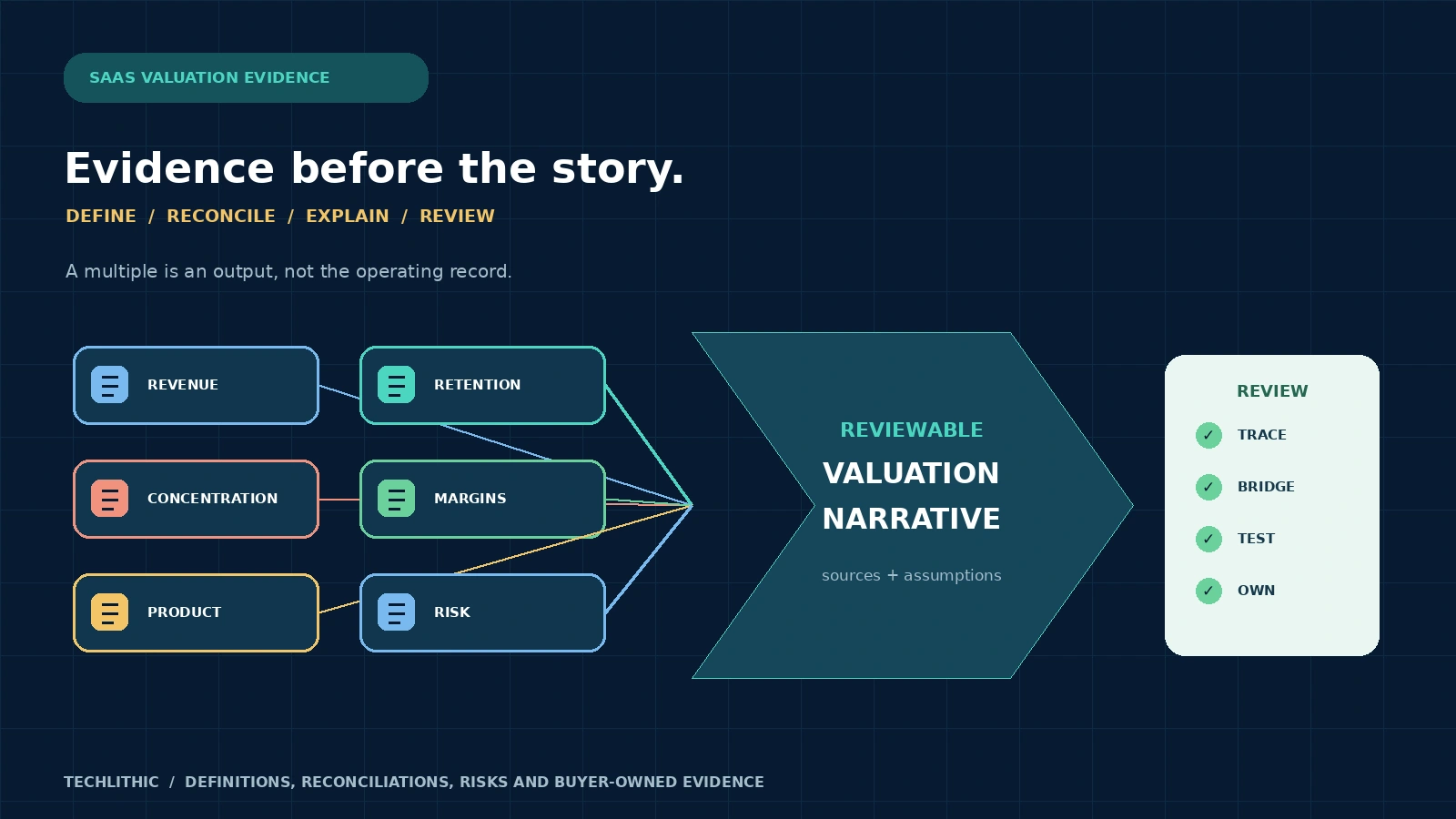
Buy an evidence and decision package, not a valuation promise. Require a stated purpose and valuation date, a KPI dictionary, revenue and recurring-metric reconciliations, cohort and concentration schedules, margin and cash bridges, an assumption register, documented risks, scenario logic and buyer-owned source files. A narrative is ready when a reviewer can trace every material claim to dated evidence and identify what still requires accounting, legal or valuation judgement.
Define the mandate before discussing a number
Begin with the decision, audience, subject interest, valuation date and intended use. A fundraising discussion, internal planning exercise, tax matter and acquisition process can require different bases of value, professional standards and evidence. State whether the work covers the operating business, equity, a specific share class, intellectual property or another interest. Record the jurisdiction and the professionals responsible for accounting, tax, legal and valuation conclusions.
The International Valuation Standards identify scope of work, basis of value, approaches, data and inputs, models, documentation and reporting as distinct parts of a valuation assignment. [1] That structure is useful even when the immediate purchase is only narrative preparation. It prevents a marketing document from quietly becoming an unsupported opinion of value.
Require the advisor to list deliverables and exclusions. Narrative support can organize records, define metrics, reconcile sources and document assumptions. It should not be described as an independent valuation, fairness opinion, audit, legal advice, capital-raising guarantee or promise of a transaction. The final value conclusion belongs to an appropriately qualified professional working under the relevant mandate.
Create a controlled SaaS metric dictionary
For every headline metric, record the name, purpose, formula, population, period, currency, source system, owner, refresh date, exclusions and treatment of discounts, taxes, refunds, credits, trials, paused accounts, delinquency, usage charges and services. Give each definition a version. If a method changes, preserve the old result, the new result and the bridge between them.
This discipline matters because platform defaults are configurable. Stripe, for example, defines MRR as the monthly-normalized value of active and past-due subscriptions, while excluding taxes, free plans and metered products. Its Billing Analytics settings can also change discount treatment and when a subscriber becomes active. [2] A dashboard value therefore needs its settings and underlying export, not just a screenshot.
SEC guidance for public-company KPI disclosure is a useful quality benchmark: define the metric and calculation, explain why it is useful, state how management uses it, identify estimates or assumptions, and explain material methodology changes. [3] A private SaaS company is not automatically subject to that disclosure regime, but the controls make a narrative easier to test and harder to misunderstand.
Reconcile recurring metrics, revenue and cash
Build separate schedules for contracted value, billing, collections, recognized revenue and recurring run rate. They answer different questions. Tie subscription records to invoices and credits, invoices to payment and refund records, and accounting revenue to the financial statements. Identify implementation, professional services, hardware, pass-through costs and other non-recurring items rather than quietly including them in recurring revenue.
Revenue recognition is not the same as billing or cash receipt. FASB Topic 606 establishes principles for reporting the nature, timing and uncertainty of revenue from customer contracts. [4] Ask the company's accountant to confirm the applicable treatment. A narrative-preparation provider should preserve that professional boundary and show how the SaaS operating measures reconcile to the accounting records.
Adjusted measures need equal care. The SEC warns that non-GAAP measures can mislead when labels, adjustments or period-to-period methods are inconsistent, and its guidance requires certain public-company measures to reconcile to the most comparable GAAP measure. [5] For a private evidence pack, use the same practical control: keep the reported accounting result visible, name each adjustment, state the rationale and show its value by period.
Show retention and concentration as distributions
A single churn or retention percentage hides important variation. Provide customer and revenue retention by starting cohort, plan, contract term, region and customer size where the data supports it. Separate new, expansion, contraction, reactivation and churn movements. State whether the denominator is customer count, starting recurring revenue or another base, and whether involuntary churn and later reactivation are treated consistently.
Pair cohort results with customer concentration. Show the share of recurring revenue, recognized revenue and receivables represented by the largest customers, without unnecessary personal data. Include contract start and renewal dates, termination rights, minimum commitments, discounts, service obligations, overdue balances and any side agreements that could change durability.
The goal is not to force every business into the same retention profile. It is to reveal the tradeoff. A smaller enterprise customer base may offer longer contracts and lower servicing duplication, while creating renewal and bargaining concentration. A broad self-service base may diversify revenue, while increasing acquisition, support or payment-failure sensitivity. The narrative should describe both the evidence and the exposure.
Connect growth, margin and cash without double counting
Present gross margin with a written cost policy. Identify hosting, third-party APIs, payment fees, customer support, onboarding and implementation labor, data services and other costs that scale with delivery. If finance and management reporting classify an item differently, show both views and a bridge. Do not improve a margin by moving a recurring operating cost outside the calculation without disclosure.
For acquisition economics, define the expense pool, attribution window, customer population and treatment of sales salaries, commissions, brand work, partner fees and discounts. If lifetime value depends on retention or margin assumptions, expose them. Avoid presenting a precise ratio when the underlying cohort is immature or the attribution system cannot support it.
Then connect operating performance to cash. Show collections, payment timing, annual prepayments, deferred revenue, receivables, refunds, chargebacks, working-capital effects, capitalized development where applicable and recurring capital needs. Growth purchased with prepayment discounts can strengthen near-term cash while reducing contract value. Product investment can depress current profit while supporting future capability. Present the tradeoff rather than selecting only the favorable side.
Document product, ownership and operating risk
A valuation narrative needs the operating facts that can change future cash flows. Include product roadmap dependencies, technical debt, security and privacy obligations, outage history, third-party infrastructure, model or data licensing, open-source obligations, key-person dependence, support load, regulatory exposure and unresolved customer commitments. Link each material risk to an owner, evidence, current control and next review date.
Clarify what the company owns and can transfer. Review corporate documents, cap table, share rights, employee and contractor invention assignments, trademarks, domains, code repositories, data rights, vendor agreements and change-of-control clauses with appropriate advisers. IVS 200 notes that ownership rights and capital structure are relevant to business interests, while market comparisons need a reasonable basis and verifiable comparable data. [6]
Do not convert an unresolved risk into a silent discount or an optimistic footnote. Put it in the assumption and gap register. A reviewer should see whether the risk is verified, estimated, disputed, outside scope or awaiting specialist advice.
Use scenarios and comparables with visible limits
Do not begin with a universal ARR multiple. A market approach requires comparability across business characteristics, data quality and transaction basis. An income approach requires cash-flow assumptions and a rate consistent with the cash flow and risk. IVS 200 describes both approaches and allows multi-scenario models when the amount or timing of future cash flows is uncertain. [6]
For every comparable, record the source, transaction or market date, scale, growth, retention, margin, concentration, geography, product model, control characteristics and adjustments. Mark information that is unavailable. A public software company, a small private asset sale and a preferred financing round are not interchangeable observations.
For scenarios, show the operating drivers rather than only three output values. Link customer starts, expansion, contraction, churn, pricing, gross margin, hiring and investment to forecast revenue and cash. Separate management's operating plan from the valuer's selected inputs. State which assumptions are externally observable, internally evidenced or judgemental. IFRS 13, in the context where it applies, frames fair value around market-participant assumptions at the measurement date, including risk. [7]
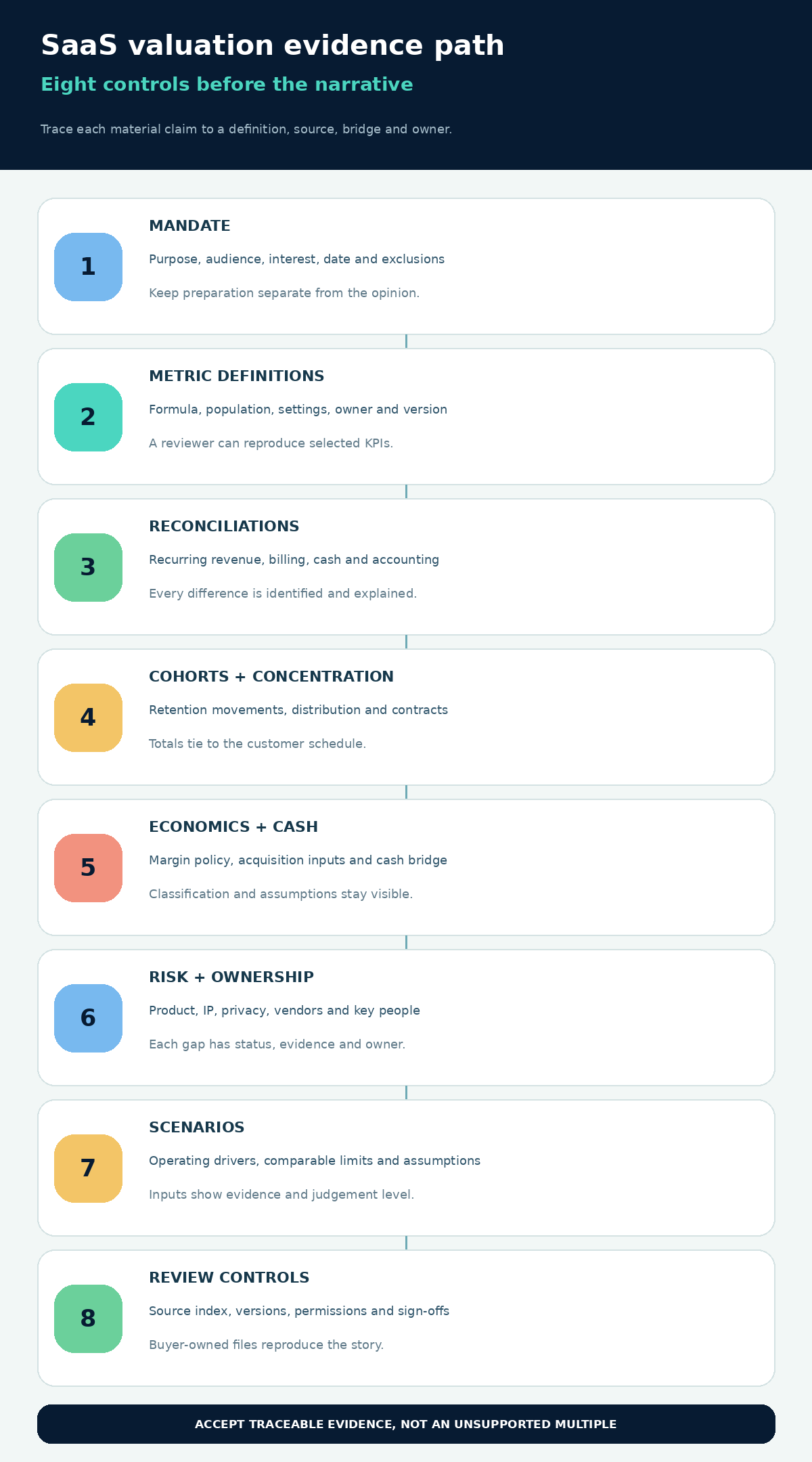
Accept the work through an eight-part evidence matrix
| Control | Minimum delivery | Acceptance evidence |
|---|---|---|
| Mandate | Purpose, audience, subject interest, date, intended use and exclusions | Written scope separates narrative support from professional opinions. |
| Definitions | Versioned KPI dictionary with formulas, populations, settings and owners | A reviewer reproduces selected metrics from source exports. |
| Reconciliations | Recurring metrics, billing, cash and accounting revenue bridges | Differences are identified, quantified and explained by period. |
| Cohorts and concentration | Retention movements, customer distribution and contract context | Totals tie to the recurring-revenue schedule without hidden exclusions. |
| Economics | Margin policy, acquisition inputs, working capital and cash bridge | Cost classification and assumption changes remain visible. |
| Risk and ownership | Dependency, IP, security, legal and key-person gap register | Each material item has evidence, status, owner and review date. |
| Scenarios | Driver-based cases, comparable criteria and assumption register | Inputs are labeled observable, evidenced or judgemental. |
| Review controls | Source index, version history, permissions and sign-offs | Buyer-owned files reproduce the published narrative. |
Score proposals on traceability, consistency, professional boundaries and ownership, not on the attractiveness of a preliminary value range. Require editable source files, formulas, exports, notes and a final walkthrough. A dashboard that cannot be reproduced after the advisor leaves is not an accepted deliverable.
Worked example: reconcile a fictional ARR claim
Consider a fictional SaaS company whose presentation calls its current recurring run rate 1.20 million currency units. This example is intentionally hypothetical and is not a benchmark, valuation or client result. The evidence review finds that the dashboard includes 90,000 of one-time implementation work, 40,000 from a canceled contract that remains active in the billing system and excludes 30,000 of permanent discounts.
The team does not replace the headline with another unexplained number. It creates a bridge: start with the exported dashboard value, remove implementation work, remove the canceled contract and apply the documented discount policy. The resulting 1.04 million run rate is then tied to customer-level subscription records. The accounting schedule remains separate because recognized revenue follows its own period and contract treatment.
Next, the team shows that one customer represents a material portion of the reconciled run rate and renews within the forecast period. It presents base, renewal and non-renewal operating cases rather than averaging the risk away. Each scenario updates revenue, gross margin, support cost and cash timing. A qualified valuer can then decide how those facts affect the selected approach and inputs.
The deliverable is accepted when an independent reviewer can reproduce the bridge from the dated exports, see the original and adjusted definitions, locate the contract evidence, follow the scenario formulas and identify every remaining assumption. The arithmetic supports a professional conversation. It does not produce the professional conclusion.
Buyer checklist for valuation narrative support
- The purpose, audience, subject interest, valuation date and intended use are explicit.
- The scope says who supplies accounting, tax, legal and valuation conclusions.
- Every headline KPI has a versioned definition, formula, owner and source.
- Dashboard settings, currencies, time zones and reporting periods are preserved.
- Recurring revenue excludes or separately identifies services and other non-recurring items.
- Billing, cash, revenue and recurring metrics are reconciled rather than treated as synonyms.
- Discounts, credits, refunds, delinquency, trials and usage billing have written treatment.
- Methodology changes have a quantified period-to-period bridge.
- Retention is shown by movement and cohort with a stable denominator.
- Customer concentration includes contract and renewal context.
- Gross-margin costs and acquisition-cost pools have documented policies.
- Forecasts connect operating drivers to revenue, margin and cash.
- Comparable data has a source, date, basis and comparability assessment.
- Product, security, privacy, IP, vendor and key-person risks are visible.
- Capital structure and ownership documents are reviewed by appropriate advisers.
- Assumptions are labeled observable, internally evidenced or judgemental.
- Every material claim maps to a dated source and gap status.
- Editable models, exports, notes and version history belong to the buyer.
- No provider guarantees a valuation, investor, buyer, funding or transaction.
TechLithic offers SaaS valuation narrative support and SaaS acquisition profile preparation. Apply this checklist equally to TechLithic and competing providers. For adjacent decisions, use the fundraising-readiness scope guide, SaaS exit-readiness guide and SaaS listing evidence guide.
Frequently asked questions
Is a SaaS valuation narrative the same as a business valuation?
No. Narrative support can organize definitions, evidence, risks and assumptions. A valuation conclusion requires an appropriate mandate, basis of value, method, judgement and qualified professional under the relevant standards and jurisdiction.
Which SaaS metrics belong in a valuation evidence pack?
Use metrics material to the business model, commonly including recurring revenue movements, retention, concentration, gross margin, acquisition economics, cash and operating drivers. Define each metric and reconcile it to source records.
Should a founder use an ARR multiple from an online benchmark?
A benchmark can be one input, but it is not a standalone valuation. Assess its date, market, transaction basis, scale, growth, retention, margin, concentration, rights and data quality before treating it as comparable.
How should ARR reconcile to accounting revenue?
Keep them as separate measures. Document the ARR population and normalization, then bridge subscription records to billing and accounting schedules. Have the applicable revenue-recognition treatment confirmed by the company's accountant.
What is the most important acceptance test for this engagement?
Ask an independent reviewer to reproduce selected metrics and reconciliations from the dated source exports, follow the scenario formulas and locate the evidence behind material claims without relying on the advisor's private system.
Can a valuation narrative provider promise funding or a sale?
No. The provider can commit to defined preparation deliverables and evidence controls. Valuation conclusions, investor interest, buyer interest, funding and transactions depend on independent parties and professional judgement.
Sources and research notes
Sources checked on 2026-11-26. Pricing and policy documents can change; verify current terms before approving expenditure.
- International Valuation Standards Council: Standards
Official overview of IVS general standards for scope, bases of value, approaches, data and inputs, models, documentation and reporting, plus IVS 200 for businesses and business interests.
- Stripe Billing documentation: Analytics and metric definitions
Primary platform documentation for MRR, recurring-revenue movements, exports and configurable treatment of discounts and active subscribers.
- US SEC: Guidance on key performance indicators and metrics
Official public-company disclosure guidance on metric definitions, usefulness, management use, estimates, methodology changes and controls. Used as a quality benchmark, not as a claim that every private company is subject to the regime.
- Financial Accounting Standards Board: Revenue Recognition overview
Official overview of Topic 606 principles for reporting the nature, timing and uncertainty of revenue from customer contracts.
- US SEC: Non-GAAP Financial Measures compliance interpretations
Official staff guidance on labels, inconsistent adjustments, reconciliation and potentially misleading non-GAAP presentation for applicable public-company disclosures.
- International Valuation Standards, effective January 31, 2025
Official standards covering relevant, traceable data; documented inputs; model judgement; market comparability; income approaches; scenarios; ownership rights and business interests.
- IFRS Foundation: IFRS 13 Fair Value Measurement
Official IFRS overview defining fair value through an orderly market-participant transaction at the measurement date and assumptions that include risk, where IFRS 13 applies.
IVSC, SEC, FASB, IFRS Foundation and Stripe primary materials were checked on November 26, 2026. Regulatory and professional standards apply according to mandate, entity, jurisdiction and intended use; the article does not provide accounting, tax, legal or valuation advice. The fictional reconciliation is an original teaching example, not a market statistic, client result, benchmark or value conclusion. No multiple, valuation, investor interest, buyer interest, funding or transaction outcome is promised.