
WhatsApp and messaging buying guides
Appointment Automation: Buyer Tests for Booking and Reminders
A booking form that creates one clean calendar event is not an appointment automation system. The real purchase has to survive two people choosing the same slot, daylight-saving changes, reschedules, payment delays, duplicate webhooks, failed reminders and staff intervention. Buyers should therefore evaluate the complete journey as a stateful service, with a named source of truth and evidence for every transition.
Prepared with AI assistance and checked against the linked sources. Numerical comparisons are illustrative unless expressly sourced.
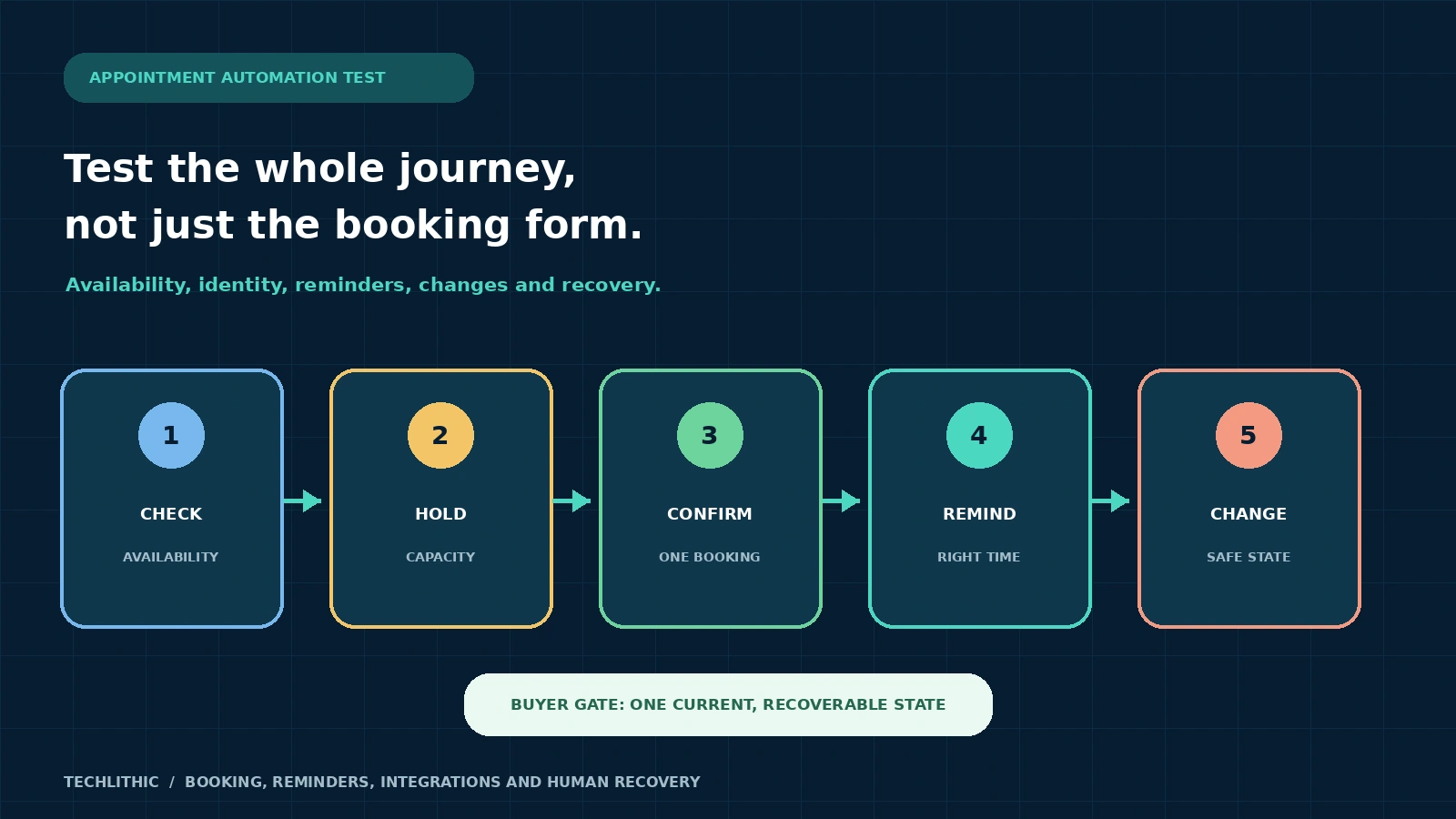
Approve appointment automation only after a supplier proves the full lifecycle: eligible slots come from current availability, one request creates one booking, customer and staff times remain unambiguous, changes cancel obsolete reminders, integrations handle duplicate and out-of-order events, and an operator can recover exceptions without editing several systems by hand.
Define the booking journey and its source of truth
Write the journey before comparing tools: choose service, qualify the requester, calculate eligible slots, hold or reserve a slot, confirm the appointment, send reminders, reschedule or cancel, record attendance, and close any payment or follow-up task. Name the system that owns the appointment identifier and status. Calendar, CRM, messaging and payment systems should reference that identifier instead of inventing separate records.
Define the allowed states, such as requested, held, confirmed, rescheduled, cancelled, completed and no_show. For every transition, specify the actor, trigger, validation, side effects and compensation when a dependency fails. A reminder is a consequence of a confirmed appointment, not proof that the appointment exists.
Microsoft's Bookings appointment resource separates create, update, delete and cancel operations and includes service, staff, customer, time-zone, buffer and reminder fields. [1] Buyers do not need that product, but the resource model is a useful reminder that an appointment is more than a start time.
Test availability at selection and again at commitment
Availability must combine working hours, staff calendars, service duration, location or resource capacity, preparation and cleanup buffers, minimum notice, maximum booking horizon, holidays and approved exceptions. Ask whether the scheduler reads live calendars, cached availability or a replicated store, and what happens when one calendar is unavailable.
Google Calendar's FreeBusy query accepts a time range, time zone and a set of calendars, then returns busy intervals and per-calendar errors. [2] A buyer test should therefore include both a valid conflict and a calendar error. The system must not silently treat an unreadable calendar as free.
Run a concurrency test with two browser sessions selecting the last available slot. Both may see it, but only one may receive a confirmed booking. If the design uses a temporary hold, record its owner, expiry and release behaviour. Repeat with a staff member creating a calendar event between slot display and final confirmation. The commitment step must revalidate availability or use an atomic reservation mechanism.
Make identity, time zones and recurrence explicit
Define which fields identify a customer, how duplicate contacts are merged and whether a shared phone number or email is allowed. Validate contact channels without blocking legitimate international formats. Store the appointment instant in a stable form, but also retain the customer's named time zone and the service location time zone so each message can explain the local time.
The iCalendar standard uses a UID to identify a calendar component and combines UID, sequence and recurrence ID to identify an instance in a recurring series. It also defines time-zone components for standard and daylight observances. [3] Test a booking across a daylight-saving boundary, a customer and provider in different zones, an ambiguous local time, and one changed occurrence in a series.
The acceptance evidence should show the time in the booking page, confirmation, calendar invite, staff view, CRM and reminder. A conversion that is technically valid but displays a different wall-clock time in one channel is a failure. Avoid abbreviations such as CST when a named zone such as America/Chicago is available.
Require one confirmation for one committed appointment
Decide what confirmation means. If staff approval, payment or eligibility review is required, the requester should see a pending state and should not receive wording that implies a committed appointment. If payment succeeds after a hold expires, the system needs an explicit recovery path rather than creating a conflicting booking.
Test repeated taps, browser refresh, network timeout after submission and the same API request sent twice. The result should be one appointment identifier, one active calendar event and one confirmation sequence. The user should be able to retrieve the outcome instead of guessing whether to submit again.
For paid bookings, do not rely only on the browser returning to a success page. Stripe's Checkout guidance tells integrators to use server-side events for completion and delayed success or failure because redirect-only fulfillment is unreliable. [4] Treat payment and booking as linked state machines, with documented rules for hold expiry, refund, cancellation and manual reconciliation.
Test reminder content, eligibility and suppression
Create a message matrix for confirmation, reminder, reschedule, cancellation and recovery. For each message record the trigger, channel, template, language, recipient, send window, retry policy, suppression conditions and evidence of delivery. A reminder should include the correct service, local date and time, location or join details, and a secure way to manage the booking.
Meta's WhatsApp template interface exposes categories, languages, review status and quality state for templates, including appointment-related categories in its API reference. [5] Procurement should include approved production-like templates and failure tests for a rejected, paused or unavailable template. A fallback channel must not create two reminders when the primary channel later recovers.
Keep service reminders factual. The UK Information Commissioner's Office distinguishes an informational appointment reminder from direct marketing and explains that adding promotional content can make the message marketing. [6] This is UK guidance, not universal legal advice. Buyers should map applicable jurisdictions, consent and preference rules, and keep promotional campaigns separate from operational reminders.
Reschedule and cancel as state transitions, not edits
A reschedule should preserve the appointment identity and history while replacing the active occurrence. Test changes by customer, staff, administrator and upstream calendar. The old slot must become available when policy allows, obsolete reminders must be cancelled, the calendar event must update or be superseded, and every participant must receive the correct change notice.
Test cancellation just before a reminder is due, cancellation while the messaging provider is unavailable, and two reschedules in quick succession. Inspect queued jobs, not only the final calendar. The system should either remove obsolete jobs or recheck the latest appointment version immediately before sending.
Cal.com's webhook documentation lists distinct triggers for booking creation, rescheduling, cancellation, payment and no-show changes, and shows signed deliveries to a subscriber endpoint. [7] A buyer should see the equivalent event contract for the proposed platform, including stable IDs, event version, timestamp, signature and retry behaviour.
Challenge integrations with duplicates and missed changes
Calendar notifications, booking webhooks and payment events are signals, not a perfect ordered log. Deliveries may be repeated, delayed or arrive after a newer change. Google notes that Calendar notification message numbers increase but are not sequential, that a notification may contain no change details and that the receiver must fetch the resource. [8] Its incremental synchronization process persists sync tokens and includes deleted entries so clients can reconcile state. [9]
Ask the supplier to replay one event, reverse the order of reschedule and cancel events, omit a notification, expire a sync token and temporarily return an error from the CRM. The handler should deduplicate by event or business key, compare versions, retry safely, reconcile from the source of truth and expose a failed-event queue.
OWASP recommends signature verification, replay protection, event-ID deduplication, idempotent handlers, payload validation, transport security and durable handling for webhooks. [10] Require logs that link an external event to the appointment ID and show whether processing succeeded, retried, was ignored as stale or needs human action.
Use an eight-gate appointment acceptance matrix
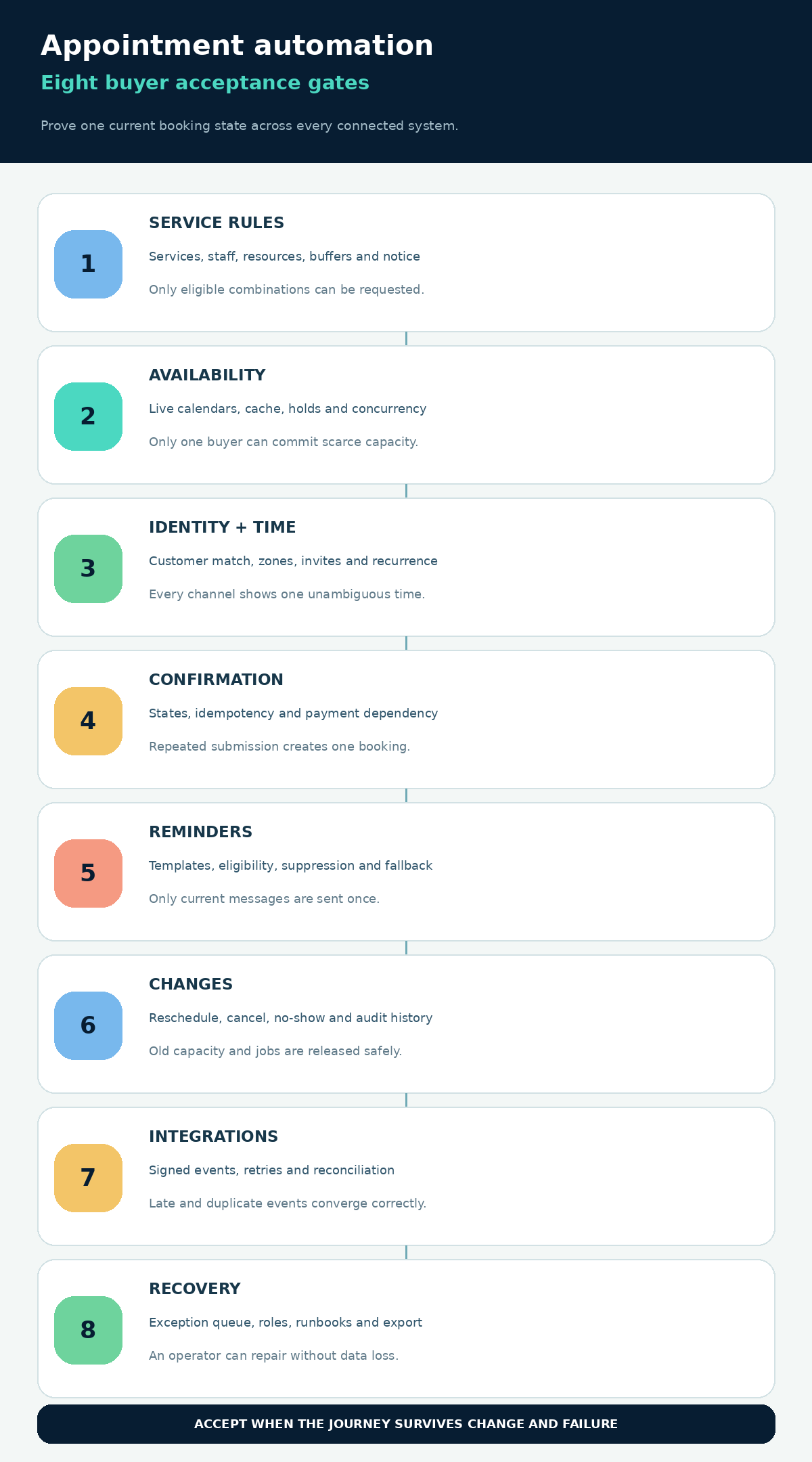
| Gate | Evidence to request | Acceptance test |
|---|---|---|
| Service rules | Service, staff, resource, buffer, notice and approval rules | Only eligible combinations can be requested |
| Availability | Calendar sources, cache policy, hold and concurrency design | Two buyers cannot confirm the same capacity |
| Identity and time | Customer matching, zone storage, invite and recurrence model | Every channel shows the same unambiguous appointment |
| Confirmation | State definitions, idempotency key and payment dependency | Repeated submission produces one committed booking |
| Reminders | Template matrix, consent, suppression, retry and fallback rules | Only current, eligible messages are sent once |
| Changes | Reschedule, cancel, no-show and audit transitions | Old slots and obsolete jobs are released safely |
| Integrations | Signed event contract, retry, deduplication and reconciliation | Duplicate, late and missing events converge correctly |
| Recovery | Exception queue, operator roles, runbooks and export | A trained operator can repair an exception without data loss |
Give each gate an owner, test case, expected result and retained artifact. A polished booking page cannot compensate for a failed concurrency, duplicate-message or recovery gate.
Worked example: a fictional multi-location consultation service
Consider a fictional consulting firm that offers 30-minute video calls and 60-minute on-site sessions across two offices. Video calls require one consultant. On-site sessions require a consultant and a room, plus 15-minute buffers. A deposit is required for on-site sessions. Customers can reschedule until a policy cutoff.
The buyer creates a test pack with a normal video booking, the last room at a busy time, two customers racing for the same slot, a customer in another time zone, a daylight-saving transition, a payment that completes after a hold expires, a reschedule followed quickly by cancellation, and a messaging outage. Each case records expected appointment state, calendar events, payment state, CRM activity, messages and operator task.
During testing, both users can initially view the last on-site slot. The first payment commits it. The second payment attempt is not accepted for that capacity and the user receives fresh alternatives. A duplicate payment event does not create another appointment. When the confirmed customer reschedules, the old room reservation and reminders are released, a new reminder schedule is created and the audit history remains attached to the same booking.
The messaging outage leaves a visible retry item. When service returns, only the latest eligible reminder is sent. An operator can see the failed dependency and recover it from one queue. This is a fictional acceptance example, not a client result, product guarantee or recommended universal policy.
Buy operations and handover, not only initial configuration
Require a responsibility matrix for service rules, staff calendars, templates, consent records, integration credentials, incident response, refunds and data correction. Ask which changes business users can make safely and which require engineering. Configuration changes should have version history, approval and rollback.
The handover should include state definitions, data map, integration contracts, template inventory, environment details, secrets ownership, monitoring, alert thresholds, reconciliation procedure, exception runbooks, test cases and an export path. Confirm retention, role-based access, audit logs and deletion behaviour for customer details and meeting notes.
Define measurable operational acceptance without inventing a generic industry target. Examples are: every test case reaches its expected state, no critical duplicate booking occurs, obsolete reminders are suppressed, failed events are visible within the agreed monitoring interval, and the buyer's operator completes a recovery exercise. Thresholds should reflect the buyer's risk and service commitments.
Use this checklist before approving appointment automation
- The complete booking lifecycle and source of truth are documented.
- Appointment states, transitions and owners are explicit.
- Service, staff, resource, buffer, notice and approval rules are testable.
- Availability errors fail safely instead of appearing free.
- Concurrent requests cannot confirm the same limited capacity.
- Customer identity and duplicate-contact rules are defined.
- Time zones are stored and displayed consistently in every channel.
- Recurring appointments and one-instance changes retain stable identifiers.
- Repeated submissions, callbacks and payment events are idempotent.
- Pending, confirmed, rescheduled and cancelled wording is unambiguous.
- Reminder templates, eligibility, consent, suppression and fallback are documented.
- Obsolete reminders are cancelled or revalidated before sending.
- Webhooks are signed, validated, deduplicated and safely retried.
- Late, missing and out-of-order events can be reconciled.
- Failed events and messaging jobs appear in an operator queue.
- Roles, audit history, retention and deletion controls are tested.
- The buyer receives test cases, runbooks, configuration history and export access.
TechLithic offers appointment booking automation, WhatsApp marketing automation, CRM integration and AI workflow automation. Apply these tests equally to TechLithic and competing suppliers. Use the CRM integration scope guide for system ownership, the WhatsApp template governance guide for message controls and the messaging trigger map for event design.
Frequently asked questions
What is the most important appointment automation test?
Run a full lifecycle test with concurrent booking attempts, then reschedule and cancel the winning appointment. Verify capacity, calendars, CRM state, payments, reminders, audit history and human recovery rather than checking only the booking page.
How should appointment automation prevent double booking?
It should revalidate or atomically reserve capacity at commitment, use a documented hold and expiry when needed, and make repeated submissions idempotent. A cached slot display alone is not sufficient.
Should reminders be sent by WhatsApp, SMS or email?
Choose channels according to customer expectations, applicable consent and messaging rules, template availability, urgency, cost and fallback behaviour. Test suppression and duplicate prevention when a channel fails and later recovers.
What should happen when a customer reschedules?
The automation should preserve booking history, release the old capacity, reserve the new capacity, update calendars and connected systems, cancel obsolete reminders, create the correct new reminders and notify affected participants.
What evidence should a supplier hand over?
Request the state model, rule configuration, data map, integration contracts, template inventory, credentials ownership, monitoring, audit design, exception runbooks, acceptance results, regression tests and an export path.
Sources and research notes
Sources checked on 2026-11-22. Pricing and policy documents can change; verify current terms before approving expenditure.
- Microsoft Graph: bookingAppointment resource type
Primary Microsoft documentation for appointment operations and fields covering customer, staff, service, time zone, buffers, reminders and cancellation.
- Google Calendar API: Freebusy query
Primary Google documentation for querying free and busy intervals across calendars, time ranges and time zones, including per-calendar errors.
- IETF RFC 5545: iCalendar
Internet standard covering calendar UIDs, recurrence identifiers, sequence values and time-zone components.
- Stripe: Payments for existing customers
Primary Stripe documentation recommending server-side events for completed, delayed-success and delayed-failure payment outcomes rather than redirect-only fulfillment.
- Meta Graph API: WhatsApp Business Account message templates
Primary Meta API reference for template categories, languages, status, quality and creation.
- UK ICO: Marketing and data protection in detail
Official UK guidance distinguishing factual appointment reminders and other service messages from promotional direct marketing.
- Cal.com: Webhooks
Primary platform documentation showing signed webhook deliveries and booking lifecycle triggers including creation, rescheduling, cancellation, payment and no-show changes.
- Google Calendar API: Push notifications
Primary Google documentation on watched resources, notification headers, non-sequential message numbers, empty notification bodies, retries and channel expiry.
- Google Calendar API: Synchronize resources efficiently
Primary Google documentation on initial and incremental synchronization, persisted sync tokens, pagination and deleted entries.
- OWASP Cheat Sheet Series: Webhook Security
Official OWASP guidance on signatures, replay protection, idempotency, duplicate events, TLS, validation, durable processing and monitoring.
Primary technical standards, official platform documentation and official regulatory guidance were opened and checked on publication day. Vendor documentation is used to identify testable integration behaviours, not to recommend a specific product. The fictional worked example contains no client result or fabricated performance claim.