
WhatsApp implementation guides
Ecommerce Messaging Automation: Map Triggers Before Buying
Ecommerce messaging automation is not a list of campaigns. It is a decision system that turns changing cart, payment, order and fulfillment records into customer communications. Before selecting software or an implementation partner, define which event is authoritative, who is eligible, what cancels a queued message and how humans take over when the state is uncertain.
Prepared with AI assistance and checked against the linked sources. Numerical comparisons are illustrative unless expressly sourced.
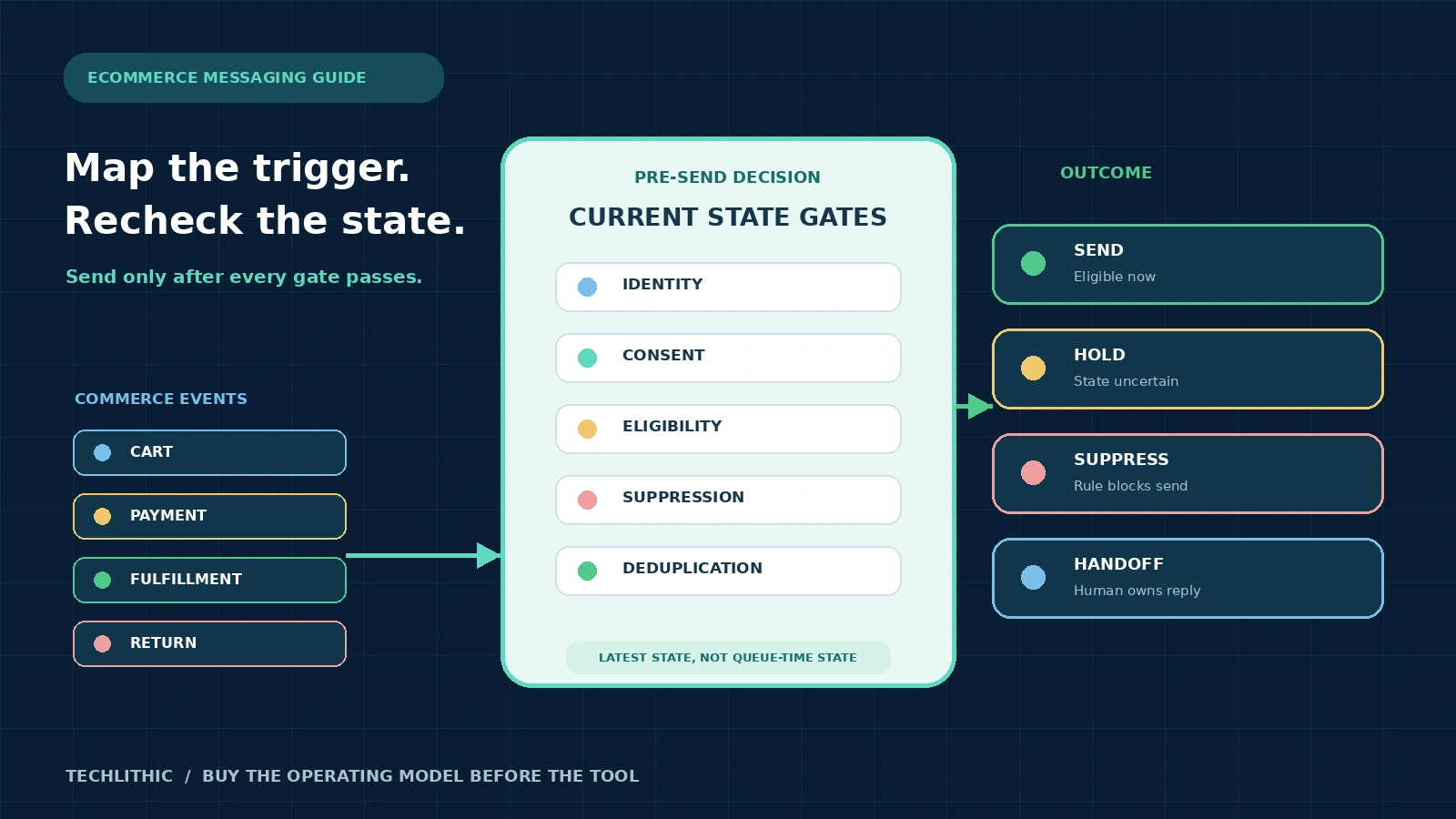
Buy an auditable event-to-message operating model, not a collection of triggers. The minimum scope should define stable commerce identifiers, source-of-truth states, consent by purpose and channel, suppression priority, deduplication, delayed and out-of-order handling, support ownership, reconciliation and acceptance evidence. A message should send only when the latest customer and order state still satisfies every gate at dispatch time.
Define the operating model before choosing the tool
Start with the customer outcome and the operational owner. Examples include helping a shopper recover a valid checkout, confirming a successful payment, explaining a delivery change or routing a reply to support. Do not begin with a platform menu labelled abandoned cart, order update or win-back. Similar labels can hide different source events, timing rules and failure behaviour.
List every system that can change the decision: storefront, checkout, payment processor, order management, warehouse, carrier, CRM, consent store, messaging provider and support inbox. For each system, name its owner and the record it controls. Shopify now distinguishes its newer Events mechanism from broadly covered webhooks, but both require subscription, filtering, delivery verification and use of the received event. Its documentation explicitly calls for signature verification and deduplication with unique IDs. [1]
The provider should turn this inventory into a versioned event contract and a state model. If a proposal shows only campaign diagrams, it has not yet described how the automation will remain correct when data arrives late, repeats or conflicts.
Choose canonical identifiers and source-of-truth states
Use stable identifiers for customer, session or checkout, order, payment, fulfillment and conversation. Document how identities are linked and when they must remain separate. Email, phone number and browser session are attributes, not always durable identity keys. A guest checkout can later attach to an account, and one order can have multiple payments or fulfillments.
Create a state table that distinguishes observed events from current business state. A checkout-updated event is evidence that something changed; it is not permission to message. Shopify exposes topics such as checkout create and update, order paid, order fulfilled and partially fulfilled. [2] WooCommerce likewise supports webhooks for order and customer changes and can trigger custom actions. [3] These capabilities make platform integration possible, but the buyer still has to define what each event means in its own process.
For each message decision, specify the authoritative query. Payment confirmation should normally depend on a successful payment or paid order state, not merely order creation. Delivery messaging should distinguish fulfillment created, carrier accepted, out for delivery, delivered, exception, cancelled and returned. When two systems disagree, state which wins, who investigates and whether messaging pauses.
Model consent by channel, purpose and evidence
A phone number in an order does not automatically authorize every WhatsApp message. The WhatsApp Business Messaging Policy says a business may contact people only when it has their number or username and opt-in permission, and must respect requests to stop or opt out. [4] Applicable privacy, marketing and consumer rules vary by jurisdiction, so the implementation must support the buyer's legal review rather than replace it.
Store consent as evidence: channel, business identity, purpose or message class, capture point, wording or version, timestamp, source, jurisdiction where relevant and revocation state. Separate operational messages from marketing eligibility. Define how a change made in checkout, preference centre, support or the messaging channel updates the same suppression decision.
At dispatch time, evaluate the latest consent and contactability state. Do not rely only on eligibility calculated when a message was queued. A customer may opt out, ask support to stop a sequence or change contact details during the delay. The contract should state how quickly revocations propagate and what monitoring proves that they did.
Treat cart and checkout recovery as eligibility, not a timer
A recovery message should require more than elapsed time. Define the qualifying object, abandonment threshold, valid contact, channel permission, available inventory, serviceable destination, usable recovery link and absence of a later purchase. Shopify describes an abandoned checkout as incomplete after contact information is supplied, and its legacy guidance suppresses recovery in several cases, including when a sale completes before the email sends. [5]
Separate cart activity from checkout activity. A cart may have no verified customer identity or recoverable checkout URL. Decide whether a fresh cart update restarts the wait, whether a different completed order suppresses the reminder and how multiple open checkouts are collapsed. State which products, regions, customer groups and payment failures are excluded.
The send worker should re-read current eligibility immediately before dispatch. Cancellation events should include checkout completion, order creation or payment, explicit opt-out, support suppression, invalid contact, stock or shipping failure, fraud or bot classification, expired link and manual cancellation. A useful proposal names every cancellation signal and the maximum time from signal receipt to queue removal.
Map payment, fulfillment, return and exception transitions
Draw state transitions separately for payment and fulfillment. Payment may move through initiated, authorized, pending, captured, failed, cancelled, partially refunded and refunded. Fulfillment may be unfulfilled, partially fulfilled, fulfilled, in transit, delayed, delivered, returned or cancelled. Avoid a single status field that forces independent processes into one sequence.
For every transition, record the message purpose, eligible audience, delay, channel, template, cancellation events and owner. Define whether split shipments produce one summary or multiple updates, how partial refunds are explained and what happens when a carrier reverses a delivery estimate. The correct decision may be no message when the data cannot support a clear customer action.
Keep transactional and marketing priorities explicit. A delivery exception or support reply should normally pause lower-priority recovery and promotional sends. Quiet-hour treatment, frequency limits and emergency exceptions should be configuration, not hard-coded assumptions. Where WhatsApp is used, the implementation must also account for the platform's message types and approved operating rules. Meta's platform documentation separates utility, authentication, marketing and service messaging capabilities. [6]
Design for duplicates, delayed delivery and changed order
Webhook delivery should be treated as at least once, not exactly once. Authenticate the payload, record its provider delivery or event ID, persist it before side effects and make each downstream action idempotent. Shopify's event guidance requires HMAC verification and unique-ID deduplication. [1] OWASP similarly recommends persisting processed event IDs, skipping repeats and making database writes and notifications idempotent. [7]
Do not assume arrival order. An older checkout update can arrive after an order-paid event, or a carrier retry can appear after delivery. Use provider versions or sequence fields only when documented. Otherwise fetch the authoritative current object, compare allowed transitions and prevent older information from overwriting a newer business state. OWASP advises fetching current state when an event may be stale. [7]
Define an idempotency key at the message-intent level, such as customer, order, message purpose and state version. Provider event ID alone prevents processing the same delivery twice but may not prevent two different events from creating the same customer message. Retain the decision record, template version, eligibility snapshot, dispatch result and suppression reason for audit and replay.
Give replies and exceptions a named support handoff
Every two-way channel needs conversation ownership. Define which replies stay in automation, which create a support case and which pause all outbound sequences. Examples include address changes, cancellation requests, payment disputes, delivery problems, accessibility needs and requests to stop.
Specify the shared inbox or case system, routing keys, service hours, priority, fallback queue and identity context passed to the agent. The agent should see the triggering event, current order state, consent state, recent messages and the reason automation paused. Limit sensitive data to what the role needs.
Document release from handoff. A closed ticket should not automatically resume an old cart reminder. The support resolution must state whether the conversation is complete, operational messaging may continue or a marketing suppression remains. Include queue failure, unavailable agents and duplicate case creation in acceptance testing.
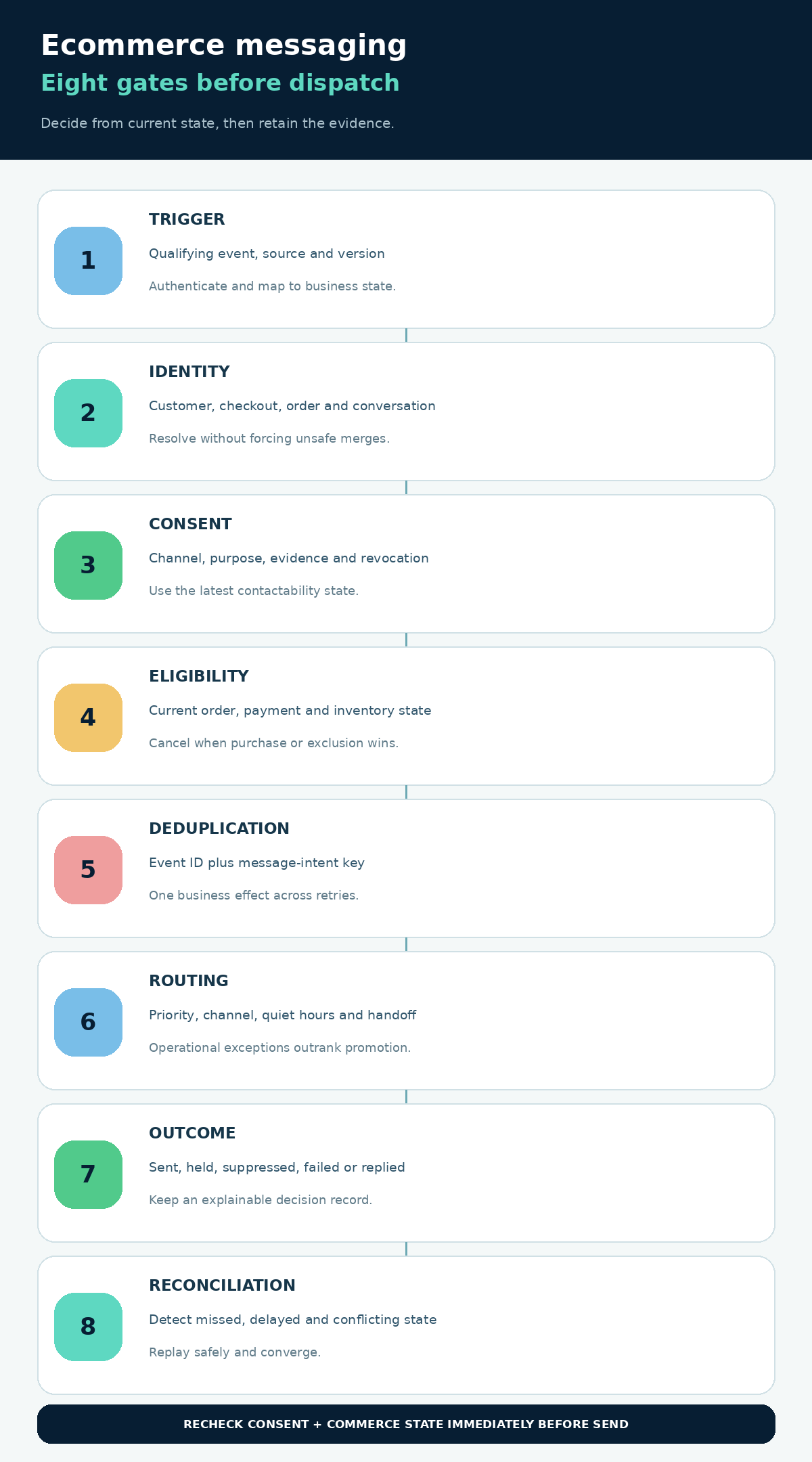
Use an eight-gate acceptance matrix
| Gate | Required decision | Acceptance evidence |
|---|---|---|
| Trigger | Qualifying event, source and version | Signed sample events map to the intended state. |
| Identity | Customer, checkout, order and conversation linkage | Guest, merged and conflicting identities are handled. |
| Consent | Channel, purpose, evidence and revocation | Opt-out blocks a queued send within the agreed limit. |
| Eligibility | Current state, timing and exclusion rules | Completed, invalid or unsupported cases are suppressed. |
| Deduplication | Event and message-intent idempotency | Retries and equivalent events create one effect. |
| Routing | Channel, priority, quiet hours and handoff | Operational exceptions outrank lower-priority sends. |
| Outcome | Delivery, failure, reply and audit record | Each intent has a traceable final state. |
| Reconciliation | Detection and repair of missed or conflicting state | A controlled replay converges without duplicate messages. |
Require tests for the happy path, duplicates, out-of-order delivery, delayed consent changes, missing fields, platform outage, provider rejection, partial fulfillment, refund, return and human handoff. The provider should supply test inputs, expected results and retained evidence, not only screenshots of a successful campaign.
Worked example: a paid order arrives after recovery is queued
Consider a fictional store where checkout C-417 is inactive long enough to qualify for recovery. The customer has valid marketing consent, the item is available and a WhatsApp reminder is scheduled for 14:00. At 13:58, the payment processor confirms payment, but the order-paid event reaches the messaging service at 14:01.
A timer-only implementation sends the reminder at 14:00. A gated implementation queries the authoritative checkout and payment state just before dispatch. If payment is already captured, it cancels the reminder even though the event consumer has not yet processed the order-paid webhook. If current state cannot be confirmed, it holds the message and records the reason instead of assuming abandonment.
The order later splits into two fulfillments. The state model links both to the same order, sends a single summary where the channel design allows it and routes a delivery exception for the second shipment to support. When the customer returns one item, the return event does not overwrite the delivered state of the other fulfillment. A partial refund message uses the refund record and identifies only the affected item and amount.
Acceptance evidence includes the original events, message-intent keys, pre-send state check, cancellation decision, fulfillment linkage, support case and final reconciliation. No conversion or client result is assumed. The example tests correctness under changing state.
Scope the implementation around ownership and failure recovery
Price the event discovery, source connectors, consent migration, identity matching, state store, rules, templates, provider setup, shared inbox, observability, test fixtures, rollout and training separately. Identify recurring provider and channel charges, platform limits and support effort, but verify current prices directly because they can change.
Require buyer ownership of the event dictionary, state model, rule configuration, templates, consent evidence, message and decision logs, test pack and runbooks. Define environment separation, credential handling, access removal, data retention, export and exit support. The buyer should be able to change a suppression rule without reverse-engineering undocumented code.
Monitoring should cover event receipt, signature failures, queue age, duplicate rate, state conflicts, suppressed intents, provider rejection, delivery result, replies awaiting humans and reconciliation gaps. Alerts need named owners and response procedures. Include a kill switch by message purpose and channel, plus a safe replay process that does not recreate customer-facing effects.
Use this buyer checklist before approving implementation
- Each customer outcome has a named business and operational owner.
- Storefront, checkout, payment, order, warehouse, carrier, CRM, consent and support systems are inventoried.
- Stable identifiers and source-of-truth rules are documented.
- Payment, fulfillment, refund and return states remain independently traceable.
- Consent evidence is stored by channel and purpose, with revocation propagation tested.
- Recovery eligibility includes current state, inventory, serviceability and cancellation events.
- Pre-send checks re-evaluate consent, suppression and current commerce state.
- Event IDs and message-intent keys prevent duplicate side effects.
- Late and out-of-order events cannot regress a newer state.
- Transactional, support and marketing priorities are explicit.
- Replies have a staffed handoff, fallback queue and release rule.
- Logs explain why each message was sent, held, suppressed or failed.
- Reconciliation and replay are tested without duplicate customer messages.
- Editable rules, evidence, runbooks and exit data remain buyer-owned.
TechLithic offers ecommerce messaging automation, CRM and ecommerce integration and WhatsApp marketing automation. Apply this checklist equally to TechLithic and competing providers. For connector boundaries, use the CRM integration scope guide; for cross-channel sequence design, see the lifecycle email automation guide; for WhatsApp approvals and change control, review the template governance guide.
Frequently asked questions
What should be mapped first for ecommerce messaging automation?
Map the customer outcome, source event, authoritative current state, stable identifiers, consent, cancellation events, support owner and acceptance evidence before selecting the messaging tool.
Is an abandoned cart timer enough to trigger recovery?
No. A timer should be only one gate. Recheck current checkout and payment state, consent, suppression, inventory, destination eligibility and link validity immediately before dispatch.
How should duplicate commerce webhooks be handled?
Verify the sender, persist the event ID, skip authenticated repeats and make downstream effects idempotent. Also use a message-intent key because different events can represent the same customer communication.
What happens when ecommerce events arrive out of order?
Fetch or compare the authoritative current object, enforce allowed state transitions and prevent an older event from overwriting newer state. Hold messaging when the current state cannot be established safely.
Should support replies pause automated messages?
Define this by message purpose and issue type. Cancellation, dispute, delivery problem, accessibility request and opt-out replies should normally create a human handoff and suppress incompatible automated sequences until an explicit release decision.
Sources and research notes
Sources checked on 2026-11-16. Pricing and policy documents can change; verify current terms before approving expenditure.
- Shopify developer documentation: Events and webhooks
Official guidance on subscription workflow, filtering, HMAC verification, unique-ID deduplication and event processing.
- Shopify Webhooks reference
Official reference for checkout, order, payment and fulfillment webhook topics.
- WooCommerce: Webhooks documentation
Official documentation on event notifications for orders, customers, products and custom commerce actions.
- WhatsApp Business Messaging Policy
Official policy covering permission to contact people and the requirement to respect stop and opt-out requests.
- Shopify Help Center: Recovering abandoned checkouts
Official guidance on abandoned checkout qualification, recovery links and cases where recovery is not sent.
- Meta for Developers: WhatsApp Business Platform
Official platform documentation for WhatsApp message capabilities, categories and webhooks.
- OWASP Webhook Security Cheat Sheet
Security guidance on signature validation, duplicate events, idempotency, delivery order and durable processing.
All seven sources were opened and checked on November 16, 2026. Platform capabilities and policy requirements are attributed to official provider documentation; OWASP supplies independent security guidance. The eight-gate model, state matrix and worked example are original educational frameworks. The example is fictional and contains no client result, conversion statistic or ranking promise. Buyers must obtain jurisdiction-specific legal advice for consent and privacy obligations.