
SEO and LLM search buying guides
Content Marketing Retainer: Compare Evidence and Workflow
A content marketing retainer should buy a repeatable evidence and publishing system, not an unspecified number of words. The proposal needs to show how topics are selected, claims are verified, subject experts participate, drafts are accepted, pages are distributed, performance is interpreted, and outdated content is corrected or retired. Buyers can compare retainers by testing that workflow on one representative content package before committing to volume.
Prepared with AI assistance and checked against the linked sources. Numerical comparisons are illustrative unless expressly sourced.
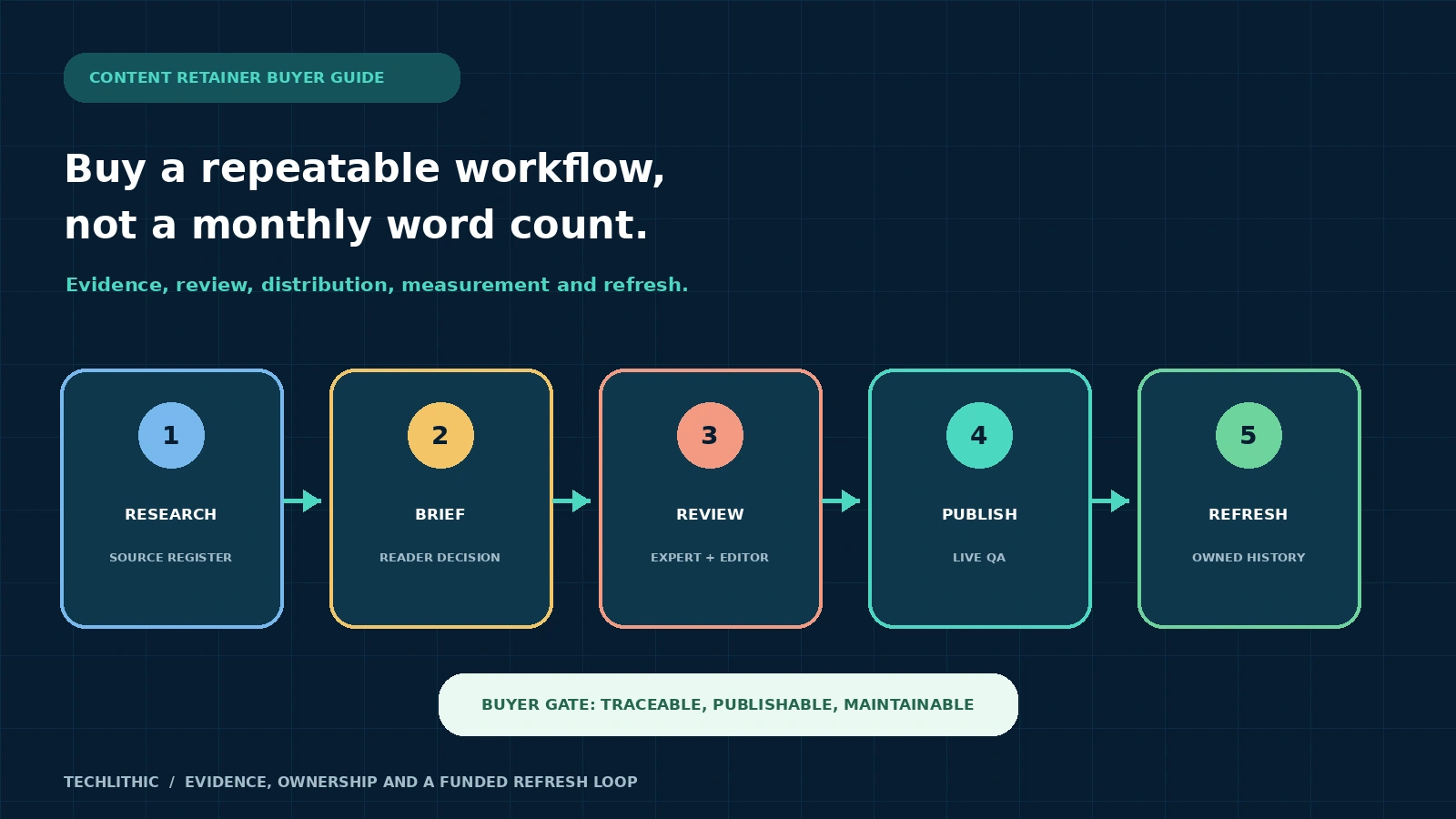
Approve a content retainer only when the supplier defines the decision behind each asset, provides a traceable research register and brief, assigns review and approval roles, delivers publishable files with technical and accessibility checks, measures outcomes against a dated baseline, and gives the buyer ownership of source material, accounts, history and refresh decisions.
Buy a content operating system, not a monthly word count
Begin with the business decisions that content must help a defined audience make. Map the product, services, customer questions, sales objections, existing pages and channels before committing to a calendar. A retainer that starts with a fixed volume but cannot explain audience, intent, evidence or distribution has specified output without specifying value.
Google says people-first content should serve an intended audience, demonstrate relevant experience or depth, help a reader achieve a goal and provide a satisfying experience. Its guidance also states that Google has no preferred word count. [1] Use that as platform guidance, not a promise of ranking. A useful scope defines completeness and acceptance rather than paying for padded length.
Ask for a rolling content register with the asset, audience, decision, funnel role, page owner, primary query or discovery path, supporting offer, evidence status, stage, publication target and next review date. This becomes the control plane for the retainer.
Require a decision brief before research begins
Every asset should start with a brief approved by the buyer. It should state the reader, situation, job to be done, questions to resolve, proposed angle, existing page to update or replace, search intent, conversion path, evidence needs, exclusions and success signal. The brief must also show why a new page is necessary, because improving an existing authoritative page can be better than creating an overlapping one.
Separate the content hypothesis from the target metric. For example: publishing a technical comparison with claim-level evidence may help qualified evaluators understand integration differences, measured through assisted demo journeys and sales feedback. The hypothesis can be tested without promising a particular ranking or lead total.
GOV.UK's measurement guidance recommends choosing methods according to the service or journey being assessed and combining performance data with user research rather than relying only on digital analytics. [2] A retainer brief should therefore name the behavioural question and the qualitative evidence needed alongside traffic data.
Make the research register an acceptance artifact
For each factual claim, record the source URL, publisher, publication or effective date, date checked, claim supported, geographic or product scope, and any uncertainty. Prefer primary documentation, regulators, standards, company filings and original research. Secondary sources can establish context, but the draft should not transform an unverified summary into a confident fact.
The supplier should flag sources that are inaccessible, contradictory or likely to change. Current prices, laws, product limits and platform rules need publication-day checking. Quotes require exact transcription and reasonable context. Original observations should identify the method and conditions. If the evidence cannot support a claim, narrow or remove it.
This register lets a subject expert review facts without rewriting the article. It also reduces refresh cost because the next editor can see which claims depend on volatile sources. A bibliography alone is insufficient if nobody can connect sources to the statements they support.
Define subject review, editorial authority and correction rights
Name who reviews technical accuracy, legal or compliance-sensitive statements, brand language, customer evidence and final publication. Provide reviewers with a deadline and a focused question set. A product expert should confirm capabilities and limitations, but should not silently turn independent education into sales copy.
Keep a decision log for disputed edits. Record the issue, evidence, editor decision, approver and date. The buyer should have a correction route for post-publication errors, including severity, response owner, correction note policy and whether distribution must be paused.
If a supplier places third-party or sponsored material, the scope must protect editorial integration. Google's spam policy says third-party content is not automatically a violation, but describes problems when it is hosted mainly to exploit a site's ranking signals, and notes the importance of sufficient host input and editorial oversight. [3] The FTC separately says commercial content should not mislead people about its advertising nature and that needed disclosures must be clear and prominent. [4] Applicable rules vary by jurisdiction, so legal review remains the buyer's responsibility.
Test originality and contract for usable rights
Define originality as a process, not a percentage from a detector. The supplier should show the outline, research notes, drafts, citations, original analysis and revision history. Require checks for unattributed copying, invented sources, unsupported quotations, duplicated passages across the buyer's site and cannibalization of existing pages.
If automation assists research or drafting, specify permitted tools, restricted data, disclosure, human verification and retention rules. Google asks publishers to consider who created content, how it was produced and why, and warns against scaled unoriginal pages made primarily to manipulate rankings. [1] [3]
Contracts should assign rights in final deliverables, buyer-supplied materials, commissioned graphics, source files and reusable templates, while identifying third-party licenses. The U.S. Copyright Office states that copyrightability of AI-assisted output depends on sufficient human-authored expressive elements and that prompts alone are not enough. [5] This is U.S. guidance, not a worldwide rights opinion. Ask counsel to fit ownership language to the relevant jurisdictions and production method.
Specify the production definition of done
A finished draft should include the title, description, URL slug, heading structure, source links, internal links, calls to action, images, alt text, captions, author and date fields, canonical target, schema requirements and publication notes. The scope should state who uploads, formats, checks mobile layouts, validates links, compresses assets and verifies the live page.
Google documents Article structured data as a way to identify an article's title, images, dates and authorship more explicitly. [6] It does not guarantee a search feature, so acceptance should test valid markup and accurate visible content rather than promise a result appearance.
Accessibility belongs in the production gate. W3C guidance says informative images need text alternatives that convey essential information, decorative images use a null alternative, functional images describe the action, and complex diagrams need a complete text equivalent. [7] Require a text or table equivalent for any infographic that carries essential meaning.
Treat distribution as a named deliverable
Publishing is one distribution event, not the whole plan. For each asset, define the owned channels, newsletter segment, sales-enablement use, community or partner route, social adaptations, internal-link placements and any paid support. Name the person responsible for each action and the asset format they receive.
Require channel-specific derivatives rather than identical copy pasted everywhere. A useful package might contain a sales answer, email summary, short executive post, visual excerpt and two internal-link recommendations. Sponsored placements or influencer use need the required commercial disclosures.
Use a consistent campaign-tagging convention for distributed links. Google Analytics documents manual UTM parameters for source, medium, campaign, term and content, and warns that missing parameters can produce incomplete reporting. [8] The buyer should own the taxonomy and a campaign register so a new supplier does not fragment historical data.
Measure decisions and fund a refresh loop
Record a dated baseline before publication or material revision. At minimum, capture the URL, current query and page visibility, relevant journeys, conversions or assisted actions, backlinks or mentions where available, publication state and known content gaps. Separate production metrics, such as accepted assets and cycle time, from audience outcomes and business outcomes.
Search Console recommends focusing more on impression and click trends than position alone and cautions that many outside events can affect performance after a page change. [9] A retainer report should state what changed, the comparison period, data limitations and plausible alternatives, not claim causation from a simple before-and-after chart.
Define refresh triggers: a source changes, a product or policy changes, a page loses relevance for its intended queries, sales reports a repeated gap, a competing page adds material evidence, or the scheduled review date arrives. The refresh decision can be keep, correct, expand, consolidate, redirect, archive or leave unchanged. Changing a date without a substantive update is not a refresh.
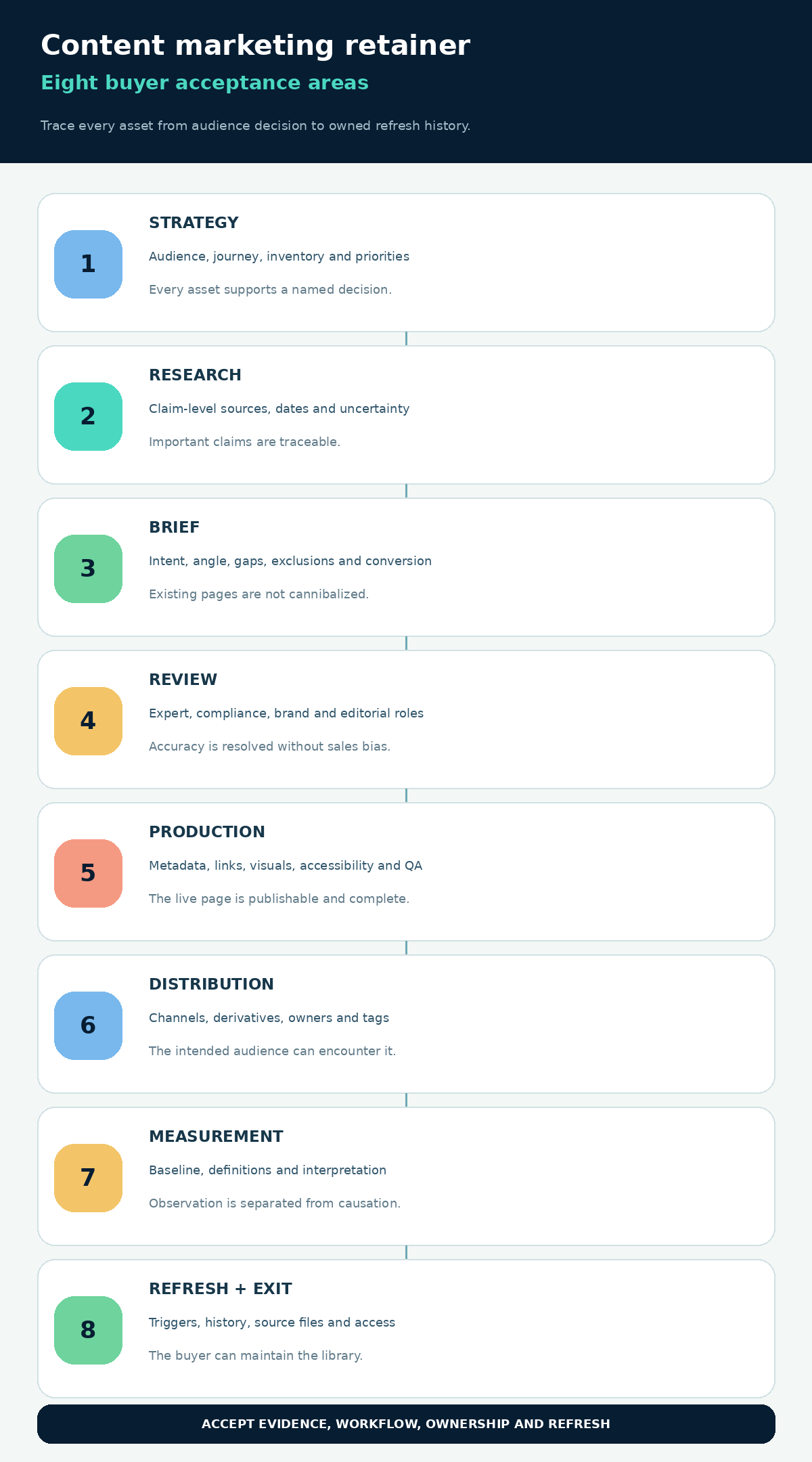
Use an eight-part retainer acceptance matrix
| Workstream | Evidence to receive | Acceptance question |
|---|---|---|
| Strategy | Audience, journey, inventory, priorities and content register | Does every asset support a named reader decision? |
| Research | Claim-level source register, dates, scope and uncertainty | Can an editor trace important claims to current evidence? |
| Brief | Intent, angle, gaps, exclusions, conversion path and success signal | Does the brief avoid overlap with existing pages? |
| Review | Subject, compliance, brand and editorial roles with decision log | Can accuracy issues be resolved without sales bias? |
| Production | Draft, metadata, links, visuals, accessibility and live QA | Is the page publishable and technically complete? |
| Distribution | Channel plan, derivatives, owners, disclosures and campaign tags | Will the intended audience actually encounter the asset? |
| Measurement | Dated baseline, definitions, dashboard and interpretation notes | Can the buyer separate observation from causal claims? |
| Refresh and exit | Triggers, review dates, history, source files and access handover | Can the buyer maintain the library after the retainer ends? |
Attach an owner and due date to each artifact. A supplier should not pass the matrix by sending a polished draft while withholding evidence, source files, account access or the refresh queue.
Worked example: a fictional B2B software content package
Consider a fictional workflow software company commissioning a buyer guide about approval automation. The proposed package includes one guide, one comparison table, one infographic, one newsletter summary and sales-enablement notes. The buyer wants qualified evaluators to understand when a workflow tool is appropriate and what implementation evidence to request.
The supplier first audits the existing site and finds two posts that already explain basic workflow concepts. Instead of creating another definition article, the brief targets a later-stage decision: how to test permissions, routing, exceptions, audit history and ownership. The research register uses official product documentation, a security standard and the buyer's verified configuration. A product specialist confirms observed capabilities while the editor keeps limitations and alternatives visible.
The acceptance run checks every external claim, labels the fictional scenario, validates internal links, supplies text equivalents for the infographic, records metadata and confirms the live canonical and schema. Distribution includes a tagged newsletter link, a short sales answer and contextual links from the two existing educational posts. The baseline records current visibility and demo journeys without setting a guaranteed lead target.
After the agreed observation window, the report separates publication completion, audience behaviour, sales feedback and business outcomes. A later product change triggers a source recheck and revision. The buyer receives the source register, editable artwork, history and refresh record. This is a fictional procurement example, not a client result or performance promise.
Use this checklist before approving a content retainer
- The retainer maps content to defined audiences, decisions and business journeys.
- A content inventory prevents duplication and search-intent cannibalization.
- Every asset starts with an approved decision brief.
- Important claims have primary sources, dates, scope and uncertainty notes.
- Current prices, laws, policies and product limits are rechecked before publication.
- Subject experts, compliance reviewers, editors and approvers have clear roles.
- Commercial relationships and sponsored content are disclosed appropriately.
- Originality is supported by notes, drafts, analysis and revision history.
- Automation and AI rules cover data, verification, disclosure and human authorship.
- Rights, licenses, source files and editable assets are contractually identified.
- The definition of done includes metadata, links, visuals, accessibility and live QA.
- Distribution channels, derivatives, owners and campaign tags are specified.
- A dated baseline and metric definitions exist before interpretation.
- Reports distinguish observation, contribution and causation.
- Refresh triggers and keep, correct, consolidate, redirect or archive decisions are funded.
- The buyer owns accounts, history, dashboards, registers and the exit handover.
TechLithic provides content marketing and authority building, SaaS SEO and LLM visibility, SaaS review and comparison content and SaaS demand generation. Apply this matrix equally to TechLithic and competing providers. Use the comparison-content evidence checklist for product comparisons, the SEO audit deliverables guide for diagnosis, and the LLM search proposal guide for discovery-specific scope.
Frequently asked questions
What should a content marketing retainer include?
It should define strategy, content inventory, briefs, research evidence, subject review, editorial production, technical publishing, distribution, measurement, refresh work, ownership and exit handover. Volume alone is not a complete scope.
How can a buyer test a content agency before a long retainer?
Commission one representative content package and require the complete workflow: brief, claim-level source register, expert review, draft history, production QA, distribution assets, baseline, report and editable handover.
Should a content retainer guarantee rankings or leads?
No. Search visibility and demand outcomes depend on many factors outside one supplier's control. Require measurable deliverables, a dated baseline, transparent methods and careful interpretation rather than ranking or revenue guarantees.
Who owns content created under a retainer?
The contract should identify rights in final work, source files, buyer materials, commissioned visuals, templates and third-party components. Applicable copyright rules and AI-assisted production may affect the answer, so buyers should obtain jurisdiction-specific legal advice.
How often should published content be refreshed?
Use risk-based triggers rather than changing dates on a fixed cycle. Review when volatile sources, products or policies change, performance or sales evidence reveals a gap, or the scheduled review date arrives. The decision may be to keep, correct, expand, consolidate, redirect or archive.
Sources and research notes
Sources checked on 2026-11-23. Pricing and policy documents can change; verify current terms before approving expenditure.
- Google Search Central: Creating helpful, reliable, people-first content
Primary Google guidance on intended audiences, usefulness, completeness, authorship, production method, automation, originality and the absence of a preferred word count.
- GOV.UK Service Manual: Measuring the success of your service
Official service-design guidance on matching measurement methods to the journey and combining performance metrics with user research and other evidence.
- Google Search Central: Spam policies for Google Web Search
Primary Google policy on scaled unoriginal content, third-party content, site reputation abuse and the role of host editorial oversight.
- U.S. Federal Trade Commission: Native advertising guide for businesses
Official U.S. guidance on commercial-content transparency and clear, prominent disclosures where needed to prevent deception.
- U.S. Copyright Office: Copyright and Artificial Intelligence report, Part Two
Official U.S. Copyright Office summary on human authorship and copyrightability of AI-assisted and AI-generated material.
- Google Search Central: Article structured data
Primary Google documentation for Article and BlogPosting structured data, including title, images, dates and authorship.
- W3C Web Accessibility Initiative: Images tutorial
Standards-body guidance on text alternatives for informative, decorative, functional, text and complex images.
- Google Analytics Help: Traffic-source dimensions, manual tagging and auto-tagging
Primary Google documentation on UTM source, medium, campaign, term and content parameters and the reporting impact of missing values.
- Google Search Console Help: Performance report common tasks
Primary Google guidance on interpreting clicks, impressions, CTR, position trends, change comparisons and causal limitations.
Primary platform documentation, government guidance and standards-body material were opened and checked on publication day. Search and analytics sources are used to define observable workflow and reporting evidence, not to promise rankings or causal business results. The worked example is fictional and contains no client outcome.