
Software development buying guides
Mobile App Development Quote: Compare the Full Delivery Scope
A mobile app quote is not comparable until every provider is pricing the same platforms, user journeys, backend responsibilities, device coverage, security work, accessibility, store submission, analytics and post-launch ownership. A short screen list can hide most of the delivery risk. This guide gives buyers a practical scope and acceptance framework for turning different proposals into an equal-assumption comparison.
Prepared with AI assistance and checked against the linked sources. Numerical comparisons are illustrative unless expressly sourced.
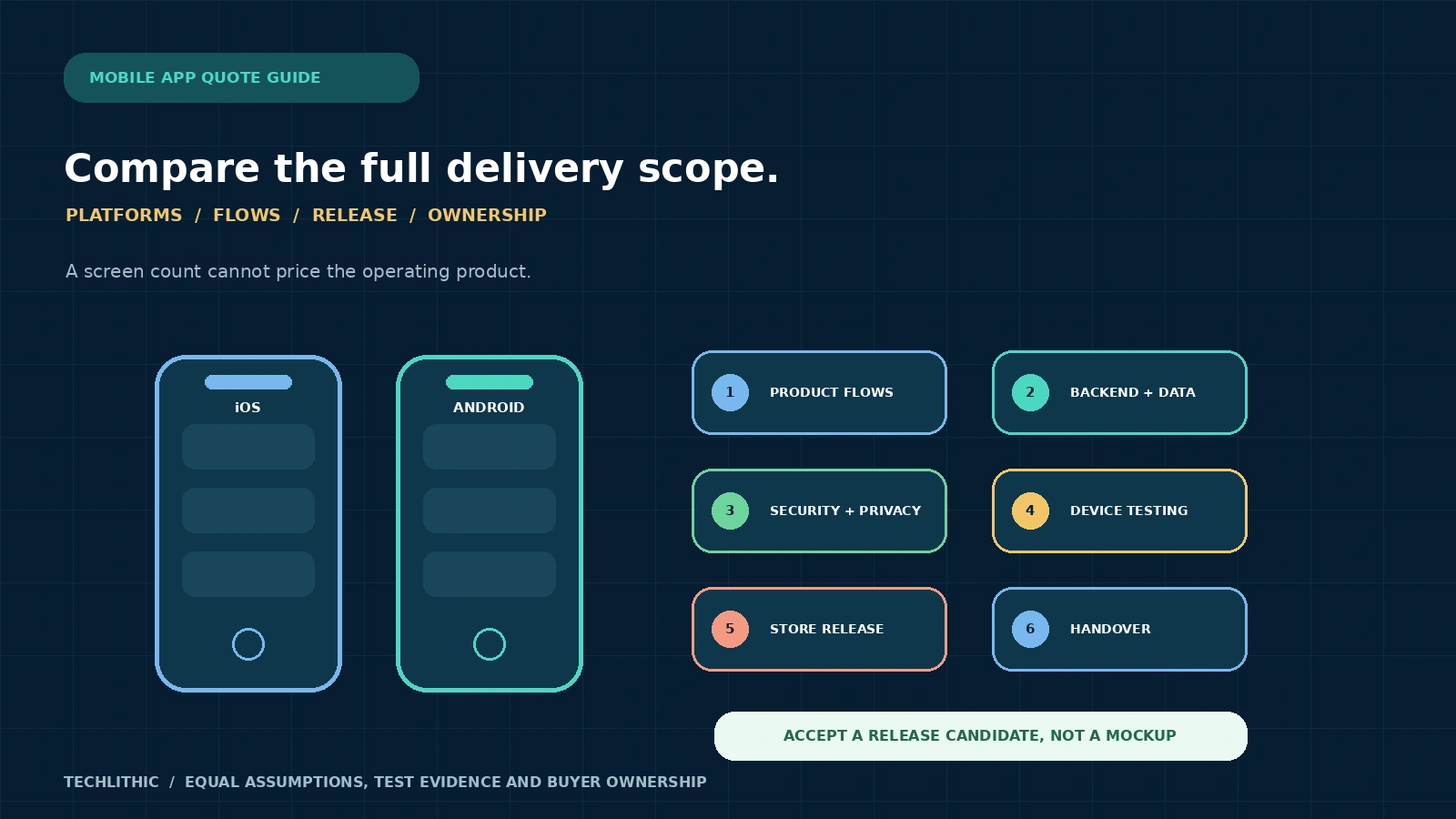
Normalize the operating assumptions before comparing price. Define the supported platforms and devices, critical flows and failure states, backend and third-party boundaries, mobile security controls, privacy disclosures, accessibility criteria, device test matrix, beta and store-release work, analytics validation, handover and maintenance. Accept evidence from a release candidate in buyer-owned accounts, not screenshots or a demonstration build.
Normalize the product and platform assumptions
Start with a quote brief shared with every provider. Name the target users, countries, languages, iOS and Android requirement, supported device classes, minimum operating-system versions, orientation, accessibility target, account model, payment model, offline behavior, notification needs and launch boundary. Identify whether tablets, foldables, wearables or companion web tools are included.
Separate a proof of concept, private beta, public first release and ongoing product program. Each carries different expectations for support, store readiness, monitoring and maintenance. Record exclusions such as iPad layout, offline sync, subscriptions, biometric login, localization or an administrator portal. An item is not safely excluded if another accepted flow depends on it.
Ask providers to estimate from the same release map and to state every assumption that changes effort. Compare one-time discovery, design, development, testing and submission separately from recurring infrastructure, third-party services, developer accounts, support and maintenance. A low total based on a single platform or buyer-supplied backend is not equivalent to a quote that includes both.
Compare the delivery architecture, not framework labels
A proposal may use native iOS and Android code, a cross-platform framework, a web-based shell or a mix. Do not choose from a slogan about speed. Require a decision note explaining how the approach handles the actual requirements: camera and file access, background work, notifications, deep links, offline data, animation, payments, accessibility, performance, platform-specific screens and future OS changes.
For cross-platform delivery, identify the shared layer, native modules, third-party packages and platform-specific work. For native delivery, identify how the teams will keep features and analytics consistent. In either case, ask who owns framework upgrades, package replacements, signing changes and store-policy remediation after launch.
OWASP notes that its mobile security controls apply across native, cross-platform and hybrid apps, while framework-specific risks still require appropriate practices. [1] The useful comparison is therefore the architecture, dependencies and acceptance evidence, not an assumption that a technology name makes the app secure or maintainable.
Price complete user flows and interface states
Replace a screen count with end-to-end flows. For each role, describe the starting condition, steps, success result, stored state, messages and recovery. Include first launch, registration, authentication, consent, permissions, empty states, loading, validation, offline or slow network, expired sessions, denied permissions, interrupted payment, retry, cancellation and account deletion where applicable.
The design scope should name research inputs, information architecture, user flows, wireframes, visual system, interactive prototype, content, platform adaptations, design QA and editable source ownership. Define who supplies brand assets, product copy, legal text, illustrations, icons, screenshots and store graphics. Require states for different text lengths and system settings rather than approving one ideal device mockup.
Accessibility acceptance should cover meaningful labels, focus order, screen-reader behavior, text scaling, contrast, touch targets, motion, captions where relevant and keyboard or switch access on supported platforms. Android's core quality guidance includes checks for touch-target size, contrast and content descriptions, plus representative device testing. [2] Specify manual testing alongside automated checks.
Expose the backend and integration boundary
A mobile client rarely delivers the whole service. The quote must say whether it includes API design, server logic, database, administration, identity, media processing, search, notifications, email or SMS, payments, entitlement checks, rate limits, audit logs, analytics export and operational dashboards. If an existing backend is assumed, require an interface and readiness review before the estimate is fixed.
List every third-party system and the buyer-provided inputs: credentials, sandbox access, contracts, data, content, test accounts and approvals. Define behavior when a dependency is unavailable, slow, duplicated or returns an unexpected response. For offline work, document which data is cached, how conflicts resolve, when synchronization occurs and what the user sees during failure.
Make environments and ownership explicit. Development, test and production should use buyer-controlled cloud, store and service accounts unless a temporary arrangement is approved. The proposal should include API contracts, configuration, migrations, secrets handling, notification certificates, deep-link domains and an access map. Use the separate API development proposal guide when the backend is a major independent workstream.
Select mobile security and privacy evidence
Turn security into requirements based on the app's data, permissions, transactions and threat model. Cover device storage, cryptography, authentication, authorization, network communication, platform interaction, code integrity, logging, privacy and relevant resilience controls. OWASP MASVS groups mobile controls across these areas and describes the standard as a procurement baseline that should be tailored to risk. [1]
Require an SDK and dependency inventory with owner, purpose, data access, version and update path. Review analytics, advertising, crash, identity, payment and messaging SDK behavior rather than treating them as invisible implementation details. Apple states that developers are responsible for compliance of third-party SDKs and analytics services in their apps. [3]
The privacy work should reconcile actual collection and sharing with in-app notices, consent, account deletion, the privacy policy and store disclosures. Apple requires developers to disclose data practices of integrated third parties and keep privacy answers current. [4] Google likewise makes the developer responsible for accurate Data safety disclosures across currently distributed versions. [5] Legal review and jurisdiction-specific obligations remain buyer responsibilities unless separately contracted.
Define a device, failure and beta test plan
Ask for a test matrix tied to the target audience. It should name representative physical devices and emulators, operating-system versions, screen sizes, permissions, locales, accessibility settings and network conditions. Include unit, integration and user-interface automation where valuable, plus manual exploratory, installation, upgrade, interruption, background, notification, deep-link, payment and recovery tests.
Android's quality guidance recommends representative hardware and emulator coverage, testing the latest Android version and exercising interruptions, network changes and app state. [2] Do not accept a promise to test every device. Accept a reasoned matrix, risk-based coverage and a documented list of remaining limitations.
Beta distribution is part of delivery, not an informal link. Define tester groups, supported builds, test instructions, feedback intake, crash review, issue severity, regression rules and exit criteria. Apple TestFlight supports distributing beta builds, managing testers and collecting feedback before review. [6] Google Play provides internal, closed and open testing tracks before production. [7] The quote should include who operates those tracks and owns the resulting records.
Treat store submission as a workstream
Store delivery needs buyer-owned Apple and Google developer accounts, verified organization details, agreements, tax and banking setup where monetization applies, application identifiers, signing, entitlements, package names, build versions and authorized roles. Record who holds signing keys and recovery access. The development company should not become the permanent owner of the buyer's app identity.
Scope the product listing, descriptions, keywords where applicable, categories, screenshots, preview media, icons, support URL, privacy URL, age or content rating, review notes, demo credentials, data declarations, export or encryption questions, pricing, territories and release controls. Apple requires a privacy-policy link in store metadata and within the app, and its review guidelines remain a living document. [3]
Define the number of submission and remediation cycles included, but do not accept a guarantee of store approval or a fixed review time. Google Play separates testing tracks from production and requires the store listing, review preparation and pricing before release. [7] Acceptance should prove that the release candidate, metadata and declarations were submitted from buyer-owned accounts and that any rejection is triaged with a documented response.
Validate analytics, release operations and maintenance
Define the measurement plan before implementation. Each critical event needs a name, trigger, parameters, identity and consent behavior, expected platform parity and business owner. Test representative journeys and reconcile analytics with backend or billing records where applicable. Firebase DebugView can show raw app events from development devices in near real time for instrumentation validation. [8] Seeing an event does not prove its business definition, so acceptance should verify both.
Production readiness includes crash reporting, performance signals, backend health, alerting, support intake, incident roles, feature or configuration controls, staged release, rollback or mitigation and customer communication. Agree who watches the first release, how long the observation period lasts and what stops further rollout.
Separate a defect warranty from maintenance. Define severity, response target, supported OS range, dependency and SDK updates, store-policy changes, certificate renewal, security remediation, analytics changes and new features. State what happens when an OS update breaks an old dependency. The handover must give the buyer repositories, design files, build instructions, automated tests, environment configuration, store access, signing and recovery records, API documentation, data definitions and known limitations.
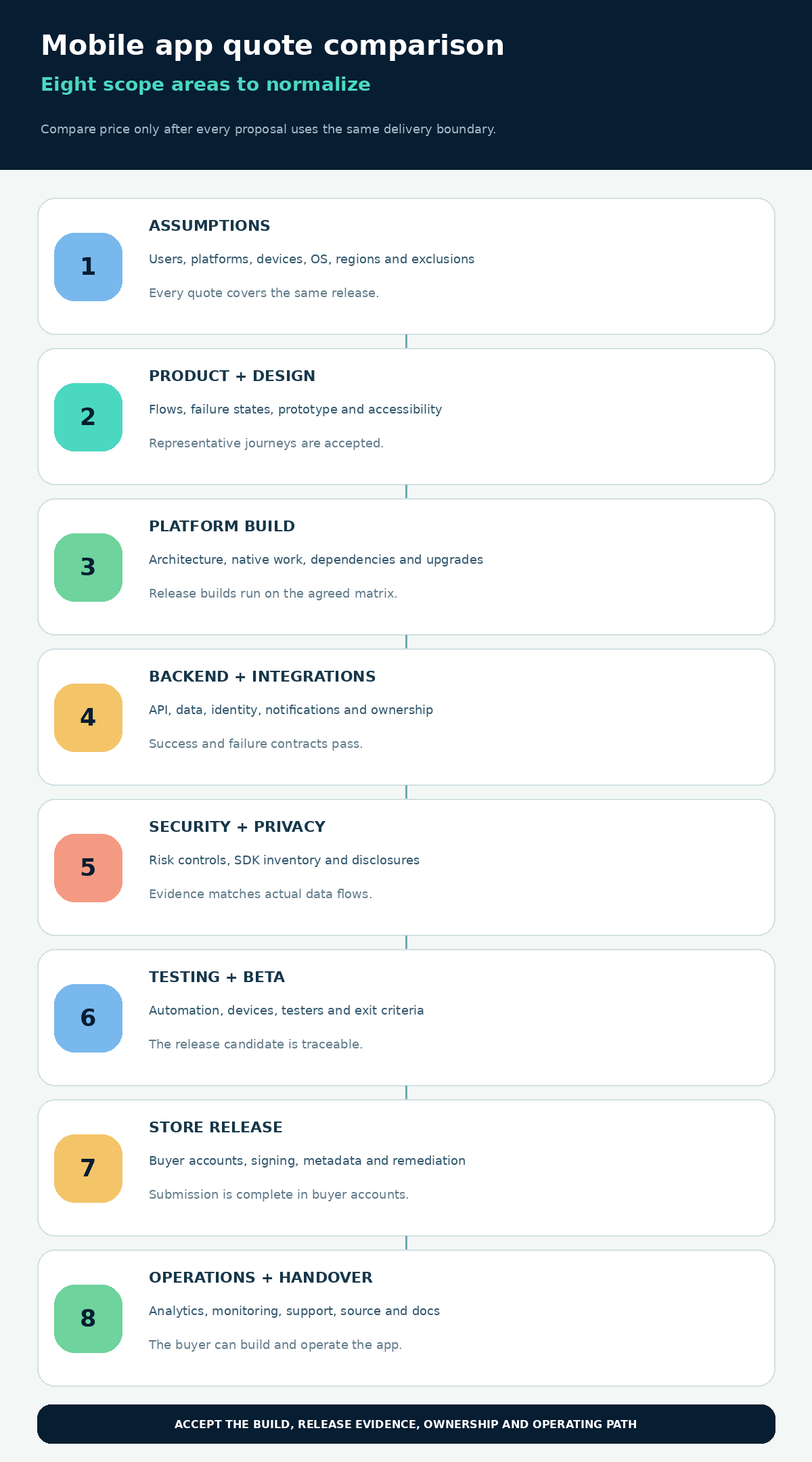
Use an eight-part quote acceptance matrix
| Scope area | Minimum delivery | Acceptance evidence |
|---|---|---|
| Assumptions | Users, platforms, devices, OS versions, regions, languages and exclusions | Every quote uses the same release boundary. |
| Product and design | Role-based flows, failure states, prototype, content and accessibility criteria | Representative flows pass design and accessibility review. |
| Platform build | Architecture, native adaptations, dependencies and upgrade path | Release builds run on the agreed matrix. |
| Backend and integrations | API, data, identity, notifications, third parties, environments and ownership | Success and failure contracts pass end to end. |
| Security and privacy | Risk-selected controls, SDK inventory, disclosures and deletion behavior | Evidence maps to applicable requirements and actual data flows. |
| Testing | Automation, manual tests, devices, beta, defects and regression rules | Release candidate meets agreed exit criteria. |
| Store release | Buyer accounts, signing, metadata, declarations, submission and remediation | Submission is complete and traceable in buyer-owned accounts. |
| Operations and handover | Analytics, monitoring, support, maintenance, source and documentation | The buyer can build, release, observe and support the app. |
Ask each provider to mark included, buyer-supplied, third-party cost, optional and excluded. Add a quantity or assumption where scope can expand, such as roles, flows, integrations, languages, device classes, beta rounds and submission cycles. Compare commercial terms only after these cells align.
Worked example: a fictional field-service app
Consider a fictional maintenance company seeking iOS and Android apps for technicians. One quote lists login, job list, job detail, photo upload and completion. Another is higher because it includes offline work, push notifications, a backend change, device testing and store submission. The titles alone do not reveal which quote fits the operating need.
The normalized brief states that technicians work in poor connectivity, use company phones across two supported OS ranges and must capture photos, parts and a customer signature. The app downloads assigned jobs, stores encrypted local data, queues changes offline and resolves a server conflict by preserving both versions for supervisor review. The buyer supplies identity and scheduling APIs but the provider must validate their contracts.
Acceptance uses successful, denied-permission, expired-session, offline, duplicate-upload, interrupted-sync and conflict fixtures. A representative device matrix covers both platforms, text scaling and screen-reader checks. Analytics records job opened, work started, sync failed and completion accepted, then reconciles test jobs with the backend. Beta users follow a written test script.
The release is accepted only when the buyer can build from source, operate TestFlight and Play testing tracks, verify privacy disclosures, review monitoring and support records, and submit from its own developer accounts. A separate maintenance option covers supported OS and dependency updates. This fictional example illustrates scope comparison and is not a client result, cost estimate or delivery promise.
Buyer checklist for comparing mobile app quotes
- The target users, countries, languages and release type are explicit.
- iOS, Android, tablets and other device classes are marked included or excluded.
- Minimum OS versions and a representative device matrix are named.
- Critical user flows include validation, permissions, offline and recovery states.
- Design includes editable sources, platform adaptations and accessibility criteria.
- The architecture note explains shared, native and third-party components.
- Backend, API, administration and integration responsibilities are separated.
- Offline storage, synchronization and conflict behavior are specified where relevant.
- Cloud, developer, analytics and service accounts belong to the buyer.
- Security requirements are selected from the app's data and threat model.
- The SDK inventory connects actual data flows to privacy disclosures.
- Automated and manual testing have fixtures, environments and exit criteria.
- Beta groups, feedback, crash review and regression rules are included.
- Store metadata, graphics, declarations, credentials and remediation are scoped.
- No provider guarantees approval, ranking, adoption or revenue.
- Analytics events have definitions and validation evidence.
- Crash, performance, backend and support signals have owners.
- Warranty, maintenance, OS updates and new features have separate boundaries.
- Repositories, signing, builds, tests, design files and documentation transfer at handover.
TechLithic offers mobile app development, API development and UI and UX product design. Apply this checklist equally to TechLithic and competing providers. For adjacent decisions, use the MVP development scope guide, API proposal guide, software handover checklist and product launch readiness checklist.
Frequently asked questions
What should a mobile app development quote include?
It should define platforms, supported devices and OS versions, user flows, design, backend and integrations, security and privacy, accessibility, testing, store submission, analytics, handover, warranty and maintenance. It should also identify buyer inputs, third-party costs and exclusions.
Is cross-platform development always cheaper than native development?
No. A shared codebase can reduce some duplicated work, but platform-specific features, native modules, testing, performance, accessibility, upgrades and maintenance still affect cost. Compare the architecture against the actual product requirements.
Who should own the Apple and Google developer accounts?
The buyer should normally own the organization developer accounts, app identifiers, store records, signing and recovery access. Providers can receive the minimum roles needed to build and submit.
Does a development agency guarantee App Store or Google Play approval?
A provider can commit to preparing compliant builds, metadata, disclosures, review notes and remediation within a defined scope. Store operators control review and policy enforcement, so approval and timing should not be guaranteed.
How should mobile app testing be priced?
Price the agreed device and OS matrix, automated and manual test layers, critical failure fixtures, accessibility checks, beta rounds, regression work and store-release validation. Separate open-ended compatibility work from the initial release.
What belongs in mobile app handover?
Handover should include repositories, design files, build and release instructions, tests, API and data documentation, environment configuration, buyer-owned account access, signing and recovery records, analytics definitions, store assets and known limitations.
Sources and research notes
Sources checked on 2026-11-25. Pricing and policy documents can change; verify current terms before approving expenditure.
- OWASP Mobile Application Security: Using the MASVS
Primary OWASP guidance on mobile security control groups, procurement use, risk-based profiles and applicability across native and cross-platform apps.
- Android Developers: Core app quality guidelines
Primary Android guidance on representative device coverage, current OS testing, interruption and state tests, accessibility and app quality.
- Apple Developer: App Review Guidelines
Primary Apple review requirements covering submission preparation, third-party SDK responsibility, privacy policies and ongoing support.
- Apple Developer: App privacy details on the App Store
Primary Apple guidance on declaring app and third-party data practices and keeping App Store privacy information current.
- Google Play Console Help: Data safety section
Primary Google Play guidance on accurate Data safety declarations, currently distributed versions and developer responsibility.
- Apple Developer: TestFlight overview
Primary Apple guidance on beta build distribution, tester management, feedback and pre-review improvement.
- Google Play Console Help: Prepare and roll out a release
Primary Google Play guidance on internal, closed, open and production tracks, app bundles, permissions and release preparation.
- Firebase: Monitor collected events using DebugView
Primary Firebase documentation on near-real-time validation of app analytics events and user properties on development devices.
Apple, Google, Android, Firebase and OWASP primary guidance was checked on November 25, 2026. Store rules are living requirements and must be rechecked at submission. The field-service example and comparison matrix are original procurement illustrations, not client results, universal benchmarks or cost estimates. Security and privacy references are planning inputs and do not replace app-specific legal or specialist review. No approval, schedule, adoption, ranking or revenue outcome is promised.