
Product launch buying guides
Product Launch Readiness: A Go or Hold Checklist
A launch date is a coordination target, not proof that a product is ready. A defensible go or hold decision needs current evidence that intended users can complete the critical journey, the team can operate and support the release, commercial claims are supportable, measurement works and the rollout can be contained or reversed. This guide turns those questions into an acceptance process buyers can use with internal teams, agencies and launch consultants.
Prepared with AI assistance and checked against the linked sources. Numerical comparisons are illustrative unless expressly sourced.
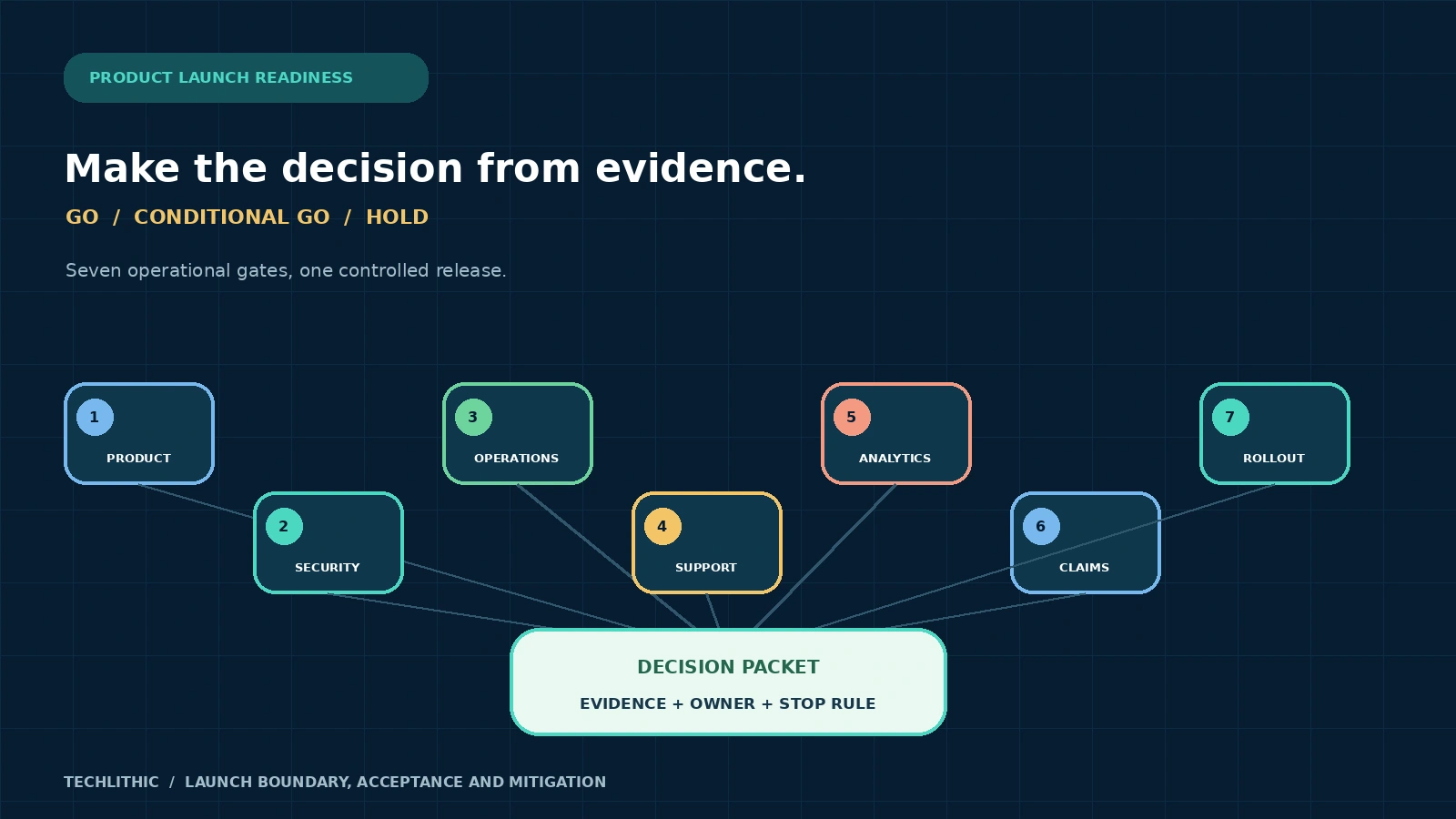
Define the launch slice, decision rights and evidence standard before the final review. Require named owners, dated test records, production-like validation, support and incident runbooks, verified business events, approved claims, a staged rollout and a practiced mitigation path. Pass only when every critical gate has evidence or an explicitly accepted exception. If a critical unknown cannot be contained, hold the launch rather than hiding it in a checklist.
Start with the launch decision and boundary
Write a one-page launch charter before reviewing readiness. Name the product or feature version, intended users, countries, platforms, acquisition channels, traffic or account limits, release window and exclusions. A private pilot for invited teams is not the same decision as general availability. Neither is enabling a feature flag for staff the same as exposing it to paying customers.
Define three possible outcomes: go, conditional go and hold. A conditional go needs a contained exception, a named risk owner, a mitigation, a deadline and a trigger that stops or reverses the release. A hold means a critical acceptance condition is unproven or the risk cannot be contained. Avoid percentages such as 95 percent ready because they allow a missing payment control to be averaged against completed copy edits.
AWS describes an operational readiness review as a structured check that a team can operate a workload safely before it goes live, with architecture, operational process, event management, release quality, security, governance and compliance in scope. [1] Treat the review as evidence for a decision, not as a meeting that creates evidence at the last minute.
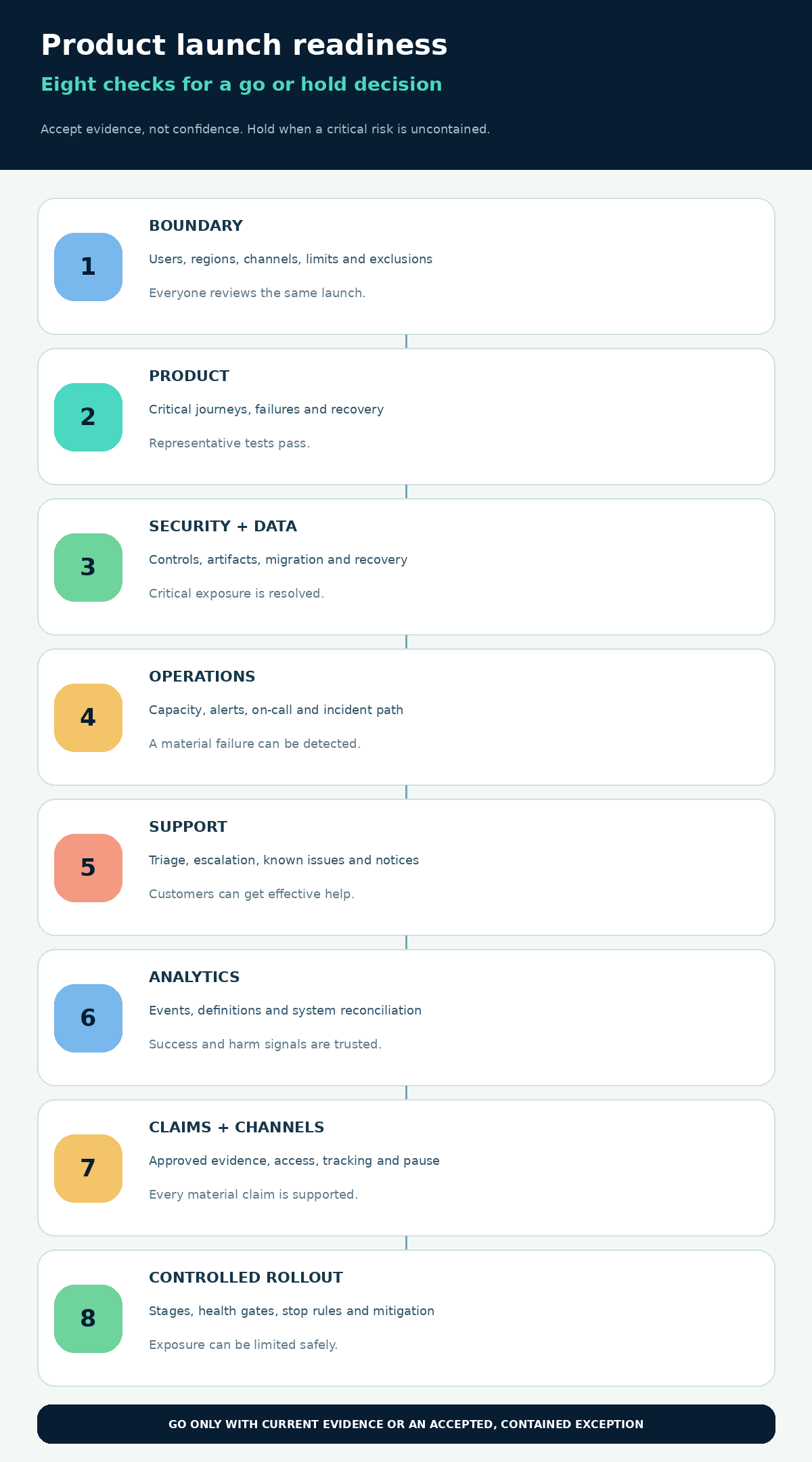
Set evidence rules and decision rights
Every gate should have an accountable owner, acceptance statement, evidence link, reviewer, status and expiry date. Useful evidence includes test results, screenshots, logs, monitoring configuration, runbooks, approved copy, training records and signed risk exceptions. A verbal assurance or an unchecked ticket is not evidence.
Use pass, conditional pass, blocked and not applicable. The reviewer should be independent enough to challenge the owner and skilled enough to interpret the evidence. Assign one launch decision owner, plus explicit stop authority for engineering, security, support and legal or compliance where their critical criteria fail. Record dissent and unresolved assumptions.
AWS recommends bringing security, operations and development perspectives into the checklist and connecting items to live signals such as alarms, infrastructure definitions and deployment pipelines where possible. It also says generated answers still require human acceptance and unreviewed answers count as unanswered. [1] The review meeting can then focus on exceptions and tradeoffs instead of collecting status.
Gate one: prove the product, security and data path
Map the critical user journeys from entry to value, including account creation, authentication, payment where applicable, onboarding, the core task, error recovery, cancellation and data export or deletion. Test representative roles, devices, browsers, network conditions and permissions in an environment that matches production closely. Record expected results, actual results and evidence for every critical path.
Security acceptance should cover the controls appropriate to the product and risk, including authentication, authorization, session handling, input validation, secrets, encryption, logging, dependency review and abuse cases. OWASP ASVS provides a structured basis for testing web application technical security controls and secure-development requirements. [2] Use a selected requirement set with explicit applicability rather than claiming broad compliance from an automated scan.
For the release artifact, require version identification, authorized build provenance, dependency inventory, vulnerability disposition and integrity verification. NIST's Secure Software Development Framework is a risk-based set of secure development practices that can inform these controls. [3] Data migrations also need backup, rehearsal, validation, compatibility and recovery evidence. A reversible code deploy does not automatically make a destructive schema change reversible.
Gates two and three: operations and support readiness
Operations evidence should show production capacity assumptions, dependency health, quotas, alerts, dashboards, log access, on-call coverage and incident severity rules. Define the first signals that indicate failure, who sees them and what action follows. Test the alert route and one representative incident path before launch.
Microsoft's safe deployment guidance recommends versioned artifacts, production-like staging, predeployment checks, feature flags, multiple test types, staged exposure and rollback plans. [4] A release plan should therefore state the deployment sequence, health checks, observation windows, traffic increments and stop thresholds. The person monitoring the release must have the access and authority to act.
Support readiness is separate from system monitoring. Provide a current help path, issue categories, triage questions, response ownership, escalation contacts, status-page rules, known limitations and customer communication templates. Rehearse at least one case that crosses support, product and engineering. Confirm who handles billing, privacy, account access and security reports. A launch consultant may coordinate these deliverables, but the buyer must own the ongoing service.
Gate four: validate measurement before traffic arrives
Create a measurement contract for the launch. List the critical business events, event names and parameters, identity and consent rules, source of truth, expected latency, owners and reconciliation tests. Track both value and harm signals: activation and successful completion alongside errors, refunds, support contacts, opt-outs and rollback conditions.
Run a synthetic journey from acquisition source through the critical product action and confirm the event appears with the expected parameters. Google Analytics states that Realtime and DebugView can be used to confirm collection while normal reports may take time to process. [5] Platform visibility does not prove the business meaning is correct, so reconcile a small set of test records against the product database, CRM or billing system where applicable.
Write the dashboard interpretation before launch. Define denominators, exclusions, time zones, test traffic treatment and the minimum observation period for each decision. Do not turn an early spike into a causal claim. The objective is to notice broken journeys and make the next rollout decision with comparable evidence.
Gates five and six: messaging, channels and accessibility
Build a claim register for the website, launch emails, listings, sales scripts, ads, demos and partner materials. For each objective claim, record the exact wording, evidence, limitations, approver and locations where it appears. The U.S. Federal Trade Commission says advertisers need a reasonable basis for objective claims before dissemination, and the required support depends on the claim, product and consequences of error. [6] Other jurisdictions and regulated sectors can impose additional requirements.
Channel readiness includes final URLs, tracking parameters, audience and suppression rules, budgets, owners, moderation, sender reputation and a pause method. Preview every asset in its actual destination. Confirm that pricing, trial, refund, privacy and support statements agree across product and promotion. Do not let a launch agency publish from accounts the buyer cannot access or recover.
Accessibility is also an acceptance responsibility. Test the critical journey with keyboard navigation, visible focus, meaningful labels, error recovery, zoom, contrast and relevant assistive technology. W3C advises evaluating accessibility throughout development and notes that no tool alone can determine conformance, so knowledgeable human evaluation is required. [7] Record the tested scope and known limitations instead of treating an automated score as certification.
Gate seven: control exposure and practice mitigation
Choose a rollout unit that limits blast radius, such as internal users, invited accounts, a region, a platform or a small traffic segment. For each stage, state entry evidence, exposure, observation window, health measures, stop thresholds and the person who approves expansion. Keep commercial messaging aligned with the actual availability boundary.
Write a mitigation tree rather than a single rollback sentence. Options can include disabling a feature, stopping new sign-ups, routing to the previous version, restoring data, applying a forward fix or communicating a degraded mode. Microsoft notes that feature flags can control exposure and that rollback plans should accompany staged deployment, while data changes can make reversal more complex. [4]
Run a tabletop or technical drill for the highest-risk path. Verify access, commands, backups, compatibility, decision authority and customer communication. Time the drill only to expose operational friction, not to create a universal recovery promise. A plan that has never been exercised is an assumption.
Use this launch readiness acceptance matrix
| Gate | Minimum evidence | Hold condition |
|---|---|---|
| Launch boundary | Users, regions, platforms, channels, limits, exclusions and decision owner | The team is reviewing different launch scopes. |
| Product | Dated critical-journey tests in a production-like environment | A critical path is untested, failing or lacks recovery. |
| Security and data | Applicable control checks, artifact integrity, migration and recovery evidence | A critical exposure or irreversible data risk is unresolved. |
| Operations | Capacity assumptions, alerts, dashboards, on-call and incident runbook | No owner can detect and act on a material failure. |
| Support | Help path, triage, escalation, known issues and communication templates | Customers cannot get effective help for a critical scenario. |
| Analytics | Validated critical events, definitions and system reconciliation | Success or harm signals cannot be trusted. |
| Messaging and channels | Approved claims, final assets, access, tracking and pause controls | A material claim lacks support or a channel cannot be controlled. |
| Controlled rollout | Stages, health gates, stop thresholds and practiced mitigation | Exposure cannot be limited or failure cannot be mitigated safely. |
Apply the strictest status to the launch as scoped. A conditional pass is appropriate only when the exception is bounded and the residual risk is explicitly accepted by the person accountable for it. High-criticality findings should reach the decision owner rather than being downgraded to protect the date. AWS describes escalating high-criticality ORR findings as input to a go or no-go decision. [8]
Worked example: a fictional SaaS launch review
Consider a fictional workflow SaaS preparing to launch a paid team plan. The original scope says public launch, but the readiness review finds that the billing webhook retry path is untested, support has no refund triage and the activation event is recorded before a user completes setup.
The decision owner narrows the launch to invited accounts on one plan and one region. Engineering proves the payment and cancellation journeys with test evidence, corrects the activation event and reconciles representative records across the application, analytics and billing system. Support rehearses failed payment, access and refund cases. Marketing removes an unsupported productivity claim and adds the approved availability boundary.
The team uses a feature flag for account eligibility, monitors payment failures, onboarding completion and priority support contacts, and defines a stop trigger for repeated billing inconsistency. A drill confirms that new invitations can be paused without affecting existing accounts. One non-critical documentation issue receives a conditional pass with an owner and next-day deadline.
The outcome is go for the bounded invitation phase, not general availability. Expansion requires a stable observation window, resolved documentation and another decision review. This is an original procurement illustration, not a client result, benchmark or promise.
Buyer checklist for launch consulting proposals
- The proposal defines the exact launch boundary and exclusions.
- Go, conditional go and hold outcomes have written criteria.
- One person owns the final decision and critical functions have stop authority.
- Every gate has an owner, reviewer, evidence type and expiry date.
- Critical user journeys include failure, recovery and cancellation paths.
- Security requirements are selected for the product and risk, not implied by a scan.
- Release artifacts, dependencies, migrations, backups and recovery are verified.
- Capacity, quotas, dependencies, alerts and incident severity rules are documented.
- On-call and support teams rehearse representative launch incidents.
- Analytics events are validated and reconciled with operational systems.
- Objective claims have evidence, limitations and an approver before publication.
- Accessibility includes manual review of the critical journey.
- Channel accounts, budgets, audiences, suppression and pause controls belong to the buyer.
- The rollout uses bounded stages, health gates and stop thresholds.
- Rollback, roll-forward and degraded-mode options cover data as well as code.
- Exceptions name the risk owner, mitigation, deadline and residual risk.
- The final packet includes source files, logs, approvals, runbooks and a decision record.
- Post-launch review updates the checklist from real incidents and support evidence.
TechLithic provides product launch consulting, startup consulting, SaaS product development and SaaS GTM consulting. Use this checklist equally when reviewing TechLithic and competing providers. For adjacent decisions, see the SaaS GTM deliverables guide, software handover checklist, conversion tracking acceptance guide and MVP development scope guide.
Frequently asked questions
What is a product launch readiness review?
It is a structured, evidence-based review of whether the defined product release can be delivered, operated, supported, measured and controlled safely. It produces a go, conditional go or hold decision for a specific launch boundary.
What should automatically hold a launch?
A launch should be held when a critical user journey, security or data control, operating capability, support path, measurement signal, material claim or mitigation path is unproven and the risk cannot be contained within the proposed launch boundary.
Is a conditional go the same as accepting technical debt?
No. A conditional go requires a bounded exception, accountable risk owner, mitigation, deadline and stop trigger. Ordinary technical debt may exist, but it should not conceal a critical readiness failure.
Who should attend the go or hold review?
Include the decision owner and accountable representatives for product, engineering, security, operations, support, analytics, marketing and relevant legal or compliance review. Dependencies and customer-facing teams should join when their evidence affects the decision.
How close to launch should the review happen?
Readiness work should begin during delivery, not at the final meeting. Hold a formal decision review when the required evidence is current, with enough time to remediate or narrow the launch. Recheck anything that changes after approval.
Does passing a launch checklist guarantee success?
No. A readiness review reduces known operational and decision risk but cannot guarantee customer adoption, revenue, reliability or compliance. Continue monitoring, support and review after release.
Sources and research notes
Sources checked on 2026-11-24. Pricing and policy documents can change; verify current terms before approving expenditure.
- AWS Well-Architected Framework: Assess operational readiness
Primary cloud-provider guidance on operational readiness review scope, evidence, stakeholders, live signals and lifecycle review.
- OWASP Application Security Verification Standard
Primary OWASP project page describing ASVS as a basis for testing web application technical security controls and secure-development requirements.
- NIST SP 800-218: Secure Software Development Framework
Primary NIST publication page for risk-based secure software development practices.
- Microsoft Azure Well-Architected Framework: Safe deployment practices
Primary provider guidance on versioning, staging, test diversity, feature flags, progressive exposure, health checks and rollback planning.
- Google Analytics Help: Confirm that you are collecting data
Primary product documentation on using Realtime and DebugView to validate analytics collection.
- Federal Trade Commission: Policy Statement Regarding Advertising Substantiation
Primary U.S. regulatory policy explaining the reasonable-basis and prior-substantiation requirements for advertising claims.
- W3C Web Accessibility Initiative: Evaluating Web Accessibility Overview
Primary W3C guidance on continuous accessibility evaluation and the need for knowledgeable human review alongside tools.
- AWS Well-Architected Framework: Inspect the operational readiness review process
Primary provider guidance on reviewing completed readiness evidence and escalating high-criticality findings into go or no-go decisions.
AWS, Microsoft, NIST, OWASP, Google, FTC and W3C primary guidance was checked on November 24, 2026. The readiness matrix and fictional SaaS example are original procurement illustrations, not client results or universal benchmarks. Regulatory and framework references are planning inputs and do not replace product-specific legal, privacy, security or accessibility review. No launch, adoption, revenue, reliability or compliance outcome is promised.