
Startup consulting buying guides
SaaS GTM Consulting: Deliverables, Dependencies and Exit Criteria
A SaaS go-to-market engagement should leave the buyer able to make and repeat commercial decisions. A polished strategy deck is not enough. The scope should convert evidence about customers, alternatives, product readiness and economics into testable positioning, channel experiments, sales workflows, measurement and a buyer-owned operating system.
Prepared with AI assistance and checked against the linked sources. Numerical comparisons are illustrative unless expressly sourced.
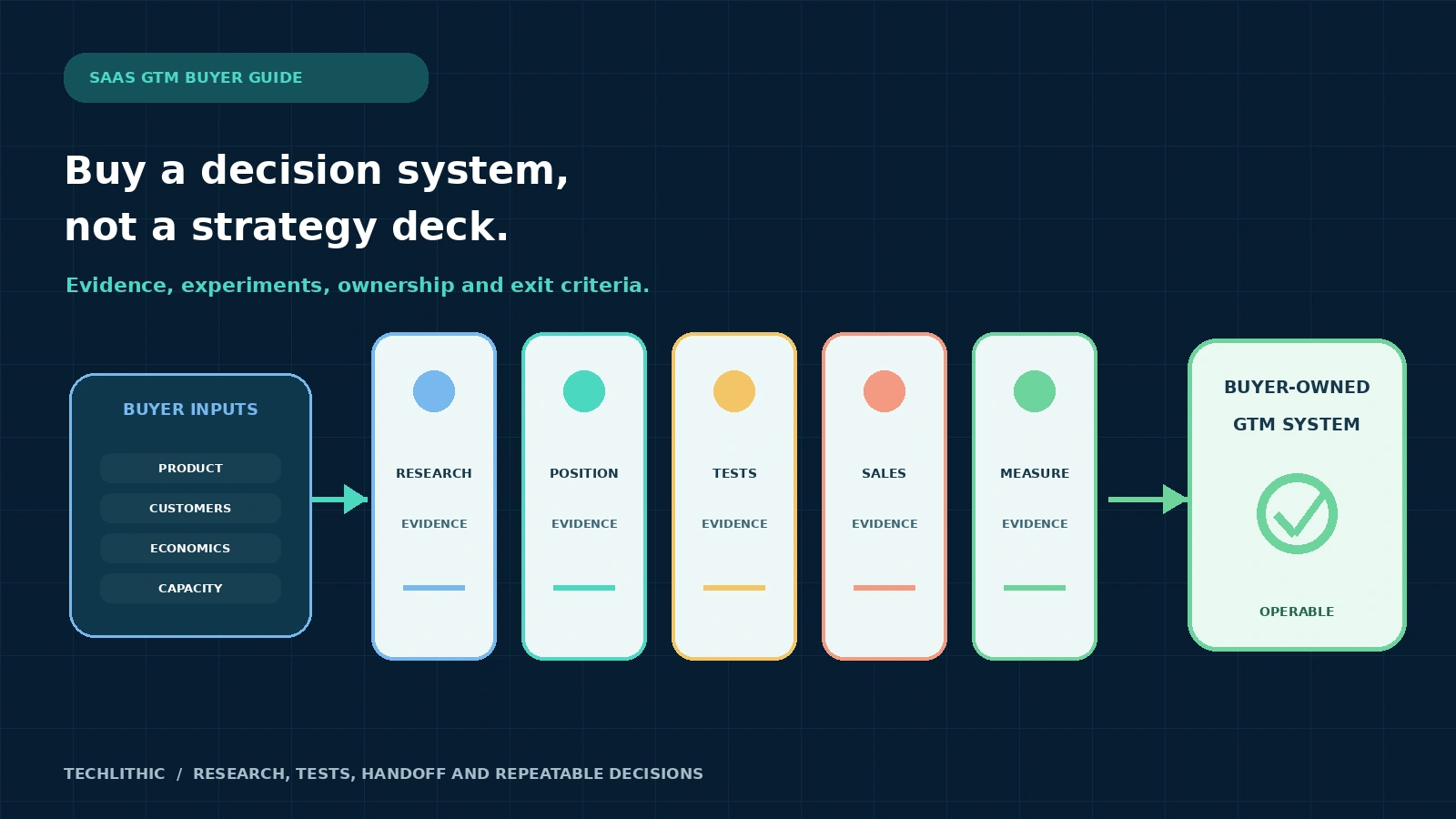
Buy a staged decision process, not a promise of growth. Define the baseline, research questions, target segment, message and offer hypotheses, channel test cards, sales handoffs, measurement rules, internal dependencies and exit criteria before work starts. Require source evidence, decision logs, reusable assets and a final handover that your team can operate.
Define the decision the engagement must enable
Start with a commercial decision, not the instruction to create a GTM strategy. The decision may be which segment to pursue first, whether a self-serve or sales-assisted motion is viable, which message deserves a larger test, or whether the product is ready for a market-entry investment. Name the decision, decision owner, deadline, constraints and evidence needed.
Record what is outside scope. A GTM consultant cannot repair missing product reliability, approve legal claims, create unlimited campaign assets, operate sales indefinitely or guarantee revenue unless those services are separately defined. Separate strategy, validation, launch support and ongoing demand generation so proposals can be compared on the same boundary.
Stripe's 2026 GTM guide distinguishes the broader cross-functional GTM scope from ongoing marketing and includes market analysis, target customers, value proposition, sales, pricing, distribution, support, metrics, budget and timeline. [1] Use those components as a coverage check, not as a universal template.
Require a verified baseline and dependency register
The consultant should begin with a source register rather than assumptions. Provide approved access to product analytics, billing definitions, CRM stages, campaign history, win and loss notes, support themes, pricing, onboarding, current website, contracts and known restrictions. Each source needs an owner, date range and limitation.
Create a dependency register with product readiness, data access, tracking, design, content, legal review, sales capacity, customer references, integration support and budget. Assign a buyer owner and due date to each dependency. If a required input is late, the plan should show which decision or experiment is blocked instead of silently filling the gap with generic advice.
Baseline metrics need written definitions. For recurring revenue, clarify inclusion of discounts, refunds, services, taxes and currency treatment. For leads and pipeline, define the timestamps and stage rules. Stripe's SaaS metrics guide separates acquisition, engagement, retention and growth measures, including customer and revenue churn. [2] Select the measures relevant to the engagement rather than producing a vanity dashboard.
Buy research that changes a commercial choice
A research deliverable should state the questions, sample, method, evidence and limitations. Useful inputs can include buyer interviews, usage and support evidence, sales-call review, loss analysis, competitor and alternative mapping, category language, pricing context and channel discovery. Distinguish customer evidence from consultant interpretation.
The U.S. Small Business Administration advises combining market research with competitive analysis and examining direct and indirect competitors, strengths, weaknesses, barriers and market segments. [3] The output should therefore be more than a logo grid. It should explain which buyer problem, trigger, alternative and proof requirement make one segment more testable than another.
Do not accept invented personas. GOV.UK's service guidance recommends user research, secondary analysis, prototypes and analytics to understand the problem, while treating unverified opinions as assumptions. [4] For a SaaS engagement, require anonymized evidence notes and a decision log showing what changed because of the research.
Turn research into positioning, message and offer hypotheses
Positioning should name the priority segment, job or problem, triggering situation, alternatives, differentiated value, proof and boundaries. Messaging then adapts that position for the website, ads, sales conversations and lifecycle communication. The consultant should provide a message architecture, claim-to-evidence register and examples, not a collection of slogans.
The offer design should state the product or package, buyer, price presentation, commitment, onboarding, support, trial or pilot rules, expansion path and disqualifiers. It must connect to the product's ability to deliver. If a promise depends on a missing integration, manual service or future feature, label that dependency before testing the claim.
For United States advertising, the FTC says claims must be truthful, non-deceptive and supported by evidence before the ad runs, with qualifying disclosures clear and conspicuous. [5] Other markets and regulated sectors have their own rules. Require legal review where appropriate and do not let a consultant approve its own risky claim.
Specify channel experiments before buying execution
Each proposed channel needs an experiment card: hypothesis, target segment, offer, asset, audience source, traffic or outreach method, budget, duration or stopping rule, primary measure, diagnostic measures, tracking, owner and next decision. Organic content, marketplace visibility, outbound, partners, paid acquisition and lifecycle programs require different test designs.
Change one important variable when feasible and preserve a baseline. Google Ads experiments can split traffic or budget between a base and trial campaign for defined changes such as landing pages, audiences or campaign settings. [6] That platform method does not make every result causal, but it illustrates why a proposal should define the comparison before spend starts.
Do not require every channel to produce immediate revenue. An early test may first show message resonance, qualified response, activation or sales-cycle evidence. Still, name the commercial decision each proxy supports. Set a maximum test cost and a review point. A consultant should not keep an inconclusive channel running merely to consume the retainer.
Make the sales handoff operational
For sales-assisted SaaS, define lifecycle stages, qualification, routing, ownership, response expectations, discovery fields, demo path, objection handling, follow-up, disqualification and feedback to product and marketing. Deliver CRM field definitions and example records, not only a funnel picture.
HubSpot's default lifecycle stages distinguish lead, marketing-qualified lead, sales-qualified lead, opportunity and customer, while allowing customization. [7] A buyer should adopt definitions that match its real process, then document who can advance, return or disqualify a record. The tool's default labels are not the strategy.
Sales enablement assets can include a discovery guide, demo storyline, proof library, objection matrix, proposal outline and follow-up sequence. Acceptance should test whether a trained internal seller can use them on representative cases. If the consultant is also operating outbound, keep list sourcing, consent, suppression and sender ownership explicit.
Create a measurement contract before reporting results
Define the source of truth, event names, campaign taxonomy, identity rules, funnel stages, attribution view, revenue connection, reporting lag and data-quality checks. A dashboard without definitions can hide duplicate leads, overwritten sources, missing consent or inconsistent opportunity values.
Google Analytics documents manual UTM parameters for source, medium, campaign, term and content, as well as auto-tagging through linked advertising products. [8] The consultant should deliver a naming convention, validation cases and ownership rules, then test that a representative journey appears correctly in analytics, CRM and billing where applicable.
Governance also covers lawful and ethical execution. The UK's Information Commissioner's Office advises planning direct marketing with data protection by design, a lawful basis, clear collection information and respect for objections or opt-outs. [9] Requirements vary by jurisdiction and channel, so the buyer should obtain appropriate legal advice.
Use an eight-part GTM acceptance matrix
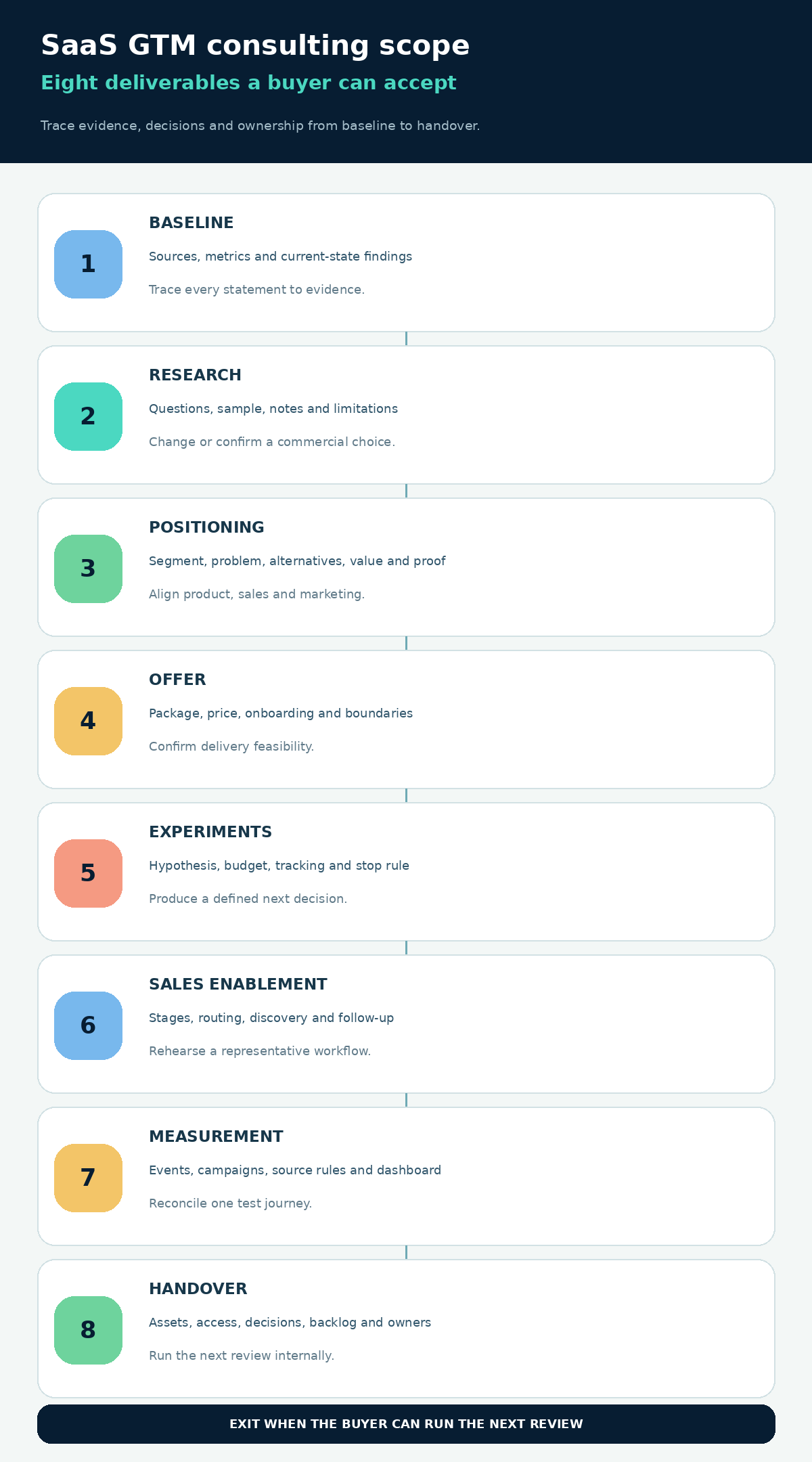
| Workstream | Minimum delivery | Acceptance test |
|---|---|---|
| Baseline | Source register, metric definitions and current-state findings | Buyer can trace each baseline statement to evidence. |
| Research | Questions, sample, method, notes, findings and limitations | Findings change or confirm a named commercial decision. |
| Positioning | Segment, problem, alternative, value, proof and boundaries | Internal teams can explain the same differentiated choice. |
| Offer | Package, price presentation, onboarding, support and disqualifiers | Product, finance, sales and delivery owners approve feasibility. |
| Experiments | Channel cards with hypothesis, budget, tracking and stop rule | Each test can produce a defined next decision. |
| Sales enablement | Stages, qualification, routing, discovery, demo and follow-up | An internal seller completes a representative workflow. |
| Measurement | Event and campaign taxonomy, source rules and dashboard | A test journey reconciles across the agreed systems. |
| Handover | Assets, access, decision log, backlog, owners and operating cadence | The buyer runs the next review without consultant dependency. |
Use pass, conditional pass and blocked statuses. A strong positioning document cannot compensate for missing tracking, an infeasible offer or a sales team with no capacity. Record the remediation, owner and decision date for every conditional item.
Worked example: a fictional workflow SaaS engagement
Consider a fictional workflow SaaS company selling to small professional-services firms. The founders ask a consultant to increase demand, but the baseline shows inconsistent CRM stages, incomplete campaign tagging and no agreed priority between self-serve teams and larger sales-assisted accounts.
The engagement first defines the decision: select one initial segment and motion for the next controlled launch phase. Research combines approved customer interviews, product usage, support themes, sales notes and a map of spreadsheets, horizontal automation tools and manual outsourcing as alternatives. The team chooses one segment hypothesis because its trigger, required integration and proof needs can be tested with current product capabilities.
The consultant creates a claim-to-evidence message architecture, an offer with explicit onboarding and support boundaries, and two channel experiment cards. One tests a focused partner referral motion; the other tests a paid landing-page message against the current baseline. Both use the same qualification fields and campaign taxonomy. Sales rehearses the discovery guide before leads are routed.
The review does not declare a winner from clicks alone. It compares qualified conversations, activation evidence, sales objections, delivery effort and the limits of the small sample. The buyer decides which hypothesis deserves a larger test, records what remains unknown and takes ownership of the assets, dashboard and next experiment. This is a fictional operating example, not a client result or growth promise.
Define exit criteria and buyer ownership at contract time
Time alone should not define completion. Set exit criteria for accepted baseline, completed research, approved position and offer, runnable test cards, working measurement, usable sales assets, documented findings and a buyer-led review. Also define early stop conditions such as an unsafe claim, missing product capability, unavailable data, no sales owner or a test that cannot be measured.
The handover should include editable source files, research and evidence registers, raw exports where permitted, configuration and naming conventions, creative and copy versions, CRM definitions, test history, dashboards, access map, decision log, backlog and known limitations. Remove or transfer consultant-owned accounts and revoke unnecessary access.
Require a final operating session in which the buyer runs the review, explains the evidence and chooses the next action. Continuing support can be useful, but renewal should purchase new work, not access to the buyer's own strategy or measurement system.
Use this checklist when comparing GTM consulting proposals
- The engagement names a commercial decision and accountable buyer owner.
- Strategy, validation, launch execution and ongoing demand generation have separate boundaries.
- Current metrics, sources and limitations will be documented before recommendations.
- Product, data, tracking, legal, design, sales and budget dependencies have owners.
- Research questions, sample, method and evidence outputs are specified.
- Personas and segments must be supported by buyer or market evidence.
- Positioning includes alternatives, proof and boundaries, not only taglines.
- Claims require an evidence owner and appropriate review.
- The offer states pricing presentation, onboarding, support and disqualifiers.
- Every channel test has a hypothesis, cap, tracking plan and stop rule.
- CRM stages, qualification, routing and sales feedback are operationally defined.
- Campaign and event taxonomy can reconcile a test journey across systems.
- Compliance, consent, suppression and data ownership are explicit dependencies.
- Decision logs distinguish evidence, interpretation and unresolved uncertainty.
- The buyer receives editable assets, access, test history and known limitations.
- Exit criteria prove the internal team can run the next GTM review.
TechLithic offers SaaS GTM consulting, SaaS demand generation, SaaS launch visibility and startup consulting. Apply this checklist equally to TechLithic and competing providers. Use the paid marketing proposal guide for acquisition economics, the landing-page experiment guide for conversion tests and the SaaS listing evidence guide for marketplace readiness.
Frequently asked questions
What should a SaaS GTM consultant deliver?
A useful engagement should deliver traceable research, positioning and offer hypotheses, channel test cards, sales and CRM rules, measurement definitions, decision logs, accepted assets and a buyer-owned handover. The exact mix depends on the commercial decision.
Is a GTM strategy the same as a marketing plan?
No. A GTM scope normally connects the target customer, positioning, offer, pricing, sales, distribution, support, launch and measurement. Marketing is one part of that cross-functional system.
Should a GTM consultant guarantee revenue or growth?
A consultant can commit to defined work, evidence quality, test execution and decision support. Revenue also depends on product fit, pricing, delivery, sales capacity, market conditions and buyer execution, so ranking or revenue guarantees should be treated cautiously.
How should channel experiments be scoped?
Each experiment should state the hypothesis, segment, offer, asset, audience, budget cap, duration or stopping rule, primary measure, tracking, owner and decision that follows the result.
When is a GTM consulting engagement complete?
Completion should require accepted evidence, runnable experiments, operational sales and measurement rules, documented limitations, transferred assets and a buyer team that can conduct the next review without depending on the consultant.
Sources and research notes
Sources checked on 2026-11-21. Pricing and policy documents can change; verify current terms before approving expenditure.
- Stripe Atlas: What is a go-to-market strategy?
Primary provider guidance on GTM scope across market intelligence, positioning, sales, marketing, distribution, support, operations, risk and compliance.
- Stripe: Essential SaaS metrics
Primary provider guidance distinguishing SaaS acquisition, engagement, retention and growth measures, including customer and revenue churn.
- U.S. Small Business Administration: Market research and competitive analysis
Official guidance on customer research and competitive analysis across market segments, direct and indirect competitors, barriers, strengths and weaknesses.
- GOV.UK Service Manual: Understand users and their needs
Official service-design guidance on user research, secondary analysis, prototypes, analytics and testing assumptions.
- U.S. Federal Trade Commission: Advertising FAQs for small business
Official U.S. guidance on truthful, non-deceptive advertising, claim substantiation and clear, conspicuous disclosures.
- Google Ads Help: About the Experiments page
Primary platform documentation on comparing base and trial campaigns, experiment types and applying tested changes.
- HubSpot Knowledge Base: Use lifecycle stages
Primary CRM documentation on lifecycle stages, customization, automation and marketing-to-sales handoff.
- Google Analytics Help: Traffic-source dimensions, manual tagging and auto-tagging
Primary analytics documentation on UTM parameters, linked-platform auto-tagging and source, medium, campaign, term and content dimensions.
- UK Information Commissioner's Office: Direct marketing guidance
Official UK guidance on data protection by design, lawful basis, fair collection, transparency and respect for objections and opt-outs.
All nine supporting sources were opened on publication day. Official regulator, government and primary platform documentation informs specific claims. The worked example is explicitly fictional and no client result, ranking promise or fabricated statistic is used.