
Performance marketing buying guides
Ad Creative Testing: A Buyer Brief for Useful Experiments
Ad creative testing should answer a decision, not merely produce a folder of variations. A useful buyer brief holds the audience, offer, landing experience and delivery conditions steady enough to learn whether a meaningful message or execution change improved the selected business outcome. It also defines the assets, approvals, rights, measurement and stop rules before media spend begins.
Prepared with AI assistance and checked against the linked sources. Numerical comparisons are illustrative unless expressly sourced.
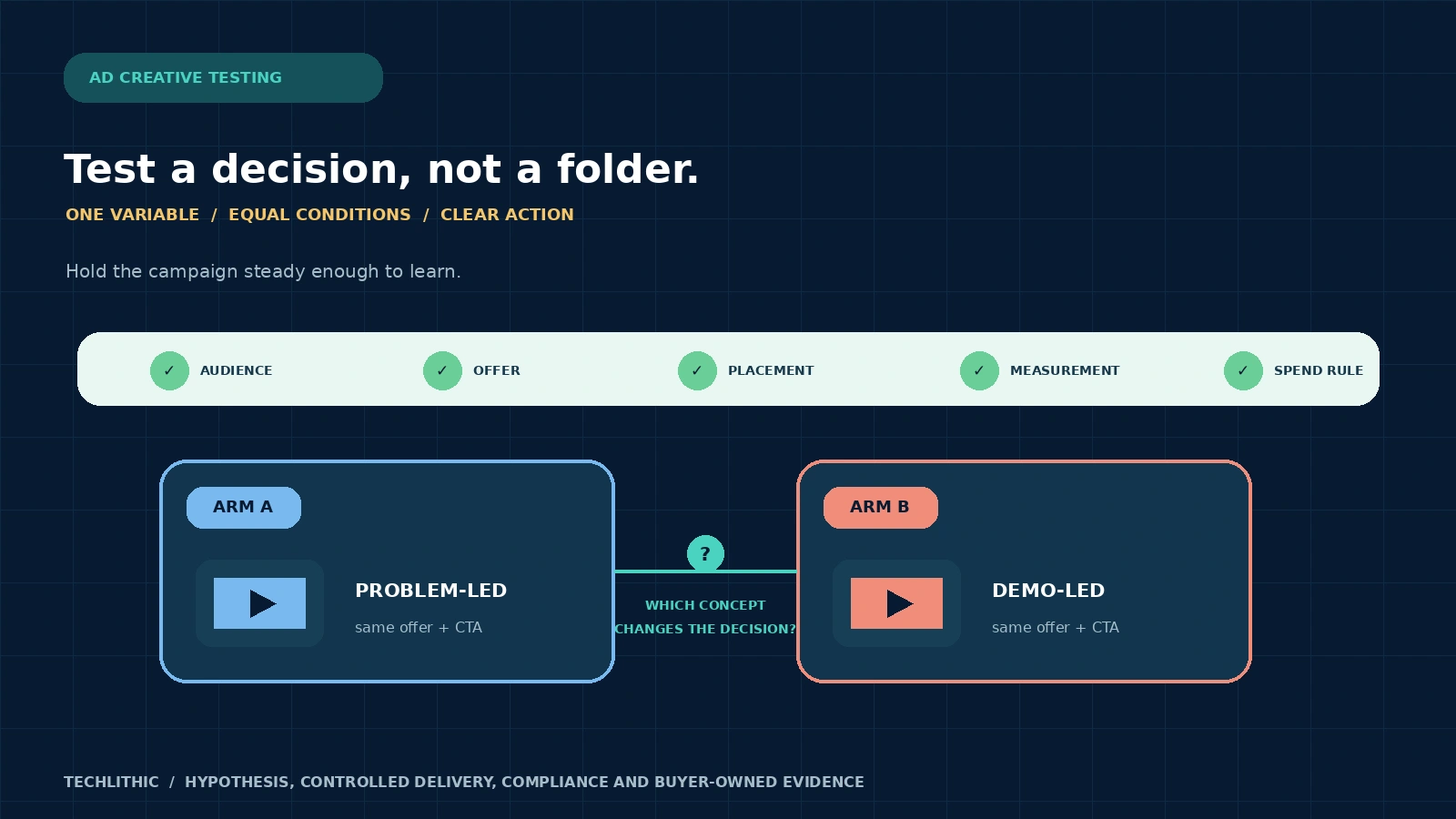
Buy a documented learning system, not a promise of a winning ad. Approve one decision, a testable hypothesis, the controlled variables, a sufficiently different challenger, the asset and format matrix, claim evidence, usage rights, platform disclosures, measurement rules, budget authority, quality checks and decision log. Accept the work when another operator can reproduce the setup, verify the files and apply the result without relying on agency memory.
Start with one decision the test can change
Write the decision before requesting concepts. Examples include choosing a problem-led or outcome-led message for one audience, selecting product demonstration or founder explanation for one placement, or deciding whether a direct offer should replace an educational introduction. The decision should be within the buyer's control after the test.
Convert it into a hypothesis with a mechanism: for this defined audience and offer, changing this creative element is expected to improve this primary outcome because of this reason. Google advises advertisers to tie the hypothesis to a business goal, test one variable at a time and select the success metric before the experiment begins. [1]
Reject briefs that say only “find a winner” or “test more hooks.” They do not say what will remain fixed, which outcome matters or what action follows. Also separate an exploratory content batch from a controlled experiment. A varied batch can discover ideas in live delivery, but when audience, placement, bid, format and message change together, it cannot isolate the cause of a difference.
Lock the audience, offer and delivery baseline
Describe the eligible audience, exclusions, geography, language, device or placement, campaign objective, optimization event, bid strategy, schedule, frequency controls, landing destination and offer. Record the account, campaign and tracking configuration that will be used. If the test compares creative, those conditions should remain equivalent unless the platform experiment explicitly manages them.
Meta explains that its A/B testing tool creates random, non-overlapping groups and keeps the tested versions identical except for the distinct variable. It warns that simply running two ordinary campaigns can create overlapping audiences and uneven delivery. [2] TikTok likewise describes split testing as equal audience groups in which each group sees only one ad group. [3]
Archive the baseline creative, landing page, offer terms and tracking checks. If any of them change during the run, log the time and decide whether the result remains interpretable. A platform can optimize delivery correctly while the business still tests the wrong event or sends users to inconsistent destinations.
Define a meaningful creative variable
Distinguish the concept from the execution. A concept is the central promise, problem, proof or demonstration. An execution includes the opening frame, headline, speaker, visual style, duration, caption treatment, product shot, call to action or layout. Decide which level the test addresses and keep the remaining elements aligned.
A challenger must differ enough to represent the hypothesis, not merely use a different background color unless color is the actual question. TikTok's current best-practice guidance recommends a clear hypothesis and obvious differences between test groups, while also advising adequate budget, duration and audience size and avoiding changes after launch. [4]
Create a variable map with four columns: fixed, tested, allowed production adaptation and prohibited change. For example, a message test may fix the same audience, offer, format, duration range, call to action and landing page while changing the opening problem and supporting proof. Platform-required crops or safe-area adaptations are allowed, but a different discount is prohibited.
Turn the concept into an asset and placement matrix
List every required deliverable by concept, format, aspect ratio, duration or frame count, copy field, language, placement and file type. Include thumbnails, captions, subtitles, audio mix, source files and editable templates where relevant. Identify which variants are true test arms and which are mechanical adaptations of the same arm.
Specify the approval sequence: evidence and claim review, concept, script or copy, storyboard or layout, rough cut, final master, platform adaptations and trafficking. Define the included revision rounds and who can approve. Late changes to the offer or message should return to the appropriate approval gate rather than being hidden inside final production.
For video, require a version that remains understandable when sound is unavailable, along with captions appropriate to the placement. W3C explains that captions convey dialogue plus meaningful non-dialogue audio and should not obscure relevant visual information. [5] Treat accessibility as part of the asset specification, not a patch after the experiment starts.
Review claims, rights and synthetic media before launch
Build a claim-evidence table for express and implied statements. Record the exact claim, evidence owner, source, limitations, required disclaimer and approved markets. The US Federal Trade Commission states that advertisers and agencies should have a reasonable basis for objective claims before dissemination, including the support implied by the ad. [6] Other jurisdictions may impose different or additional rules.
Track usage rights for footage, music, fonts, stock, product screens, customer material, talent, voice, likeness and creator content. Record territory, channels, term, paid-media use, editing permission and renewal. If a testimonial or endorsement is used, verify the experience and disclosure. FTC guidance says material connections that can affect how an audience evaluates an endorsement should be disclosed. [7]
For AI-generated or significantly altered media, record the tool, inputs, source permissions, human review and required label. TikTok's current advertising policy requires disclosure for covered AI-generated or significantly modified content and restricts misleading claims, inconsistent offers and identity misuse. [8] Do not assume a disclosure cures an unsupported claim or unauthorized likeness.
Plan measurement, allocation and spend together
Select one primary decision metric and a small set of diagnostic or guardrail measures. The primary metric should match the decision and campaign objective, such as qualified lead, completed purchase or another verified business event. Click-through rate, video completion and platform engagement can help explain attention, but they do not replace the downstream outcome when the goal is acquisition.
Document the event definition, attribution window, value treatment, deduplication, reporting time zone and source of truth. Run preflight tests through the ad click, landing page and conversion path. Use the separate conversion tracking acceptance guide when measurement implementation is not already approved.
Ask the platform or analyst to estimate whether the eligible audience, baseline event rate, expected difference, allocation and spend can support the intended decision. Do not invent a universal budget or duration. Google notes that an inconclusive Demand Gen experiment can be useful and may mean the creative difference was not substantial enough. [9] The brief should allow “no decision” rather than forcing a winner from noise.
Control the run and preserve an audit trail
Before launch, capture experiment ID, arms, creative file hashes or approved filenames, audiences, placements, budget, schedule, optimization, landing URLs, events and owner approvals. Confirm both arms are eligible and approved. Check that one arm is not blocked by policy, inventory or a broken destination.
During the run, monitor delivery balance, disapprovals, tracking failures, landing-page outages, spend, audience overlap where applicable and major external changes. Do not repeatedly edit creative, budgets or targeting because early results look attractive. If a safety, legal or brand issue requires intervention, pause and document it.
Separate operational monitoring from outcome interpretation. The team can stop for a broken asset, invalid measurement or approved spend limit without declaring one concept better. Preserve screenshots or exports of the final setup and result view, plus raw or underlying reports available to the buyer. Access should remain in buyer-owned advertising and analytics accounts.
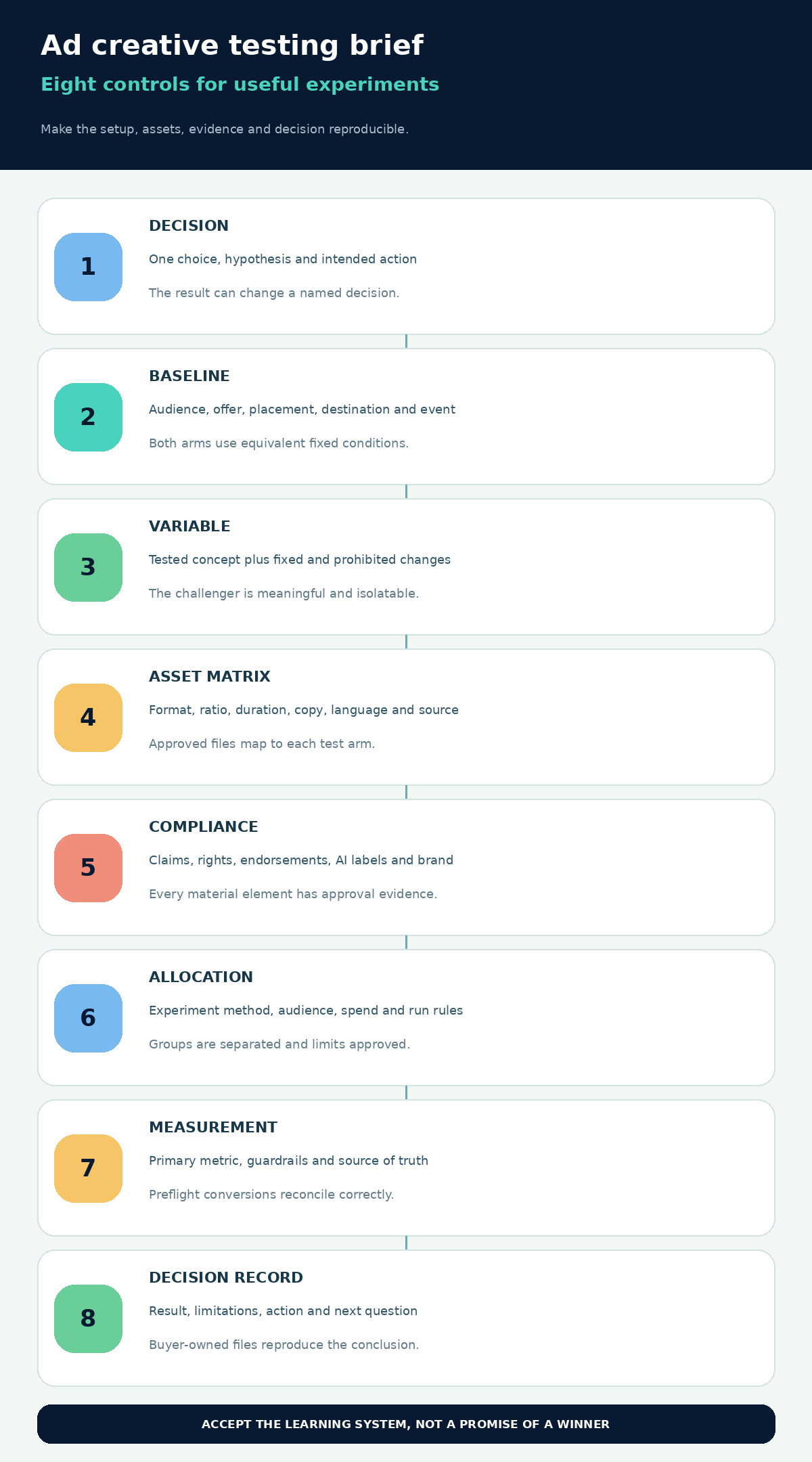
Use an eight-part creative test acceptance matrix
| Control | Minimum delivery | Acceptance evidence |
|---|---|---|
| Decision | One business choice, hypothesis and intended action | The result can change a named decision. |
| Baseline | Audience, offer, placement, objective, destination and tracking | Both arms use equivalent fixed conditions. |
| Variable | Concept or execution change plus fixed and prohibited changes | The challenger is meaningful and isolatable. |
| Assets | Concept, format, ratio, duration, copy, language and source-file matrix | Approved files map exactly to the experiment arms. |
| Compliance | Claim evidence, rights, endorsements, disclosures and brand rules | Every material claim and asset has an owner and approval. |
| Allocation | Experiment method, audience, spend authority and run conditions | Platform setup shows separated test groups and approved limits. |
| Measurement | Primary metric, guardrails, event rules, attribution and source | Preflight conversions reconcile to the chosen source of truth. |
| Decision record | Result, limitations, action, reusable learning and next question | Buyer-owned exports and files reproduce the conclusion. |
Ask every provider to mark what is included, optional, buyer-supplied, paid to a third party and excluded. Separate production fees, creator or talent costs, licensing, media spend, platform fees, measurement work and iteration after the test. A low production quote is not comparable if it omits usage rights, adaptations or experiment operations.
Worked example: a fictional B2B workflow campaign
Consider a fictional workflow software company testing paid social creative for operations managers. This is an original teaching example, not a client result or performance claim. The buyer must choose whether the next production cycle should lead with the cost of manual handoffs or with a product demonstration.
The brief fixes the audience, country, offer, landing page, placement family, video duration range, call to action, campaign objective, bid approach and verified demo-request event. Arm A opens with a specific manual-handoff problem and then shows the product. Arm B opens directly with the same product workflow. Both use the same narrator, proof points, closing frame, captions and destination.
The asset matrix contains one master and the required placement adaptations for each arm. The claim table removes an unsupported time-saving figure and approves a factual description of the workflow instead. Talent, music and product-screen rights are recorded. No customer testimonial or synthetic likeness is used.
The test is accepted for launch only after both arms pass policy review, the tracking preflight records the same demo-request event and the experiment tool confirms separated groups. The decision rule allows three outcomes: adopt the problem-led concept, adopt the demonstration-led concept or retain the current baseline because the result is inconclusive. The final log records the result, delivery limitations and the next creative question without turning a directional signal into a guarantee.
Buyer checklist before approving creative testing
- The test answers one named business decision.
- The hypothesis explains why the creative change may affect the primary outcome.
- The eligible audience, exclusions, placements and destination are documented.
- The offer, objective, optimization, bid and tracking conditions are fixed.
- The tested variable is separated from allowed adaptations and prohibited changes.
- The challenger differs enough to represent the hypothesis.
- Every concept maps to a complete asset and format matrix.
- Copy, layout, captions, audio and safe-area rules are specified.
- Concept, claim, rough and final approval gates have owners.
- Objective claims have evidence and approved limitations before production.
- Testimonials and endorsements have verified experience and disclosures.
- Footage, music, fonts, talent, creator content and product screens have usable rights.
- AI generation or material alteration has provenance, review and required labels.
- The primary metric and guardrails are chosen before launch.
- Event meaning, attribution, value, deduplication and source of truth are defined.
- Audience, budget and duration can support the intended platform experiment.
- Operational stop rules are separate from outcome rules.
- An inconclusive result is an allowed outcome.
- Advertising, analytics and source-file ownership remains with the buyer.
- The final log includes setup, exports, limitations, action and next question.
TechLithic offers ad creative production, performance marketing and AI-assisted creative production. Apply this checklist equally to TechLithic and competing providers. For adjacent decisions, use the paid marketing proposal guide, product video brief and landing-page experiment guide.
Frequently asked questions
What is an ad creative test brief?
It is the approved specification for the decision, hypothesis, fixed campaign conditions, tested variable, assets, compliance checks, measurement, spend authority, run controls and decision rule.
Should an ad test change only one element?
For a controlled A/B test, isolate one meaningful variable or concept while keeping other conditions equivalent. A broader exploratory batch can vary several elements, but it should not be interpreted as proof of which element caused the result.
Is click-through rate enough to choose a winning creative?
Only when click-through is genuinely the primary business decision. For acquisition, use a verified downstream event as the primary outcome and treat attention metrics as diagnostics or guardrails.
How much budget does a creative test need?
There is no universal amount. Plan from the eligible audience, baseline event rate, allocation, detectable difference, platform guidance, run conditions and value of the decision. Allow an inconclusive result if the evidence is insufficient.
Can AI-generated ad creative be tested like other creative?
Yes, subject to rights, claim, likeness, brand and platform rules. Record the generation process, review the final asset and apply required AI or synthetic-media disclosures. Disclosure does not validate unsupported claims.
What should the agency hand over after the test?
Require approved masters and adaptations, editable sources, rights and claim records, experiment configuration, tracking checks, result exports, limitations, the decision log and the next recommended question in buyer-owned accounts.
Sources and research notes
Sources checked on 2026-11-27. Pricing and policy documents can change; verify current terms before approving expenditure.
- Google Ads Help: Test with confidence with the Experiments page
Primary platform guidance on business-linked hypotheses, single-variable tests, preselected success metrics and avoiding uncontrolled campaign changes.
- Meta for Business: A/B Testing
Primary platform explanation of randomized, non-overlapping test groups, distinct variables and the limits of comparing ordinary overlapping campaigns.
- TikTok Ads Manager: About Split Testing
Primary platform documentation on equal audience groups, exclusive exposure and testable campaign variables including creative assets.
- TikTok Ads Manager: Split Test Best Practices
Primary guidance on hypotheses, meaningful differences, budget, duration, audience size, estimated power and avoiding changes after launch.
- W3C WAI: Understanding Captions for Prerecorded Media
Primary accessibility guidance describing captions as equivalents for dialogue and meaningful non-dialogue audio without obscuring relevant visuals.
- US Federal Trade Commission: Advertising Substantiation Policy Statement
Official US policy on having a reasonable basis for objective express and implied advertising claims before dissemination.
- US Federal Trade Commission: Advertisement Endorsements
Official US guidance on truthful endorsements, representative expectations and disclosure of material connections.
- TikTok Advertising Policies: Misleading and False Content
Current primary platform policy on exaggerated claims, ad and destination consistency, clickbait, AI-generated content disclosure and identity misuse.
- Google Ads Help: Create A/B experiments for Demand Gen campaigns
Primary platform guidance on holding audience and format steady, success metrics, result interpretation and learning from inconclusive tests.
Google, Meta, TikTok, FTC and W3C primary materials were checked on November 27, 2026. Platform experiment features, policies and disclosure controls can change, so the selected account and market should be rechecked before launch. FTC references concern US guidance; buyers need advice applicable to their own markets. The B2B example is an original procurement illustration, not a client result, benchmark or performance claim. No winning creative, conversion result, return, ranking or revenue outcome is promised.